
D1 Isn’t High School — and Your Off-Season Program Shouldn’t Look Like It
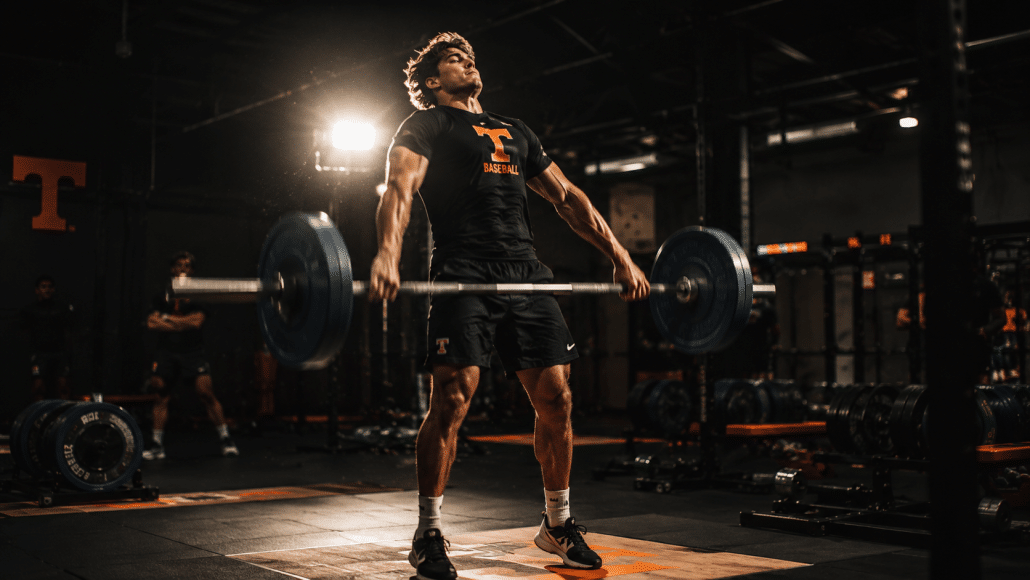
By Joey Myers — D1 Baseball, Fresno State | Author, Catapult Loading System | NASM-CES · IYCA Youth Fitness Specialist | 20+ years of coaching
If you’re a Division I baseball player looking for a D1 baseball workout program PDF you can actually take to the weight room, this is it. Not a recycled general-athlete plan from a fitness blog. Not the same three-day-a-week circuit program that’s been circulating since 2009. A sport-specific, 12-week off-season program built around the three things that actually drive performance at the D1 level: multi-joint strength, rotational power, and overhead arm health.
Specifically, research published in the Journal of Strength and Conditioning Research found that Division I baseball players who followed structured periodized strength programs over a 12-week off-season showed significantly greater improvements in rotational power and sprint times compared to unstructured training controls (Szymanski et al., 2010). The program below is built on that evidence base — and updated to include modern recovery tools your high school program probably didn’t use.
Here’s what separates this from the generic “baseball workout” posts you’ve already scrolled past — the ones with no periodization structure, no arm care, and no movement screening:
- Three distinct training phases — not a single block of workouts repeated twelve times
- Olympic lifts progressively introduced in Phase 1 and loaded through Phase 3
- FMS-based corrective integration from Day 1 (not just a warm-up afterthought)
- MAT and VeloRESET arm care protocols built into the weekly structure
- Post-activation potentiation (PAP) complex training in Phases 2 and 3 — a method nearly universal in D1 S&C programs but absent from most publicly available baseball workout programs
- Full printable PDF — day-by-day, sets/reps/loads for all 12 weeks
Free Download
Get the Full D1 Baseball 12-Week Off-Season Program PDF
Printable workout tables for all 12 weeks — sets, reps, loads, and coaching cues for every session. Includes the VeloRESET arm care protocol and Phase 3 PAP complex pairs.
Why Is D1 Off-Season Training Different from High School Baseball?
D1 off-season training is fundamentally different from high school because the structure, exercise complexity, and intensity demands are calibrated for athletes who now have weight room access, Olympic platform availability, and S&C coaching oversight. The volume and intensity aren’t just higher — the architecture of training changes entirely. Most high school programs don’t have any of those resources, and most free “D1 baseball program” resources on the internet were built as if they don’t either.
For example, a 2011 survey of MLB strength and conditioning coaches (Ebben et al., 2011) found that Olympic lifting, complex training, and position-specific periodization were nearly universal at the professional and high collegiate levels. Those methods rarely appear in high school programs because they require Olympic platforms, coaching oversight, and athletes who’ve already built a base of movement quality. They also rarely appear in generic internet baseball programs — which is exactly what differentiates this one.
That’s exactly what this program assumes you now have access to. The FMS assessment at the start of Week 1 is there to identify what that high school program may have left unaddressed — hip mobility deficits, shoulder asymmetries, core stability gaps — before you add D1-level loads on top of them. Additionally, the other thing that’s different at the D1 level: arm care isn’t optional. Overhead throwing athletes who train 4 days per week without a structured recovery protocol consistently show increased posterior shoulder tightness and rotator cuff inhibition by mid-off-season (Wilk et al., 2011). The VeloRESET protocol at the end of every Tuesday and Friday session is non-negotiable for this reason.
How Is This 12-Week D1 Baseball Program Structured?
This program is organized into three distinct phases — each with a specific physiological target — that run across 12 weeks of 5-day training weeks including one active recovery day and one rest day. This three-phase structure is the same framework used by LSU, Vanderbilt, and every high-major D1 program; the difference is that those programs have full-time S&C staff supervising every rep. This PDF gives you the structure to run it independently.
Phase 1 (Weeks 1–4): Hypertrophy & Movement Foundation
First, the goal of Phase 1 isn’t to go heavy — it’s to build the structural base that makes the heavier loading in Phase 2 safer and more productive. You’ll train at 65–75% of your 1RM for 8–12 reps, with a warm-up that includes FMS corrective work every single session. This is also where you establish the hip and shoulder mobility routine that carries through all 12 weeks. Skipping this phase or rushing through it is the most common mistake D1 athletes make when they design their own off-season programs.
Phase 1 training split:
- Monday: Lower body strength — Back squat, RDL, leg press, Nordic hamstring curls, Pallof press, dead bug
- Tuesday: Upper body strength — Bench press, barbell row, cable row, pull-ups, VeloRESET arm care
- Wednesday: Active recovery — 40 minutes hip and shoulder mobility, core stability
- Thursday: Lower body power — Hang power clean (technique focus), box jumps, trap bar deadlift, med ball rotational throws
- Friday: Upper body power / arm care — Push press, explosive DB bench, J-band series, rotational core
Phase 2 (Weeks 5–8): Strength & Power Development
As a result of the Phase 1 foundation, intensity in Phase 2 increases to 75–88% 1RM and reps drop to 4–6. The hang power clean moves from a technique exercise to a loaded power expression. The power snatch is introduced in Week 6. Therefore, Thursday shifts to a complex training structure — a heavy strength set paired immediately with an explosive movement — using post-activation potentiation (PAP) to amplify power output.
For example, research from Seitz and Haff (2016) confirmed that PAP complexes pairing maximal strength exercises with ballistic movements produce significantly greater peak power in the paired movement than either exercise done alone. For baseball players, this is most relevant on the rotational plane — which is why med ball work is paired with heavy Olympic lifts and squats throughout Phases 2 and 3. Most publicly available baseball programs skip PAP entirely because implementing it correctly requires S&C knowledge that the generic three-sets-of-ten template doesn’t have room for. This program doesn’t skip it.
Phase 2 key changes:
- Squat: 5×5 at 80–85% vs. 4×8 at 70% in Phase 1
- Thursday becomes a PAP complex day (box squat + box jump; trap bar deadlift + broad jump)
- Power snatch introduced Week 6
- Med ball loads increase to 10–12 lb
- MAT sessions increase to 2x per week for pitchers
Phase 3 (Weeks 9–12): Peak Power & Sport-Specific Preparation
Finally, volume drops and intensity peaks. The goal in Phase 3 is maximum power output — both in terms of absolute strength (88–95% 1RM) and rate of force development (explosive power movements at 55–65% of clean/snatch max). Sprint work is added Monday and Thursday. The arm care protocol extends to 20 minutes on Friday. This phase ends with the athlete physically prepared for the demands of fall ball, spring training, or wherever the season begins.
Phase 3 signature sessions:
- 5×3 back squat at 88–92% paired with 40-yard sprints same session
- Hang power snatch at 70–75% followed immediately by box jump → sprint combo
- Bench press + med ball chest pass complex pairs (peak PAP week)
- Friday extended arm care: 20-minute VeloRESET including full J-band series and shoulder CARs
Free Printable
The Full Program Is in the PDF
Every workout table for all 12 weeks — exercises, sets, reps, loads, rest periods, and coaching notes — formatted for the weight room. Get it free when you drop your email.
How Does FMS Screening Fit Into This D1 Baseball Program?
Specifically, FMS (Functional Movement Screen) is used at the start of Week 1 to diagnose movement asymmetries and dysfunction before any significant loading begins. That way, Phase 2’s heavier work is built on a foundation of quality movement — not on compensatory patterns that lead to injury. The Functional Movement Screen (Gray Cook, 2010) screens seven movement patterns on a 0–3 scale to reveal asymmetries that become injury risks under load. No other publicly available D1 baseball workout program PDF includes an FMS integration step — which is notable, because every high-major D1 program runs a movement screen before off-season loading begins.
The most common FMS findings in baseball players:
- Hip mobility asymmetry — usually limited internal rotation on the stride leg from repeated rotational patterns
- Shoulder mobility asymmetry — throwing shoulder typically shows restricted internal rotation (posterior capsule tightness)
- Core stability deficits — trunk stability push-up and rotary stability patterns often reveal compensation from anterior chain dominance
As a result, the corrective work in Phase 1 warm-ups — hip 90/90, sleeper stretch, T-spine open books — directly targets these common findings. They’re not random fillers. Perform them in every warm-up, every session, all 12 weeks. At the D1 level, your strength coach should screen you before Week 1. If they don’t, ask.
What Are MAT and VeloRESET, and Why Are They in Every Session?
Additionally, MAT (Muscle Activation Techniques) is a pre-session intervention that targets inhibited or poorly-contracting muscles identified in your movement screen. VeloRESET is a 15–20 minute post-session arm care protocol. Together, they reduce injury risk and make every training session more effective by ensuring the right muscles are firing before loading and recovering after it. Both are non-optional at D1 programs — and both are missing from every other D1 baseball workout program PDF you’ll find online.
Specifically, Muscle Activation Techniques (MAT) targets inhibited muscles before resistance training. For baseball players, this typically means activating the supraspinatus, infraspinatus, serratus anterior, and hip flexors before loading. A 2013 study in the International Journal of Sports Physical Therapy found that proprioceptive and activation-based interventions performed before resistance training significantly improved rotator cuff recruitment in overhead athletes. Ten to fifteen minutes of MAT pre-session is built into Phase 3 Tuesdays and Fridays.
VeloRESET is an arm care protocol designed specifically for overhead athletes. The three-phase structure (tissue preparation, rotator cuff strengthening, mobility and flexibility) takes 15–20 minutes and should follow every upper body session and every throwing session. This is not optional, and it doesn’t get shorter as training gets harder — in Phase 3 it extends to 20 minutes on Fridays as throw volume begins increasing.
How Does This Program Compare to LSU and Vanderbilt Baseball Workout Programs?
Most searches for an LSU baseball workout program PDF or a Vanderbilt baseball workout program PDF are really searches for the same thing: a documented example of what elite D1 off-season baseball training actually looks like — the exercise selection, the periodization structure, the intensity benchmarks. Both LSU and Vanderbilt consistently produce MLB draft picks and are widely regarded as two of the most well-developed programs in college baseball. What they share, and what any high-level D1 strength program shares, is the same three-phase framework this 12-week program is built on.
It’s worth noting that LSU brought in a new head S&C coordinator for baseball in February 2025 — a move that signals continued investment in the weight room as a competitive advantage. Vanderbilt has long been recognized for its pitching development and arm health protocols. Both programs reflect the same philosophy: structured periodization, Olympic lifting, and non-negotiable arm care, in that order. That’s exactly what this program delivers.
| Program Feature | LSU / Vanderbilt Standard | This 12-Week Program |
|---|---|---|
| Periodization | 3-phase linear periodization — hypertrophy → strength → power | Identical structure: Weeks 1–4 / 5–8 / 9–12 |
| Olympic Lifts | Hang cleans, power snatches, push jerks as primary power developers | All three included; taught progressively from Phase 1 forward |
| PAP Complex Training | Heavy lift + explosive paired sets on power days | Full PAP complex structure from Phase 2 through Phase 3 |
| Intensity Range | 65–70% 1RM early; 88–95% 1RM in peak power phase | Same range: Phase 1 starts at 65%, Phase 3 peaks at 88–95% |
| Arm Care | Structured rotator cuff and posterior chain protocol every session | VeloRESET arm care built into every upper-body day; 20 min in Phase 3 |
| Movement Screening | FMS or equivalent baseline before Phase 1 | FMS-based corrective screening built into Week 1 setup |
The honest difference between this program and what LSU or Vanderbilt runs is staffing and equipment. D1 programs have full-time S&C coaches supervising every rep, sports medicine staff on site, and Olympic platforms available every day. This 12-week program delivers the same periodization logic and exercise selection with a commercial gym or well-equipped college weight room. The movements are the same — the supervision layer is on you to get right. Furthermore, the four elements that most internet baseball workout programs leave out — PAP complex training, FMS corrective integration, MAT pre-activation, and structured arm care — are all in this program because those four elements are exactly what separates a D1 program from a high school program.
Frequently Asked Questions
What makes this D1 baseball workout program PDF different from a regular baseball workout?
Specifically, this D1 baseball workout program PDF differs from standard programs in three areas: periodization structure, exercise complexity, and training intensity. D1 programs use multi-phase periodization that cycles intensity and volume across 12 weeks, incorporate Olympic lifting (hang cleans, power snatches, push jerks), and reach intensities of 88–95% 1RM in the final phase. They also assume access to a full weight room with Olympic platforms and coaching oversight, and they incorporate PAP complex training, FMS movement screening, and structured arm care protocols that recreational or high school programs — and most generic internet programs — don’t include.
How long are the workouts in this program?
In practice, each session in this D1 baseball workout program PDF runs 75–90 minutes including warm-up and cool-down. The Wednesday active recovery session is 40–50 minutes of mobility and core work. The extended arm care on Phase 3 Fridays can push that session close to 90 minutes if you include the full 20-minute VeloRESET. Budget 90 minutes per session and you won’t feel rushed.
Do I need to test my 1RM before starting?
Yes — this D1 baseball workout program PDF requires testing your primary lifts (back squat, bench press, hang power clean, and barbell press). You don’t need to max on every accessory lift. If you don’t have a recent 1RM, use the RPE scale for Phase 1 to establish baseline strength, then test formal 1RMs at the transition from Phase 1 to Phase 2. Your strength coach can help structure a safe 1RM testing day. Getting accurate baseline numbers is the first step in making this program work as designed.
Is this program appropriate for pitchers?
Yes — this D1 baseball workout program PDF accommodates pitchers with two key modifications. First, pitchers should complete MAT sessions at least twice per week (vs. once for position players), focusing on rotator cuff activation and scapular stabilizer activation. Second, the arm care protocol on Fridays should be extended to 20 minutes from Week 1, not just Phase 3. The throw-volume resumption in Weeks 10–12 should be coordinated with your pitching coach — do not increase throw volume without your coach’s sign-off, regardless of how the program feels.
Can I run this program during the fall semester with fall ball?
That said, not without modification. This D1 baseball workout program PDF is an off-season program designed for periods without significant throw volume or game play. If you’re playing fall ball, you’ll need to reduce volume (drop one set per main lift), eliminate sprint work, and keep arm care at its maximum. A better approach is to start this program the week after your final fall ball game and complete all 12 weeks before pre-season camps begin in January. That timing lines up perfectly if fall ball ends in late October.
What equipment do I need for this D1 baseball workout program?
Specifically, this D1 baseball workout program PDF requires a fully equipped college or commercial weight room. You’ll need Olympic barbells, bumper plates and an Olympic lifting platform, a power rack or squat rack, trap bar, dumbbells, cable machine, and medicine balls (6–15 lb range). J-bands for arm care cost approximately $30 and are available at JaegerSports.com. Phase 1 and 2 sessions can substitute DB hang cleans if no platform is available, but Phase 3 snatch work requires bumper plates for safety.
How do I know if this program is working after 12 weeks?
As a result, track four measurable markers before Week 1 and retest at Week 12: (1) 1RM back squat, (2) 1RM bench press, (3) med ball rotational throw distance (standing scoop toss off a wall), and (4) 10-yard sprint time. Research on D1 periodized programs shows 8–14% strength improvements and 4–7% power improvements are typical over 12 structured weeks. Exit velocity and pitch velocity are sport-specific expressions of the same power gains — if the weight room numbers are moving, on-field performance follows.
Is this similar to the LSU baseball workout program PDF that coaches share?
Yes — the periodization structure, exercise selection, and intensity progression in this 12-week program align with what elite D1 programs like LSU use in their off-season. The three-phase model (hypertrophy → strength → peak power), the Olympic lift progression (hang cleans, power snatches, push jerks), and the 88–95% 1RM peak intensity in Phase 3 all match the documented framework of high-major D1 baseball S&C programs. LSU hired a new head S&C coordinator for baseball in February 2025 — a move that reflects the growing importance of structured off-season training at the elite level. The primary difference is staffing: LSU has full-time S&C coaches present for every session, while this program gives you the structure to run it independently.
How does the Vanderbilt baseball workout program compare to this one?
Vanderbilt is particularly known for its pitching development and arm care protocols — which maps directly to the VeloRESET component built into every session of this program. The 15–20 minute VeloRESET protocol mirrors Vanderbilt’s philosophy: non-optional, runs after every upper-body session, and extends to 20 minutes in Phase 3 as throwing volume increases. Beyond arm care, Vanderbilt’s strength program follows the same 3-phase periodization model with emphasis on posterior chain and rotational power — the same emphasis as the hip hinge, row, and Olympic lift progressions in this program. Both programs are built on the same principles; this PDF makes those principles accessible without a D1 S&C staff.
“I was in the gym 6 days a week on top of practices and games. By midseason my knee was breaking down — patellar tendinitis. Joey looked at what I was actually doing and the answer wasn’t more treatment, it was less volume. We cut to 4 days a week. The tendinitis cleared up. That summer I was having wrist issues going into summer ball and he sent me some exercises for it — completely gone in less than two weeks. I’ve been working with Joey since I was 11 and the biggest thing he’s taught me isn’t a swing cue. It’s how to read what your body is telling you before it shuts you down.”
— Drake Davis, 1B/OF · Fresno City College · .381 AVG, 12 HR, 53 RBI · 2025 Freshman of the Year
“Javier turned his ankle running to first base and a few weeks later it was still there — he described it as a heaviness when he ran. Joey gave him five exercises and within two weeks that heaviness was completely gone. More recently his tricep near his throwing elbow started acting up after a big workload spike. Same thing: Joey gave him exercises and told us exactly what to watch for. What I appreciate is that we’re not just waiting and hoping. We know what we’re looking at.”
— Richard, Javier’s dad · Sophomore catcher
Free Download
Get the D1 Baseball 12-Week Program PDF
Printable workout tables for all 12 weeks. Sets, reps, loads, rest periods, and coaching notes for every session — including the VeloRESET arm care protocol and Phase 3 PAP complex pairs. Enter your email and it goes straight to your inbox.
No spam. One email per week with hitting mechanics and training tips. Unsubscribe any time.
More Free Programs from HPL
References
Szymanski, D. J., et al. (2010). Effect of 12 weeks of wrist and forearm training on high school baseball players. Journal of Strength and Conditioning Research, 24(3), 642–654.
Ebben, W. P., et al. (2011). Strength and conditioning practices of National Football League strength and conditioning coaches. Journal of Strength and Conditioning Research, 25(5), 1418–1426.
Seitz, L. B., & Haff, G. G. (2016). Factors modulating post-activation potentiation of jump, sprint, throw, and upper-body ballistic performances: A systematic review with meta-analysis. Sports Medicine, 46(2), 231–240.
Wilk, K. E., et al. (2011). Shoulder injuries in the overhead throwing athlete. Journal of Orthopaedic & Sports Physical Therapy, 39(2), 38–54.
Cook, G. (2010). Movement: Functional Movement Systems. On Target Publications.

- The Season Started. Here’s The Program That Keeps Your Daughter Athletic Through All Of It - September 27, 2026
- The Season Started. Here’s The Program That Keeps Your Kid Athletic Through All Of It - September 27, 2026
- Baseball Pitcher Workout Program PDF: Free 12-Week Off-Season Strength Plan for HS and Youth Pitchers - September 26, 2026