
High School Softball In-Season Strength Training Guide
Most High School Softball Players Lose Their Off-season Strength Gains By Mid-April — Not Because Of Slumps, But Because Nobody Gave Them An In-Season Plan
By Joey Myers — D1 Baseball, Fresno State | Author, Catapult Loading System | NASM-CES · IYCA Youth Fitness Specialist | 20+ years of coaching
Your daughter worked all winter. She lifted twice a week, built her hip strength, improved her rotational power, and came into the season hitting the ball harder than she ever had. Then the season started. Practice every day, games two or three times a week, school in between. The weight room fell off. By April, something was different — less pop, slower swing, arm that felt heavier late in games. That’s the gap this high school softball in-season strength training plan is designed to close.
This is the detraining pattern that plays out for the majority of high school softball players every spring. It’s not a mechanical problem. It’s not a confidence problem. It’s a training structure problem — and it has a straightforward solution. A structured high school softball in-season strength training program is that solution.
Two strength sessions per week, 30 minutes each, structured around the game schedule — that’s the difference between players who finish the season hitting the same as they started it and those who quietly fade. Here’s what that program looks like, why it works, and how to fit it into a week that’s already full. (Download the free PDF here if you’d rather skip straight to the program.)
What is in-season strength training for high school softball players?
In-season strength training for high school softball is a reduced-volume resistance program — typically two sessions per week — designed to preserve the power and arm health built during the off-season without accumulating the fatigue that degrades game performance. It is not an off-season program run during the season. It is a maintenance program. That distinction is the core philosophy of high school softball in-season strength training.
The structure is fundamentally different from off-season training in three ways. Volume is lower — about 30% fewer sets per session. Intensity stays the same — the movements are still done with purpose, not as going through the motions. And the scheduling is organized around the game calendar, not around a linear progression. You’re not trying to get stronger during the season. You’re trying to stay as strong as you were when it started. That’s the goal of high school softball in-season strength training done right.
If your daughter completed the 12-week HS softball off-season lifting program before the season, in-season S&C is what protects that investment. Without it, research on detraining consistently shows that strength and power gains begin declining within two to three weeks of stopping resistance training. That’s the science behind the minimum effective dose in high school softball in-season strength training.
Why do high school softball players fall apart physically mid-season — and why isn’t it about mechanics?
The decline usually starts quietly. A coach notices the barrel isn’t getting through the zone as cleanly. Fly balls that were clearing the outfield in February are dying at the warning track by May. The player feels it too — something’s different — but can’t explain it. Coaches often default to a mechanics check. Parents wonder if it’s a mental thing. Both are usually wrong.
What’s actually happening is detraining. Fast-twitch muscle fibers — the ones responsible for bat speed and explosive first steps — are the first to decline when resistance training stops. They’re also the last to come back. A hitter can look mechanically identical in April compared to February and still have meaningfully less bat speed, because the neuromuscular system that fires those fast-twitch fibers has gone quiet from lack of training stimulus.
The good news is that preventing it requires far less than building it did. Two sessions per week — one lower body and core, one upper body and rotational — is enough. The fastpitch softball hitting mechanics stay intact when the physical capacity to execute them is maintained. That’s the case for high school softball in-season strength training: physical capacity drives mechanics, not the other way around.
The players who finish the season performing at or above their opening-day level are almost always the ones who kept the training consistent, even at low volume. The players who fade are typically the ones who stopped entirely when the schedule got busy — which is understandable, but costly.
How many days per week should high school softball players lift during the season?
Two days per week is the evidence-based target for in-season strength maintenance in high school athletes. Research on maintenance training consistently shows that two sessions per week with reduced volume but maintained intensity is sufficient to preserve off-season gains for the duration of a 12–16 week season. That research is the foundation of every high school softball in-season strength training template in this post.
One session per week produces some maintenance but is not optimal — especially as the season lengthens past 8 weeks. Three or more sessions per week risks accumulating residual fatigue that compromises game-day performance, which defeats the purpose entirely. Two is the number. It’s also realistic in a schedule that includes daily practice, 2–3 games per week, and school. That’s what separates a sustainable high school softball in-season strength training plan from one that collapses by mid-April.
The same 2-day-per-week framework applies to the HS baseball in-season workout program — the principle is consistent across sports at the high school level. Two sessions, 30 minutes each, organized around the game schedule. That structure is what makes high school softball in-season strength training realistic through a full spring season.
Get the full program built on 5 proven training frameworks — free PDF
The updated PDF integrates Poliquin maintenance periodization (2 sets, Eccentric–Pause–Concentric tempo), Weck rotational pattern warm-up drills, Starrett pre-session tissue quality protocols, Chek primal movement standards, and the complete VeloRESET arm readiness system — J-Band protocol, daily 0–10 soreness check, and season-long throw count tracker. Session A (lower/core) + Session B (upper/rotational) + weekly schedule templates. Fastpitch softball. Free, instant download.
Why is arm care the most overlooked part of HS softball in-season training?
Arm care gets less attention than it deserves at the high school softball level, largely because softball throwing is perceived as lower-risk than baseball throwing. That perception is wrong. High school softball seasons involve substantial cumulative throwing volume — practice warm-ups, infield/outfield routines, game repetitions, and bullpen work for pitchers — and the rotator cuff and posterior shoulder capsule absorb deceleration forces on every throw.
The most protective habit a high school softball player can build is the J-Band arm care protocol performed before every throwing session. J-Bands, developed by Jaeger Sports, are used at every level from high school through the professional ranks specifically because the resistance band exercises address the rotator cuff and posterior capsule patterns that accumulate stress over a full season. It takes 5 minutes. It is done before the arm is warm — not as a cool-down. The sequence runs: arm circles, internal rotation, external rotation, horizontal abduction, and trunk rotation with band resistance. Two sets of 10 reps for each exercise, no rest between them.
The critical rule: do the J-Band sequence on heavy throwing days specifically. Coaches and parents often think of arm care as something for “extra” training days when there’s more time. The reality is the opposite — the days with the most throwing are exactly the days it matters most and is most often skipped.
Pitchers and catchers should add 2×10 pronation/supination with a light dumbbell (2–3 lb) after the J-Band sequence on any day with extended pitching or catching volume. This addresses the medial elbow stress that accumulates specifically in those positions over a full high school season.
What exercises should be in a high school softball in-season S&C program?
The in-season program splits into two sessions: Day A targets the lower body and core (the power source for bat speed and base running), and Day B targets the upper body and rotational system (the driver of exit velocity and throwing arm health). Both sessions are 30–35 minutes with a 5-minute dynamic warm-up included.
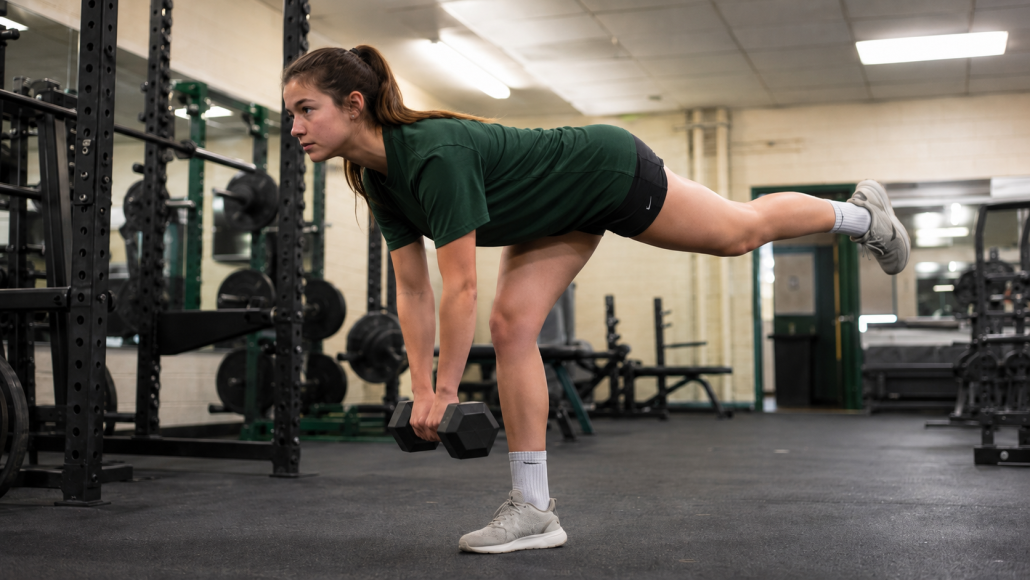
Day A — Lower Body & Core runs 7 exercises at moderate load (70–80% of off-season working weight): goblet squat, single-leg RDL, dumbbell hip thrust, lateral band walk, reverse lunge, dead bug, and Copenhagen plank. The reverse lunge is preferred over the forward lunge in-season because it’s easier on the knee under game wear. The Copenhagen plank — side plank with the top leg elevated — targets the adductors, which are a common weak point for softball players under high game volume and are among the first things to decline without direct training.
Day B — Upper Body & Rotational runs 7 exercises: med ball rotational toss, single-arm dumbbell row, half-kneeling dumbbell press, face pull, Y-T-W raises, Pallof press, and bat overspeed swings. The bat overspeed drill — 3 sets of 8 swings with the lightest bat available at maximum intent — is a nervous system drill. It keeps the fast-twitch pathway active that drives bat speed throughout the season. It’s different from swinging a heavy bat, which is a load-based approach and is better suited for off-season training.
Equipment requirements are minimal: dumbbells in the 15–30 lb range, loop bands, resistance bands, a 6–8 lb medicine ball, and J-Bands. No barbell or trap bar required. The program is designed to run in a basic school weight room or at home — the goal is zero setup time so the session starts immediately.
What should high school softball players skip during the season — and why?
In-season is not the time for maximum effort lower body days, new movement patterns, or any training that creates significant delayed onset muscle soreness (DOMS). The list of what to avoid during the season is just as important as the list of what to do.
Skip: Heavy barbell squats and deadlifts. These are excellent off-season exercises that produce significant DOMS — which is fine when there’s 72 hours before the next game. In-season, that same DOMS shows up in Thursday’s game after a Tuesday lift. Dumbbell and bodyweight alternatives are used in the in-season program specifically to reduce this risk while maintaining the movement pattern.
Skip: Heavy overhead pressing. High school softball involves substantial shoulder accumulation. Adding heavy strict overhead press to a week that already includes 150+ throws is a recipe for rotator cuff inflammation by mid-season. The half-kneeling dumbbell press used in Day B presses at a natural angle, not straight overhead, which keeps the rotator cuff in a healthier position under load.
Skip: Sprint conditioning and high-volume plyometrics. These are CNS-intensive and slow recovery. The game itself — base running, outfield reads, stolen base situations — provides plenty of explosive movement training during the season. Adding sprint intervals or box jump series on top of that schedule is too much for most high school athletes to recover from adequately.
The rule that covers all of this: if an exercise would make your daughter noticeably sore 24–48 hours later, don’t do it in-season unless there’s enough calendar space to recover before the next game. Game performance is the priority. Training supports it — it doesn’t compete with it. This is the same guiding principle behind the college softball S&C program and applies equally at the high school level. It’s the same thinking behind every high school softball in-season strength training decision in this program.
How do you fit in-season softball S&C into a full game and practice schedule?
The scheduling rule for Day A (lower/core): perform it on a practice day, after practice, not before a game day. The legs need 24–36 hours to clear the training stimulus before a game. The most reliable slot is mid-week after a light practice — Wednesday for most teams with Tuesday/Thursday games.
The scheduling rule for Day B (upper/rotational): perform it on an off-day or two days after the most recent game. It can be done the morning before an evening game if the session stays at moderate intensity — no maximum-effort pressing on a game day, but the rotational work and arm care exercises are fine. Saturday morning is the most common slot for teams with a Friday game.
On heavy game weeks — three games in five days — the lift that gets skipped is Day A (lower/core). The legs are taking game wear from running the bases, fielding, and the physical demands of three games. In those weeks, Day B (upper/rotational) and the J-Band arm care are prioritized, and the lower body gets its recovery from the games themselves.
Sleep and hydration are built into this framework as training variables — not just “general wellness” advice. Eight to nine hours of sleep is when the body adapts to the training stimulus and repairs the tissue stressed by games. Three to four liters of water daily keeps muscular contraction efficient. These two things, done consistently, amplify the effect of every 30-minute session in the weight room. The mental and physical preparation around game performance works the same way — small habits, done consistently, compound across a full season. That’s the payoff of consistent high school softball in-season strength training.
Frequently Asked Questions: High School Softball In-Season Strength Training
How many days per week should a high school softball player lift during the season?
Two days per week is sufficient to maintain off-season strength gains throughout a high school softball season. Two sessions per week maintains power levels; more than two risks accumulating fatigue that shows up in games. Sessions should be 30–35 minutes at moderate intensity — lower volume than off-season training, same quality of movement. That intensity-first design is what makes high school softball in-season strength training effective in 30 minutes.
Will lifting during the season make my daughter sore before games?
Not if the program is structured correctly. The key rules: never lift lower body the day before a game, never do a heavy upper-body session the morning of a game, and reduce off-season volume by 30%. A well-designed 2-day in-season program produces minimal soreness because sessions are built around game schedules, not around maximizing volume. That scheduling principle is what makes high school softball in-season strength training sustainable through a full spring season.
What’s the most important part of in-season training for high school softball players?
Arm care — specifically the J-Band arm care sequence performed before every throwing session. Five minutes of J-Band work before throwing is the single highest-return investment in a high school softball player’s in-season training. The rotator cuff and posterior shoulder capsule absorb deceleration stress on every throw and are the most common failure points in a full season. That’s why arm care is non-negotiable in any high school softball in-season strength training program.
Should high school softball players do arm care exercises every day during the season?
Yes — on every day that involves throwing. That includes practice days, game days, bullpen sessions, and catch days. The J-Band sequence is performed before throwing begins, when the shoulder is cold. Skipping it on heavy throwing days is the most common arm care mistake at the high school level, and those are exactly the days it matters most. This is the most important habit in high school softball in-season strength training: do the arm care on game days.
Can in-season strength training help my daughter hit with more power during the softball season?
Yes, indirectly. In-season S&C preserves the power built in the off-season. Without it, exit velocity and bat speed typically decline significantly by mid-season as fast-twitch muscle fiber capacity decreases from lack of training stimulus. The rotational med ball work and bat overspeed swings in the in-season program specifically target the nervous system pathway that drives bat speed, keeping it sharp for game performance. Bat speed maintenance is one of the key outcomes of high school softball in-season strength training done properly.
What happens if a high school softball player stops lifting during the season?
Research on detraining shows that strength and power gains begin declining within 2–3 weeks of stopping resistance training. For a 12–16 week high school softball season, stopping entirely means the off-season work disappears by mid-season. The player may look mechanically unchanged but will have meaningfully less bat speed, slower throwing velocity, and reduced first-step explosion — all of which show up gradually as the season progresses.
More Free Programs from HPL
Free Download
Get the HS Softball In-Season S&C Program — Updated 2026
The updated PDF — now built on 5 training frameworks: Weck rotational mechanics, Poliquin maintenance periodization, Starrett tissue quality protocols, Chek primal patterns, and VeloRESET arm readiness. Session A (lower/core) + Session B (upper/rotational), with Poliquin tempo on every exercise, pre-session tissue quality protocols, J-Band arm care, daily soreness check, weekly schedule templates for 2-game and 3-game weeks, and a 15-week season tracker. Free. Instant.

With 28,000+ online bat speed program sales, my methods have transformed coaches, instructors, and parents just like you. I'm affiliated with esteemed organizations like ABCA, IYCA, and SABR, advocating for positive coaching. With 15+ years in corrective fitness and a Division One baseball background, my knowledge is unmatched.
Join our blog and unlock the secrets to successful hitting, elevate your performance, and ignite your passion. Welcome to the world of limitless possibilities at HittingPerformanceLab.com.
- The Season Started. Here’s The Program That Keeps Your Daughter Athletic Through All Of It - September 27, 2026
- The Season Started. Here’s The Program That Keeps Your Kid Athletic Through All Of It - September 27, 2026
- Baseball Pitcher Workout Program PDF: Free 12-Week Off-Season Strength Plan for HS and Youth Pitchers - September 26, 2026