College Baseball Workout Program PDF: Free 12-Week Off-Season Plan for D2, D3, NAIA & JuCo Athletes
By Joey Myers — D1 Baseball, Fresno State | Author, Catapult Loading System | NASM-CES · IYCA Youth Fitness Specialist | 20+ years of coaching
This free college baseball workout program PDF is built for athletes who don’t train in a Power Five weight room. Most off-season plans assume Olympic platforms, full-time S&C coaches, and bumper plate inventory found only at schools with eight-figure athletic budgets. If you compete at D2, D3, NAIA, or JuCo, those programs don’t transfer to your weight room as written.
This free 12-week college baseball workout program PDF is different. It’s designed around the equipment you actually have access to — a trap bar, kettlebells, dumbbells, resistance bands, and a cable machine. Every single exercise includes a listed substitution so the program works whether you’re training at your school’s weight room, a commercial gym, or a basic facility. No Olympic platform. No dedicated S&C coach standing over you. No problem.
Download the complete 12-week program now — printable PDF with every set, rep, load, and substitution mapped out across all three phases.
Free. No credit card. Instant download.
Why Don’t Most College Baseball Workout Programs Work for D2, D3, NAIA, and JuCo Athletes?
Most college baseball workout program PDF options don’t work for D2/D3/NAIA/JuCo athletes because they’re built for Power Five facilities. Specifically, they assume Olympic platforms, full-time S&C staff, and athletes who’ve been following periodized programs since high school. The strength and conditioning gap between Power Five programs and lower-division programs is enormous, and it starts in the weight room.
For example, D1 Power Five programs have full-time S&C staff, Olympic lifting platforms, and athletes who have been following periodized programs since their freshman year of high school. The programs published in journals and distributed by those programs are built for that infrastructure. (See the full D1 program here.)
That said, at the D2, D3, NAIA, and JuCo level, you’re often working with a shared weight room, part-time S&C support or none at all, limited bumper plate availability, and teammates at wildly different strength levels. What you need is a program that:
- Uses linear periodization — a straightforward, self-programmable model that doesn’t require a coach watching every set to adjust loads
- Provides equipment substitutions — if you don’t have an Olympic platform, the program still works
- Fits into 60–75 minutes — respecting that shared weight rooms have peak hours
- Develops real triple-extension power without requiring Olympic lifting — the kettlebell swing and trap bar complex delivers the same posterior chain training stimulus as power cleans, without the technical barrier
- Includes arm care from Week 1 — because the arm injury risk is just as real at D2/D3 as it is at the Power Five level
How Is This 12-Week College Baseball Program Structured?
Specifically, this 12-week program uses linear periodization divided into three phases: Foundation (Weeks 1–4 at 65–75% 1RM), Strength Development (Weeks 5–8 at 75–82% 1RM), and Power & Sport-Specific Preparation (Weeks 9–12 at 82–88% 1RM). Each phase has one clear goal, and progressions are simple enough to run without someone adjusting your loads every session.
Phase 1 (Weeks 1–4): Foundation & Movement Quality
Intensity 65–75% 1RM | 8–12 reps | 60–70 min sessions
In fact, most college athletes arrive at off-season training with movement quality issues — limited hip internal rotation, poor posterior capsule flexibility, and scapular instability from months of throwing. Phase 1 addresses all of it before load increases. You’ll learn the trap bar hinge pattern, introduce the kettlebell swing as a hip-hinge power tool, and build the structural base that makes Phase 3 safe.
For example, research from Cook (2010) established that functional movement screening at the start of a training cycle reduces injury rates by identifying asymmetries before heavy loading begins.1 If you have access to an FMS screen, use it before Week 1.
Phase 2 (Weeks 5–8): Strength Development
Intensity 75–82% 1RM | 5–8 reps | 65–70 min sessions
Additionally, loads increase significantly from Phase 1. The KB swing moves from a teaching tool to a primary power developer — you’ll superset it directly with box jumps to create a simplified power complex. Sprint work is added at the end of Thursday sessions: 10-yard accelerations that train first-step explosion specifically for baseball.
For example, Szymanski et al. (2010) found that a periodized resistance training program over 12 weeks produced significant improvements in bat velocity and rotational power in collegiate baseball players.2
Phase 3 (Weeks 9–12): Power & Sport-Specific Preparation
Intensity 82–88% 1RM | 3–6 reps | 70–75 min sessions
Finally, this is the peaking phase — highest loads of the program, and volume drops to protect recovery. You’ll run true power complexes (heavy trap bar deadlift immediately followed by broad jump), push sprint distances to 30 yards, and move med ball loads to 12–15 lbs for peak rotational power output. Arm care extends to 18 minutes on Fridays to coordinate with throwing volume resumption in Weeks 10–12.
Why Are the Trap Bar Deadlift and KB Swing the Core of This Program?
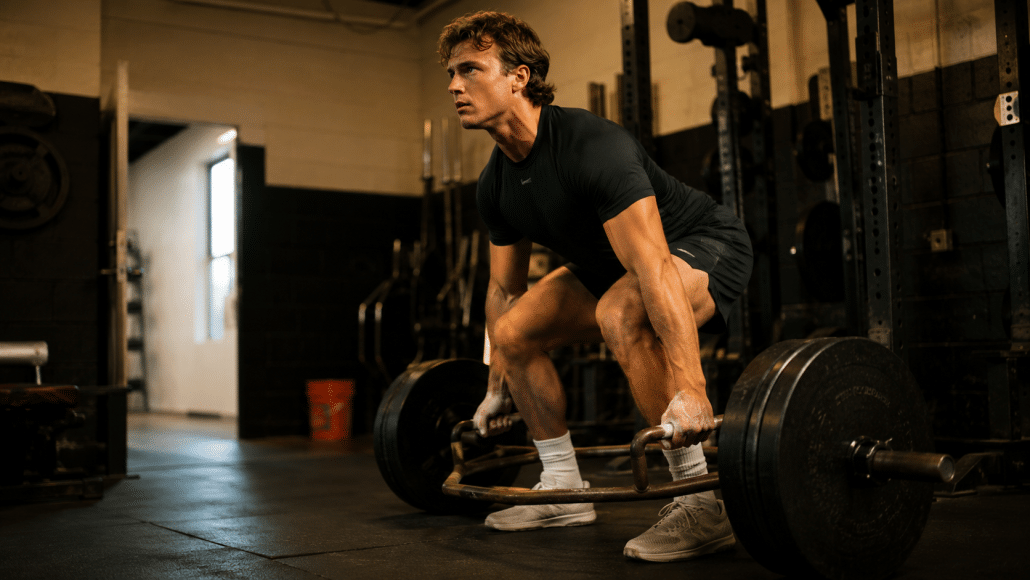
Specifically, the trap bar deadlift and KB swing replace Olympic lifting in this program because they deliver the same triple-extension power stimulus — ankle, knee, and hip extension in sequence. They do this without requiring bumper plates, a platform, or technical coaching that takes weeks to develop.
In fact, the trap bar deadlift is a superior tool for most baseball athletes compared to conventional deadlift — the neutral grip reduces spinal stress, the load sits closer to your center of mass, and the movement pattern more closely mirrors athletic hip extension. Combined with KB swings, you get the full triple-extension training stimulus without requiring bumper plates, a platform, or a coach who can coach Olympic technique.
Equipment substitution guide from the program:
- No Olympic platform: KB swing + box jump superset replaces hang power clean. Same posterior chain stimulus, no technical barrier.
- No trap bar: Conventional barbell deadlift at the same percentage, or DB Romanian deadlift for accessory work.
- No cable machine: Resistance band anchored at the appropriate height for any cable variation.
- No barbell at all: Every primary lift has a dumbbell variation with RPE prescriptions so you can match the intended training stimulus.
How Do You Build Power Without an Olympic Platform?
You build power without an Olympic platform by pairing a heavy KB swing (the conditioning activity) immediately with a box jump (the plyometric expression) — a simplified PAP complex that produces the same peak power enhancement as traditional Olympic lifting complexes. This structure is introduced in Phase 2 Thursday sessions.
For example, Seitz and Haff (2016) conducted a systematic review and meta-analysis of 32 studies on PAP. They found that complex training produces significant enhancement of explosive performance when the conditioning activity and performance exercise are appropriately matched.3 The KB swing serves as the conditioning activity (heavy hip extension) and the box jump as the performance expression (plyometric triple extension).
Additionally, you don’t need a power clean to get this effect. What you need is a heavy, explosive hip extension movement followed immediately by a plyometric expression of the same pattern. The KB swing does exactly that — and unlike the power clean, you can teach it effectively to an athlete in a single session.
Why Does Arm Care Start in Week 1 of This College Baseball Program?
Arm care starts in Week 1 — not when your shoulder starts hurting — because posterior capsule tightness and rotator cuff inhibition accumulate silently across an off-season before expressing as injury, and 8–12 weeks of consistent protocol work can measurably reverse these deficits. Waiting until you feel soreness means you’ve already lost that window.
However, most college baseball workout programs treat arm care as an afterthought. Wilk et al. (2011) established that posterior capsule tightness (GIRD) is a significant risk factor for shoulder injury in overhead athletes — and that a consistent protocol can measurably reduce GIRD over an 8–12 week period.4
Specifically, the VeloRESET protocol in this program runs three phases every session:
- Phase A: Tissue Preparation (5 min) — foam roll lats, posterior shoulder, and pec minor before any loading
- Phase B: Rotator Cuff Strengthening (5–7 min) — band ER/IR, scaption, face pulls with external rotation; 3-second eccentric on every rep
- Phase C: Mobility & Flexibility (5 min) — sleeper stretch, cross-body stretch, doorway pec stretch, shoulder CARs
Additionally, pitchers should run the full protocol within 2 hours of throwing, every time. Track your daily arm fatigue on a 1–10 scale. Any day you hit a 7 or above, no throwing — regardless of what the schedule says.
What Does a Typical Training Week Look Like?
Specifically, a typical week in this program runs five days: Monday (Lower Body Strength), Tuesday (Upper Body Strength + arm care), Wednesday (Active Recovery/Mobility), Thursday (Lower Body Power + sprints), and Friday (Upper Body + extended arm care). Saturday and Sunday are rest or light activity only.
| Day | Session Focus | Duration | Key Elements |
|---|---|---|---|
| Monday | Lower Body Strength | 60–70 min | Back squat, trap bar deadlift, KB swings, Nordic curls |
| Tuesday | Upper Body Strength | 65–70 min | Bench, rows, DB shoulder press + VeloRESET arm care |
| Wednesday | Active Recovery / Mobility | 45–50 min | Hip 90/90, pigeon, T-spine, shoulder CARs, core stability |
| Thursday | Lower Body Power | 65–70 min | KB swing + box jump complex, med ball rotational throws, sprints |
| Friday | Upper Body / Extended Arm Care | 70–75 min | Push-pull strength + full 15–18 min VeloRESET protocol |
| Sat–Sun | Rest or light activity | — | Walk, pool, yoga — active recovery only |
How Does Load Progression Work Across 12 Weeks?
In practice, load progression in this program is linear — you add weight to the primary lifts each week when you complete all prescribed reps cleanly, following three intensity zones that step up at each phase transition. The rule is simple: hit all reps with good form, add weight next session. Fall short, repeat the session at the same load.
| Phase | Weeks | Intensity | Reps | Rest (Main Lifts) |
|---|---|---|---|---|
| Phase 1 — Foundation | 1–4 | 65–75% 1RM | 8–12 | 60–90 sec |
| Phase 2 — Strength | 5–8 | 75–82% 1RM | 5–8 | 90 sec–2 min |
| Phase 3 — Power | 9–12 | 82–88% 1RM | 3–6 | 2–3 min |
That said, if you’ve never tested your 1RM: spend the first week of Phase 1 using RPE prescriptions (RPE 6–7 out of 10 for main lifts) and test formal 1RMs at the Week 4–5 transition before loading into Phase 2. Standard progressions: add 5 lb per week on lower body main lifts, 2.5–5 lb per week on upper body main lifts, when all sets are completed with good form.
Free Printable
The Full Program Is in the PDF
Every workout table for all three phases and all four training days. Equipment substitutions for every exercise. Formatted for the weight room — print it once and you’re set.
Frequently Asked Questions
Can I do this program if I don’t have access to a trap bar?
Yes — and this college baseball workout program PDF addresses it directly. Every trap bar deadlift lists a substitution — either a conventional barbell deadlift at the same percentage, or a dumbbell Romanian deadlift for sessions where you want a lower-spine-friendly alternative. The trap bar is preferred because it allows heavier loading with a more upright torso, but the conventional deadlift achieves the same posterior chain stimulus. Use what you have.
Is this program for pitchers or position players?
Both — this college baseball workout program PDF works for pitchers and position players alike. The strength and power structure applies to any college baseball athlete. The main pitcher-specific adjustment is arm care frequency and throwing coordination. Pitchers should run the full VeloRESET protocol after every bullpen or start (not just on training days), track daily arm fatigue on a 1–10 scale, and coordinate Week 10–12 throwing volume resumption with their pitching coach. The arm care protocol applies to everyone — outfielders and catchers accumulate just as much overhead stress as pitchers over a full season.
What makes this college baseball workout program PDF different from the D1 program?
Several meaningful differences set this college baseball workout program PDF apart from a D1 program. The D1 program uses undulating periodization and includes Olympic lifts — hang power cleans and power snatches — as primary power development tools. It assumes access to an Olympic platform, bumper plates, and a strength coach. This college baseball program uses linear periodization and replaces Olympic lifts with trap bar deadlifts and KB swings. Sessions are capped at 75 minutes instead of 90. Intensity ceilings are slightly lower (88% max vs. 95% at the D1 level). Both programs include VeloRESET arm care and the same 3-phase structure — the differentiation is in complexity, equipment requirements, and intensity ceiling.
When should I start this program relative to my season?
Start this college baseball workout program PDF 14–16 weeks before your first game, which means most programs should start Phase 1 in early-to-mid September. Complete Phase 3 in the final 4 weeks before your first game — that’s the peak power window. Don’t try to cram the program into 8 or 10 weeks. The Phase 1 foundation work is what makes Phase 3 safe and productive.
Do I need a strength coach to run this program?
No — this college baseball workout program PDF is designed to be self-directed. Linear periodization was chosen specifically because it’s the most effective model for self-directed training. The progressions are straightforward (add weight when you hit all reps cleanly), the substitutions are listed in the program, and the load prescriptions are specific enough that you don’t need someone adjusting your weights mid-session. If you do have access to a strength coach, bring them the program and use it as a baseline — they can adjust exercises to your specific needs and address any movement quality issues the program’s warm-up correctives don’t fully resolve.
How many days per week should I lift in-season?
That means two days per week at 60% of off-season volume — the correct in-season maintenance dose after a college baseball workout program PDF off-season block. One lower-dominant session (back squat or trap bar deadlift, hip thrust, lateral bounds) and one upper-dominant session (bench or DB press, rows, arm care sequence). Never lift the day before a game — CNS fatigue from a lower body session takes 24–48 hours to fully clear. Lifting immediately after a game on the same day is better than lifting the morning before tomorrow’s game.
Can I use this program if I’m coming back from an arm injury?
Only with medical clearance and modification. This college baseball workout program PDF is not a return-to-sport protocol. If you’ve had a significant arm injury, get medical clearance before beginning any college baseball workout program PDF. If you’ve had a shoulder or elbow procedure or a significant soft tissue injury in the last 12 months, consult your sports medicine physician or physical therapist before beginning. In most cases, Phase 1 of this program is safe to initiate during late-stage rehab — the arm care protocol is designed for exactly this population. Sprint work and upper body loading should be added progressively based on symptom response, not on the program schedule. When in doubt, defer to your medical team on throwing volume and overhead loading timelines.
“I was in the gym 6 days a week on top of practices and games. By midseason my knee was breaking down — patellar tendinitis. Joey looked at what I was actually doing and the answer wasn’t more treatment, it was less volume. We cut to 4 days a week. The tendinitis cleared up. I’ve been working with Joey since I was 11 and the biggest thing he’s taught me isn’t a swing cue. It’s how to read what your body is telling you before it shuts you down.”
— Drake Davis, 1B/OF · Fresno City College · .381 AVG, 12 HR, 53 RBI · 2025 Freshman of the Year
More Free Programs from HPL
Free Download
Get the College Baseball 12-Week Program PDF
Printable workout tables for all 3 phases and all 4 training days. Equipment substitutions for every exercise. Built for the weight room you actually have access to — trap bar, KB, dumbbells, bands.
No spam. One email per week with training tips. Unsubscribe any time.
References
1. Cook G, Burton L, Hoogenboom BJ, Voight M. Functional movement screening: the use of fundamental movements as an assessment of function. Int J Sports Phys Ther. 2014;9(3):396–409.
2. Szymanski DJ, et al. Effect of 12 weeks of wrist and forearm training on high school baseball players. J Strength Cond Res. 2006;20(4):790–799. PubMed 17194248
3. Seitz LB, Haff GG. Factors modulating post-activation potentiation of jump, sprint, throw, and upper-body ballistic performances: a systematic review with meta-analysis. Sports Med. 2016;46(2):231–240. PubMed 26391248
4. Wilk KE, et al. Correlation of glenohumeral internal rotation deficit and total rotational motion to shoulder injuries in professional baseball pitchers. Am J Sports Med. 2011;39(2):329–335. PubMed 20884834

- The Season Started. Here’s The Program That Keeps Your Daughter Athletic Through All Of It - September 27, 2026
- The Season Started. Here’s The Program That Keeps Your Kid Athletic Through All Of It - September 27, 2026
- Baseball Pitcher Workout Program PDF: Free 12-Week Off-Season Strength Plan for HS and Youth Pitchers - September 26, 2026