
College Softball Strength & Conditioning Program: The Complete 12-Week Off-Season Guide
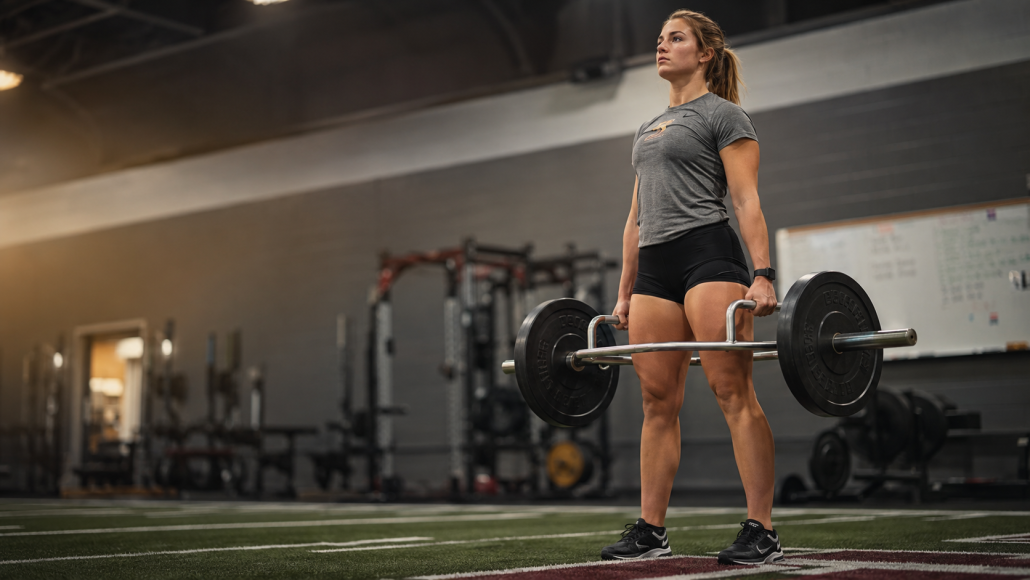
College Softball Strength & Conditioning Program: The Complete 12-Week Off-Season Guide
By Joey Myers — D1 Baseball, Fresno State | Author, Catapult Loading System | NASM-CES · IYCA Youth Fitness Specialist | 20+ years of coaching
A college softball strength and conditioning program has to do three things simultaneously that most general strength programs only do one of. It must build rotational power for bat speed and throwing velocity, develop the linear speed needed to take advantage of 60-foot bases, and protect a throwing arm that accumulates serious volume over a 60+ game season.
Specifically, this guide walks through the evidence-based approach HPL uses with college-level softball players. It covers the full 12-week program structure, the arm care protocol that belongs in every session, and how to peak physical performance so you’re at your best when conference play starts — not burned out from a poorly designed off-season.
Want the full 12-week program as a printable PDF?
Download the free College Softball Off-Season S&C Program — 7-page printable PDF with every workout, warm-up, arm care sequence, and progress tracking sheet.
Why Is Softball-Specific S&C Different from General Strength Training?
Most off-the-shelf strength programs — even ones marketed to female athletes — are built around symmetrical bilateral movement patterns: barbell squats, bench press, conventional deadlifts. These are excellent exercises, but they don’t address the specific demands that make softball athleticism unique.
Softball is a rotational sport played at short distances with explosive bursts. That’s what makes a dedicated college softball strength and conditioning program different from generic strength training. The swing is a rotational power event. The throw is a rotational power event. The pitching delivery is a rotational power event. None of these movements are trained effectively by sitting on a machine and pressing in a straight line.
As a result, a well-designed college softball strength and conditioning program addresses four specific demands that general programs overlook:
- Hip-to-Shoulder Sequencing — The rotational power of the swing and throw comes from loading the hips and transferring force through the core to the shoulder. Training this sequence with med ball work and rotational plyometrics directly improves bat speed and throwing velocity.
- Posterior Chain Dominance — Softball power comes from the posterior chain: glutes, hamstrings, and thoracic extensors. Trap bar deadlifts, single-leg RDLs, and barbell hip thrusts are more position-specific than the traditional back squat.
- Throwing Arm Durability — College softballers throw more than most people realize. A daily J-band protocol that builds rotator cuff strength and posterior capsule integrity is the difference between a healthy arm at the conference tournament and one that’s been managing pain since February.
- Short-Distance Explosive Speed — The bases are 60 feet apart. Top-end velocity matters less than first-step reaction time and acceleration mechanics. Sprint training needs to emphasize the 0-to-20 yard window, not 40-yard dash performance.
How Should a College Softball Off-Season Program Be Structured?
Specifically, the ideal college softball strength and conditioning program runs 12 weeks, 4 days per week, organized into three progressive phases. Four days is the sweet spot for college players: enough frequency to drive real adaptation without accumulating the recovery debt that leads to in-season breakdown.
Phase 1 (Weeks 1–4): Foundation. The goal is movement quality, not maximum load. Establish the hip hinge pattern with Romanian deadlifts, introduce anti-rotation core work via the Pallof press, and begin the arm care protocol that will run every session. Athletes who rush Phase 1 get hurt in Phase 2. As a result, the temptation to jump ahead is real — and it’s the fastest path to a February shoulder problem.
Phase 2 (Weeks 5–8): Power Development. Load goes up 5–10% across all compound lifts. The trap bar deadlift replaces the RDL as the primary strength exercise. Med ball rotational complexes increase in weight and intent. This is the phase where bat speed and throwing velocity gains happen.
Phase 3 (Weeks 9–12): Peaking. Volume drops 20–25% and intensity peaks. Every explosive rep — jump squats, med ball slams, flying 30 sprints — is performed at absolute maximum intent. By Week 12, the athlete transitions to a 2-day maintenance version that carries power gains through the competitive season.
Additionally, within each phase, the four day types are: Day A (Lower/Posterior Chain), Day B (Upper/Throwing Support), Day C (Rotational Power), and Day D (Speed & Agility). Ideal weekly schedule: Monday A · Tuesday B · Thursday C · Friday D.
What Exercises Should Every College Softball Player Do for Rotational Power?
First, rotational power training for softball is not the same thing as throwing weighted balls or swinging a heavy bat. Those activities have their place, but the foundational work in any college softball strength and conditioning program happens in the weight room with exercises that teach the body to sequence hip-to-shoulder force before applying it in sport-specific contexts.
The most effective rotational power exercises for college softball players:
- Med Ball Hip-Load Scoop Toss (wall-facing) — The player stands facing a wall, loads into the hip of the back leg, and drives through the hip to launch the ball into the wall. The key teaching point is that the hip loads before the shoulder moves. This mirrors the swing sequence exactly.
- Med Ball Rotational Slam (side-facing) — Stand perpendicular to a wall or open space, load into the back hip, and slam the ball as hard as possible. Full hip-to-shoulder sequence at game speed. Use an 8–10 lb ball at maximum intent — if you’re not trying to break the floor, you’re not training power.
- Pallof Press (anti-rotation) — Before you can express rotational power, you need to control rotational force. The Pallof press teaches the core to resist rotation while the arms move — the foundational skill that makes every other rotational exercise safer and more effective.
- Barbell Hip Thrust — Not traditionally classified as rotational, but the hip thrust builds the glute strength that drives the initial hip rotation in both the swing and the throw. It’s the most important lower body exercise in a softball-specific S&C program.
- Jump Squat (30% of 1RM) — Power is force times velocity. The jump squat at submaximal load trains the athlete to move a moderate weight as fast as possible — the definition of power. Results show up in first-step reaction time and exit velocity.
What Is the Most Important Arm Care Protocol for College Softball Players?
Arm care at the college level is not something you do when your shoulder starts hurting. By the time you have pain, you’ve already lost weeks of the off-season to recovery. The most important arm care protocol for college softball is one you do every single day. Run it before throwing and after every upper body lift session, starting in Week 1 of the off-season. Within this college softball strength and conditioning program, arm care is built into every training day — not added as an afterthought.
For example, the J-band protocol is the gold standard for overhead athletes at the college level. Coaches at Vanderbilt, LSU, Auburn, UCLA, and dozens of other programs have made it mandatory for their pitching staffs. The research basis for this college softball strength and conditioning program is straightforward: the exercises specifically target the posterior rotator cuff and posterior capsule, which are the structures most commonly damaged in overhead athletes who throw at high volume.
Specifically, the five most critical exercises in the college softball arm care sequence:
- External Rotation (elbow at 90°) — Band anchored at elbow height, forearm rotates away from the body. 2 sets of 10. The most protective exercise in the protocol — directly strengthens the infraspinatus and teres minor, which decelerate the arm after every throw.
- Internal Rotation (elbow at 90°) — Same setup, forearm rotates toward the body. Balances the external rotation work to prevent the muscle imbalances that cause impingement.
- Horizontal Abduction — Arms out to the side, pulling back against the band. 2 sets of 10. Strengthens the posterior capsule — the structure most commonly involved in “dead arm” among college pitchers and position players.
- Standing Trunk Rotation (with band) — Band anchored at shoulder height, athlete rotates through the core. 2 sets of 10 each side. Bridges arm care to rotational power — teaches the athlete that arm health and swing power come from the same physical system.
- Y-T-W Raises (prone, light dumbbells) — Performed on an incline bench or prone on the floor. These are scapular stabilizer exercises, not strength exercises. 2–3 lb dumbbells, 10 reps of each. The scapula is the foundation that every rotator cuff exercise relies on.
Additionally, college pitchers and catchers should add 2 sets of 10 pronation/supination with a 2–3 lb dumbbell after the J-band sequence on upper body days. The wrist rotation involved in pitching delivery and catching generates forearm fatigue that accumulates over the course of a season.
“I absolutely love my J-Bands! I am a college softball player and have been using them for years as a staple in my throwing routine. They have strengthened my arm and given me confidence in a solid warm-up. As a coach, I will always advocate for my athletes to use J-Bands each time they pick up a ball. I 100/10 recommend to all overhead athletes.”
— Gabi Nilles, College Softball Player & Coach · via JaegerSports.com
How Do You Build First-Step Speed on the 60-Foot Base Paths?
Here’s the most common mistake in college softball speed training: running too many full-speed 40-yard dashes. At 60-foot bases, the distance between home and first is about 18 meters — the average college softball player covers that distance in about 3.0–3.3 seconds. At that distance, acceleration mechanics dominate. Top-end velocity barely matters.
First-step speed on the base paths comes from three things: reactive hip extension power, efficient acceleration mechanics, and the ability to decelerate and re-accelerate at the bases. Train all three:
- Broad Jump → 10-yard Sprint — Combine horizontal power with sprint conversion. Broad jump, land, and immediately sprint 10 yards. This mimics the burst out of the batter’s box or the reaction step reading a pitch.
- Resisted Sprint (band) — Partner holds a band from behind while the athlete sprints 15 yards against the resistance. Forces a forward lean and high knee drive that mirrors proper acceleration mechanics. Over-speed on release builds the neural pattern.
- 5-10-5 Pro Agility Shuttle — The most directly applicable agility test for softball. Plant and cut on the outside foot, keep the center of gravity low through the turn. This is the core movement of rounding bases at full speed.
- Reaction Drop Sprint — A partner drops an object from shoulder height. Athlete reacts on visual movement and sprints 10 yards. Trains the read-react first step that separates fast base runners from fast straight-line sprinters.
- Barbell Hip Thrust (again) — Every speed coach worth listening to will tell you: the single best predictor of acceleration speed is hip extension strength. The hip thrust is non-negotiable for base path speed development.
How Do You Maintain Strength and Power During the Softball Season?
However, the biggest mistake college softball players make is doing too much in the weight room during the competitive season. Between practice, games, travel, and recovery, most college players have the capacity for exactly two quality lifting sessions per week. More than that becomes a cumulative fatigue problem that shows up as performance decline in the back half of the conference schedule.
Specifically, the in-season maintenance model from this program uses two days per week at 60% of off-season volume. The exercises stay the same — you don’t change the training menu during the season, you just reduce the portion size. One lower-dominant day (trap bar deadlift, hip thrust, lateral bounds) and one upper-dominant day (bench press or dumbbell press, pull-ups, arm care sequence).
Key in-season rules:
- Never lift the day before a game. CNS fatigue from a heavy lower body session takes 24–48 hours to fully recover. Schedule lifting on non-game days or immediately after a game, never before.
- The arm care protocol does not get reduced. In-season is when throwing volume is highest. If anything, add an extra J-band session on game days before warm-up. The arm care protocol prevents the cumulative damage that becomes a chronic problem by April.
- Track shoulder soreness weekly. A 0–10 scale checked every Monday morning is the most useful monitoring tool for in-season arm health. Soreness above 4 means reducing throwing volume before practice that day. Above 6 means a full evaluation before returning to full throwing.
College Softball Strength and Conditioning Program: Frequently Asked Questions
Can freshmen use this program, or is it only for upperclassmen?
This college softball strength and conditioning program is designed for college-level athletes — which means incoming freshmen who’ve completed a high school strength and conditioning program can use it. Athletes coming from a program without a structured S&C background should spend the first week in Phase 1 learning movement patterns before adding load. The program scales down for athletes who need it.
Do I need a college weight room, or can I do this at a commercial gym?
For example, a commercial gym with access to a barbell, dumbbells, a cable machine, a trap bar (or hex bar), and medicine balls covers everything in this program. J-bands cost approximately $30 and come with the exercise guide. The plyometric work and sprint drills need an open field or turf surface — a park or high school track works fine if your gym doesn’t have turf.
What if my college program has a team S&C coach? Should I still use this?
That said, if your program has a dedicated S&C coach, follow their college softball strength and conditioning program. This guide is designed for college softball players who don’t have access to a team-provided strength program — whether that’s a club team, a smaller program without S&C resources, or a player training individually during an off-season gap. It’s also useful as a framework for understanding what well-designed softball-specific training should include, regardless of who’s programming it.
How many weeks before the season should I start this program?
Start the college softball strength and conditioning program 12–14 weeks before your first game. That gives you enough time to complete all three phases and transition into the 2-day in-season maintenance model before the competitive calendar begins. Starting 8 weeks out means compressing Phase 1 or skipping it — both of which increase injury risk during Phase 2 loading.
Will this program improve bat speed, or is that separate training?
Yes — the rotational power work in this program directly develops the physical qualities that produce bat speed: hip-to-shoulder sequencing, rotational rate of force development, and posterior chain power. The primary tools are the med ball hip-load scoop toss, rotational slams, and jump squats. Bat speed is a physical quality before it’s a skill. Building the engine in the weight room makes everything you do with a bat more effective. That’s the foundation this college softball strength and conditioning program is built on.
How do you maintain softball-specific strength during the competitive season?
That means two days per week at 60% of off-season volume — the correct in-season maintenance dose from a college softball strength and conditioning program for most college players. One lower-dominant session and one upper-dominant session, never the day before a game. The J-band arm care protocol stays at full volume year-round — in-season is when you need it most. Track shoulder soreness on a 0–10 scale each Monday: above 4 means reduced throwing volume that day, above 6 means a full evaluation before returning to full throwing.
Should pitchers follow this program differently from position players?
Yes — this college softball strength and conditioning program accommodates pitchers with two specific adjustments. First, pitchers should extend the arm care J-band protocol to 20 minutes on upper body days from Week 1 — not just Phase 3. Second, any increase in pitching volume during Weeks 9–12 must be coordinated with the pitching coach; don’t ramp throwing intensity at the same time the weight room loading is peaking. Position players follow the program as written, with the standard arm care sequence added to every upper body session regardless of throwing volume.
More Free Programs from HPL
Free Download
Get the 12-Week College Softball S&C Program PDF
7 printable pages. Every workout, warm-up, arm care protocol, and progress tracking sheet. Instant download — no spam.

With 28,000+ online bat speed program sales, my methods have transformed coaches, instructors, and parents just like you. I'm affiliated with esteemed organizations like ABCA, IYCA, and SABR, advocating for positive coaching. With 15+ years in corrective fitness and a Division One baseball background, my knowledge is unmatched.
Join our blog and unlock the secrets to successful hitting, elevate your performance, and ignite your passion. Welcome to the world of limitless possibilities at HittingPerformanceLab.com.
- The Season Started. Here’s The Program That Keeps Your Daughter Athletic Through All Of It - September 27, 2026
- The Season Started. Here’s The Program That Keeps Your Kid Athletic Through All Of It - September 27, 2026
- Baseball Pitcher Workout Program PDF: Free 12-Week Off-Season Strength Plan for HS and Youth Pitchers - September 26, 2026