Posts

Discover how to hit a baseball or softball in a certain direction, like place hitting to the opposite field, at home by yourself using indoor drills with limited space.

How To Optimize Directional Force Using The “Pounding Nail” Drill


Most likely, Little Leaguers and 12-year-old young ladies won’t be driving the ball 400-feet anytime soon.  I know that. However, the point of this “Pounding the Nail” drill video post is how to train hitters to direct their swing force optimally.  In the above video, we go over…

  • Thanks to Matt Nokes,
  • Define Directional Force, takes 8,000 pounds per square inch, in one direction, to hit ball 400-feet,
  • What is a Lumberjack trying to do? Lean in and compress the baseball,
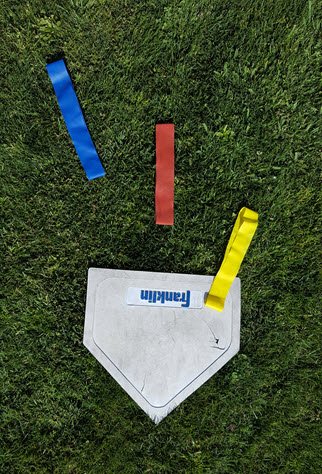
  • Using colored bands on ground to simulate pitch location directional force (see image of plate and colored bands below), and
  • Stand out front of hitter with external image (nail).

I like to pair the above “Pounding the Nail” drill with the following “Shorten Swing” drill…


However, I’ve evolved my thinking on the latter video.  And here it is:

  1. The “catcher’s glove” ball marker closest to the actual catcher is outer 1/3 of plate right-center approach (for righty, reverse for lefty),
  2. The “catcher’s glove” ball marker inline with the back foot is middle 1/3 of plate dead-center field approach, and
  3. The “catcher’s glove” ball marker inline with hitter’s belly button is inner 1/3 of plate left-center field approach (for righty, reverse for lefty).

I see coaches generally teaching a “kicking back” of barrel towards the catcher.  I found deeply accelerating barrel same for all pitch depths to be ineffective for my hitters.  As you’ll see in the syncing of these two drills, the distance between what catcher’s glove the hitter hits and the depth of impact is the same.

For example, the DISTANCE between hitting catcher’s glove position #1 above to optimum impact on the outer 1/3 of the plate SHOULD MATCH hitting catcher’s glove position #3 above to optimum impact on the inner 1/3 of the plate.  You still following me?

I was teaching the same blanket “deep barrel” acceleration as everyone else, but my cleaner hitters mechanically were having a challenge barreling up the inner 1/3 pitch.  You see, their swing path was taking too long in getting to the inner 1/3 pitch with the generalized “deep barrel” approach.

I recommend watching video of top hitters smashing the inside versus the away pitch and in most cases, you’ll see a difference in what catcher’s glove they’re hitting.  Remember the objective is directional force.  Matt Nokes says that is takes 8,000 pounds per square inch of force, in ONE DIRECTION, to hit a ball 400-feet.  Practice syncing these two drills with your hitters in the following progression:

  • Dry swings first,

    “Pounding Nail” Drill colored band staggered impact setup to simulate pitch depth (for a righty, reverse for a lefty)

  • Tee next,
  • Then soft toss (DO NOT work the “deep” catcher’s glove position here, unless you’re okay with donating your teeth!)
  • And when you get the hitter to LIVE, make sure they understand before pitcher throws the ball, they default to the middle approach, and make the smaller adjustment in or out, depending on pitch depth.
PLEASE NOTE: once the hitter gets to LIVE, make sure they understand the following:

  • Most optimized force = pounding nail over correct part of plate (ex. for righty, driving inner 1/3 to left-center),
  • Optimized force = slipping lines, and pounding one nail over (ex. for righty, driving middle 1/3 to left-center), and
  • Sub-optimal force = slipping lines, and pounding two nails over (ex. for righty, driving outer 1/3 to left-center).

Just think about it, if it takes 8,000-pounds per square inch of force in one direction to hit a ball 400-feet, and that’s optimal…what happens if the hitter uses “Sub-optimal force” like in the above bullet point?  Right! It’s going to take more force to hit it farther.  I dunno how much, but taking a guess in the aforementioned sub-optimal example, it may take 12,000 or 16,000-pounds per square inch of force to hit the ball 400-feet pounding two nails over, so make it easy..hit it where it’s pitched!

After this lesson, typically the “light-bulb” goes on with my hitters.  I hope this helps!
 

Here’s a fun youth hitting drills post to help STOP bat drag for beginner baseball and softball players.  Easy at home indoor use with limited space.  Learn how to fix dragging back elbow for 6 year olds on up.  Discover batting instruction tips for what is bat drag and what causes it.

Okay, I’ll admit it…

Baseball Hitting Instruction: Zack Racing Rear Elbow

It took 30-mins to clean up my Sophomore in High School, Zack May’s, Rear Racing Elbow using Reactive Neuromuscular Training (RNT)…

The one hitting fault that is a bugger to fix is,

Rear Racing Elbow.

Unfortunately: I find that a baseball hitting instruction fix for one player with this challenge, may not work for another.

Fortunately: I do see symptoms that tend to haunt specific Rear Racing Elbow bat drag hitters.

Unfortunately: I also find that the same combination of symptoms may not be present for every hitter.

Fortunately: For this baseball hitting instruction drill to work, the symptoms must be present.

In this post:

  • We’ll define Rear Racing Elbow,
  • Look at the symptoms of this particular case study,
  • Front knee action at landing: slightly bent or straight? and
  • How we fixed the issue in one 30-min session, using RNT…


What is Rear Racing Elbow?

It’s when the rear elbow “races” passed the hands towards the middle of the body (see “BEFORE” image up and to the right).

It can cause the hitter to:

  • Dump the barrel prematurely, which leads to flares OR misses completely to the opposite field, OR
  • Roll over or get jammed on inside pitches.

It’s a nasty bug to fix with conventional baseball hitting instruction, and one my readers sounded off on at the following two HPL posts:

  1. Hitting Tips to Boost Barrel Time on Pitch-Plane, and
  2. Baseball Online: Never Suffer from Bat Drag Again.

Symptoms of Rear Racing Elbow Bat Drag

In this particular baseball hitting instruction case study, one of my local hitters Zack May, a Sophomore in High School, over the past year, has been haunted by these three things…NOT getting the:

  1. Front leg to straight at or passed impact,
  2. Back knee to 90-105 degrees during the turn, and
  3. Downhill shoulder angle before landing, and
  4. Post UPDATE: Over-rotation is a BIG issue we see with the over-coaching of rotational mechanics.


Front Knee Action at Landing: Slight Bend or Straight?

This is a major baseball hitting instruction debate among instructors I respect.  They teach their hitters to keep a slight bend in the front knee at or passed impact.

They point to big sluggers like Mark McGwire and Mark Teixeira, among others, as examples.

The amount of bend in the front knee up to impact will depend on the amount of forward momentum (FoMo) the hitter uses.

The more FoMo a hitter uses, the more Ground Reaction Forces (GRF) are needed to transfer planes of motion from the Frontal/Coronal* (sideways) to the Transverse* (twisting).  In which case, a straightening of the front knee would be highly recommended.  Hitters like Jose Bautista and Josh Donaldson come to mind.

On the contrary though, like a lot of big sluggers, the less forward momentum (wide to little striders), there doesn’t seem to be a need to straighten the front knee during impact.

Think of a wide receiver running a 10-yard 90-degree cut route.  He uses GRF and FoMo just like a hitter, but he’s transferring from Sagittal* (front) to the Frontal/Coronal* (sideways) plane of motion.  In this case, he’s reaching a maximum forward running speed (FoMo), then has to cut very quickly, so you’ll see his plant leg go from bent to straight as he uses Ground Reaction Forces.  Evidenced by him dropping down (or getting shorter) before making the cut.

My hitter Zack is both tall (6’4″), and uses quite a bit FoMo.  So, for him, when that front knee doesn’t get to straight, that’s a problem.  Coupled with the issue of not getting sufficient bend in his back knee during the turn causes the pelvis to not fully rotate.  And as a result, his back shoulder and arm feel like they have to do extra work.  And Rear Racing Back elbow is born!

*CLICK HERE for a more in-depth overview of planes of motion on Wikipedia.

Post UPDATE: we’ve since moved away from the front knee action having to get straight as an absolute to fixing bat drag or contributing to significant power, for that matter.  We see hitters like Bellinger, Seager, Rizzo, Pedroia, and Beltre all keep significant bend in the front knee when getting a ball below their belt line.


Baseball Hitting Instruction: How We Fixed Zack’s Bat Drag in 30-Mins…

To get you up to speed, check out this Dustin Pedroia & how to fix stepping in the bucket post I did that will explain the use of Reactive Neuromuscular Training, or RNT.

Baseball hitting instruction and RNT drill we used with Zack,

  • We used two long resistance bands positioned as close to his pelvis as possible (high up the thigh without damaging “the goods”),
  • Both resistance bands pull in opposite directions (feeding the mistakes – front knee wants to stay bent, and back knee wants to straighten during the turn), and
  • We worked on getting him to “resist the resistance” during the turn.

One thing we also used that seemed to be the permanent fix was finger pressure (see below…)

Baseball Hitting Instruction SAFETY Issue: Please be careful with this drill.  The person facilitating the front band is in the way of a swinging bat!!!  To be done with adults who know better, not teammates.  Please watch video above for clarification on this.

Post UPDATE: one other concept we’re had even BETTER results with fixing dragging back elbow bat drag is the concept of wrist snap or pronation.  We kind of talk about the concept here.