
Baseball Quotes Decoded: What Ted Williams, Derek Jeter & the Game’s Greats Actually Meant
By Joey Myers | HittingPerformanceLab.com | Former D1 Baseball, Fresno State
Ted Williams once said hitting a baseball is the hardest single thing to do in sport. He was right. But here’s the part coaches miss: the quotes these legends left behind are actually instructions — not motivation. Every phrase that gets plastered on a locker room wall or printed on a dugout poster contains a biomechanical principle that most coaches never translate. They repeat the words. They don’t teach what the words mean.
This post does the translation. We’re going through the most-quoted baseball quotes from Williams, Babe Ruth, Derek Jeter, Giancarlo Stanton, Jose Bautista, and Sadaharu Oh — and breaking down what each one actually means for your hitter’s swing using the Catapult Loading System framework. By the time you’re done, these quotes will be coaching tools, not wall decoration.
We’ve also packaged 37 quotes — across 11 legends — with the full CLS translation for each one into a free printable PDF. It’s linked in three places below.
What’s Covered
→ Why baseball quote lists don’t help coaches or hitters
→ Ted Williams — the science behind his most-quoted lines
→ Babe Ruth — what his strikeout philosophy actually teaches
→ Derek Jeter — work ethic decoded with motor learning research
→ Stanton & Bautista — exit velocity and the hunter mindset
→ Sadaharu Oh — 868 home runs from mechanics, not mass
→ The most-used hitting cue that’s actually wrong
→ How to use these quotes with a struggling hitter
→ FAQ: baseball quote questions coaches ask most
Free Download
“Hitting Greats on Hitting” — 37 Baseball Quotes Decoded with the Biomechanics Behind Each One
Ted Williams. Babe Ruth. Hank Aaron. Mickey Mantle. Every quote decoded with the Catapult Loading System and Spinal Engine framework — what each one actually means for your hitter’s mechanics and mindset.
Why Baseball Quote Lists Don’t Help Coaches or Hitters
Search “baseball quotes” right now. Every result does the same thing: lists the quote, maybe adds a generic paragraph about work ethic or mental toughness, and moves on. There’s no translation. No biomechanical context. No instruction on what to actually do differently with your hitter because of what Ted Williams said in 1971.
These legends weren’t just motivating people — they were describing the physical reality of hitting. Williams’ phrase “get a good ball to hit” is a force production argument, not patience advice. Ruth’s “every strike brings me closer to the next home run” is a motor learning principle, not defiance. Oh’s “practice doesn’t make perfect — perfect practice makes perfect” is deliberate repetition research published decades before Dr. Anders Ericsson named it.
When you understand what these quotes actually mean, you can use them as coaching tools during practice, as mental models during games, and as framing to help a frustrated parent understand why their hitter needs something different than “just get more reps.”
Ted Williams — The Science Behind His Most-Quoted Lines
No hitting legend left more coaching-applicable material than Ted Williams. His book The Science of Hitting (1971) is the most rigorous first-person biomechanical breakdown of a swing ever written by an active player. His quotes aren’t motivational — they’re instructional.
“A hitter’s first obligation is to get a good ball to hit.”
— Ted Williams, The Science of Hitting
What he actually meant: Williams divided the strike zone into 77 individual cells and charted a different batting average for each one. A pitch in his sweet spot produced a .400 average. A pitch on the outer edge dropped him to .230. He wasn’t talking about patience — he was talking about force production geography. The swing doesn’t change. The pitch location changes what the optimal swing can express.
The CLS translation: In Catapult Loading System terms, you can only express maximum fascial energy release if the pitch location allows your optimal rotational plane. A ball on the outer third requires delayed hip rotation and later extension — which reduces power output even when the mechanical pattern is technically correct. Williams was describing pitch selection as a multiplier on exit velocity. The Statcast data we have now confirms it.
How to use it with your hitter: When a hitter is pressing on borderline pitches, give this quote context: “Williams wasn’t just telling you to be patient. He was telling you that pitch selection IS a power tool. A pitch in your A-zone hits 20 feet farther than the same swing on a pitch at the edge of the zone.” That reframe changes the mental model from passive waiting to active hunting.
“Hitting a baseball — I’ve said it a thousand times — is the hardest single thing to do in sport.”
— Ted Williams
What most people miss: The line that follows is almost never cited: “A round ball hit by a round bat, hitting it squarely, is the most difficult skill to master.” Williams was making the biomechanical precision case. A 90 mph fastball reaches the plate in roughly 400 milliseconds. The hitter has about 200 ms to decide and 150 ms to execute. The margin for error is measured in millimeters and microseconds.
The coaching application: This is an argument against “he’s just not talented enough.” Deeper motor patterns require less conscious processing, which leaves more cognitive bandwidth available during the actual at-bat. Williams was arguing for the primacy of deliberate practice, not natural gift. That reframe changes what parents invest in.
Babe Ruth — What His Strikeout Philosophy Actually Teaches
“Every strike brings me closer to the next home run.”
— Babe Ruth
What he actually meant: Ruth’s strikeout rate was among the highest of his era. His home run rate defined an era. Those two facts are connected, not contradictory. Ruth was describing what motor learning researchers now call intent-driven training: the body learns fastest when the motor system commits fully to the intended movement — even if the outcome is a miss. Uncommitted swings teach an uncommitted pattern.
The CLS translation: From a Reactive Neuromuscular Training standpoint, the body builds the motor pattern for maximum force production through committed, full-intent repetitions — even missed ones. A hitter who swings hard and misses is reinforcing the ballistic rotational pattern that eventually becomes a home run. A hitter who pokes defensively to avoid strikeouts is reinforcing a decelerated, non-ballistic pattern with a power ceiling much lower than their physical capability.
For youth coaches with strikeout-fearful hitters: Decode it for them. “Ruth wasn’t being defiant about strikeouts. He was describing what his body was learning every time he swung with full intent. The commitment IS the training. The miss is part of the process.” That reframe gives permission to swing without hesitation — which is exactly what most youth hitters need.
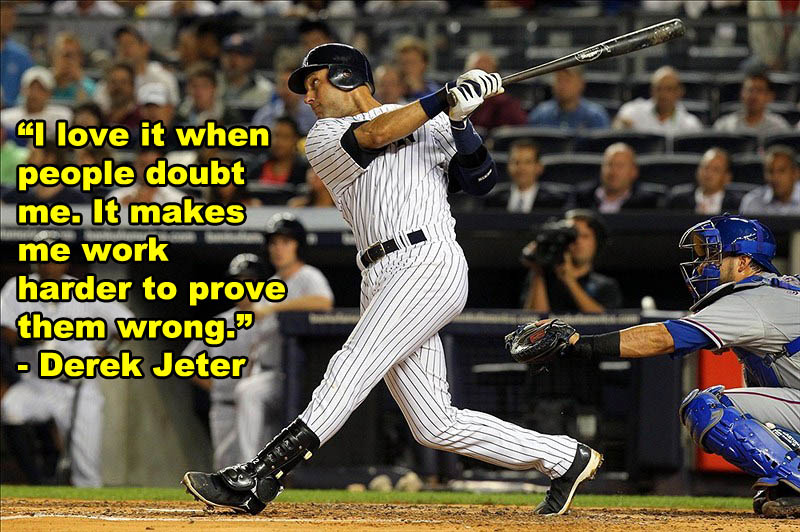
Derek Jeter — Work Ethic Decoded with Motor Learning Research
“There may be people who have more talent than you, but there’s no excuse for anyone to work harder than you do.”
— Derek Jeter
The context that makes this coaching gold: Jeter committed over 50 errors at shortstop in his first professional season. The Yankees discussed moving him to another position. He became a first-ballot Hall of Famer who won five Gold Gloves. The 50-error season wasn’t talent-limited — it was repetition-limited. He hadn’t yet accumulated the quality rep count needed to automate the pattern.
The research behind it: Dr. Anders Ericsson’s expert performance research found that the quality and quantity of deliberate practice — not innate ability — is the primary predictor of elite performance. “Quality” is the key word. Ten thousand reps of the wrong pattern don’t produce expertise — they deepen a wrong pattern. Jeter’s work ethic presumably included correction and feedback loops, not just volume.
For impatient parents: Stop asking “does this kid have talent?” Start asking “how many quality reps has this kid gotten, and under what feedback conditions?” Jeter’s career is proof that the answer to the talent question is almost always “not enough yet” — not “no.” That reframe changes what parents invest in: they stop looking for a coach who can “unlock” their kid and start looking for a system that delivers correct repetitions.
Stanton & Bautista — Exit Velocity and the Hunter Mindset
These two quotes work together as a complete offensive philosophy — and they’re almost always cited separately in ways that lose the connection.
“I just want to hit the ball hard.”
— Giancarlo Stanton
“Don’t be a fisherman — be a hunter.”
— Jose Bautista (paraphrased)
The data behind Stanton’s quote: At Hitting Performance Lab, we use the BES formula — every 1 mph of additional exit velocity adds approximately 4 feet of batted ball distance. FanGraphs research confirms fly balls carry a +358 ISO and +115 wOBA advantage over ground balls. Teaching a youth hitter to swing with maximum intent isn’t aggressive coaching — it’s the exact biomechanical principle that separates elite hitters at every level. Stanton is describing exit velocity optimization in eight words.
The philosophy behind Bautista’s quote: A fisherman is passive — reacting to what comes. A hunter is active — selecting the target and striking on his terms. Bautista was describing the same thing Williams described as “a hitter’s first obligation,” in a different frame. The hunter mindset: identify your pitch, in your zone, and commit fully when it arrives. Everything else is a take.
When parents say “I don’t want my kid to strike out”: Stanton’s quote is the answer. Exit velocity compounds: a hitter who learns to generate hard contact at 10 becomes a 95+ mph exit velocity hitter at 16. A hitter who learns to “just make contact” at 10 is still making contact at 16 — but it isn’t hard enough to matter at that level.
Sadaharu Oh — 868 Home Runs from Mechanics, Not Mass
“Practice doesn’t make perfect. Perfect practice makes perfect.”
— Sadaharu Oh
Why Oh matters: 5’10”, 173 lbs. 868 professional home runs over 22 seasons — roughly 40 per year. At a physical profile American coaches would label a “contact hitter,” Oh produced power numbers most 220-pound sluggers never approach. His quote about perfect practice is the explanation.
The biomechanical secret: Oh’s famous flamingo one-legged stance pre-loaded his hip flexors and created a massive stretch-reflex in the elastic fascia surrounding his pelvis and spine before any pitch was thrown. In CLS terms, he was performing an advanced version of the Springy X Pattern — storing elastic energy in the myofascial system and releasing it explosively through spinal rotation. His power came entirely from fascial energy storage and sequenced rotation, not physical mass.
The coaching lesson: A smaller, lighter hitter using proper mechanical loading consistently outperforms a larger hitter relying on linear force. Oh proved it over 22 seasons. His “perfect practice” quote is a direct reference to quality-rep training: he didn’t take thousands of reps. He took thousands of reps of the correct mechanical pattern until fascial energy storage became automatic and unconscious.
For parents of smaller hitters: Oh is the demolition of the size-equals-power narrative. A 100-pound hitter executing proper CLS loading with the Springy X Pattern can drive the ball 300 feet. Oh is proof at the professional level. What that hitter needs isn’t more weight — they need better mechanical loading in the load phase.
Free Download
Get All 37 Quotes — With the Full CLS Translation for Each One
Williams, Ruth, Aaron, Mantle, Jeter, Stanton, Bautista, Oh, Bonds, Pujols, and Trout — all 37 quotes decoded with the Catapult Loading System and Spinal Engine principle behind each one.
The Most-Used Hitting Cue That’s Actually Wrong
“Be short to the ball” appears in nearly every dugout in America. It creates more bat drag and dropping-hands problems than almost any other coaching cue. Worth decoding, because fixing it requires going back to what Williams actually said — which is almost the opposite.
What coaches usually mean: “Don’t extend your arms too early in the swing.” This is accurate as an observation — the arms DO appear compact at contact on elite swings. The problem is the cue targets a symptom rather than the cause.
What hitters actually do: They hear “short” and suppress arm action — which disrupts the shoulder-torso-arm sequencing that creates the compact appearance in the first place. Ted Williams never described his swing as “short.” He described it as rotational. The hips open first, the torso follows, the arms follow the torso, the hands follow the arms.
The better cue: “Let your hips fire first, and let your hands follow.” The arms appear compact as a consequence of good hip-to-torso-to-hands sequencing — not as a cause you can engineer by telling a hitter to keep their hands in. The swing that looks “short” is the result of proper rotation, not arm suppression.
Williams’ rotational framework makes “be short to the ball” obsolete as a teaching concept, because the compactness is an output of rotation — not an input you can create by suppressing the arms.
How to Actually Use These Quotes With a Struggling Hitter
The most effective baseball quotes as coaching tools are the ones that reframe the goal without adding technical overload during an at-bat. When a hitter is struggling in a game, the last thing they need is another mechanical cue competing for attention while a 90 mph fastball is coming.
Use Williams to manage attention in games
“Get a good pitch to hit” shifts cognitive load from mechanical cues (“fire the hips,” “stay back”) to situational strategy (“this pitch in my attack zone = swing, everything else = take”). Research on attention during motor performance consistently shows that external focus cues — aimed at the outcome, not the body — outperform internal focus cues during live performance. Save the mechanics for practice. In the game, Williams’ mindset is the play.
Use Ruth to address fear of failure
Decode it for them: “Every miss where you swung with full intent is teaching your body something. Every defensive poke to avoid a strikeout is teaching your body something different — and not something you want at the plate in a tournament game.” Commitment under game pressure is the skill. Ruth’s quote is the on-ramp to building it.
Use Jeter to frame the development process
When parents are impatient with progress, Jeter’s 50-errors story reframes what “working hard” means. It’s not just time and reps — it’s reps under the right feedback conditions with a specific mechanical system to check. That’s where the CLS load sequence comes in: it gives the parent something concrete to look for rather than vague “more practice” advice.
Use Oh for smaller hitters
Oh is the demolition of the size-equals-power narrative. Pull up his stats. Show the physical profile. 5’10”, 173 lbs, 868 home runs. The argument makes itself. Then frame the CLS load sequence as the mechanical system Oh was using — before it had a name. That’s not a sales pitch; it’s an accurate description of what Oh’s flamingo stance was producing in the myofascial system.
More from HPL
Free Download
“Hitting Greats on Hitting” — 37 Baseball Quotes Decoded
The complete PDF: all 11 players, all 37 quotes, with the full CLS biomechanical translation for each one. Print it. Use it. Teach from it.
Frequently Asked Questions: Baseball Quotes Coaches Ask Most
These are the questions coaches, parents, and players ask most about baseball quotes. Each answer goes beyond the quote to the coaching insight and biomechanical principle behind it.
What is Ted Williams’ most famous quote about hitting a baseball?
Ted Williams’ most quoted hitting line is: “A hitter’s first obligation is to get a good ball to hit.” It comes from The Science of Hitting, where Williams divided the strike zone into 77 individual cells and charted a different batting average for each. His point: the best swing mechanics in the world can’t overcome a bad pitch selection. The biomechanical translation — every pitch location demands a different attack angle and swing length, and making contact on a borderline pitch reduces force production even when the mechanical pattern is perfect. Williams was describing pitch selection as a multiplier on exit velocity, not patience for its own sake. In CLS terms, you can only express maximum fascial energy release if the pitch location allows your optimal rotational plane. Williams understood this in 1971. The exit velocity data confirms it.
What is the most famous baseball quote of all time?
In general culture, Yogi Berra’s “It ain’t over ’til it’s over” wins the name recognition contest. But the quote that matters most for coaches and hitters is Williams: “Hitting a baseball — I’ve said it a thousand times — is the hardest single thing to do in sport.” The line that follows is almost never cited: “A round ball hit by a round bat, hitting it squarely, is the most difficult skill to master.” Williams was making the biomechanical precision case. A 90 mph fastball reaches the plate in roughly 400 milliseconds. The hitter has about 200 ms to decide and 150 ms to execute. That precision argument is exactly why motor pattern repetition under quality feedback matters more than any single tip, cue, or drill in isolation. Volume of correct repetitions is the irreplaceable foundation.
What did Derek Jeter say about failure that every coach should know?
Jeter’s most coaching-applicable quote: “There may be people who have more talent than you, but there’s no excuse for anyone to work harder than you do.” The context: Jeter committed over 50 errors at shortstop in his first professional season. The Yankees discussed moving him to another position. He became a first-ballot Hall of Famer. The lesson backed by motor learning research: deliberate repetition with specific, immediate feedback builds competence faster than raw talent alone. Dr. Anders Ericsson’s research found that the quality and quantity of deliberate practice — not innate ability — is the primary predictor of elite performance. The coaching takeaway: stop asking “does this kid have talent?” and start asking “how many quality reps has this kid gotten, and under what feedback conditions?”
What baseball quote best explains exit velocity to a young player or their parent?
Two quotes frame it together. Giancarlo Stanton: “I just want to hit the ball hard.” Jose Bautista (paraphrased): “Don’t be a fisherman — be a hunter.” The data: every 1 mph of additional exit velocity adds approximately 4 feet of batted ball distance. FanGraphs research confirms fly balls carry a +358 ISO and +115 wOBA advantage over ground balls. Teaching a youth hitter to swing with maximum intent is not aggressive coaching — it is the exact biomechanical principle that separates elite hitters at every level. Stanton’s quote is the hitter’s version of that math expressed in the simplest possible way.
How did Sadaharu Oh hit 868 home runs at only 5’10” and 173 lbs?
Oh hit 868 professional home runs over 22 seasons at a physical profile most American coaches would label a “slap hitter.” His quote: “Practice doesn’t make perfect. Perfect practice makes perfect.” The biomechanical secret was his famous flamingo one-legged stance, which pre-loaded his hip flexors and created a massive stretch-reflex in the elastic fascia surrounding his pelvis and spine before any pitch. In CLS terms, Oh was performing an advanced version of the Springy X Pattern — storing elastic energy in the myofascial system and releasing it explosively through spinal rotation. His power came entirely from fascial energy storage and sequenced rotation, not physical mass. The coaching lesson: a smaller, lighter hitter using proper mechanical loading consistently outperforms a larger hitter relying on linear force. Oh proved it over 22 seasons.
What’s the best baseball quote to use with a youth hitter who is afraid to strike out?
Babe Ruth: “Every strike brings me closer to the next home run.” For youth coaches, fear of failure is the most common mindset problem in the game — and it produces exactly the defensive, contact-first swing pattern that caps a hitter’s development ceiling early. Ruth’s quote reframes the strikeout from failure to information. From an RNT standpoint, the body learns faster through committed, full-intent repetitions — even missed ones — than through cautious “protect the plate” swings that avoid failure by avoiding commitment. A hitter who swings hard and misses is building the motor pattern for maximum force production. Ruth’s career strikeout rate was among the highest of his era. His home run rate defined an era. Those two facts are connected, not contradictory.
What does “short to the ball” actually mean — is it good or bad advice for hitters?
This cue appears in nearly every dugout in America — and it creates more bat drag and dropping-hands problems than almost any other coaching advice. What coaches mean: “don’t extend your arms too early in the swing.” What hitters actually hear and do: “keep the elbow in and stay compact.” The biomechanical problem: “short to the ball” is a position-focused cue, not a force-focused cue. Ted Williams never described his swing as “short” — he described it as rotational. The swing that looks “short” to observers is the result of proper sequential rotation, not arm suppression. The better cue: “Let your hips fire first, and let your hands follow.” The arms appear compact as a consequence of good sequencing, not as a cause you can engineer by telling a hitter to keep their hands in.
How do you use baseball quotes to actually help a struggling hitter — not just motivate them?
The most effective quotes as coaching tools are the ones that reframe the goal without adding technical overload during an at-bat. When a hitter is struggling, the last thing they need is another mechanical cue competing for attention while a 90 mph fastball is coming. Use Williams’ framing to change what the hitter focuses on: “Get a good pitch to hit” shifts cognitive load from mechanical cues (“fire the hips,” “stay back”) to situational strategy (“this pitch in my attack zone = swing, everything else = take”). Research on attention during motor performance consistently shows that external focus cues (aimed at outcome or environment) outperform internal focus cues (aimed at body parts or mechanics) during live performance. Save the mechanics for practice. In the game, Williams’ mindset is the play.

With 28,000+ online bat speed program sales, my methods have transformed coaches, instructors, and parents just like you. I'm affiliated with esteemed organizations like ABCA, IYCA, and SABR, advocating for positive coaching. With 15+ years in corrective fitness and a Division One baseball background, my knowledge is unmatched.
Join our blog and unlock the secrets to successful hitting, elevate your performance, and ignite your passion. Welcome to the world of limitless possibilities at HittingPerformanceLab.com.
- The Season Started. Here’s The Program That Keeps Your Daughter Athletic Through All Of It - September 27, 2026
- The Season Started. Here’s The Program That Keeps Your Kid Athletic Through All Of It - September 27, 2026
- Baseball Pitcher Workout Program PDF: Free 12-Week Off-Season Strength Plan for HS and Youth Pitchers - September 26, 2026





It would be interesting to know their motivations to put in the work. It was touched on a bit with Jeter, and Ted’s was certainly to be the best ever. Being driven to “become great” is powerful. Thanks for the diverse topics, it is developing players and coaches.
Corey, totally! Motivation is super key with young hitters. Some want to put the work in. Some don’t. Some get motivated early on, and others take longer to warm up. And some never do! Studies show a ton of different causes and drivers for self motivation, but the reality is we as coaches have to attack from different angles. I’m trying to finish another product called “The Science Of Sticky Coaching”, which digs into this topic quite a bit.
The key to work ethic to me is the willingness to do your work on your own. All by your self. Parents pay thousands of dollars sending their kids to various training “opportunities” but if a kid doesn’t work on their own, they don’t really grow themselves.
You’re absolutely correct! One thing I’ve seen in my studies is that discipline at home breeds self-discipline later in life. Now, by discipline I don’t mean the Adrian Peterson kind. I mean “structure”, “routine”, and being “organized”. Giving a kid whatever they want, when they want, will crush crush their ability to put off self-gratification later in life. They want it now, well, they need to learn how to wait for or earn it. Outcomes NEED to equal “hard work”.