
The Season Started. Here’s The Program That Keeps Your Kid Athletic Through All Of It
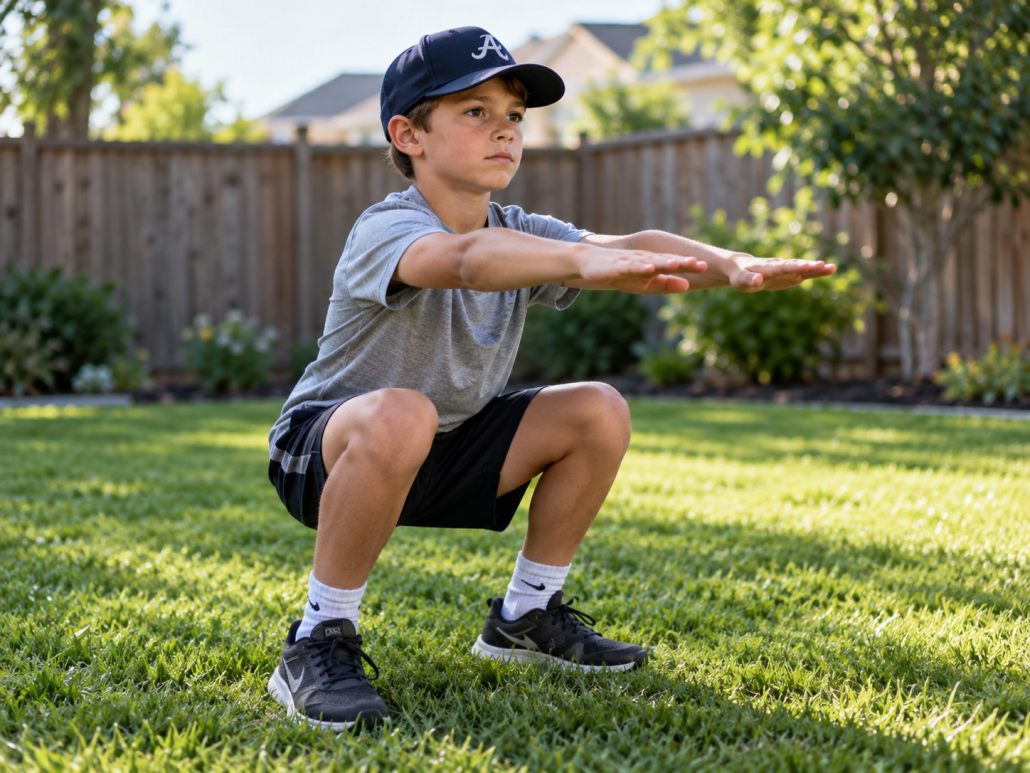
The season doesn’t have to mean stopping. Here’s the maintenance program that works around your kid’s game schedule — no gym, 35 minutes, twice a week.
By Joey Myers — D1 Baseball, Fresno State | Author, Catapult Loading System | NASM-CES · IYCA Youth Fitness Specialist | 20+ years of coaching
This free youth baseball in-season workout is built around a problem most parents run into by late April: the off-season program stops because the season started, and by July the athlete has lost ground on everything they built in the winter. A youth baseball player doesn’t need to stop training during the season. They need to train less — with the right structure.
This youth baseball in-season workout PDF is not a practice plan. Practice handles the skills. This program handles the athletic development that supports those skills: leg strength for first-step explosiveness, upper body pulling for arm durability, core stability for rotational power, and arm care to protect the shoulder and elbow during a high-throw-count season. It runs 2 days per week, takes 35–40 minutes per session, and requires nothing beyond bodyweight and a resistance band.
“I was in the gym 6 days a week on top of practices and games. By midseason my knee was breaking down — patellar tendinitis. Joey looked at what I was actually doing and the answer wasn’t more treatment, it was less volume. We cut to 4 days a week. The tendinitis cleared up.”
— Drake Davis, 1B/OF · Fresno City College · .381 AVG, 12 HR, 53 RBI · 2025 Freshman of the Year
Download the free 8-week in-season program now — arm care, Day A and Day B workouts, scheduling guide, and tracking log all in one printable PDF.
Free. No credit card. Instant download.
Why Does a Youth Baseball Player Need a Workout Program During the Season?
A youth baseball player needs a structured workout program during the season because physical development doesn’t pause when games start — and neither does the risk of falling behind athletically. Specifically, without any structured training during a 3–4 month season, an 8–12 year old can lose meaningful gains in leg strength, upper body pulling capacity, and core stability that took an entire off-season to build.
Furthermore, in-season is actually the highest-risk period for overuse injuries in youth baseball. The reason is simple: throwing volume goes up, but the arm care work that was part of the off-season program often stops entirely. Therefore, this youth baseball in-season workout keeps that arm care work active — not at off-season volume, but consistently enough to support the shoulder and elbow through a full game schedule.
Additionally, the goal of in-season training for a youth player is not improvement — it’s maintenance. Specifically, the program is designed to hold the athletic capacity already built, manage fatigue appropriately, and protect the arm. Those are three very different jobs than off-season training, and they require a different program structure.
How Is an In-Season Youth Baseball Workout Different from an Off-Season Program?
An in-season youth baseball workout differs from an off-season program in volume, frequency, and goal. In the off-season, the goal is development — adding new athletic capacity over 12 weeks through progressive loading. In-season, the goal is maintenance — protecting what already exists while the athlete’s main energy goes to games, practice, and recovery from both.
Specifically, this in-season program runs 2 days per week instead of 3. Session length drops from 45–60 minutes to 35 minutes. Loading stays at bodyweight and light resistance bands rather than adding dumbbells or barbells. Additionally, no phases exist in this program — it uses the same session structure throughout all 8 weeks because progression would compete with in-season recovery demands.
For comparison, the 12-week youth baseball off-season workout program builds toward peak athletic output. This 8-week in-season program keeps that peak stable through the games that matter.
How Is This 8-Week Youth Baseball In-Season Program Structured?
This youth baseball in-season workout runs two sessions per week — Day A and Day B — on non-consecutive days with no lifting the day before or after a game. Each session follows the same five-block structure regardless of which day it is.
Block 1 — Arm Care Circuit (8 min)
Resistance band forward fly, reverse fly, external rotation, internal rotation (10 reps each arm), and band pull-aparts (2×15). This block runs first, every session, before any athletic work begins. At ages 8–12, this is habit formation — teaching the body to warm the arm up systematically before throwing or lifting.
Block 2 — Movement Prep (5 min)
High knees, lateral shuffles, arm circles, hip circles, and jumping jacks. Elevates heart rate and activates the hips before the strength work. No equipment required.
Block 3 — Athletic Power (5 min)
Day A: Broad jumps (2×4). Day B: Lateral bounds (2×4 each side). Two sets, full rest between. Power work comes before fatigue accumulates from the strength block — this is the correct sequencing for youth athletes.
Block 4 — Bodyweight Strength (15 min)
Day A: Bodyweight squat (3×12), push-up (3×8–10), lateral lunge (2×10 each), dead bug (2×6 each side), single-leg balance hold (2×20 sec each). Day B: Glute bridge (3×12), resistance band row (3×12), split squat (2×8 each leg), plank (2×25 sec), band pull-aparts (2×15). 5 exercises, 60-second rest between sets.
Block 5 — Recovery Stretch (3 min)
Day A: Hip flexor stretch (30 sec each), doorway pec stretch (30 sec), child’s pose (30 sec). Day B: Cross-body shoulder stretch (30 sec each), hamstring stretch (30 sec each), deep squat hold (30 sec). Reduces next-day soreness and protects range of motion.
What Equipment Does This Youth Baseball In-Season Workout Require?
This youth baseball in-season workout requires a resistance band set and open floor space. That’s the entire equipment list. Every exercise in the program runs on bodyweight or resistance bands — no barbell, no dumbbells, no gym membership required. The arm care circuit, the power block, the strength block, and the recovery stretches all work in a backyard, a living room, or a hotel room during a travel ball weekend.
Specifically, one set of light-to-medium resistance bands (the kind that cost $15–$20 at any sporting goods store) covers all band exercises in the program. If bands aren’t available, the external and internal rotation exercises can be substituted with a lightweight water bottle held at the side. The band row substitutes with a towel looped around a doorknob. This program requires none of the proprietary equipment that most online youth training programs assume a family has.
Why Only 2 Days Per Week for Youth Baseball Players In-Season?
Two days per week is the correct lifting frequency for a youth baseball player in-season because the athlete’s total weekly workload is already high. Specifically, a typical 8–12 year old during travel ball or league season has 2–3 practices, 1–2 games, and roughly 6–8 hours of baseball activity each week. Adding a 3rd lifting day on top of that schedule doesn’t increase athletic development — it increases fatigue and injury risk.
Additionally, Driveline Baseball’s workload research on youth pitchers is relevant here: the primary driver of arm injury in youth players is not single-session intensity but accumulated weekly load. For a youth player already carrying a full game and practice schedule, the priority of a training session shifts from “build more” to “maintain and protect.” Two days per week in this youth baseball in-season workout achieves that goal without competing with the recovery the athlete needs between games.
For athletes not currently in-season — or those who want to build rather than maintain — the 12-week youth baseball workout program uses 3 days per week with progressive loading across three phases.
What Does the Arm Care Circuit Include in Each Youth Baseball Session?
The arm care circuit in this youth baseball in-season workout includes resistance band forward fly, reverse fly, external rotation, internal rotation (10 reps each arm), band pull-aparts (2 sets of 15), and a prone Y hold (2 sets of 8). The circuit runs at the start of every session — both Day A and Day B — and takes 8 minutes. For a deeper look at each exercise and why it matters for youth throwers, the youth baseball arm care program covers the full protocol used by top travel coaches.
Specifically, at ages 8–12, the purpose of arm care is not injury rehabilitation — it’s habit formation and foundation building. Young throwing athletes consistently develop internal rotation strength faster than the stabilizing external rotators can keep pace. Furthermore, research on youth overhead athletes confirms that shoulder and elbow injury rates are significantly higher in players who do not perform pre-activity shoulder preparation. The 8-minute arm care circuit addresses that gap before every training session.
For deeper coverage of youth pitcher arm health, the VeloRESET Arm Lab newsletter covers arm fatigue signs, return-to-throw timing, and age-appropriate workload management as a free weekly resource for parents.
When the season schedule shifts, this PDF can’t shift with it.
Back-to-back tournament weekends, rainout makeup games, or a week off from travel ball all change what the athlete can actually do. ByldrIQ rebuilds the youth player’s training plan around whatever the week actually looks like — season phase, game schedule, available days, and session time ceiling. The PDF gets them started. ByldrIQ keeps the plan matched to real life.
When Should a Youth Baseball Player Do These Workouts During a Game Week?
A youth baseball player should schedule this youth baseball in-season workout on days that do not fall immediately before or after a game. Specifically, the day before a game should be reserved for rest or light movement only — heavy legs the day before throwing off a mound or running bases compounds fatigue and increases error risk. Similarly, the day after a game is a recovery day, not a training day, because the athlete’s body is still clearing the metabolic byproducts from the previous day’s competition.
For a player with games on Tuesday and Saturday, a Monday/Thursday or Wednesday/Friday lifting schedule keeps the training sessions away from both days before and days after competition. Therefore, the scheduling guide in the PDF maps out a full 8-week sample calendar showing how to slot Day A and Day B around a typical youth baseball game schedule.
Additionally, if a week has three games due to a tournament, skip the lifting sessions entirely that week. In-season training is maintenance — missing a session during a heavy game week is the correct decision, not a failure.
What Results Should Parents Expect from an In-Season Youth Baseball Workout?
Parents should expect maintenance results from a youth baseball in-season workout — not new athletic gains. Specifically, a player who runs this 8-week program alongside their regular game and practice schedule should finish the season at or above the athletic level they started it. First-step quickness stays sharp. Throwing arm durability holds through the full schedule. The strength built in the off-season doesn’t disappear by the last game.
What parents should not expect is significant size or strength increases during the in-season period. Additionally, the arm care habit established by running these sessions consistently is the highest-value outcome of the program for 8–12 year olds — learning to warm up the arm systematically before throwing is a habit that compounds over years of play. For athletes ready to build on that foundation, the HS baseball off-season workout PDF is the next-level progression when they reach high school.
“When Josh’s oblique started giving him trouble from the pitching and hitting load, Joey gave him a specific set of exercises and it was completely gone in under two weeks. What I appreciate most is not being in a guessing game.”
— George R., Josh’s dad · pitcher & middle infield, high school freshman
More Free Programs from HPL
Download the Free 8-Week Youth Baseball In-Season Workout PDF
Arm care every session. No gym. Fits around your game schedule. Ages 8–12.
Free. No credit card. Instant PDF delivery.
Frequently Asked Questions About the Youth Baseball In-Season Workout PDF
What age is this youth baseball in-season workout appropriate for?
This program is designed for youth baseball players ages 8–12. Specifically, all exercises are bodyweight or light resistance band-based — no barbell loading, no Olympic lifting, and no equipment a youth player couldn’t find at home. Athletes younger than 8 should focus on movement play rather than structured training. Players 13 and older should progress to the 12-week youth baseball workout or a high school program.
Can my child do this workout the day before a game?
No — avoid lifting the day before any game or bullpen session. The strength block in this program creates muscular fatigue that takes 24–36 hours to clear. Lifting the day before a game means the athlete starts competing with compromised leg power and a less responsive throwing arm. Use the day before games for rest, light movement, or the stretching sequences from Block 5 only.
Does this program replace practice?
No. This youth baseball in-season workout is a separate athletic development session done outside of team practice. Practice handles baseball skills — throwing mechanics, fielding, hitting, and base running. This program handles the physical foundation that supports those skills: leg strength, pulling capacity, core stability, and arm care. The two tracks run on different days and serve different purposes.
What exercises are in the youth baseball in-season workout?
Day A includes broad jumps, bodyweight squats, push-ups, lateral lunges, dead bugs, and single-leg balance holds. Day B includes lateral bounds, glute bridges, resistance band rows, split squats, planks, and band pull-aparts. Both days open with the 8-minute arm care circuit (band forward fly, reverse fly, external rotation, internal rotation, pull-aparts) and close with a 3-minute recovery stretch. All exercises are listed in the PDF with form cues and substitutions.
How long does each session take?
Each session runs 35–40 minutes including the arm care circuit, movement prep, power block, strength block, and recovery stretches. The arm care circuit (8 min) and movement prep (5 min) account for 13 of those minutes — so the actual strength work is 15–17 minutes. Keeping sessions under 40 minutes is a hard design constraint. Adding exercises or sets beyond what’s listed pushes into the recovery window the athlete needs for games.
Can a youth softball player use this baseball program?
The exercises in this program apply equally to youth softball players — the bodyweight strength, power, and arm care work is sport-agnostic at ages 8–12. However, the youth softball in-season workout PDF uses sport-specific language and scheduling notes tailored to a softball game and practice calendar, which most parents and players find easier to follow.
What if my kid misses a session during the season?
Skip it and pick up where the program left off. Do not try to combine two sessions in one day to make up for a missed workout — that doubles the training load exactly when the athlete is already carrying game fatigue. In-season training is maintenance. Missing one session in an 8-week program has no meaningful impact on the outcome. Consistency over the full 8 weeks matters far more than perfect attendance.
References:
1. Faigenbaum AD, et al. Youth resistance training: updated position statement paper from the National Strength and Conditioning Association. Journal of Strength and Conditioning Research. 2009.
2. Fleisig GS, et al. Risk of serious injury for young baseball pitchers: a 10-year prospective study. American Journal of Sports Medicine. 2011.

With 28,000+ online bat speed program sales, my methods have transformed coaches, instructors, and parents just like you. I'm affiliated with esteemed organizations like ABCA, IYCA, and SABR, advocating for positive coaching. With 15+ years in corrective fitness and a Division One baseball background, my knowledge is unmatched.
Join our blog and unlock the secrets to successful hitting, elevate your performance, and ignite your passion. Welcome to the world of limitless possibilities at HittingPerformanceLab.com.
- The Season Started. Here’s The Program That Keeps Your Daughter Athletic Through All Of It - September 27, 2026
- The Season Started. Here’s The Program That Keeps Your Kid Athletic Through All Of It - September 27, 2026
- Baseball Pitcher Workout Program PDF: Free 12-Week Off-Season Strength Plan for HS and Youth Pitchers - September 26, 2026