
Baseball Pitcher Workout Program PDF: Free 12-Week Off-Season Strength Plan for HS and Youth Pitchers
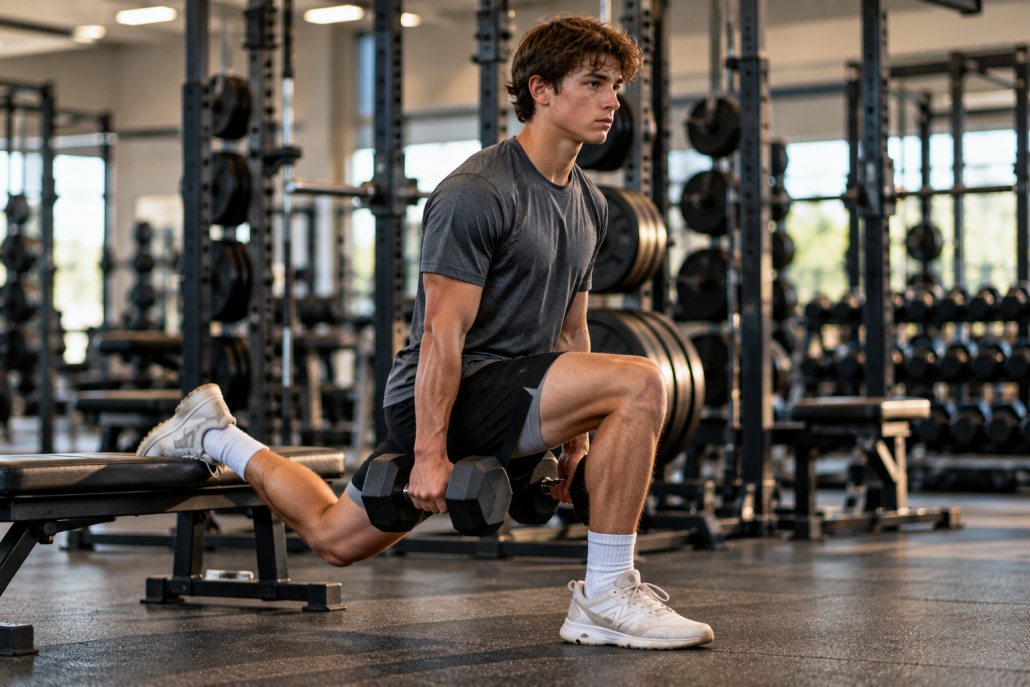
Everything on the mound traces back to what happens in the weight room — here’s the program that doesn’t require a facility your pitcher doesn’t have.
By Joey Myers — D1 Baseball, Fresno State | Author, Catapult Loading System | NASM-CES · IYCA Youth Fitness Specialist | 20+ years of coaching
This free baseball pitcher workout program PDF is built for one specific problem: most pitcher strength programs assume equipment, supervision, and scheduling flexibility that HS and youth pitchers don’t have. Driveline’s free pitching PDF requires PlyoCare balls, weighted baseballs, and a PULSE sensor. TopVelocity’s PDF is built around Olympic lifting platforms and biomechanics coaching. Those are excellent resources — for pitchers who already train at a facility equipped for them.
This free baseball pitcher workout program PDF is different. It covers the off-field strength side of pitching: the weight room work that supports what happens on the mound. It requires a barbell or trap bar, dumbbells, and resistance bands. It runs 3 days per week — leaving room for your existing throwing program and recovery. Arm care is built into every session, not treated as an afterthought. And it works whether the pitcher is off-season, heading into pre-season, or managing a lighter summer schedule.
“I was in the gym 6 days a week on top of practices and games. By midseason my knee was breaking down — patellar tendinitis. Joey looked at what I was actually doing and the answer wasn’t more treatment, it was less volume. We cut to 4 days a week. The tendinitis cleared up.”
— Drake Davis, 1B/OF · Fresno City College · .381 AVG, 12 HR, 53 RBI · 2025 Freshman of the Year
Download the complete 12-week program now — printable PDF with every warm-up, arm care exercise, set, rep, and substitution mapped out across all three phases.
Free. No credit card. Instant download.
Why Don’t Most Baseball Pitcher Workout Programs Work for High School and Youth Athletes?
Most baseball pitcher workout programs don’t work for HS and youth athletes because they’re built for elite facilities and athletes who have already spent years in a structured weight room. The gap is real. Driveline’s free pitching PDF (one of the best resources available) explicitly states its program is designed for “biologically mature” athletes 14 and older — and it still requires proprietary PlyoCare balls, weighted baseballs, and a PULSE sensor for arm speed tracking. TopVelocity’s 3X program uses undulated periodization with Olympic lifting variations that require both a lifting platform and a qualified coach to teach the movement.
Furthermore, neither program directly addresses the scheduling reality of a HS pitcher: 2–3 team practice days per week, throwing off a bullpen mound 1–2 times weekly, a game on the weekend, and a shared weight room with limited open hours. A program that adds a 6-day-per-week throwing + lifting schedule onto that doesn’t reduce injury risk — it raises it.
Therefore, this baseball pitcher workout program PDF was designed around what the pitcher actually has. Three lifting days. Equipment found in any HS or commercial weight room. Arm care embedded so it doesn’t get skipped. A total weekly workload that complements a throwing program rather than competing with it.
What Is the Difference Between a Pitcher Workout Program and a General Baseball Program?
A pitcher-specific workout program differs from a general baseball strength program in three key ways: exercise selection, weekly volume structure, and arm care integration. Specifically, pitchers need more unilateral leg work (single-leg strength to support the drive leg and landing leg separately), more posterior shoulder and scapular stabilization, and a training frequency and total volume that accounts for the arm stress they already carry from throwing.
For example, the bilateral back squat is the foundation of many general baseball programs. For pitchers, split squats and single-leg Romanian deadlifts earn more volume because pitching is a single-leg rotational movement — the drive leg must generate and transfer force through one foot at a time. Similarly, horizontal pressing volume is reduced compared to pulling volume because a pitcher’s posterior cuff and scapular retractors are consistently under-developed relative to their internal rotators from throwing.
Additionally, arm care in a pitcher workout is not three sets of band external rotation tacked onto the end of the workout. In this program, it’s a structured 8-minute arm care circuit at the start of every session and a 5-minute recovery circuit at the end — the same priority level as the main lift, not optional cooldown work.
How Is This 12-Week Pitcher Workout Program Structured?
This baseball pitcher workout program PDF uses linear periodization across three phases. Linear periodization means loads increase progressively each week while rep ranges decrease — the most beginner-friendly and self-programmable strength model available. Specifically, each phase has one clear goal, and you don’t need a coach adjusting your loads each session to run it correctly.
Phase 1 (Weeks 1–4): Foundation & Arm Health
Intensity 65–72% 1RM | 3×10–12 reps | 45–55 min sessions
Phase 1 establishes the movement patterns that Phases 2 and 3 build on. You’ll learn the trap bar hinge, the split squat, and the landmine press — all pitcher-friendly movement patterns that load the body without the shoulder impingement risk of traditional barbell pressing. Arm care volume is highest in Phase 1 because this is when pitchers most commonly return to training with unaddressed shoulder tightness or rotator cuff fatigue from the previous season.
Research published in the Journal of Shoulder and Elbow Surgery confirms that off-season shoulder strengthening specifically targeting the rotator cuff and scapular stabilizers reduces in-season arm injury rates in overhead throwing athletes.1 Phase 1 is where that foundation is built.
Phase 2 (Weeks 5–8): Strength Development
Intensity 73–82% 1RM | 3×6–8 reps | 50–60 min sessions
Phase 2 increases load across all primary movement patterns. The trap bar deadlift load increases, split squat volume moves to heavier dumbbell loading, and the landmine press transitions from a learning tool to a strength driver. Arm care volume remains consistent — it does not get dropped to add more main-lift sets. Most pitchers who carry strength gains from Phase 2 into a throwing ramp-up period report better arm durability and more consistent velocity compared to athletes who only throw in the off-season without structured lifting.
Phase 3 (Weeks 9–12): Power & Pre-Season Prep
Intensity 80–88% 1RM | 3×4–6 reps | 50–60 min sessions
Phase 3 shifts the emphasis from pure strength toward explosive power expression. Specifically, medicine ball rotational throws replace one of the warm-up sets each day, and the main lifts shift emphasis toward intentional concentric speed. This power phase aligns with the pre-season throwing ramp-up period — the weight room work peaks before the throwing program demands most of the pitcher’s recovery capacity during the season.
What Equipment Does a Pitcher Need for This Workout Program?
This baseball pitcher workout program PDF requires a trap bar or barbell, a pair of adjustable dumbbells or a dumbbell set, a resistance band set, and a pull-up bar or cable row machine. Every exercise in the program has a listed substitution so the program works whether the pitcher is training at a fully-equipped commercial gym, a HS weight room with limited equipment, or at home with dumbbells and resistance bands only.
Specifically, the trap bar deadlift — the primary posterior chain movement — can be substituted with a barbell Romanian deadlift, a hex dumbbell deadlift, or a cable pull-through if no trap bar is available. The landmine press can be substituted with a half-kneeling single-arm dumbbell press. The inverted row substitutes as a band pull-apart progression if no low bar or suspension trainer is accessible. This program requires none of that: no PlyoCare balls, no weighted baseballs, no PULSE arm speed sensor. It uses what you already have access to.
Why Does a Pitcher Workout Program Run Only 3 Days Per Week?
Three days per week is the correct lifting frequency for pitchers who are also running a throwing program because it leaves adequate recovery capacity for both. A pitcher throwing 2–3 times per week off a mound and lifting 3 days per week has 6 days of structured work. With one full rest day, that weekly schedule is already at the upper boundary of what most HS athletes can recover from effectively without accumulated fatigue compounding into arm injury risk.
Additionally, the Driveline research on weekly workload in HS pitchers is worth noting here: the biggest risk factor for arm injury is not individual session intensity — it’s acute-to-chronic workload ratio. Adding lifting days beyond 3 per week doesn’t increase strength gains proportionally; it reduces recovery quality. Therefore, 3 lifting days is not a shortcut — it is the optimal frequency for a pitcher who is also throwing.
For pitchers who are not currently running a throwing program during a true off-season, the program can be run 4 days per week by adding a fourth session using the Phase 1 volume and exercise selection for the entire 12 weeks. However, most HS pitchers are throwing year-round at some level, and 3 days is the design baseline.
When the schedule changes, this PDF can’t change with it.
Pre-season starts, practice volume jumps, or game weekends push your training days around. ByldrIQ rebuilds the pitcher’s training plan around what the week actually looks like — season phase, team workload, available days, session time ceiling, and equipment access. The PDF gets you started. ByldrIQ keeps the program matched to real life.
What Arm Care Exercises Are in a Pitcher’s Workout Program?
The arm care circuit in this baseball pitcher workout program PDF runs at the start of every session (pre-lift) and at the end (post-lift recovery). The exercises are: J-band forward fly, J-band reverse fly, J-band internal rotation, J-band external rotation, J-band bicep curls, J-band tricep extensions, band pull-aparts, face pulls, and prone T holds. The complete pre-lift arm care circuit takes 8 minutes. The post-lift recovery circuit takes 5 minutes.
Specifically, this arm care structure follows the same framework described in research on overhead athlete maintenance: external rotators and scapular retractors in pitchers are consistently weaker than internal rotators because the throwing motion develops internal rotation strength far faster than the stabilizing muscles can keep pace.2 The arm care circuit in this program specifically targets that imbalance — every session, before the main lift begins.
For pitchers looking for a more comprehensive arm care and recovery protocol, the VeloRESET Arm Lab newsletter covers pitching arm health from a parent-friendly perspective — arm fatigue signs, recovery protocols, and when to back off versus push through — as a free weekly resource.
How Does This Pitcher Workout Program Work Alongside a Throwing Program?
This baseball pitcher workout program PDF is designed to complement a throwing program, not replace it. The weight room work and the throwing program are separate tracks. Specifically, this program does not include a throwing schedule, pitch counts, long toss progressions, or bullpen protocols. Those belong to the pitcher’s coach, sports medicine provider, or a dedicated throwing program.
The coordination rule is simple: do not lift on the day before a bullpen or a start, and do not lift on the day after a start. For a pitcher who throws bullpens on Tuesday and pitches games on Saturday, a Mon/Wed/Fri lifting schedule keeps the weight room and the mound from competing for the same recovery window. If the schedule shifts, adjust accordingly.
Additionally, this program pairs well with the 12-week HS baseball off-season workout for position players on the same team — the programming philosophy is consistent, which means a pitcher and a shortstop on the same team can train on the same schedule without one program undermining the other’s recovery.
What Are the Most Important Strength Exercises for Pitchers?
The most important strength exercises for pitchers develop posterior chain power, unilateral leg strength, rotational core stability, and shoulder durability. Specifically, the five exercises that appear in every phase of this program are: (1) the trap bar deadlift or Romanian deadlift, (2) the DB split squat, (3) the landmine press, (4) the inverted row or neutral-grip pull-up, and (5) the Pallof press.
Here’s why each one earns its place. The trap bar deadlift trains the same hip hinge and leg drive mechanics that power the pitching delivery — the drive leg push-off and hip extension pattern are identical. The DB split squat trains the landing leg independently, which is the asymmetry pitchers most need to address. The landmine press develops shoulder stability and rotational pressing strength without the impingement risk of overhead pressing. The inverted row targets the scapular retractors and posterior cuff — the muscles that decelerate the arm after ball release and are most at risk in throwing athletes. The Pallof press builds anti-rotation core stability, which is the core demand of pitching: not flexion and extension, but resisting unwanted rotation while producing intended rotation at the right moment.
These five movements appear in every phase because they address the five most common physical gaps in HS pitchers: limited posterior chain power, unilateral leg strength asymmetry, weak scapular retractors, inadequate shoulder durability, and underdeveloped rotational core stability. For more on baseball pitching training fundamentals, see the full pitching training resource page on HPL.
More Free Programs from HPL
Download the Free 12-Week Pitcher Workout PDF
Arm care included every session. No proprietary equipment. Works with your existing throwing program.
Free. No credit card. Instant PDF delivery.
Frequently Asked Questions About the Baseball Pitcher Workout Program PDF
What age is this baseball pitcher workout program appropriate for?
This baseball pitcher workout program PDF is designed for pitchers ages 13 and older who have at least one year of basic weight room experience. Specifically, the program assumes the pitcher can perform a bodyweight squat, a dumbbell Romanian deadlift, and a push-up with acceptable form before adding load. Pitchers younger than 13 or those with no weight room experience should start with a youth baseball workout program before transitioning to this program.
Does this pitcher workout program replace a throwing program?
No — this baseball pitcher workout program PDF covers the off-field strength side of pitching only. It does not include a throwing schedule, bullpen protocol, long toss progression, or pitch count guidelines. Pair this program with your pitching coach’s throwing protocol or a dedicated arm care and throwing program. The two tracks run simultaneously — they are not alternatives.
Can a pitcher use this program during the season?
Yes, with modifications. During the in-season period, reduce lifting volume to 2 sessions per week and use Phase 1 exercise selection and loading (65–72% 1RM). The goal in-season is to maintain — not build — the strength developed in the off-season. Do not lift the day before or after a start or bullpen session. The arm care circuits at the start and end of each session remain the same regardless of season phase.
What does the arm care circuit include in each pitcher workout session?
Each session opens with an 8-minute pre-lift arm care circuit: J-band forward fly, reverse fly, internal rotation, external rotation, bicep curls, and tricep extensions (10 reps each), followed by band pull-aparts (2 sets of 15). Each session closes with a 5-minute post-lift recovery circuit: prone T holds, face pulls, and band pull-aparts. The arm care is not optional — it is part of the session time estimate, not additional time on top of it.
How long does each pitcher workout session take?
Each session runs 45–60 minutes including the arm care circuits. Phase 1 sessions average closer to 45 minutes because loading is lighter and rest periods are shorter. Phase 3 sessions may reach 60 minutes because heavier loads require longer rest intervals between sets. The 60-minute ceiling is a hard design constraint — the program does not add volume that pushes sessions past one hour.
Does this program work for softball pitchers?
The strength training structure in this program works for fastpitch softball pitchers as well as baseball pitchers. The hip hinge, unilateral leg strength, and rotational core exercises are directly applicable regardless of sport. However, the arm care circuit is calibrated for overhead throwing mechanics — softball pitchers using an underhand delivery may want to modify the external rotation emphasis and consult with their pitching coach on which arm care exercises are most applicable to their delivery pattern.
What if a pitcher doesn’t have access to a trap bar?
Every exercise in this baseball pitcher workout program PDF includes a listed substitution. Specifically, the trap bar deadlift substitutes with a barbell Romanian deadlift, a hex dumbbell deadlift, or a kettlebell deadlift depending on available equipment. The program was designed around the constraint that most HS weight rooms and commercial gyms have dumbbells, resistance bands, and either a barbell or trap bar — but not always a full complement of specialty equipment. All substitutions are listed directly in the PDF workout tables.
References:
1. Forthomme B, et al. Scapular muscle-strengthening program for overhead throwing athletes. Journal of Shoulder and Elbow Surgery. 2013.
2. Wilk KE, et al. The relationship between glenohumeral internal rotation deficit and injury in professional baseball pitchers. American Journal of Sports Medicine. 2011.

With 28,000+ online bat speed program sales, my methods have transformed coaches, instructors, and parents just like you. I'm affiliated with esteemed organizations like ABCA, IYCA, and SABR, advocating for positive coaching. With 15+ years in corrective fitness and a Division One baseball background, my knowledge is unmatched.
Join our blog and unlock the secrets to successful hitting, elevate your performance, and ignite your passion. Welcome to the world of limitless possibilities at HittingPerformanceLab.com.
- The Season Started. Here’s The Program That Keeps Your Daughter Athletic Through All Of It - September 27, 2026
- The Season Started. Here’s The Program That Keeps Your Kid Athletic Through All Of It - September 27, 2026
- Baseball Pitcher Workout Program PDF: Free 12-Week Off-Season Strength Plan for HS and Youth Pitchers - September 26, 2026