“Staying Closed” for Fastpitch Softball & Baseball (NOT What You Think)…
In this article, we’ll compare the swings of Oakland Athletic’s (now Yankees) Josh Donaldson and quasi retired Jose Bautista. In the video, we’ll discuss:
Donaldson v. Bautista metrics,
What “staying closed” means to spine engine mechanics, and
Where Josh Donaldson might be leaking force at impact.
Josh Donaldson v. Jose Bautista Metrics
This section is split up as follows:
Physical
Swing analysis
Key offensive stats
Physical
Tale of the tape (according to Baseball-Reference.com):
Josh Donaldson – 6’0″, 220lbs
Jose Bautista – 6’0″ 205lbs
SCIENCE-BASED TRAINING:
Improve your hitting strategy dramatically by applying human movement principles.
Learn not only how and what to train but also the science behind the methods.
So why does Jose Bautista come out on top even though he’s outweighed by 15lbs? Consider this…
Josh Donaldson: CLICK HERE to see a scatter graph of his dinger disbursement in 2013 (according to ESPN Stats & Information Group). In the 158 games he played in 2013 (24 homers) his…
Average true distance was 391.3 feet, and
Average speed off the bat was 103.7 mph.
Jose Bautista: CLICK HERE to see a scatter graph of his home-run disbursement in 2013 (according to ESPN Stats & Information Group). In the 118 games played (hand/wrist injury) in 2013 (28 homers) his…
Average true distance was 400.3 feet, and
Average speed off the bat was 104.8 mph.
The bottom line?
Joey Bats played 40 less games in 2013, but still outhit Josh Donaldson. So let’s answer the question of how Bautista hit each homer, on average, 9 feet further, and drove the ball 1.1 mph faster off the bat.
Let’s begin building a case as to where Josh Donaldson may be bleeding force at impact…
'Add 40-Feet' To Batted Ball Distance
Swing Study reveals how tens of thousands of hitters are adding 40-feet to batted ball distance by using one simple strategy.
Click the button below to access the FREE video that's been downloaded over 30K times!!
What “Staying Closed” Means to Spine Engine Mechanics
Most confuse the meaning of the coaching cue “staying closed”. The hitter DOES NOT “stay closed” with the bottom half. For maximum energy transfer, the pelvis should open when the body weights the front foot after striding. Both hitters seem to prematurely open their pelvis before the heel hits the ground. This isn’t efficient! We’ll talk about:
The truth about staying closed,
The importance of heel strike to locomotion, and
Swinging in sand: effortless power or powerless effort?
The Truth About Staying Closed
In the video, we apply two of three coupled motion of the spine actions, according to Dr. Serge Gracovetsky’s book The Spinal Engine:
Side bending (evidenced by a down shoulder angle), and
Axial rotation (hitter shows numbers to pitcher, while pelvis stays parallel to the plate)
In the video, we clearly see both hitters do this. Donaldson more than Bautista. I mentioned both hitters prematurely open their pelvis before heel strike. Let’s look at the gravity (pun intended) of doing or not doing this…
The Importance of Heel Strike to Locomotion
In the book, Gracovetsky offers one of several meanings for maintaining a healthy spine using spinal engine mechanics (p. 168):
“…the compressive pulse generated at heel-strike is essential to the locomotion process. The shape of this pulse must be very specific if maximum energy is to be transferred from the earth’s gravitational field to the rotating pelvis.”
Both hitters “stand tall” before falling forward and “getting shorter” into the turn. This lifting of the torso is like running versus walking. When running, our heel hits the ground creating a compressive force that is equaled to NINE-times our body weight, Dr. Gracovetsky says. Gravity pulls our body down (Un-Weighting Principal), and at heel strike, the ground pushes back in a compressive force. The greater the force, the faster the pelvis opens.
The following is where I foreshadow the problem with Donaldson…
Swinging in Sand: Effortless Power or Powerless Effort?
Dr. Serge Gracovetsky offers this example in the book (pgs. 168-169),
“Running or walking on soft sand is not easy and is very tiring, In this particular case, the energy leaks into the sand, the impact force is reduced, and the compressive pulse through the spine is attenuated [disabled] as the total energy recovered is reduced.”
The compressive force is softened by the sand, which doesn’t allow the pelvis to turn using efficient spine engine mechanics. To maneuver, the brain has to recruit big muscles to do the work. This is why you get a workout walking on sand…it’s powerless effort, rather than effortless power.
Donaldson is basically turning his pelvis using muscle mass (like walking in the sand). Whereas Bautista looks more effortless because he’s using efficient spine engine mechanics, gravity, and gravitational reaction forces…
Where Josh Donaldson May Be Leaking Force at Impact
In the video, you’ll see Donaldson start opening his pelvis five frames before he weights his front foot. His front foot looks like it almost “hovers” over the ground for 3-4 frames. Opening the pelvis without a true compressive force (gravity and gravitational reaction forces) would be like hitting a baseball while standing on sand!
Bautista starts opening his pelvis only two frames ahead of weighting his front foot. Joey Bats experiences a higher compressive force at landing than Donaldson does. This is why “staying closed” with the upper half, and committing the body to landing on the front foot is crucial to an average increase of:
9 feet to batted ball distance, and
1.1 mph to ball exit speeds.
Post UPDATE: after Josh Donaldson was traded to the Toronto Blue Jays in 2015, this post was picked up by the Canadian National Post (Just above the Jose Bautista image). Also, there was an “upgrade” to his hitting mechanics since this post was first published in 2014. CLICK HERE for a link to an Athletics Nation article talking about a difference in J.D.’s 2013 & 2014 swing mechanics. In 2015, Josh Donaldson reverted back to his minimalist “barrel tilt” 2013 hitting mechanics.
'Add 40-Feet' To Batted Ball Distance
Swing Study reveals how tens of thousands of hitters are adding 40-feet to batted ball distance by using one simple strategy.
Click the button below to access the FREE video that's been downloaded over 30K times!!
https://hittingperformancelab.com/wp-content/uploads/2022/08/Josh-Donaldson-Baseball-Softball-Swing-Advice-Front-Side-Flying-Open-Spinning-Off-Hitting-Drills-2.png423800Joey Myershttps://hittingperformancelab.com/wp-content/uploads/2021/10/hitting-performance-labs_c90c0362088ef1d3d528f3078f4f8ac1-300x75.pngJoey Myers2022-08-22 09:00:522025-01-31 05:36:51FIX Pulling Head Off, Front Side Flying Open, Over Rotation Spinning Off Baseball Or Softball Hitting Drills | Josh Donaldson Vs Jose Bautista “Keep Front Shoulder In” Common Flaw Swing Advice & Batting Stats
Discover some of the best youth batting stance drills for baseball, fastpitch softball, and slowpitch softball. In the video below, Josh Donaldson addresses proper swing hitting mechanics such as power, elbow up or down, closed stances, and hitting lefty or righty.
13 Josh Donaldson Gold Nuggets: You Didn’t Have To Be A Professional, To Teach High Level Baseball Batting Stance & Hitting Techniques
(I apologize in advance…PLEASE set aside about 14 minutes of reading time for the following baseball batting stance & hitting techniques post. It’s a bit of an emotional RANT 😉
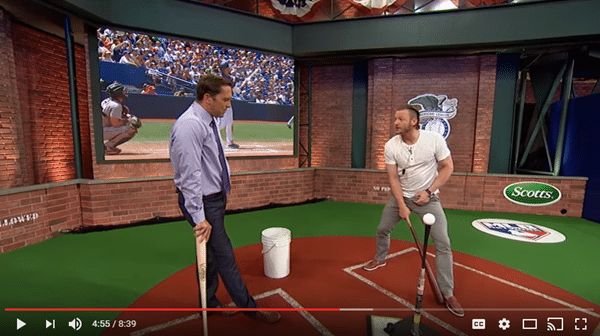
Josh Donaldson talks hitting with Mark DeRosa on MLB Network. Photo courtesy: MLB.com
We FINALLY have validation!!! To have 2015 AL MVP Josh Donaldson affirm A LOT of what we teach here at HPL! Some of you may have seen the above video already. If you HAVE NOT seen it, then please watch.
In the following baseball batting stance & hitting techniques post, I go into more depth about the 13 talking points Josh Donaldson mentions about the “NEW science of hitting”, beginning where Ted Williams left off.
I want to address the few ex-Pro and MLB player TROLLS that wrongly tear myself, my colleagues, and my readers down on the socials for bringing up things Josh Donaldson addresses in the above video.
Without further adieu, from my baseball batting stance & hitting techniques video notes…
Note #1: Back knee inside foot or weight inside back knee?
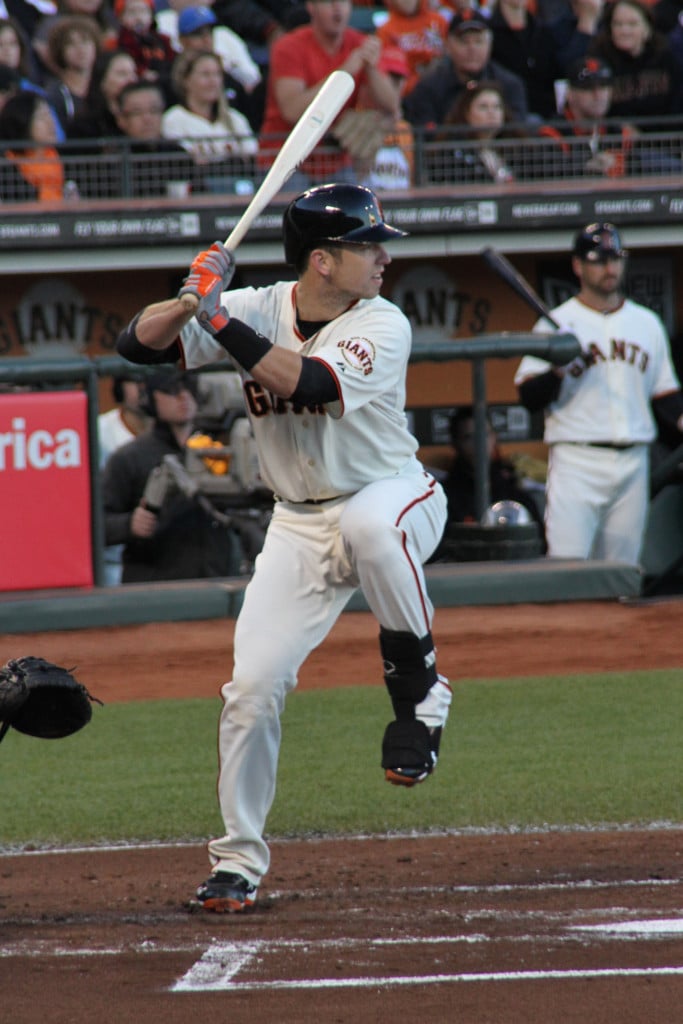
Is Buster Posey’s back knee being prematurely shifted inside his foot in the ‘Float’? Photo courtesy: InWriteField.com
This was a question from Mark DeRosa…
Josh Donaldson responds that he focuses his weight on his back heel and back hip.
I HATE when hitting instructors PREMATURELY force the back knee of every hitter they instruct, inside the foot (even in the stance).
There are phases to the swing, and Donaldson is talking about what my hitters refer to as the ‘Float & Fall’…
Matt Nokes calls it the ‘Ride & Stride’.
During the ‘Float’ or ‘Ride’, the hitter DOES NOT have to prematurely push their back knee inside the back foot…or focus the weight on the inside of the back knee.
CLICK HERE for a baseball batting stance & hitting techniques post I did on this, dealing with a Twitter Troll.
NEWS FLASH…
Self proclaimed elite hitting instruction doesn’t rest on taking a ton of ‘quality hacks in the cage’ and/or debating over millions of hours of video analysis footage of ‘only the best hitters’.
WTF does ‘quality hacks’ and ‘only the best hitters’ mean!!!!!?
Are we suppose to take your word for it that you know what you’re doing?!
Nah.
I’d rather watch The Kardashians.
Okay, back to focusing on where the weight is in the Float…
Prematurely forcing weight on the inside of a ‘dumb joint’, like the knee, can really put undo stress on the ligament material.
Coaches…please DO NOT wear holes in your players’ knees. This is really important for those FP softball hitting coaches.
And on that note,
FP softball coaches, CLICK HERE for a great BreakingMuscle.com post titled, “Women: Protect Your Knees With the Sprinter Stance Squat”.
Note #2: Not thinking about hands going towards the baseball
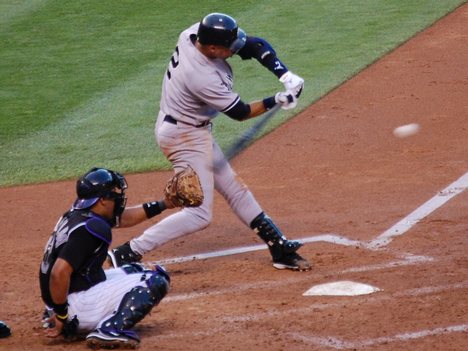
Derek Jeter is one of the few having a lengthy career with an extreme handsy approach. Not too many hitters could get away with how he did what he did. Photo courtesy: BaseballByTheYard.com
I totally agree!
ALL the following baseball batting stance & hitting techniques coaching cues are destructive for youth swings:
Hands to the ball
Knob to the ball
Be short to the ball
Hands inside the ball
Yes! Especially the last one…
WHY?
Like the others, it gets the hitter thinking about doing something with the path of their hands.
Some of you use this cue when instructing hitters, and may get occasional positive results…
However,
Any coaching cue that requires an extensive explanation or doesn’t get predictably positive outcomes, is INEFFECTIVE.
I’m looking for cues that with a minimal number of words, gets my hitter to do what I want them to do, even if the concept is new to them…over and over.
Note #3: When Josh Donaldson begins his fall forward, that’s when he goes into loading his upper half (his ‘coil’)
Andrew McCutchen ‘showing his numbers’ while his lower half is beginning to turn counter-clockwise. Photo courtesy: MLB.com
YESSSSS!!
I get asked this baseball batting stance & hitting techniques question quite a bit…when does the ‘load’ start?
And this depends on your definition of a load. But in Donaldson’s context…
The timing of Donaldson’s load, or ‘coil’, isn’t necessarily the rule,
It’s one of three options…
Option #1: Some hitters start in the ‘coiled’ position (highly recommended for younger hitters):
Yoenis Cespedes,
Hunter Pence, and
Ben Zobrist (from the left side)…
Option #2: Some hitters move into the ‘coiled’ position similar to Donaldson:
Bautista,
Cano, and
McCutchen…
Option #3: Some hitters move into the ‘coiled’ position later, like Dustin Pedroia.
The objective is that at landing, or what Josh Donaldson refers to as ‘heel plant’, the hitter is in this ‘coiled’ position.
And it requires the lower half to be open at landing (pelvis on down), and the upper half (above pelvis), to be closed.
Additionally, I LOVE Jose Bautista’s timing cue of loading ‘slow and early’ (CLICK HERE for a post I did on that).
More on the lower half landing open a bit later…
Grab 'Finger Pressure' Video
Frustrated with fixing BAT DRAG? Beat it!
Swing Study reveals how majority of hitters are correcting 'racing back elbow' bat drag within 1-2 weeks WITHOUT overhauling swing mechanics OR buying fancy and expensive hitting aids.
Click button below to access FREE video that has been downloaded over 20K times!
Note #4: Creating bat speed with shoulders, NOT hands (effortless bat speed)
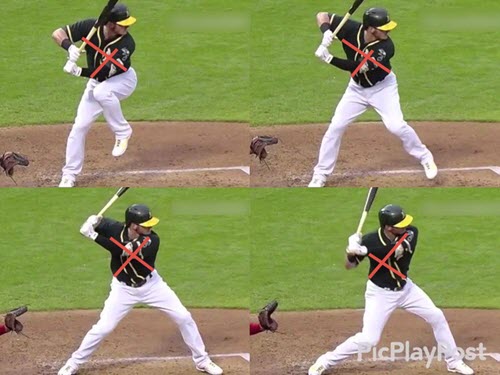
Josh Donaldson’s swing illustrating the spinal engine and Springy ‘X’ Pattern discussed in the next section. Photo courtesy: PicPlayHost
This is VERY important…
WHY?
Because EVERY human movement is driven by the spinal engine…pelvis-spine-shoulders.
According to Dr. Serge Gracovetsky in his book The Spinal Engine, the spinal engine can move in a vacuum.
However, it’s the relationship between arms, legs, and Gravitational Forces that amplify how explosive an athlete can be.
Quite a few hitting instructors talk about hip thrust or loading and exploding the hips.
But what are the shoulder’s function in all this?
Being passive?
I don’t think so.
Some would say a right handed hitter’s front shoulder at landing should be pointing at the pitcher.
This is an ineffective hitting mechanic, shown in this Zepp swing experiment (CLICK HERE) where I observed an average 6-mph boost in Bat Speed at Impact showing my numbers to the pitcher versus pointing the front shoulder at the pitcher (not showing numbers), over 200 swings.
Don’t get me wrong, YES, the pelvis does ‘lead the way’ as Ted Williams said in The Science of Hitting.
But it plays a much smaller role than coaches believe.
Think about how we walk…
If I told you to fire your hips as you walked, what do you think your shoulders would do?
They’d FIRE also!
How about if I told you to fire your hips while walking, but don’t let your shoulders move…
Would that feel awkward?
Dr. Serge Gracovetsky talks about the coupled motion of the spine…
Meaning, while the hips rotate when we walk (albeit small to the naked eye), the shoulders counter-rotate the pelvis.
This is why your right arm and left leg swing forward at the same time.
To have effortless bat speed, like Josh Donaldson says, you MUST teach your hitters to take advantage of these natural laws of human movement.
DON’T use baseball batting stance & hitting techniques to coach them out of them.
Note #5: Rubber band effect, ‘stretching’, creating tension at the finish of his load
Another YESSSSS!
Although Josh Donaldson uses different baseball batting stance & hitting techniques terms, he’s talking about the compression/tension forces in the body via connective tissue called fascia.
Thomas Myers in his book Anatomy Trains describes, what he calls Tensegrity (Tension-Integrity), like this:
I don’t like to think of the body as a rubber band, but rather like a spring.
But what Donaldson is describing is correct.
I refer to this as the Springy ‘X’ Pattern.
CLICK HERE for this video post describing this using Adrian Gonzalez’s swing as a model.
Note #6: Creating the timing to hit the pitch
Most people probably missed this point in the video…Donaldson briefly mentioned it, but I find it VERY important.
TIMING FOR HITTING IS EVERYTHING.
This is why I don’t like rapid fire soft toss OR 15-pitch marathon rounds batting practice.
It’s NOT about quick hands either.
Look, a baseball player may only see one pitch every 12-20 seconds.
A fast-pitch softball player may see one pitch every 8-15 seconds.
In games, swing intensity EVERY swing matters.
I can take a hitter with seemingly slow hands, adjust his or her timing, and have them barreling the ball more.
Of course, we’ll have to address their still ineffective mechanics at some point in the future, but the point is, it’s not about fast hands.
It’s about using the shoulders to speed up the hands.
The opposite IS NOT true.
Coaches handicap hitters by using ineffective drills like rapid fire soft toss, drop toss, and/or marathon B.P. sessions.
Again,
TIMING IS EVERYTHING IN HITTING.
CLICK HERE for “The Dead Simple Guide To Optimizing A Hitter’s Timing In Games”.
Note #7: Front foot is open…hips can’t separate from upper half
Miguel Cabrera is one of my favorite swings to model, except for landing closed (less than 45-degree angle). However, he’s a physical beast, and most definitely succeeds despite one ineffective mechanic. Photo courtesy: MLB.com
Another baseball batting stance & hitting techniques golden nugget from Josh Donaldson.
However, there are quite a few other coaches getting their panties in a bunch about this comment.
CLICK HERE and follow the thread of one of my Facebook posts.
CLICK HERE and follow a Facebook post thread of my friend and colleague Taylor Gardner, founder of the BackSpin Tee. Actually a lot of really good discussion happening on this one.
They’re reinterpreting it as Donaldson is saying to ‘point the landing toe at the pitcher’.
This may be what it looks like in the video, which we also have to be careful of camera angles…
But the point of the matter is, that Donaldson is saying to ‘land open’.
And this is where, us coaches, must define terms.
I say if the landing foot is opened less than 45-degrees, the foot is closed.
If the landing foot is opened more than 45-degrees, the foot is open.
Chris Welch at ZenoLink says the front foot should land open, roughly around 65-degrees (at about 2-min mark):
And I agree.
I do think hitters like Donaldson and Bautista are more on the open side than others.
With my definition of landing foot closed versus open, I’d rather have my hitters err on the side of open, than closed.
CLICK HERE for another Zepp swing experiment where I tested this and found an average bat speed boost of 3-mph boost when landing open, over 200 swings.
Kyle Harrington, dad of one of my online hitting lesson students Stephen, who’s currently 13yo, 5’7″, 130-lbs…
Recently, increased his Ball Exit Speed 5-mph in the last 5 months off the tee, to now 77-mph.
I asked Kyle, what were the two biggest contributors to the increase…and he responded with:
“He grew about 2″ but he’s only 5’7”. I think the main thing is that he is not stalling the bat. In the 3D testing with Chris Welch [of ZenoLink.com] his peak bat speed slowed almost 10 mph before impact, which is common. So he is decelerating the barrel less coming into impact. He was blocking with the front hip and all the speed was too early . So he’s actually moving the bat speed forward in his swing more (where impact is) rather behind the ball before impact. That’s the main reason.”
This can happen for a few reasons:
Too much forward momentum (yes you can have too much),
Landing closed with the front foot, and
Inward turning (coiling) the pelvis towards the catcher (shifts our 45-degree optimal impact zone too deep into the swing).
When the hitter lands closed, as Donaldson said, it’s more challenging to optimize the body’s natural springy fascia.
It’s also worth noting that the front ‘foot shape’ will change depending on pitch location at impact.
For instance,
On an outside pitch, we’ll see the foot more flat, and possibly more closed, than on an inside pitch.
Note #8: 10yo kid told to get on top of the ball, tell them NO…don’t get paid for hitting ground-balls
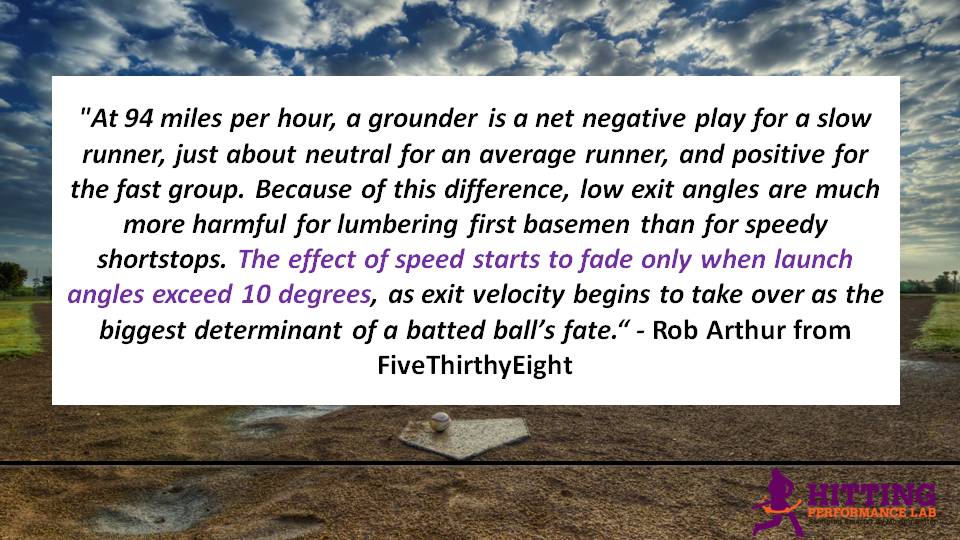
Ground-ball Coaches, if you spent more time instructing 10-degree launch angles and boosting Ball Exit Speeds, than you do telling hitters to always hit the ball on the ground, our hitters will be in a better position to crush pitchers.
For me, this tip was definitely the highlight of this video.
There was a comment on my baseball batting stance & hitting techniques Facebook post that is worth noting:
Reader A: “If I’m coaching a team of 10 year olds, and either the kid (or parent) tells me no, they ought to start looking for another team to play for. If you allow a kid to tell you no at that age, the kid will become uncoachable when he gets older.”
And here was a great response from another readers to this person:
Reader B: “If a teacher tells your kid 2+2 is 5, you don’t want him to have the courage and character to question the teacher? This society man, anyone that questions authority is deemed to be at fault…how dare they!!!”
I agree with Reader B…however, I understand there are ignorant parents, as well as players, out there as well.
However, speaking in the context of what Donaldson is saying, I agree with Reader B on this.
If you’re a coach that’s teaching hitters to ALWAYS hit the ball on the ground, you’re being ineffective as a coach. And you MUST get educated because if you’re aren’t growing, then you’re dying.
Note #9: Relaxed in stance…time that arms get engaged with the body is during his ‘coil’ (mentions ‘scap load’)
Jace, one of my 11yos, weighs 67-lbs, and hit his first homer over a 180-foot fence. We fixed his racing back elbow bat drag with connecting his hands to his spinal engine through finger pressure.
I totally agree.
There’s a time to be relaxed, and then there’s a time to connect the body (driving engine) to the “things” holding the bat…the hands.
CLICK HERE for another Zepp swing experiment that talks about what I teach to my hitters as ‘finger pressure’, and how we’re banishing racing back elbow bat drag with this technique alone.
It’s ALL about “connection” folks. Quite a few of the young hitters I see just aren’t connected.
But when they get connected…this is when we can triple their body-weight in distance (see Jace image above).
Grab 'Finger Pressure' Video
Frustrated with fixing BAT DRAG? Beat it!
Swing Study reveals how majority of hitters are correcting 'racing back elbow' bat drag within 1-2 weeks WITHOUT overhauling swing mechanics OR buying fancy and expensive hitting aids.
Click button below to access FREE video that has been downloaded over 20K times!
Note 10: Hands load it (versus shoulders), then barrel tips too much…leads to getting underneath balls
Josh Donaldson is talking about getting into his load (or ‘coil’) with his shoulders and not his hands.
When he uses his hands to get there, he feels it leads to an excessive ‘barrel tip’ (click following link), and to getting under the ball too much.
CLICK HERE for an AthleticsNation.com article titled, “Josh Donaldson: Changes in Approach & Mechanics”.
In this article, Jerry Brewer from East Bay Hitting Instruction compares Donaldson’s swing and metrics from 2013 to 2014.
The one big difference being an excessive barrel tip in 2014, leading to drops in his BA, OBP, & SLUG metrics by something like 50 points EACH.
By the way, Jerry is right on with the swing as well.
Note 11: At landing, wants bat to be at 45-degree angle, and to split his head from behind
I agree.
I don’t really want to get into this, but I thought it was a good little baseball batting stance & hitting techniques nugget from the video.
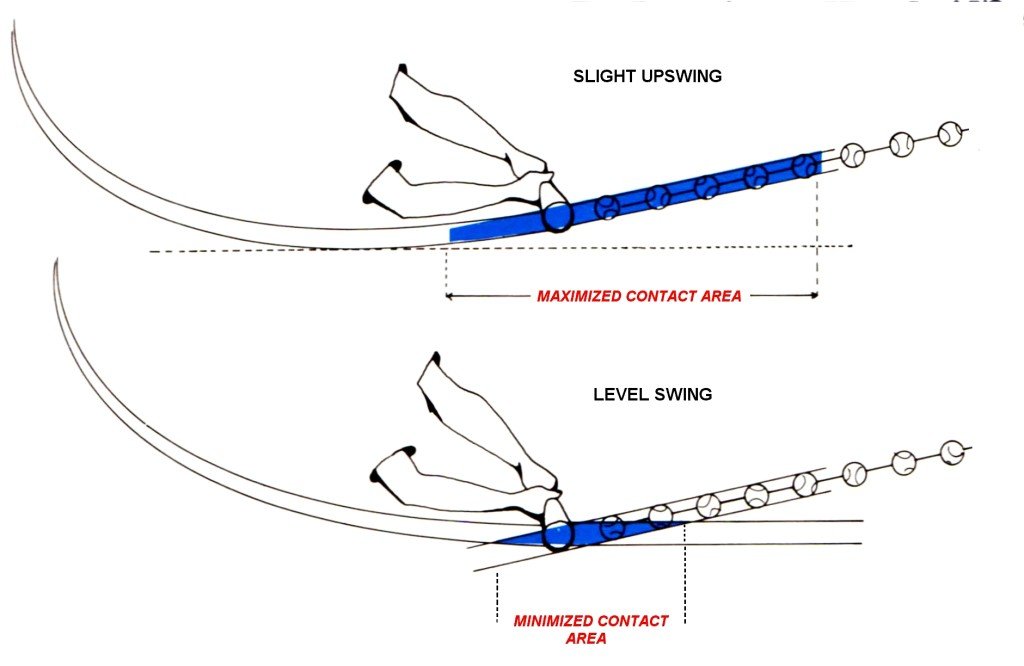
Note 12: Swing down to create backspin
This is where I see Josh Donaldson picking up where Ted Williams left off. This is a well known graphic from Williams’s book The Science of Hitting.
This is something Josh Donaldson is against, and I agree.
Yes, every once in awhile, a hitter can swing down on a ball and launch one.
Did you read the keywords there…? “Every once in awhile.”
Do you know what the majority outcomes will be doing this?
Ground-balls.
And if you read my Ground-ball RANT, then you know how inferior default teaching your hitters to hit them is, unless of course you have hitters who run like greased lightning, or in a Hit & Run type scenario.
The biggest argument here, comes from Little League coaches saying, but the ground-ball is the hardest hit ball to field, throw, and catch.
And my rebuttal is, what happens when your ground-ball hitting team meets a team that can play catch?
It doesn’t matter anyway, because a majority of pitches are taught to keep the ball down in the zone to hitters.
WHY?
Because PITCHERS WANT HITTERS DRIVING THE BALL INTO THE GROUND.
Note#13: Intent – damage at all times
I thought this was a HUGE baseball batting stance & hitting techniques gold nugget.
When asked if Donaldson makes educated decisions to commit on pitches or against pitchers, he says, yeah it depends…
BUT,
His intent is to do damage at all times.
“Why wouldn’t I?” He smirks to Mark DeRosa 😛
Double and Dinger damage.
That’s what the Blue Jays pay him for.
Our objective as hitting coaches should be to get our sluggers hitting the ball as hard as their physical ability will allow them…as frequently as possible.
To return this baseball batting stance & hitting techniques post full circle, let me repeat:
You Don’t Have To Be A Professional, To Teach High Level Baseball Batting Stance & Hitting Techniques Today
You just have to understand human movement principles that are validated by science, and apply these “rules” to hitting a ball.
Circling back to the headline of this post, looking at proper swing hitting mechanics: power, elbow up or down, closed stances, and hitting lefty or righty…
Power – at HPL we believe 70-80% of consistent power comes from properly moving our spinal engine, power doesn’t mostly come from the lower half as some would believe.
Back elbow up or down – what’s important is hitter gets a slight downhill shoulder angle by stride landing(6-10 degrees down). Lifting the back elbow can help with this, but if lifting the back elbow keeps shoulders level, then it doesn’t matter.
Closed stances – I know Donaldson and I differ on this, but I like the closed stance to restrict hip movement. Some hitters OVER rotate their lower half and lose out on directional force.
Hitting righty or lefty – I don’t have a preference for this. The hitter will figure it out either way. However, I do have an opinion on switch hitting…I don’t believe switch hitting is all it’s cracked up to be because they get waaay more at-bats on the left side early on because there aren’t that many lefty pitchers, so the righty swing significantly suffers. Evidence of this lack of lefty pitchers is shown in the majority of lefty hitters struggling against lefty pitchers.
Grab 'Finger Pressure' Video
Frustrated with fixing BAT DRAG? Beat it!
Swing Study reveals how majority of hitters are correcting 'racing back elbow' bat drag within 1-2 weeks WITHOUT overhauling swing mechanics OR buying fancy and expensive hitting aids.
Click button below to access FREE video that has been downloaded over 20K times!

 :
:

 , the spinal engine can move in a vacuum.
 .
. describes, what he calls Tensegrity (Tension-Integrity), like this: