Posts

Discover the ideal line drive launch angles and ball exit speeds for optimal distance while hitting a baseball or softball.

Addressing The Biggest Lies In Hitting: Improve Line Drive Frequency In A Few Short Weeks
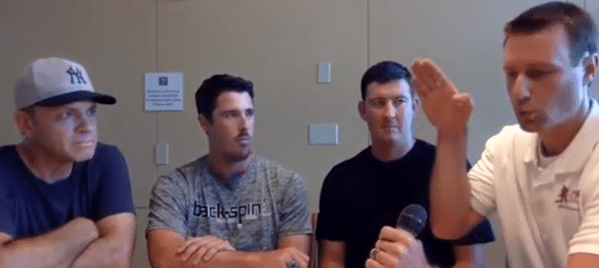


ABCA Hitting Think Tank: Matt Nokes, Taylor Gardner, Jarrett Gardner, & Joey Myers

This Hitting Think Tank will be doing more talks like this at the 2017 ABCA in Anaheim in our booth (from left to right: Matt Nokes, Taylor Gardner, Jarrett Gardner, & Joey Myers)

I have a confession to make…

But first, the context,

After driving 7 hours down to San Diego, I met up with a couple boss hitting/pitching dudes.

I had the privilege to sit down and talk hitting with the two co-founders of the Backspin Tee (brothers Taylor and Jarrett Gardner), and 1987 All-Star Silver Slugger Matt Nokes.

Now, the confession…

We only spent 15 minutes “sitting down” (for the above interview), the other time was spent talking hitting in:

  • Underground parking garages,
  • A library,
  • Down the streets of Padre’s Petco Park,
  • At a USSSA Pride professional fast-pitch softball game, and
  • In a Hilton Hotel lobby over beverages with USSSA Pride infielder Shelby Pendley….

Not to mention, Matt Lisle graced us with his presence to talk hitting for over an hour at the Pride game.

Also, we narrowly missed Ryan Lehr on account of him having to be home late night to be a good dad and husband 😉 lol j/k Lehr just busting your balls.

…By the way Lehr (if you’re reading this), Matt Lisle’s wife allowed him to attend the All Star festivities in San Diego (he’s from the Bay Area), for 4+days away from the her and their 4 kids!!

I told him, he must have a lot of money in the family’s ’emotional bank account’ to have the ability to do that.

So, there’s NO excuse Lehr 😛

Needless to say, my brain hurt on the 7-hour drive back home the next day (not a hangover, believe it or not, I only had one beer the night before)

Moreover,

We’ll be sharing a booth at the 2017 American Baseball Coaches Association (ABCA) conference in Anaheim,

And will be doing more of these LIVE Hitting Think Tank Q&A’s during the conference, so if you find yourself out that way, at that time, then please stop by booth #383 and say hi.

In addition, there will be other mystery guests at the conference coming to our booth to talk about things like pitch tracking, recognition, bat lag, and distraction training.

So, DON’T MISS IT!!

Besides me, here are the cast of characters in the above video:

In this interview, we discuss the following:

  • Defining a line drive (Matt Nokes at 2:13 mark)
  • How to get a line drive? (Matt Nokes at 3:20 mark)
  • Making adjustments to get to the line drive (Matt Nokes at 4:20 mark)
  • The right swing path to get a line drive (Jarrett Gardner at 6:00 mark),
  • The idea of a “flat swing” (Matt Nokes at 7:37 mark),
  • The goods and bad of “Feel v. Real” & making bold adjustments (Joey Myers at 10:20 mark),
  • Correlation DOES NOT necessarily equal causation (Matt Nokes and Joey Myers at 13:31 mark).

We’d love to get YOUR take on what was discussed in the above video,

And, please respond below by letting us know what else you’d like us to discuss at the upcoming ABCA event…by the way, we may record these Q&A sessions and make them available to you at a later date.

THANKS in advance!
Discover the best launch angles for batted ball distance, and learn how to hit more line drives and square up the baseball or softball instead of hitting too many ground balls. Check out this interview with EffectiveVelocity.com’s Perry Husband

Why You SHOULD NOT Teach Hitters To Hit Homers?


Here’s the Hitting Jam Session Interview Collection with Perry Husband:

  1. [YOU ARE HERE] Why You Should Not Teach Hitters To Hit Homers?
  2. What’s The Biggest Mistake Coaches Make In Boosting Ball Exit Speeds
  3. How To Make Teaching Proper Weight Shift In Swing More Understandable To Hitter
  4. Teach: How To STOP Hitting Excess Of Ground-balls & Fly-balls
  5. 5,000 Swing Experiments Validate Locked Lead Arm Is Superior To Bent
  6. Overload Bat Training: Hitting Has To Work Butt Off To Resist “Casting”

Here’s what we discuss in Hitting Jam Session #1:

  • Formal Introductions
  • Carlos Pena and Boston Red Sox hitting coach phone conversation for segment on MLB Now Show,
  • Bro-Science v. REAL Science,
  • How to know who/what to follow,
  • Demystifying Launch Angles, and
  • Q&A…

You can also CLICK HERE to view the original video and comments from the Jam Session on Facebook.


Show Notes

  • At about the 3-minute mark, Perry Husband shares a phone conversation he had with Carlos Pena and Boston Red Sox hitting coach Tim Hyers about Effective Velocity (EV) tunnels from a hitter’s perspective (watch Liquid Analytic videos to MLB Now segments below)
  • At about 5-min, 30-secs mark, cool swing experiment Perry did with Tim Hyers in the past, showing how same speed pitch “appears” faster or slower depending on location in the zone, and how this disrupts a hitter’s reactionary timing (aka hitter’s “attention”).  Gear hitters to a speed, they focus on that speed – changing it causes hitters to be early or late.
  • At about 12-min, 30-min mark, the basic idea of Liquid Analytics, and how to look at pitchers through EV “eyes” we can get hitters to understand the best approach against certain pitchers.  How pitchers adapt to changes to hitter’s approach, it’s like a Chess game, approaches can shift and change multiple times throughout the game, and how to use Liquid Analytics to make these changes predictable.
  • At about 15-min mark, we talk about sabotaging hitting coaches who have no clue how to counter EV by releasing EV 101, 202, and 303 to pitchers.  This will take a couple years for younger pitchers to catch up.  Our hitters will have the anecdote.  2018 World Series was a great picture of a team using EV on both sides of the ball (Red Sox), and a team that really wasn’t (Dodgers).  Any hitting approach right now will get away with murder, but when pitchers get EV efficient, most approaches that don’t take EV into account will die off.
  • At about 20-min mark, Perry using the football cornerback analogy to explain EV tunnels and where hitters tend to stay when it comes to timing pitches.
  • At about 22-min mark, what is the main operating system you’re teaching your hitters? Decrease strikeouts? Hit homers?  Increase Batting Average?  Hard Hit Contact %?  Every drill, teach, hitting aid, etc. will lift up the main operating system, example of the early armbar teach in mechanics.
  • At about 25-min mark, these Jam Sessions are an experiment in themselves, what you’re doing right now may be working, but someone somewhere is doing it better, how to find out what “optimizing” hitters looks like, tinker and test, tinker and test, Growth Mindset v. Fixed Mindset, swing experimentation, REAL Science v. “bro-science”, Scientific Method: question, hypothesis, research & study, collect data (experiment), conclusion, is data Science? Jam Sessions going forward…
  • At about 31-min 30-sec mark, Perry starts talk on Launch Angles, Jay Bell experiment (at 10-degree Launch Angle), hit center of circular target at about 10-feet to measure Launch Angles, early or late hitter pulls or pushes the ball away from the center of the target, more ground-balls – hitting ball later in the swing arc, pop-fly – hitting ball earlier in the swing arc, comparing 9 possible golf shots to hitting, precision in golf.
  • At about 36-minute mark, ranking 10 swings off a tee using the circular target, how many times hit the target, measuring precision how often swing line is inline with pitch, hitter is going to miss more than they hit it good, Aaron Judge 75% of his one-rep swing max a majority of the time, it’s not about hitting it perfect, it’s the quality of your misses.
  • At about 41-min mark, are ALL ground-balls bad? 100-mph+ GB’s equals batting over .500 at the Big League levels, take out ground-ball hits and Donaldson hits .205, it’s about maxing out the Ground-balls, 90-mph fly-balls – how many guys hit .400? zero.  Did you know MLB skews data on fly-balls by adding line drives in the formula.
  • At about 45-min mark, I talk with my hitters about hitting the ball back through the “tube” that it came from, roughly misses are 40% up, 20% on a line, and 40% are down, trying to hit fly-balls causes more ground-balls?  Base your hitter’s operating system on the Jay Bell 10-degree Launch Angle, -5-degrees to 25-degrees highest exit velocities – keep misses within 10-degrees above or below the 10-degree line, extreme up Launch Angles will create a big hole in the swing for EV-minded pitchers to exploit, it’s about the “miss”
  • At about 50-min mark, we finish with Q&A…

Where you can find more about Perry Husband:

  1. HittingIsAGuess.com (Effective Velocity) use discount code: EV25 for 25% OFF
  2. Twitter: @EVPerryHusband

Discover the optimal hit more line drives launch angle for home-run distance (25-30 degrees) like Joey Votto for baseball and softball hitters, and…

Joey Votto Explains Why Coaches SHOULD NOT Be Obsessed With Launch Angles


The Josh Donaldson interview last year was awesome, but I think THIS interview with Joey Votto may be better.  It doesn’t have the same let-the-beast-out-of-cage feeling that Donaldson contributed, but I feel Votto gives us more of a glimpse into the true art of hitting.  What Votto shares confirms what my hitters have been working on this past off season…line drive barrel control.  Precision.

Look, I love teaching my hitters the process of how to increase Ball Exit Speeds and to get the ball off the ground (optimal Line Drive Launch Angles), but as Joey Votto says, it’s not the whole story.  And this is where I’ve been lying to you for a couple years.  Actually, not lying, just not sharing the whole story. 😉

Let me explain…

My friend and professional golf instructor Lee Comeaux knows golf, and brought this idea of “precision” to my attention a few years back.  He understands springy fascia and the spinal engine, which is a PLUS.  Also, over the past few years he’s mentored his teenage daughter to hit .600 in Texas fast-pitch softball leagues.  But most importantly, he comes from a sport where precision is king.  Ask any golfer if they’re as obsessed about Ball Exit Speeds and Launch Angles like we are, and they’ll look at you as if a third eye grew in the middle of your forehead overnight.

What good is Ball Exit Speed if the ball is not going towards the hole?  And Launch Angles matter depending on the distance to the target.  And by the way, the angled club face kind of takes care of Launch Angles for golfers anyway.

Put yourself in a golf mindset for a moment.  Imagine thinking about hitting, like you would golf?  Precision.  In the above interview, Joey Votto mentions the best hitters can hit the ball where they want, when they want.   This may not be 100% true in games, but during Batting Practice most surely.  How many of your hitters can do that?  Not many of mine, but we’re working on it.

Precision.  This is not being talked about or taught in today’s baseball and softball circles.  How to control the line drive.  The height AND width of it.  Why are we so obsessed with the vertical aspect of the field and not the horizontal?  So many coaches out there believe a hitter can’t have power without sacrificing swing quality.  An increase in power doesn’t have to dampen Batting Average and/or increase a hitter’s Strikeouts.

Precision.  How to control the line drive.  It’s not easy, but it CAN be done.  Hitters CAN have a high Batting Average (even though BA isn’t a good indicator of value anymore, according to Sabermetrics), power numbers, and low strikeout totals.  And I think Joey Votto touched on what I feel is just the tip of the iceberg.  Here are the few key things to look out for in the above interview:

  • This idea of Precision. Controlling the line drive.
  • Setting hitting goals and reverse engineering purpose of the swing.
  • The idea of using a batted ball as feedback to make adjustments (not new for golfers btw).

Without further adieu, here are…


My Joey Votto Interview Notes on his 2018 Hitting Approach

  • About 0:20 second mark, Votto believes talking Launch Angles isn’t telling the whole story, how complete you are as a hitter, rebuts Josh Donaldson’s “ignore coach if he tells you to hit a ground-ball” comment, all fly-balls are not good fly-balls,
  • About 1:30 minute mark, Votto talks about how hitters like Donaldson, et al. can hit a ball with any trajectory to any part of the ballpark, he uses golfer with a bag of clubs metaphor, doing anything you want at anytime is the story we’re not telling, best hitters can do everything – he brings up Mike Trout (diverse array of skills),
  • About 3:00 minute mark, Eric Byrnes asked Votto how his approach has changed since coming into league in 2007, give away less pitches, anytime he takes a swing there’s intent or purpose to each swing (not being reckless), since he’s aging as a player, Votto isn’t able to make up for swing inefficiencies he could with a young athletic swing,
  • About 4:30 minute mark, Byrnes asks Votto how he is super-human with his walk to strikeout ratio when the league really doesn’t care about inflated K quantities, making a conscious effort to cut down on K’s, goals – looked to Sabermetrics to see how he could hit .340 or .350 last year and math said he had to strikeout a bit less, mentioned a few years prior his goal was to get on base half the time (OBP would = .500), chokes up, the “con” was it led to softer contact at times, ability to foul off tough pitches, buys a better pitch later in the AB, spreading out, seeing ball a little deeper,
  • About 6:50 minute mark, Votto was asked about how he has the highest batting average in his first AB, how important is starting game off with good momentum, separated each AB like it’s their own thing, focusing on one AB at a time, every single game over an entire season, sticking with plan in the long run, Jay Bruce “to hit homer, you have to miss homers”, focus on process,
  • About 8:40 minute mark, Byrnes asked Votto, “I have a 6yo boy at home, what’s the #1 thing you’d teach him about hitting?” Let the ball be your feedback.  Spending too much time on mechanics, ball is going straight in the air, ground-ball, in the air, is the ball coming off 4-seam, on a line with backspin, story about watching Albert Pujols with Cardinals on a line with backspin.

Longest Home Run Ever “Principles” May SURPRISE You…


Is the 700 foot home run the longest ever?  And how hit it?  Mickey Mantle, Babe Ruth, Barry Bonds, or Aaron Judge?  The answer will shock you.  What about the longest MLB home run in 2021?  Or in the World Series?  What is the optimal home run launch angle and exit velocity formula?  And how do you get it?  Interesting swing experiment…

Longest Home Run Ever? 696-Feet!

Photo Courtesy of: SmarterEveryDay YouTube channel

Popular player longest home runs:

But before analyzing the longest home run ever ‘principles’, I want to share a few important resources…

Some of you may remember first reading Physics Professor Robert Adair’s book The Physics Of Baseball.  Think of the above video as the “engineering” of baseball – ahem, hitting specifically.  Many of you know our motto here at Hitting Performance Lab and HOW our hitting approach is different than most out there …

We apply human movement principles that are validated by Science, to hitting a ball … (unlike the willfully ignorant ‘bro-science’ approach to hitting).  

Another good longest home run ever engineering principles book resource is The Golfing Machine authored by Homer Kelley, who was an aeronautical engineer that worked for Boeing during the Great Depression.  He fell in love with golf and applied engineering principles to the golf swing, which were meticulously described in the book.


A fantastic post on the topic of longest home run ever comes from Dr. Alan Nathan over at PopularMechanics.com titled, “What’s The Longest Possible Home Run”. Alan Nathan is a professor emeritus of physics at the University of Illinois who has spent a career tracking physics, especially as it relates to baseball. He says two primary factors guide how far a ball is going to fly: exit velocity and launch angle.  Click the PopularMechanics.com link to read more.

The SmarterEveryDay YouTube channel is a MUST subscribe.  They’re a bunch of engineering geeks that put together fascinating experiments and tests that challenge things like the longest home run ever (above) to the backwards brain bicycle.  Their videos are very entertaining, funny, and extremely informative.

What I have for you below are time marked bullet points I found interesting in the above longest home run ever SmarterEveryDay video.  Big THANK YOU to the golfing sensei, and my good friend, Lee Comeaux for the share…

  • At 1-min, 25-sec mark, he acknowledge the “Launch Angle” craze, their focus is to “…point at the fence and swing a bat as fast as we can.”
  • Safety first kids!!  These guys took many many safety precautions when running this experiment defending against batted balls (200+ mph!), broken flying wood and metal bats, or even broken shards of machine.
  • At 2-min mark, they discuss how they setup the scenario for higher probability of moving ball hitting moving bat
  • At 2-min, 45-sec mark, talked about who these guys are and 3-phase power, “…dads who love to build things.”
  • At 4-min, 40-sec mark, discussed how wood bat broke during first phase of experiment, “tension” break
  • At 5-min, 45-sec mark, 2nd phase of experiment, metal bat broke off at plastic knob (slo mo at 6:40), and flew 581-feet!!
  • At 7-min, 45-sec mark, interesting to note the imbalance of the “Mad Batter Machine” when one of two metal bats break off…think about a hitter that isn’t counter-balancing their body when swinging (e.g. breaking one-joint rule – rear ear closing in on rear shoulder during turn, OR shifting weight during stride, then continuing to go forward during turn – lunging).
  • At 10-min, 15-sec mark, fantastic frame-by-frame of bat ball collisions – ground-ball, high fly-ball, hit too early … as power was turned up, they started breaking bats … crazy how much fun these guys were having doing this.  I’m so envious!
  • At 11-min- 35-sec mark, talked about fastest ball exit speed being Giancarlo Stanton (123.9-mph), one hop double play grounder to second baseman, their pitching machine was throwing balls at 50-mph, while their high speed bat was hitting batted balls at 240-mph!  This goes to show pitching velocity isn’t the best predictor of batted ball distance (1-mph of added pitching velocity only adds 1-mph to ball exit speeds) … bat speed is (1-mph of added bat speed adds 4-mph to ball exit speeds).
  • Thought experiment … imagine if these guys angled the Mad Batter Machine in an extreme downward or upwards plane – what would happen?  I think this experiment would take them months, not days.  Think about it, a couple engineering guys, didn’t care about the ‘Launch Angle’ craze, and just angled it to where it’d hit the majority of balls … hmmmm, let that sink in 😉
  • At 12-min, 10-sec mark, history of longest home run ever tape measure shots: Mickey Mantle – 565-feet, Babe Ruth – 575-feet, and Joey Meyer – 582-feet (no immediate relation :-P)
  • At 12-min, 45-sec mark, they show the longest home run ever… (full power!!!)

Perfect Baseball Swing By Swinging Down?


1) Can we improve launch angle hitting path (angle batted ball takes off the bat) for baseball and softball by swinging “down”?  2) What kind of swing plane drills or cues can we use to optimize batted ball distance?  And 3) What is the ideal home run formula?

  1. ANSWER – listen closely to Barry Bonds’ answers to Alex Rodriguez’s questions… (I’ve included my video stamped notes below)
  2. ANSWER – CLICK HERE for Paradoxical Intention and CLICK HERE for how to properly teach ‘launch angle’ swing (not what you think)
  3. ANSWER – CLICK HERE for the ideal home run formula…

This baseball swing video where Alex Rodriguez interviews Barry Bonds was a two parter to this video post. Here are four of the interview’s finer points:Baseball Swing: Alex Rodriguez Interviews Barry Bonds

  1. “X” factor. Why top hand and back shoulder have to communicate with front leg,
  2. Per-fect swinging down because it’s easy to go up,
  3. 200+ Stikeouts as long as you hit 40-homers? And,
  4. How bunting can ‘line up’ your hitting.

Here are my interview time stamped notes…

  • At about the 1-min, 40-sec mark, Alex Rodriguez asks Barry Bonds about the “Ferris wheel” v. “merry-go-round” swings.  Bonds says he’s more of a down-angle swinger. “Down” means to flatten out the barrel path.  Not talking about swinging straight down.
  • At about the 3-min mark, Barry Bonds goes into what he calls the “X” factor and the “center-line”.  Back shoulder going to communicate with front leg.  And front shoulder with back leg.
  • At about the 4-min, 15-sec mark, Alex Rodriguez asks Barry Bonds if he hits off his back leg.  Causes head to fly open, front shoulder, and uppercut.  Bonds talks about using top hand as “guide” hand, bottom is power.  Top hand (back shoulder) and front leg have to communicate.  If they don’t, then head can pull open.
  • At about 6-min, 30-sec mark, Alex Rodriguez asks Barry Bonds about the advice Barry give him about not dipping his back shoulder too much.  Bonds expects hitters to work chopping ball off ground during tee work.  It’s easy to go up.  Over exaggerate down on a consistent basis. “Per-fect” the down level swing.
  • At about 9-min mark, Alex Rodriguez asks Barry Bonds about in today’s game it’s okay to strikeout over 200 times per season, just as long as you hit 40-homers.  A-Rod asked Bonds how he developed the discipline and balance at the plate.  Game has changed.  Don’t blame the players, they adapt to the environment.  In Barry’s day, had to hit .300, strikeout less than 100 times per season or you were sent down.  Bonds was told growing up to be a great hitter.  Home-runs don’t matter.  Tony Gwynn was a big influence to Barry. Use line to line, that will open the gaps.
  • At about 11-min, 30-min mark, Barry and A-Rod talk about bunting against the shift.  Bonds adds that bunting can always get you lined up for hitting.  Playing “catch” with the baseball.  Bunting slows things down.  My buddy Aaron Miles tells a story about this.
  • At about 13-min mark, Alex Rodriguez asks Bonds that if he was graduating from Arizona in 2020, gets drafted by the Giants in a Sabermetrics heavy environment, would he have listened to his dad?  Baseball is a eye hand coordination sports.  Computers are limited on what they can predict.
  • At the 15-minute mark are Alex Rodriguez’s “takeaways”.