Posts

Discover private youth hitting lessons in Fresno, CA.  Learn how to use lower half ground reaction forces, baseball, and softball drills for beginners…

How To Use Your Legs Like Edwin Encarnacion


I recently worked with Christopher Solis one-on-one, from Pasadena, CA.  He just signed with the University of Sioux Falls, South Dakota this Fall to play for the Cougars division-two baseball team.  He’s in his third year of eligibility, and found me after watching a video I did analyzing Lou Gehrig’s swing.

We talked about a lot of current hitters, but one in particular was Edwin Encarnacion.  In this video, we’ll be discussing:

  • What “Blocking” is (according to German Champion discus thrower Robert Harting),
  • How Edwin Encarnacion “Blocks”, and
  • Building Chris Solis 2.0.

What “Blocking” Is (According to German Champion Discus Thrower Robert Harding)

From what I’m told, the current German discus throwers “block” very well.  Other throwers end up spinning around and hopping after they throw.  What’s the significance of Blocking?

My friend Rob Suelflohn (top-5 national Shot Putter in mid-80’s) sent an email about a Facebook comment from former Shot Put world record holder Brian Oldfield, about Blocking:

“I have been looking back one of my experiences with Gideon Ariel at Casa de Cota and remembered throwing from a force plate that measured the P.S.I.’s [pounds per square inch] in my foot work/technique. I don’t know the exact pressure I put on each step of the transition but I think it went something like this. The first left foot pivot out of the back of the circle beginning the drive was 500 PSI’s then lunging down to the middle of the circle to the next right foot  pivot created a 750 PSI pressure . Finally, a shorter deeper step at the toe board registered 1000 PSI’s. I used my speed and torque down through the “J” phase pushing on the earth until the earth pushed back.” 


How Edwin Encarnacion “Blocks”

This home-run was Edwin Encarnacion’s 26th of the 2014 season, and a walk-off.  Interesting to note, he was out in front of this 85-mph hanging breaker.  And this is where “Blocking” becomes really important.  Two things:

  1. The swing is a snapping towel – move forward to landing (Fight Position), then snap back (Blocking) through the turn, and
  2. Blocking is a combination of falling and pushing into the ground (Gravity), and the ground pushing back (Gravitational Reaction Forces).

“Sit back” hitters will have a difficult time with Blocking because they’re moving forward during the Final Turn.  A hitter would have to be at least 6’3″ and 230-40 lbs to get away with sitting back.


Building Chris Solis 2.0

In our time together, we focused primarily on footwork.  Getting to the proper Fight Position, then Blocking, or pushing into the ground as hard as we could to initiate the Final Turn.  In the after video, we were able to:

  • Get him “shorter” with his back leg through the turn (90 degrees versus a 104 degree angle),
  • Detach, or un-weight, his back foot during his turn, and
  • Shift his head/spine angle back (Blocking helps with this).

Blocking is how to fix the “racing back elbow” or “bat drag” so rampant in Little League.  If you watch a racing back elbow hitter – not necessarily arm barring – you’ll see a bent front knee throughout the swing.  Blocking with the front side is virtually non-existent, and their swing is inefficiently being driven by the backside.  The racing back elbow is the back shoulder joint fighting to get into a stable position during the Final Turn.

We have to re-condition the front side to Block like Robert Harting and Edwin Encarnacion.

Discover where to find the best private hitting lessons near Fresno or Clovis, CA for youth baseball and fastpitch softball beginner hitters.

Part-2: Dramatically Reduce Time To Impact Without Losing Power


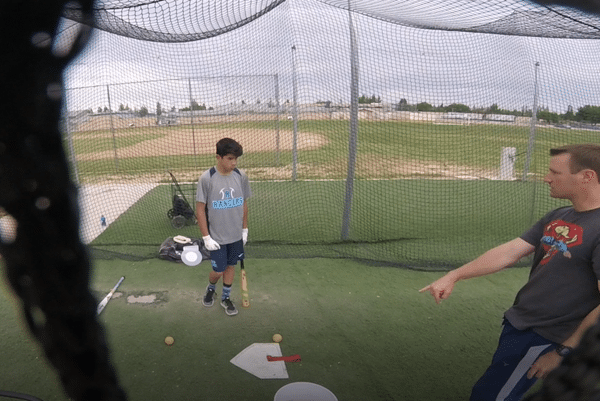
Here’s Part-2 – a continuation of – a three part series showcasing a local lesson of mine…

I get questions every week on how I’d run a practice or one-on-one session.  This is an over-the-shoulder look.  The main objective of this video series is to demonstrate how I use some of the “sticky” coaching principles covered in this post, and in my new book The Science Of Sticky Coaching: How To Turn Ordinary Athletes Into Extraordinary.

In case you missed the background information of Part-1,

Zack is a 14-year-old hitter from Visalia, California, which is approximately an hour drive from me.  And this is the first time I worked with him since about a year ago.  We’ve had about half a dozen session together in total.  And what I like about Zack is he asks a lot of really good questions during our sessions.

And before we started this session, Zack was having a challenge with hitting line drives.  He was either hitting the ball on the ground or non-productive balls in the air.

DISCLAIMER about the video:

  • Fortunately the video quality is great because Dad used his GoPro, but unfortunately I wasn’t mic’d up, so the audio isn’t like some of my other videos.
  • We’re at a public High School on a Saturday afternoon, so there are other team noises, bird sounds, emergency vehicles, etc. going on in the background that can be distracting.

Sadly, a few coaches on the socials will be overly critical of this hitter, and I’m asking you to suspend judgement.  The purpose of this video IS NOT about being overly critical of the hitter’s swing, it’s about the demonstration and use of sticky coaching principles.

Swing and coaching suggestions are welcome, but be nice coaches.

Now, for those coaches looking to learn and help their hitters get better…ONWARD…again!

A typically lesson I do, is organized like the following, from start to finish:

  1. Dynamic warm-up,
  2. Beginning Ball Exit Speed readings,
  3. Record and analyze current swing,
  4. Lesson, and
  5. Ending Ball Exit Speeds readings.

Part-2 lands you at #4 above.

What you can look out for in above video

  • Talking about lowering Zack’s hands to not get above armpit line to landing – benefits of (about 1-min mark),
  • Why a “flat bat” at stride landing can feel heavier than a more vertical bat. Center mass of bat in relation to center mass of hitter (about 4-min mark),
  • Getting into a more Hunched or Hollowed Position at the start of the swing. CLICK HERE to see tips and benefits of the Hollow Hold from BreakingMuscle.com, and CLICK HERE for the Hollow Hold exercise Zack did during warm-ups (about 9:30 mark), and
  • Intro to the first time working out new hitting material, varying the “Wrist Snap” using the red ankle resistance band – THANK YOU LEE. Objective with Wrist Snap is to snap over the red band and to hit the ball as hard and as far as you can. (about 16:00 mark)

Also, when it comes to sticky coaching principles, notice how I:

  • Move the tee positioning around after every swing (both high/low and inside/outside),
  • Vary soft toss heights and depths,
  • Vary mechanics on certain swings in a 5-swing round (I call these Varied Rounds), or practice one thing the whole round (I call these Block Rounds),
  • Ask quite a few feel, visual, and/or audio feedback questions AFTER round is over (think of it like a hitting quiz),
  • Keep my mouth shut during the 5-swing round (little to no feedback from me),
  • Don’t make Zack take a lot of swings during our time together,
  • Chunking certain movement together, so they don’t seem like separate pieces,
  • Have him change his bat size during rounds, and
  • Work with him on simplifying the juggling of a couple different mechanical cues.

Discover the best online youth hitting coaching blog for baseball and softball analysis, instruction, and private lessons program.  Why the best? Because we apply human movement principles validated by science to hitting a ball.

How To Get Hitters To Buy Into The System


In this video, we answer the following reader question:

“How Do You Get Kids To Buy Into These Movements When Every Hitting Instructor In The Area Is Teaching Robotic, Sequential Hitting Positions?”

We’ll go over:

  • Hypnosis: GOOD or BAD?
  • Internal v. external cues, and
  • Listing successful case studies…

But before we get into these, some housecleaning, and the elephant in the room…any new hitting movement a hitter learns, regardless of the content, will look robotic and mechanical, until they’ve put enough repetitions in.  For kids to ‘buy into’ the process, they must understand this.  For instance, if I taught a hitter to reverse their hands on the bat (ex. right handed batter – right hand on bottom, left hand on top), it would feel real awkward at first, but after 66 days of constant practice, it would feel comfortable.

Imagine what it would be like if you experimented with switching up how to steer a bike:


The initial learning process for young hitters may look, sound, and/or feel like this.  I tell my hitters that we take one step back, to take two forward when learning a new hitting mechanic.  Arnold Schwarzenegger outlines his path to making the unreal, REAL, in his book Total Recall:

  1.  Goals,
  2. Steps, and
  3. Reps.

Whether Arnold was talking about how he won Mr. Olympia, prepping for a movie like Terminator 2, or being Governor of California, he stuck to these three objectives.  Setting specific GOALS, with a timeline, and focusing on the things that athlete can control are crucial.

Where girls softball hitting tips start to get fuzzy is whether these hitters are being shown the right STEPS to get there.  Or as Tony Robbins calls it, the most effective ‘pathway to power’.  In other words, are they focused on learning the right things?  What are the ‘right’ things?

Are the hitting movements they’re learning following human movement principles that are validated by science?

When the right things are being taught, doubts seldom rise in the minds of my hitters.  PLEASE NOTE: we’re NOT talking about girls softball hitting tips philosophy or theory here.  Our hitters MUST live and die by a better and more secure hitting standard.  Validation through REAL science.  NOT pseudo science that is subjective, versus being objective.

And lastly, are hitters focused on doing those things right (efficiency – putting in the REPS).  Now, let’s dive into the main content of this girls softball hitting tips post…


Hypnosis: GOOD or BAD?

Hitters MUST NOT work with instructors that are teaching ineffective mechanics, technique that’s unsupported by science.  PERIOD.  Or they’re wasting their time and their parent’s money.

If we rule out the instructor, then most likely their school coach will be reinforcing ineffective hitting hypnosis.  How do we get kids to buy into the system?  What are some girls softball hitting tips and tactics to deal with this kind of scenario?

Give the hitter a heads up

They MUST know what they’ll be hearing at practice, and how it may be different than what an effective instructor is teaching, and most likely COMPLETELY backwards!!

Also, passively listening to the BAD hypnosis over time will manifest physically, even if the hitter knows it’s bad.  The more we hear the same message over and over, it’s only a matter of time before what’s subconscious, becomes conscious.  The fix?

The hitter MUST consciously hear what the coach is saying, and actively compartmentalize that information as ineffective in their brain.  Where there’s awareness, there’s power of control.

The ‘bobblehead nod’

Use this when coach is telling you to:

  • Swing down on the ball,
  • Chop down on the ball, or
  • Knob to the ball…

Then you nod your head up and down, saying “Yes Coach”.  And when they leave your presence, go back to what an effective swing path should look like.

Preach Science, NOT hitting theories

Other ways to reinforce GOOD hypnosis is to preach how the movements they’re learning are validated by human movement science.  Promote curious experimentation with specific hitting movements.  Cite hitting experiments.  Encourage hitters to try it the wrong way, then the right way, and have them compare their visual, auditory and/or feel feedback after 5 swings.

Inspire your hitters to seek out specific hitters on YouTube like McCutchen, Pedroia, Sadaharu Oh, Hank Aaron, Bautista, and Donaldson, and encourage them to look for what it is you’re teaching them.

You can also do movement tests like Dr. Kelly Starrett’s One-Joint Rule from one of the links above.

Internal v. External Cues

There seem to be two groups of coaches online…ones who believe effective teaching is using 100% external cues…and the other? Using 100% internal cues!  Both are wrong.  It’s a blend.  Just like the swing is either rotational or linear…it’s a blend.  Just like superior athletes are either born with it or work at it…this too is a blend.  And if someone tells you otherwise, they’re lying to you.  And probably not teaching the game on a consistent basis.

That being said, sticky coaching cues are key to getting kids to buy into the system.

When you sink the blade of an ax into a block of wood, are you thinking about keeping your right arm at X-degree angle, or slotting your back elbow?

No.

You’re thinking of taking that handled ‘blade thing’ in your hand, and splitting that ‘wooden thing’, sitting on a platform in front of your feet, in half.

Talking about  limb angles and back elbows slotting as girls softball hitting tips are internal cues…and can, with the right coaching cues, be effective.

But not quite as effective as external cues such as:

  • ‘Get shorter’ at landing or ‘stay shorter’ throughout the turn,
  • ‘Let the barrel chase the ball’ after impact,
  • ‘Hit the bottom half of the ball’, or
  • ‘Skip the barrel across the lake’.

I like to use external cues to kill 2, 3, or 4 birds with one stone.  I call it the “lazy” coaches way to success, again, I use these myself.  However, if I need to target specific movements and external isn’t working, I go internal.  This does require knowledge about human movement validated by science, which I’ve found some coaches don’t want to take the time to learn.  Additionally, it can depend entirely on the hitter and their learning style.  CLICK HERE to read what science says about this in a post I did titled, “What Every Coach MUST Know About Giving Feedback To Hitters…”


Girls Softball Hitting Tips – Listing Successful Case Studies…

Girls Softball Hitting Tips: Liam Wolf

Liam Wolf is one of my 11u hitters. Photo courtesy: his parents.

Successful case studies are the lifeblood of getting your hitters to buy into the system.  These can be your own, or borrowed from someone else.

These are powerful for young hitters.

Remember the time when your kids were learning how to swim?

Did they learn better watching adults swim OR when they saw kids their own age or slightly younger/older swimming?

Here is a current list of my case studies I often bring up to my hitters:

  1. 98-lb 11yo hitting the ball 300-feet, multiple times
  2. 95-pounder hitting their first dinger over 270-feet? (this is actually the brother of the above hitter but 2 years younger)
  3. 115-lb 11yo not only hitting the ball 300-feet multiple times, but hitting over 40 homers in one season…to ALL fields
  4. 66-lb 11yo hitting the ball over 180-feet, AND
  5. a 115-lb 13yo hitting the ball 330-feet (this one I borrowed from a hitting instructor in my area that teaches the same things as I do)…

Here’s video footage of #1 above (which was hit on a field in Manteca where the fences were set at 330-feet):


And I have many more, but these are the easiest to rattle off without having to give too much context.  If you don’t have any, then feel free to borrow mine, just please give credit where credit is do.

To recap…

Girls softball hitting tips to get your kids to buy into the system:

  • They MUST hear GOOD hitting hypnosis,
  • They MUST hear sticky coaching cues, and
  • They MUST hear this stuff working with hitters close to their age.

Discover an online baseball and softball hitting lesson private training program for bat speed that’s validated by science.  Learn about a hitting website with the best remote instruction and skills coach.

Online Baseball Lessons: Dead Simple Plan I Used To Help Aidan in Illinois…


…when I’m in California!!  Aidan B. (15 yo) signed up for online baseball lessons back in the middle of April 2014 when I opened The Feedback Lab.  What is The Feedback Lab?

“It’s the #1 strategy to repeatable power. It’s clear focused step-by-step video feedback & accountability in less than 48-hours.”

The 90-Day Sprint empowers parents and coaches to help young hitters achieve their full potential of consistent power through scientific movement principles, and sticky coaching strategies proven with empirical research.This baseball lessons blog post will show the dead simple plan we used to build repeatable power into Aidan B.’s swing.  We’ll go over:

  • Aidan’s before and after swing (2-week difference),
  • The “WHY” behind the change, and
  • 2-steps to spinal extension & “getting shorter”.

 Aidan’s Before & After Swing (2-week difference)

This video is a snapshot of Aidan’s swing from June 6-17th, 2014).  The swing was captured during soft toss.  In my notes,

  • BEFORE – on June 6th, Aidan had an excessive side bend at the waist after contact, and had a back leg angle of 115 degrees after impact.
  • AFTER – on June 17th, Aidan was extending up and over the catcher with his spine, and had a 105 degree bend in his back leg after contact.

Baseball lessons result?  More repeatable power.


The “WHY” Behind the Change

The challenges Aidan B. from Illinois was having were faulty spine engine mechanics, and not getting on plane with the pitch…here’s the baseball lessons breakdown:

  • Spine Engine Mechanics (according to Dr. Serge Gracovetsky) – During the Final Turn, the spine NEEDS to freely spring up and back over the catcher (extend through the head).  This is because we’ve already engaged two of three possible spine engine movements: 1) Side bending (down shoulder angle), and 2) Axial rotation (showing pitcher our numbers) before stride foot lands.
  • Get on Pitch Plane – And in order to get on a level plane with a downward traveling pitch, we must “get shorter” with the back leg.  The back foot placement has a role of swing stability as well.

To see the latter point in action, watch this YouTube video analysis of Barry Bonds:


2-Steps to Spinal Extension & “Getting Shorter”

  1. Back Foot Variance Drill – sets the back foot into a more stable position to get a good efficient stacked spinal lean.
  2. Lean Drill – using RNT (Reactive Neuromuscular Training) to “feed the mistake”.

If you’re interested in baseball lessons online (or softball), then CLICK HERE to get more information about The Feedback Lab.  If you aren’t ready to delegate your kiddo’s instruction just yet and want more of a DIY coaching approach, then grab a 30-day free trial to our War Room online video instruction program membership.

Learn about an online hitting training bat speed program risk free trial built for baseball and softball parents, team coaches, and instructors.  Discover the best remote learning way to teach swing instruction skills to your kiddos or other kiddos in the area…

Don’t Buy Into Fear Of Not Having Enough Playing Or Coaching Experience…


Have you ever wondered why we often fear the irrational?

From the time we were children, we looked under our bed and in our closet for the boogeyman and monsters. Perhaps you were terrified the first time you jumped into the deep end of the pool, or that first day of class. None of these things killed you, yet they felt like they would at the time.

You owe it to yourself to put any fears that no longer serve you aside.

A key factor in improving your kid or team’s hitting by swinging the bat smarter is ditching an irrational fear of not having enough playing or coaching experience.

Game Of Thrones creator George R.R. Martin once said, “Fear cuts deeper than swords.” Well, for hitting enthusiasts like you, this “sword” can slice right through your detecting and correcting swing challenges goals. It can drag you back to the old, ineffective ways of thinking, like falling for “Listen to the Guru because he said so“, the belief that wasting time on information that isn’t validated by REAL Science is the way to go. This can flat-out derail your success.

Currently, ESPN and the Aspen Institute reported on a study indicating that most kids stop playing baseball and softball by age 11. Combine this with the fact that coaches nowadays just want to win games and aren’t focusing on the processes that help them do that. I think buying into this fear is partially to blame, along with video analysis zealots staring at 2-dimensional figures on a screen and well intended coaches who aren’t updated on the research — sources that often support this myth and fan the flames of misinformation.

This has a hefty price tag: it can harm you by focusing on the wrong things.

I remember when I first paid that price. I first noticed it when I trusted MLB players (some Hall of Famers) and prestigious coaches in their books, telling me to do it this way because they said so.

It hurt my progress considerably as a coach following by blind faith because of their “expertness”. Fortunately, I overcame it by doing my own critical thinking and going down the many human movement science-based rabbit holes. You can, too.

I spent the past 18 years working on a fearless approach to hitting and helping friends and colleagues do the same. They were struggling to improve their hitters by swinging the bat more effectively, and more often than not, this fear is one of the reasons their hitters struggled.

Now, it’s true: what’s right for me and other successful hitting enthusiasts may not be right for you. However, if you’ve bought into the fear of not having enough playing or coaching experience, you may want to consider rethinking things.

I hope this helps!

Part-3: How To Develop Powerful Wrist Snap Like Hank Aaron (Is Devastating Against Pitchers)


Youth hitting consistent power trainer for baseball, softball, and senior league softball located in Fresno – Clovis, CA.  Discover wrist snap batting drills, techniques, and training for home use.  This video is a sneak peak at a 1 on 1 private lesson, and we also do online lessons as well.

Here’s Part-3 – a continuation of – a three part series showcasing a local lesson of mine…Over Shoulder Look: Hank Aaron Wrist Snap

I get questions every week on how I’d run a practice or one-on-one session.  This is an over-the-shoulder look.  The main objective of this video series is to demonstrate how I use some of the “sticky” coaching principles covered in this post, and in my new book The Science Of Sticky Coaching: How To Turn Ordinary Athletes Into Extraordinary.

In case you missed the background information of Part-1,

Zack is a 14-year-old hitter from Visalia, California, which is approximately an hour drive from me, one way.  And this is the first time I worked with him since about a year ago.  We’ve had about half a dozen session together in total.  And what I like about Zack is he asks a lot of really good questions during our sessions.

And before we started this session, Zack was having a challenge with hitting line drives.  He was either hitting the ball on the ground or non-productive balls in the air.

DISCLAIMER about the video:

  • Fortunately the video quality is great because Dad used his GoPro, but unfortunately I wasn’t mic’d up, so the audio isn’t like some of my other videos.
  • We’re at a public High School on a Saturday afternoon, so there are other team noises, bird sounds, emergency vehicles, etc. going on in the background that can be distracting.

Sadly, a few coaches on the socials will be overly critical of this hitter, and I’m asking you to suspend judgement.  The purpose of this video IS NOT about being overly critical of the hitter’s swing, it’s about the demonstration and use of sticky coaching principles.

Swing and coaching suggestions are welcome, but be nice coaches.

Now, for those coaches looking to learn and help their hitters get better…ONWARD…again!

A typically lesson I do, is organized like the following, from start to finish:

  1. Dynamic warm-up,
  2. Beginning Ball Exit Speed readings,
  3. Record and analyze current swing,
  4. Lesson, and
  5. Ending Ball Exit Speeds readings.

Part-3 lands you towards the end of #4 above.

What you can look out for in above video

  • Training something new should feel goofy, that’s normal…if they feel no change in movement at the beginning stages of motor skill development, then they’re repeating the same old thing (about 0:45 mark)
  • The arch and hollow (hunched) positions in Gymnastics.  “Hunch” can have a negative connotation, but reality says it’s a VERY SAFE position for a twisting spine to start in. CLICK HERE for a Zepp swing experiment that looked at the benefits of a “Hunched” spine. (about 1:55 mark)
  • Playing around with wrist snap variance using the target ankle resistance bands.  It’s NOT a roll over, it’s like a “waggle” that golfers use pre-swing.  Great defender against off speed and breaking pitches, AND increase BA by controlling the barrel.  Keep main objective in mind: hit ball as hard and far as you can.  (about 3:45 mark)


  • Working the Wrist Snap Variance Drill on the open field hitting targets. Hank Aaron was really good at this.  Watch Hank Aaron video below and watch his wrist action at impact… (about 6:15 mark)
  • The Frog Tape bat…barrel awareness.  Focusing on hitting a certain part of the barrel AND hitting it in a specific direction or target. (about 11:20 mark)
  • Discussing how switching bats between rounds forces a hitter to focus on adjusting their timing. Heavier/top heavy bats have to start sooner…lighter/balanced bats can start later.  (about 15:30 mark)
  • Zack made the observation that Finger Pressure makes the Wrist Snap Variance Drill easier to feel.  (about 17:30 mark)


Also, when it comes to sticky coaching principles, notice how I:

  • Move the tee positioning around after every swing (both high/low and inside/outside),
  • Vary soft toss heights and depths,
  • Vary mechanics on certain swings in a 5-swing round (I call these Varied Rounds), or practice one thing the whole round (I call these Block Rounds),
  • Ask quite a few feel, visual, and/or audio feedback questions AFTER round is over (think of it like a hitting quiz),
  • Keep my mouth shut during the 5-swing round (little to no feedback from me),
  • Don’t make Zack take a lot of swings during our time together,
  • Chunking certain movement together, so they don’t seem like separate pieces,
  • Have him change his bat size during rounds, and
  • Work with him on simplifying the juggling of a couple different mechanical cues.