Discover how to hit more hard line drive lasers, up the middle, for baseball and softball players. Fix swinging under the ball too much, STOP excessive pop ups, and figure out WHY you’re hitting too many ground balls. Learn beginner hitting drills you can do at home by yourself.
In this hitting baseball drills line drive mystery post, we’re going to answer the question above by diving into the following:
What “predictable” is for some hitting coaches may not be for others. Consider this…Coach A uses horoscopes, astrology, and sorcery to teach his hitters how to hit line drives. And after 20 years of teaching like this, he swears his hitters hit predictable line drives. This is all he knows. All he knows.
Let’s look at Coach B, who applies human movement principles validated by REAL Science to hitting a ball. And after 20 years of teaching hitters like this, she swears HER hitters hit line drives predictably. So which coach is more effective with their hitters?
If the hitting baseball drills answer doesn’t immediately jump out at you, then you may be the first one dead during a zombie apocalypse. Of course I was exaggerating the two coaching strategies for effect (well, at least one of them). This seems to be the duality of hitting logic I see online. “Listen to ME because I said so”. No standard. Just listen to me because I slept in the same bed as Ted Williams in XYZ hotel. Or I’ve binge watched millions of hours of slow motion hitting video of only the best hitters. Or I have the MLB record of 9th inning doubles in the month of August. Blah blah blah.
“Behaving or occurring in a way that is expected.” 20% line drive rate is expected. So in 20-years of coaching, would Coach A or Coach B do better? Let’s say Coach A’s astrology hitters came in at an average 12% line drive. This is exceptional to him because it’s the pinnacle of what he’s experienced. But what Coach A doesn’t know is Coach B’s science hitters clocked in at a 20% average line drive rate. Coach A doesn’t have a clue until he talks to Coach B. Lesson here? We don’t know what we don’t know. Now you know!
I can tell you, when it comes to THIS means THAT … hitting predictable line drives and striking out less comes from applying human movement principles that are validated by real science to hitting a ball. Hitters hit more predictable line drives when they follow principles outlined in: Physics, Engineering, Biomechanics, body work, Geometry, and Psychology.
Of course there is bad Science. Just read Ben Goldacre’s book Bad Science : Quacks, Hacks, and Big Pharma Flacks. But there are irrefutable principles that have been proven for decades, if not hundreds of years. Take Gravity for one. Jump out of a plane and you’ll fall 100% of the time – as long as you call earth home. Look, there are 50 ways to skin a cat, but there is always one most efficient way…
Astrology Coach A may say something like this about Science:
“…yes u can argue with science. Science is religion not fact. It’s guessing and testing not thinking and proving. Very little is proven fact in science. Science is only science until better science comes along. For example. The science of hitting….. there’s ppl out there that say he wasn’t completely right. Then there will be someone new saying the same of your doctor…..i find it funny scientists who can’t hit anything telling ppl the proper way to hit.”
And Science Coach B may respond with something like this:
“Science is neither religion or guessing and testing. It is the discipline of seeking knowledge in pursuit of the truth and understanding. Whether being applied to medicine, the weather or the baseball swing, that understanding is only as good as the currently available information (data), and yes a process of observation, testing and retesting as tools improve necessarily updates our knowledge and improve our understanding. It does not rely on faith as religion does. It relies on evidence and data. “Hard anywhere” is a result. It doesn’t explain or teach how in fact one hits the ball hard anywhere consistently. That requires some understanding of how the biomechanics of the swing works and can be made most efficient for each player. If you want to argue with “science” as you refer to it, you are welcome and encouraged to do so…but bring your superior evidence and data to the argument!”
I want to keep Coach A’s name anonymous, so as not to expose him to ridicule, thrown tomatoes, and bunny ears. Look, there are hundreds of different ways to teach hitting baseball drills. A lot of coaches believe this, and I agree. But I’d argue there is a more effective way. What is it?
Consider this scenario…imagine you and I sitting down at the kitchen table to talk hitting. One hour before, we were both involved in a feverish game of Octopus Tag (you don’t want to know). And are famished! What’s on the menu? A big fat bowl of creamy tomato soup. But before we begin nourishing our bodies with sweet Lycopene, I give the choice of eating your soup with three primitive caveman tools. WARNING: you can only pick one…
- Spoon,
- Fork, or
- Knife
Which tool would you choose to eat your soup? Think hard. I’ll wait… okay, time’s up!! You chose the spoon didn’t you. How did I know? Astrology? Horoscope-ology (is that a word)? No, of course not. I knew because that was the most effective tool for the job. Hitting is the same. Anything less than applying human movement principles validated by REAL Science to hitting baseball drills, is like eating delicious creamy tomato soup with a fork or even dumber, a knife. One can pull it off. But others would look at you like you were a wooden dummy.
Remember, we’re looking at “behaving or occurring in a way that is expected.”
Let’s look at another puzzle piece to helping hitters consistently hit line drives…
'Add 40-Feet' To Batted Ball Distance
Swing Study reveals how tens of thousands of hitters are adding 40-feet to batted ball distance by using one simple strategy.
Click the button below to access the FREE video that's been downloaded over 30K times!!
Click here to 'Get Instant Access'
Difference between ‘Launch Angle’ and ‘Attack Angle’?
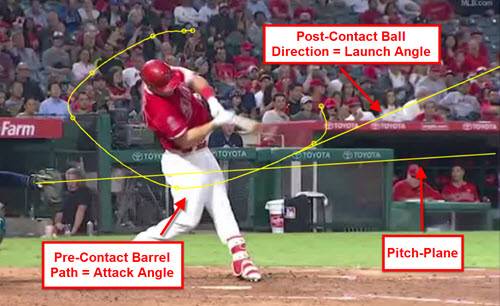
Here are the definitions of both attack angle and launch angle…
According to FanGraphs.com, Attack Angle is…
“The attack angle, or swing plane, is the angle that the bat is moving at when it hits the ball.”
And according to MLB.com, Launch Angle is…
“Launch Angle represents the vertical angle at which the ball leaves a player’s bat after being struck.”
There is no such thing as a ‘Launch Angle” swing, since every batted ball produces a Launch Angle, even a bunt. Attack and Launch Angles are just numbers without a brain. They’re a mode of measurement. They’re different, but similar. More like first cousins. That’s it. Period. End of story.
But I can see where the hitting baseball drills confusion is. The Launch Angle “swing” is a case of guilty by association. In the past, coaches preaching launch angles, maybe using HitTrax or Rhapsodo, tended to instruct their hitters to hit the top back third part of the cage. Did you get that? Imagine that for a second…top-back-third-part-of-the-cage. The coaching logic goes like this … if most doubles and dingers are hit within twenty to thirty degree launch angles, then let’s teach hitters to do just that.
Problem is, when the majority of hitters – especially the young ones – attempt this, they end up hitting more popups. I know because I taught it too!! And like the Big Bang, just like that, the ‘Launch Angle’ swing was spoken into existence. But I can tell you, THIS does not mean more predictable line drives. Let me explain…
What is an Optimized Attack or Launch Angle?
The angle the barrel takes to the ball is an Attack Angle. The Launch Angle is angle ball takes off the bat. Which begs the question, “What is an optimized Attack or Launch Angle?”
According to Fangraphs.com, the league average Attack Angle from 2015 through 2017 are: 11.4, 12.0, and 13.8 (in degrees), respectively. The average Launch Angles in the same time frame were: 10.5, 11.1, and 11.0 (in degrees), respectively. Launch Angle is a little more tricky than Attack Angle. A hitter can control their Attack Angle. Not so much their Launch Angle. Fangraphs.com adds…
“…we see a relatively weak correlation between attack angle and launch angle, because launch angle is also strongly dependent a hitter’s aim, timing, and bat speed. While we don’t have any direct measurements of aim or timing, we can see that players with flatter swings (lower attack angles) have more margin for error when it comes to timing, and therefore tend to have higher contact rates than players with uppercut swings (larger attack angles).”
And the optimal home run Launch Angle seems to be about 24-degrees. Ironically, the optimal Attack Angle for home runs is about 24-degrees. But think about this, in the Big Leagues a fastball being thrown at 95-mph, typically is coming DOWN at a 5-degree angle. So if the hitter’s Attack Angle is UP at 24-degrees, then yes we may see more dingers and doubles, but at the expense of hits, Batting Average, and higher strikeouts percentages. The extreme uppercut example isn’t a good demonstration of the “slight uppercut” Ted Williams was talking about in his book The Science of Hitting. Food for thought.
Furthermore, a fantastic post on the topic of the longest home run ever, comes from Dr. Alan Nathan in a post at PopularMechanics.com titled, “What’s The Longest Possible Home Run”. Alan Nathan is a professor emeritus of Physics at the University of Illinois. The professor has spent a career tracking physics, especially as it relates to baseball. He says two primary factors guide how far a ball is going to fly: exit velocity and launch angle. From the Popular Mechanics post:
“Consider Nathan’s ideal home run, hit with 120-mph exit velocity at a 26-degree launch angle. If Giancarlo Stanton hit that ball on a 70-degree day, at sea level, with no wind and 50 percent relative humidity, then Nathan’s calculations show the ball will travel 492 feet…If you start changing those atmospheric conditions, that number can go up a lot. An out-blowing wind at 5 mph, which is not a lot of wind, can add 24 feet to a fly ball, so now you are at 516 ft. If instead you go to Denver (lower air density at a higher elevation) and that goes up to 533 feet.”
Now, I know what you may be thinking…
How does the Brain get the Body to Optimize Attack (AA) and Launch Angles (LA)?
Perry Husband of HittingIsAGuess.com dragged me to the following hitting baseball drills conclusion. We talked about this already, but league average line drive rates in the Bigs is 20%, so this should be our primary focus. Physics says, the hardest ball hit requires center-center contact between barrel and ball. And remember league average fly-ball and ground-balls rates hover around 40% each. The best hitters in the game are missing center-center contact 80% of the time – LOSERS!! Kidding!
Dingers and doubles are what we call “quality misses”. Aim small, miss small. Hit the ball back through the “tube”. Shoot for the ten to fifteen degree Launch Angle (our 20% line drive rate), and rest assured hitters will accumulate more of these quality misses. Dingers and doubles without sacrificing swing quality. Practicing this may not be sexy, but the results are, believe me. Because if hitter shoots for dingers and doubles, they’ll hit more pop flies – I can tell you.
Remember, we’re looking at “behaving or occurring in a way that is expected.” Consistent. Predictable. Higher probability of line drives. Here’s the how and the hitting baseball drills lesson…
To optimize AA, we focus on optimizing the net outcome of LA. Our hitter’s default focus is back through the “tube”. Path ball takes from pitcher’s hand to catcher’s glove. Distance from the ground sets the “tube”. Hitter works on hitting it back through the tube. If it’s an inch off the ground … ball comes off bat an inch off the ground. If the tube is set at 4-feet off the ground, then ball comes off bat 4-feet off the ground. So if it comes back through the tube, it’s coming back through the tube at 10 to 15 degrees. That is our optimized default launch angle we want to see our hitters practicing every single swing they take.
If it is not back through the tube, then we want them making the Dr. Victor Frankl Man’s Search For Meaning paradoxical intention adjustments. If they hit the ball above the tube (pop fly or quality miss above), then we want them to make an adjustment down below the tube next time. Why do we want to include an adjustment for quality misses (doubles and dingers) above the tube? Because if they try for them, they’ll miss higher. Not good. We praise them for the quality miss, but remind them to get back to the tube. The same is true if they hit it below the tube (a grounder), then we want them to make an adjustment above the tube.
I know I sound like a broken record, but the body is always a step or two behind the brain. So we have to exaggerate the adjustment cue in order to get the body to do what the brain wants it to. Thoughts move quickly. We want to make sure that we get the big old bag of bones, muscle, springy fascia, and organs on par with the brain. Tell body to overshoot where we want it to go, in order to get it in the middle.
'Add 40-Feet' To Batted Ball Distance
Swing Study reveals how tens of thousands of hitters are adding 40-feet to batted ball distance by using one simple strategy.
Click the button below to access the FREE video that's been downloaded over 30K times!!
Click here to 'Get Instant Access'
Case Study: does Teaching Hitters to Hit Top Back Third Part of Cage Work for Hitters in Games?
I argue no, it does not. And I will also say that I was there a few years ago, teaching the same thing to my hitters. If I was talking to two years in the past Joey Myers today … he would think I was crazy. And in his finite wisdom, would demand whose hitting baseball drills Kool-Aid I was drinking. But I can assure two-years in the past Joey Myers that hitting the back third part of the cage isn’t what we want our hitters practicing.
I mentioned I taught this exact thing a few years ago, and what I found, especially with a lot of my junior high and high school hitters, was that focusing on the double and dinger caused a majority of my hitters to hit more … you guessed it … pop flies. Some were flying out three and four times a game. And at that time we were telling our hitters to get the ball off the ground, and that all ground balls sucked eggs. There are still a lot of coaches out there, progressive ones, good coaches, that still subscribe to that. But the problem is probability of averages. “Behaving or occurring in a way that is expected.” Consistent. Predictable line drives.
Again, you look at the best hitters in the game, league average 20 percent line drive rate, 40 percent fly ball, and 40 percent ground ball. 80 percent of the time, the best hitters in the world miss hit the center of the ball. Center ball meeting center bat. The best hitters in the game are missing 80 percent of the time. So think about that. If we shoot for a ten to fifteen degree launch angle, hit it back through the tube, then our misses are going to be more quality. Net results?
A higher probability of lines drives. Back to at least league average. So if we’re shooting for a 10 to 15 degrees Launch Angle, and we miss slightly under that center point, what ends up happening is that 20 to 30 degree launch. We’re going to accumulate more doubles and dingers by shooting for the middle. Shooting for the tube.
And when it comes to quality ground-balls, I think in the big leagues, when the ball exit speeds get above 94 miles an hour defensive errors go up. They significantly increase. Now, why is that? Well, because the ball’s speeding up and it’s moving faster than the best can react to get to the ball. And the less bounces, the more likely the ball will get to an outfielder. More bounces slow the ball down significantly. So the speed the ball comes off the bat matters “big tyne”, as Domingo Ayala would say. According to a “Fun With Statcast (Exit Velo)” post at Medium.com, here’s what happens to batting average when ball exit speeds increase:
- 92-mph = .261
- 94-mph = .311
- 96-mph = .369
- 98-mph = .425
- 100-mph = .508
- 102-mph = .565
- 104-mph = .635
- 106-mph = .701
- 108-mph = .718
Then they level off on any ball exit speeds above that. So not all ground-balls are bad. Especially if we’re hitting them over 94-mph. And by the way, the stats you just read reflect Major Leaguers!! If you have a kid in Junior High or High School hitting 92-mph ground-balls, then the batting average for that hitter at that level will be much higher than what’s reflected above. Major Leaguers are MUCH better fielders.
Bottom line? Our focus should be in hitting the ball hard. Ball exit speed MUST be a big part of the equation. It’s king. Optimized launch angles don’t mean as much with slow ball exit speeds. We can get away with it for a little while, but the ability to hit more extra base hits, hit the ball to the wall or over the wall is going to be a major challenge at higher levels.
And if it’s one thing that high school coaches hate, are their hitters hitting an excess of fly balls. They would take a ground ball, even if it’s a weak one any day of the week. Why? Because they bank on that fielder either miss playing it, or over throwing it. They’ll say that there’s more that can go wrong with the ground-ball than a fly ball, which is true. Fielder has to field and throw cleanly, and the receiver has to catch it. Three things can go wrong with the ground ball than a fly ball. They just have to catch it. I’d disagree that “just catching” the ball is easy though.
As an outfielder who played at the Division 1 level in college, I can tell you it’s not that easy to track and catch a ball in the air. You’ve got to take the right route. You’ve got to read it correctly off the bat. You’ve got to listen to the sound of contact. Solid, or not quite. If the ball is hit hard, we were taught to take your first step back. You don’t want a line drive going over your head. There’s a lot that goes into catching a ball in the air. So I will disagree that it’s easy to catch a fly ball. And I think most that say it’s easy, never played outfield on a regulation big field against higher level hitters.
In addition, with a skill like hitting that is reactive, versus pitching which is proactive, control isn’t what hitters are gifted with. Only control what you can control. And to hear these coaches say hit the ball on the ground because the defense might make an error. In a sport with less control, why would you pin hopes and dreams on “might” make an error. You can’t control that. So only focus on what you can control.
“Behaving or occurring in a way that is expected.” Consistent. Predictable line drives. Our hitters CAN control improving their Ball Exit Speeds and optimize their Attack Angles. In Chapter-3, we discussed what leads to hitting more “predictable” line drives and less strikeouts. We dove into the following:
- What does “predictable” mean and why does probability matter? And,
- Difference between ‘Launch Angle’ and ‘Attack Angle’…
'Add 40-Feet' To Batted Ball Distance
Swing Study reveals how tens of thousands of hitters are adding 40-feet to batted ball distance by using one simple strategy.
Click the button below to access the FREE video that's been downloaded over 30K times!!
Click here to 'Get Instant Access'






 : Quacks, Hacks, and Big Pharma Flacks. But there are irrefutable principles that have been proven for decades, if not hundreds of years. Take Gravity for one. Jump out of a plane and you’ll fall 100% of the time – as long as you call earth home. Look, there are 50 ways to skin a cat, but there is always one most efficient way…
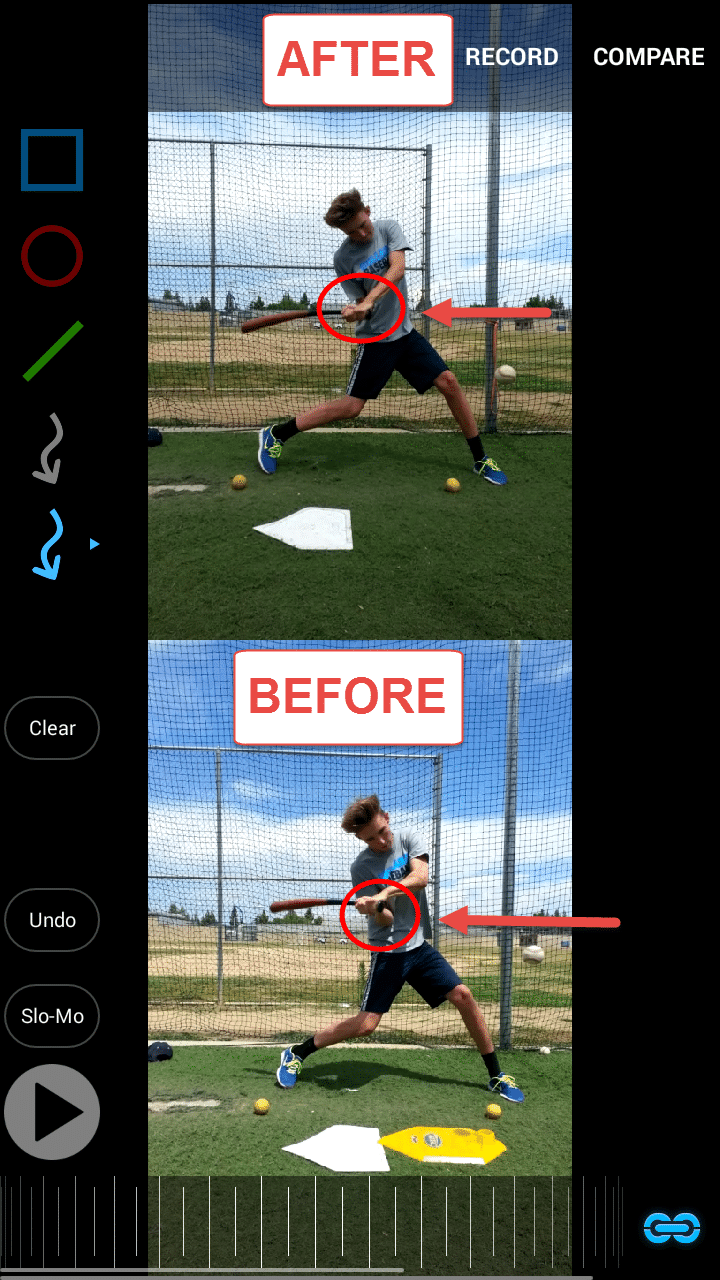

 . It’s NOT a roll over, it’s like a “waggle” that golfers use pre-swing. Great defender against off speed and breaking pitches, AND increase BA by controlling the barrel. Keep main objective in mind: hit ball as hard and far as you can. (about 3:45 mark)