Learn how to improve hitting timing problems using simple drills to fix late swings in a baseball or softball game.
Hitting Timing Drills: Get Rid Of Hitters Feeling Dominated By Upper Level Pitchers Once And For All
In this timing hitting drills post, I’ll be addressing the following reader question…
“How to teach fearlessness when facing upper level pitchers and timing the hard throwers?”
We’ll be addressing the following in the above video:
Barry Bonds one step towards machine after every swing,
Two or three-plate drill, and
Develop hunting approach at the plate…
Barry Bonds One Step Toward Machine After Every Swing
CLICK HERE for a link to get more information on the golf whiffle ball MaxBP pitching machine at The Starting Lineup Store. Get 15% OFF by using the: GET15OFF coupon code at checkout.
🚀 Unlock the Secrets: FREE VIDEO on Mastering Powerful Oppo Field Hits & Pulling
Are your hitters struggling to effectively hit to the opposite field or pull the ball with power? Discover our breakthrough techniques now!
Get instant access to our exclusive FREE VIDEO: 'Mastering the Art of Pulling & Going Oppo'. Learn how to maintain explosive ball exit speeds while mastering directional hitting.
https://hittingperformancelab.com/wp-content/uploads/2018/08/Stop-Late-Swings-Simple-Baseball-Softball-Batting-Drills-to-Dramatically-Improve-Hitting-Timing.png423800Joey Myershttps://hittingperformancelab.com/wp-content/uploads/2021/10/hitting-performance-labs_c90c0362088ef1d3d528f3078f4f8ac1-300x75.pngJoey Myers2023-02-17 09:45:182023-02-18 06:25:57Improve Hitting Timing Problems: Drills To Fix Late Swings In Baseball Or Softball Game
Discover how to improve hitting timing tips, get the front foot down on time, and fix late baseball or softball swing. Learn how in this Josh Hamilton batting rhythm swing breakdown.
Josh Hamilton Swing Breakdown: Coaches Don’t Tell You This…
…In this Josh Hamilton swing breakdown we’re focusing on what most coaches don’t tell you (or simply don’t know) about calibrating the timing of a hitter. You can have the best hitting mechanics, but if timing is off, results can be frustrating. In this video, we’ll analyze:
When does a swing start?
Leg kick or slide step? and
How to practice timing?
When Does a Swing Start?
Short answer? About when the hitter picks the front foot up. When walking, you can’t take a step forward without picking up your foot and putting it back down. This is why I hate “no-stride” coaching cues. Here’s how walking bio-mechanics work:
Front heel hits the ground signals pelvis to open.
Same timing signal travels up the spine to the shoulders, telling them to counter-rotate the pelvis.
This is why your opposite arm and leg come forward at the same time.
This simple timing mechanism is important to hitting. Hitting experts call this torque, but really, it’s how humans are designed to move against gravity using the spine for locomotion. CLICK HERE for a more in–depth study on walking bio-mechanics according to Dr. Serge Gracovetsky.
Leg Kick or Slide Step?
It ALL depends on a batter’s moving parts…
Leg Kick a-la Josh Hamilton forces the hitter to start the swing sooner. Hamilton starts his when the pitcher breaks the hands.
Slide Step a-la Mike Trout can start their swing later. You’ll see these types of hitters picking their front foot up when the pitcher lands and/or begins forward movement with the arm.
SCIENCE-BASED TRAINING:
Improve your hitting strategy dramatically by applying human movement principles.
Learn not only how and what to train but also the science behind the methods.
SEVEN ways a hitter can practice “collecting data”:
LIVE arm: whether seated – on a bucket, kneeling, or standing.
Soft toss or LIVE: throw baseballs, whiffle, dimple, tennis, golf, or dried pinto beans.
Broad focus: have hitter pick out a point in the pitcher’s delivery to start the swing.
On-Deck circle: work on when to pick front foot up.
Sit in on Bullpens: hitter passively (no swings) sits in on pitcher bullpens (with a helmet on of course).
Pitcher’s BP: have pitchers trade off throwing batting practice (advanced).
Intra/Inter-squat games.
Above-all, be safe. The truth about Josh Hamilton timing? It takes reps, reps, and more reps. CLICK HERE for Part-3 Matt Holliday: The Death Of Plate Discipline. In case you missed Part-1 Mike Trout: Why Your Consistency Won’t Improve, CLICK HERE.
Grab This FREE 'Timing Master Class' Video
Struggling to get your hitters ON-TIME in games? Discover HOW TO build effective laser-focused timing, so your hitters can be ON-TIME more often. These principles are validated by REAL science.
Click the button below to access the FREE video that has been downloaded over 6K times!
Softball Hitting Drills Fastpitch Video: How To Improve Timing Almost Instantly
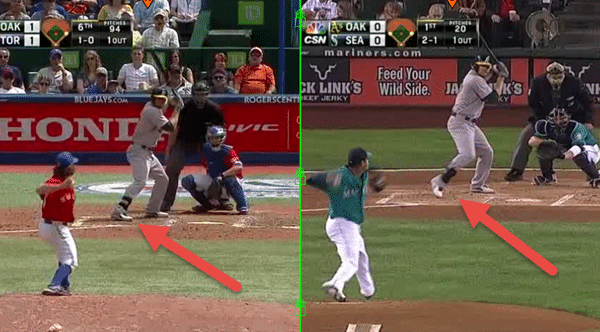
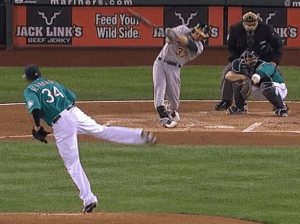
Brandon Moss 2014 synced swings. Look at when he picks his front foot up (in relation to what point in pitcher’s delivery) when homering on a 77-mph KB off R.A. Dickey versus hitting a dinger off a 93-mph FB from Felix Hernandez. Photo courtesy: MLB.com
A softball hitting drills fastpitch reader question came in recently that relates well to baseball…
“Why is Timing not taught throughout majority instructors? Great mechanics are good but without Timing principles, you just look good going back to the dugout. What are some of the different ways you would teach/describe Timing?”
Here’s what we’ll cover in this softball hitting drills fastpitch for timing post:
Bad Hitting Outcome Evaluation Checklist,
The Art of Variance: Bean Bag Study, and
Varied Reaction LIVE Toss Timing Drill…
SCIENCE-BASED TRAINING:
Improve your hitting strategy dramatically by applying human movement principles.
Learn not only how and what to train but also the science behind the methods.
I use minimal to zero feedback between swings, until the round is over. Why minimal to zero feedback? CLICK HERE to read this post on “What Every Coach Must Know About Giving Feedback To Hitters”.
Why 3-5 swing rounds and not 15-20? CLICK HERE to read this testimonial on how to make practice swings game ready.
And within 3-5 rounds of 5 swings each round (so 15-25 total swings), there’s a marked difference in the hitter’s plate discipline, timing, and mechanics…for the good.
And it doesn’t matter the age.
If there IS NOT a progression in their ability to swing at more strikes, get on-time, and hone effective mechanics within that swing round, then either:
The coach is instructing too much between swings, OR
The player needs a little education on their strike zone, how timing must change at the different distances, or, to take pressure off swing outcomes, and put pressure on executing a specific swing movement instead.
It must be said, that in games, coach will only focus on points one and two of the Bad Hitting Outcomes Eval Checklist. Players MUST be free to compete in games, not worry about mechanics.
Softball Hitting Drills Fast-pitch The Art of Variance: Bean Bag Study
So I don’t have to beat a dead horse, here are a couple resources to catch you up to speed on this:
Some of my hitting friends, whom I respect in their knowledge and experience, don’t believe we can teach timing. I disagree however. Not only can we teach timing, but we can SPEED UP the learning process!
Here’s one of my favorite drills for timing…
Varied Reaction LIVE Toss Timing Drill
Using the same principle as the Bean Bag Toss Study above, I regularly vary reaction times with our hitters. The following video is how to setup one of my favorite softball hitting drills fast-pitch for timing (works well for baseball too):
Distances, whether we’re talking baseball or softball, are different, so use common sense on this. Depending on the hitter’s official plate to mound distance, I will put 5-15 feet of distance between the two plates.
And remember, the L-screen stays where it’s at…the HITTER moves between the two plates.
Grab This FREE 'Timing Master Class' Video
Struggling to get your hitters ON-TIME in games? Discover HOW TO build effective laser-focused timing, so your hitters can be ON-TIME more often. These principles are validated by REAL science.
Click the button below to access the FREE video that has been downloaded over 6K times!
https://hittingperformancelab.com/wp-content/uploads/2022/07/Improve-Baseball-And-Softball-Batting-Timing-Rhythm-Tips.png423800Joey Myershttps://hittingperformancelab.com/wp-content/uploads/2021/10/hitting-performance-labs_c90c0362088ef1d3d528f3078f4f8ac1-300x75.pngJoey Myers2022-07-05 09:30:272022-08-17 20:36:09How To Improve Batting Timing And Rhythm Tips For Baseball & Softball Players | Hitting Drills To Fix Late Or Early, Swinging And Missing, & Get Front Foot Down Checklist
Discover how to hit slow pitching, improve batting timing and rhythm mechanism, and STOP swinging early. For beginner baseball and softball players. Learn simple drills and tips for better more on-time hitting…
This Brandon Moss analysis comes from a conversation I had with Coach Justin Karr and his 12-U Bakersfield Sliders Black team. Thanks Coach Karr, I hope this helps your troops!
I want to compare what Brandon Moss does differently hitting a slower pitcher, like knuckle-baller R.A. Dickey of the Toronto Blue Jays, to a hard throwing “King” Felix Hernandez of the Seattle Mariners. We’re going to:
Make the complicated, uncomplicated,
Learn how-to adjust to slower pitching according to Brandon Moss, and
“When it comes to learning complicated movements efficiently, the key is to make them uncomplicated. We do this by breaking them down into precise, manageable steps. Then we emphatically encourage like-your-life-depends-on-it focus in performing each step. This is the path to a tight learning curve. It’s the foundation required for optimal performance.”
We focus on one aspect at a time. In respect to the calibration of timing, we have to forget swing mechanics and focus solely on adjusting the timing. Making in-game adjustments, timing is THE most important priority. We teach three possible swing adjustments with our seven hitting strategies. We refer to these as the three dimensional hitting adjustments:
Timing – is hitter out front or behind?
Vertical (Launch Angle) – did hitter hit popup or ground-ball (or line drive?), and
Horizontal (Barrel Path) – did hitter get jammed or hit ball off the end?
Which one of these after an in-game swing, if tweaked, fixes the other two?
SCIENCE-BASED TRAINING:
Improve your hitting strategy dramatically by applying human movement principles.
Learn not only how and what to train but also the science behind the methods.
How-To Adjust to Slower Pitching According to Brandon Moss
In the video, I compare and analyze two 2013 home-run swings by the Oakland A’s first baseman Brandon Moss:
77 mphknuckle-ball from R.A. Dickey Moss (left-handed) hit over the center field fence (418 feet*), and
93 mphfastball from “King” Felix Hernandez Moss hit over the right-center field fence (387 feet*)
(*You can find out more home-run stats at BaseballSavant)
CLICK HERE to revisit a video blog article I did, featuring Josh Hamilton and Mike Trout, where I went over:
When does a swing start?
Leg kick or slide step? and
How to practice timing?
For an average velocity pitcher, each hitter MUST figure out at what point in the pitcher’s delivery that they start their swing. Then experiment starting the swing at a later point with a slower pitcher. This will be slightly different for every hitter as the Josh Hamilton article shows.
The main point is, the hitter has to make a a conscience effort to change their timing. They can’t just use the same timing for every pitcher. Hitting is a game of inches…being one inch ahead or behind can mean barreling the ball or not.
What’s the best way to practice this? The 2-plate drill shared in this article, and home run derby?? Using the 2-plate drill and throwing seated from 25-30 feet away (under or over hand front toss). The thrower will be literally lobbing the ball to the hitter as they take two swings and switching plates. Six swings per round. The slower the throw, the better. In our system, this is hitting strategy number 4.
Also, if the whole team’s offensive numbers are suffering against a slower pitcher, then the adjustment DOES NOT necessarily have to be a mechanical one.
One more interesting point…notice how far Brandon Moss cranked the Dickey knuckle-ball? 418 feet!! “King” Felix? 387 feet…a pitcher’s velocity doesn’t dramatically contribute to batted ball distance. It’s bat speed that does. According to a forum at eFastball.com, for every 1 mph of added pitching velocity, 1 foot of batted ball distance is the outcome. BUT for every 1 mph of increased bat speed, 4 feet of batted ball distance is the result!! Don’t let low velocity pitchers slow your bat speed down hitters!
Grab This FREE 'Timing Master Class' Video
Struggling to get your hitters ON-TIME in games? Discover HOW TO build effective laser-focused timing, so your hitters can be ON-TIME more often. These principles are validated by REAL science.
Click the button below to access the FREE video that has been downloaded over 6K times!
https://hittingperformancelab.com/wp-content/uploads/2014/05/brandon-moss-timing.jpg473401Joey Myershttps://hittingperformancelab.com/wp-content/uploads/2021/10/hitting-performance-labs_c90c0362088ef1d3d528f3078f4f8ac1-300x75.pngJoey Myers2022-07-01 09:00:312022-07-05 15:58:17How To Hit Slow Pitching, Improve Batting Timing Rhythm Mechanism, & STOP Swinging Early For Beginner Baseball And Softball | Drills & Tips For Better Hitting
Discover simple timing and rhythm hitting tips from Matt Nokes to quickly improve and fix a too early or late swing for baseball and softball batters. Get the front foot down on time and in games.
Timing Drills For Hitting A Softball Video: Quickly & Easily Get Hitters On-Time w/ “Snap Drill”
I don’t give much of my time to others’ timing drills for hitting a softball. And it’s not because I think I’m God’s green gift to baseball and softball. Actually, since January of 2013, I took a needed break learning hitting mechanics from others in the field, no matter how popular. I wanted to shed the hitting “BEER GOGGLES” that have stubbornly held this industry back for decades.
People ask me if I know anything about Tewks, Epstein, “Teacher Man”, etc. I don’t. And that’s the honest truth. I see their posts on Twitter and Facebook, but don’t give them anymore thought. The main reason? I’m still learning my own system!!
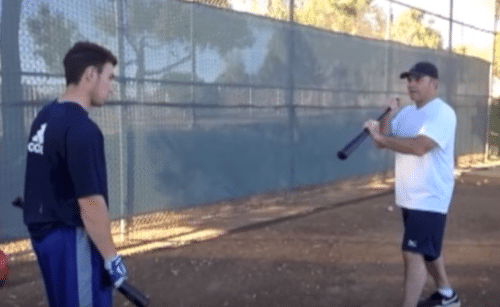
Matt Nokes talking about “leaning in and compressing the ball”. Photo courtesy: Matt Nokes’s YouTube channel
Besides, everyone has a different approach, view, and style. As you probably know, the timing drills for hitting a softball language can get quite confusing.
Back in 2013, I decided to stick to resources on Bio-mechanics, Physics, Psychology, etc. Because THIS is where the answers are. It’s not opinion, or someone’s theory or philosophy based on playing or coaching experience.
My #1 rule is to digest information that is validated by science. Don’t seek the footsteps of others, but seek the resources the “others” sought. In other words, don’t just take my timing drills for hitting a softball word for it.
That being said, there are a couple hitting coaches I do listen to, and one is Matt Nokes. I think he has an unmatched passionate curiosity for hitting, authentically wants to help hitters, is open to new ideas (can’t say that for many online gurus), and gets dramatic results with his hitters in a reasonably short amount of time.
As always, I’ve taken video notes for you, so you can skip around to what interests you most. Some of the things you’ll learn in the video are:
Swing intention: what Matt Nokes means when he tells his hitters to “lean on it and compress it” (this will upset the ‘bug squisher’ coaches out there),
Why hitters MUST swing in the same direction as their “swing motor” (and it’s not what you think),
The “Snap Drill” that will easily and quickly get your hitters on-time (an Ah-ha moment for me!), and
Much more…
Enjoy!
SCIENCE-BASED TRAINING:
Improve your hitting strategy dramatically by applying human movement principles.
Learn not only how and what to train but also the science behind the methods.
About 1:00 minute mark, Matt didn’t think about Bat Speed when he was playing, he was trying to “lean on it and compress it”. He calls this “directional force”, in which he says it takes 8,000 pounds per square inch in one direction, to hit a ball 400-feet. CLICK HERE to see our Directional Force drill video.
About 2:15 minute mark, Matt talks about how hips, knees and feet are the base, core is the motor, and arms are swing levers. What happens when swinging off the plane of the core motor. Swing in same direction as swing motor.
About 3:30 minute mark, Matt distinguishes between keeping the barrel above hands as a cue versus what really happens. Don’t miss this. He uses this oftentimes blanket-used-coaching-cue to get the hitter flattening his/her barrel to the pitch plane. Barrel MUST match shoulder plane.
About 5:30 minute mark, Matt defines a timing drills for hitting a softball approach as summing up what you’re trying to do mechanically into a one or two word cue. Ever changing because getting new info, new feelings, new observations. Talks about 2-3 minute “priming” movements before heading into battle.
About 10:15 minute mark, great hitters don’t “keep their hands inside the ball” in a way that creates what Matt calls slack. He refers to the Fence Swing Drill that exaggerate swinging down.
About 12:00 minute mark, Matt talks about transferring force with a bent landing knee, comparing to a Pole Vaulter’s pole when it sticks into the ground before propelling the athlete up. Landing bent allows for adjustment. “The front knee isn’t straightened, it gets straightened. The back leg doesn’t turn, it gets turned. The core moves the legs.”
About 14:45 minute mark, Matt breaks down how to “flatten” the swing. Tells hitter minimal movement from lower half swings, just focus on moving shoulders, hands, and bat. Matt gives limited parameters, and let’s hitter learn the lesson…in other words, he doesn’t map out step by step how to move the way he wants the hitter to move. Gives hitter an outcome and allows them to fill in the blanks.
About 16:30 minute mark, Matt talks about swing approach like what you’d do to chop down a tree. You wouldn’t think about how did I swing the ax yesterday. You’d just start swinging it! Finishing low with the hands and following the line of impact. I call this driving the big nail (Matt’s bat in the video) flush into the wall. At about 20:00 minute mark, Matt adds to this and tells hitter to “lean on this” and “compress it” (referring to his bat). He says that he just gave hitter permission to hit the crap out of the ball.
About 18:30 minute mark, compares big picture timing drills for hitting a softball cues to Fence Swing Drills. The latter being ineffective as a default way to hit. You have to hit with big picture in mind of what you want to do to the ball. Swing intention.
About 21:00 minute mark, Matt begins to talk about timing. Timing is a distance, and to make it simple by synchronizing timing from release to contact. Matt talked about how he took a guy hitting the ball 360-380 feet to hitting it 480-feet in 2.5 months…over the fence, 400-feet off a tee. “Feel” contact…stay sideways and feel contact by leaning and compressing the ball. Matt talks about the “Snap Drill”. This is golden! He also talks about the “Ride” part of “Ride & Stride” that Matt promotes within his system.
If you remember one timing drills for hitting a softball thing from this video, it’s from the 21st minute on… 🙂 Golden.
Unlike most MLB players and coaches, Matt Nokes has an intuitive sense of the swing. He can explain it from a “real” point of view, and transition that into “feel”. His system seems to fill in the blanks that I’ve always had about the swing. The good news about his principles is they’re very simple and easy to implement. Matt has a very common sense approach to hitting.
CLICK HERE to visit his Hitting Solutions website to get more information,
Struggling to get your hitters ON-TIME in games? Discover HOW TO build effective laser-focused timing, so your hitters can be ON-TIME more often. These principles are validated by REAL science.
Click the button below to access the FREE video that has been downloaded over 6K times!
https://hittingperformancelab.com/wp-content/uploads/2017/11/matt-nokes-timing-drill-post-e1510198314546.png307500Joey Myershttps://hittingperformancelab.com/wp-content/uploads/2021/10/hitting-performance-labs_c90c0362088ef1d3d528f3078f4f8ac1-300x75.pngJoey Myers2022-06-13 09:45:482022-08-15 17:44:35Timing Rhythm Hitting Tips To Quickly Improve Early Or Late Swing For Baseball & Softball Batters | Get Front Foot Down On Time In Games
Discover the best online pitch recognition hitting drills website game app for baseball and softball players. Tips to see the ball and pitch better, fix late swing timing, and help your batter that may be struggling to hit.
Get Rid of Pitch Recognition, Plate Discipline, & Timing Challenges Once and For All
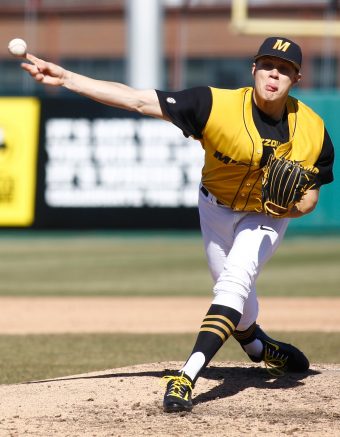
Photo courtesy: News.Missouri.Edu
In this post,
I answer the following three fan questions:
How do you practice picking up the pitch early?
Do you have players swing at everything during batting practice or let them be selective? What drills are good for teaching a player to hit a ball where it is pitched? And,
Why is Timing not taught throughout majority instructors? Great mechanics are good but without Timing principles, you just look good going back to the dugout. What are some of the different ways you would teach/describe Timing?
The following is a compilation of resources I wish I had when I was still playing.
Coaches, if you aren’t taking full advantage of these, then you’ll be slowly losing ground in games over the next 5 years, that I can assure you. Get out ahead!
Onward…
How do you practice picking up the pitch early?
Check out the feedback software you can use to work on getting GREAT at pitch recognition. Dr. Peter Fadde calls this ‘video occlusion’, which allows a hitter to focus on pattern recognition for the first 10-20 feet of ball flight. CLICK HERE for a blog interview I did with Dr. Fadde for more information on the benefits of his ‘video occlusion’ training.
The greatest thing about the GameSense software, is that coaches can keep track of their players’ use of the software with real numbers. What’s measurable is manageable.
As a player, I would’ve eaten this up when I was younger.
And yes, it requires a subscription, and the pricing plans differ depending on usage. On the homepage, GameSense is offering a free trial, so you can check it out and see if it’s right for you.
CLICK HERE to grab your FREE trial of the GameSense app that focuses on pitch recognition training…i.e. picking the ball up early out of the pitcher’s hand.
By the ways, gS Pitch-IQ was named one of the best products at the 2017 ABCA convention in Anaheim!
Boost Batting Average with Pitch Recognition Training
Unlock your full hitting potential with GameSense. Our scientifically proven pitch recognition training helps players of all levels improve their batting average, on-base percentage, and overall performance. Start your journey to better hitting today!
Do you have players swing at everything during batting practice or let them be selective? What drills are good for teaching a player to hit a ball where it is pitched?
I’m not sure I’d ever let hitters swing at everything during batting practice. Everything we do at practice, as coaches, MUST have a purpose. And that purpose MUST prepare our players for the game environment.
CLICK HERE to watch YouTuber Trevor Ragan compare the benefits of training “ugly” in a post I did showing how to EFFECTIVELY transition grooved batting practice swings into game ones.
Here’s why swinging at everything in the cages DOES NOT translate into games…motor skill learning in a competitive environment MUST follow these three steps:
READ – i.e. pitch recognition and spin
PLAN – i.e. timing
DO – the swing
You see, when a hitter swings at everything in the cages, most of what they’re working on is in the “DO” portion. There’s very little READ or PLAN present, which is required in a game environment.
“Massed Training”, as defined by SchoolOfThinking.org, is said to be a far less effective strategy for retaining knowledge or developing skills. In other words, practicing the same thing over and over again WITHOUT a break and evaluation period is inferior to spaced and/or ugly training. CLICK HERE for my Hitting Outcomes Evaluation Checklist.
So what does being selective in the cages look like:
After every 5-swing round, the hitter is asked, “How many strikes did you swing at?”(and they’re affirmed or corrected based on their answer)
You can also do what I call is a Reverse Strike-Zone round. This is where they MUST swing at “balls” – within reason, you don’t want them throwing their bat in the cage – and taking “strikes”. WHY would you do this? It helps define a hitters strike-zone/hitting zone, and offers a better variety of body movement which the body’s springy fascia LOVES!! This will melt their brain by the way 😛 lol
CLICK HERE for this post I did on plate discipline – splitting the plate up into 2/3’s and 1/3 is another great way to teach your hitters to be more selective.
This answers the second part to the reader question above…you can also turn on READ, PLAN, DO by limiting what parts of the field you want the hitter to hit to, OR limit certain elevations you want the hitter to hit at, regardless of pitch type, location, and speed. Addressing the former…you can setup targets out in the field preferably in spots where you don’t find any fielders (gaps/down the lines), and hitter has to hit the target as hard as they can. Addressing the latter…I’ve seen some coaches place shagging screens about 30 to 50-feet from the batter’s box creating a barrier to hitting ground-balls, and the objective is to hit the ball hard over the screens.
Random pitch type rounds – an example of this is randomly throwing either a 2-seam fast-ball or a curve-ball, and having the hitter stick to seeking out one pitch over the other for one 5-swing round.
2 or 3-plate drill rounds – where the hitter moves from different plate distances between or during 5 swing rounds. The plates can be placed about 3 to 5 feet apart. This is a GREAT timing drill.
Doing situational hitting rounds…hit-and-runs, move runner over, and bunts/drags/pushes.
I’m sure other coaches have cool deviations of the above, so please SHARE in the comments section below.
The point is, hitters should have a purpose when taking batting practice, NOT just swinging at everything, IF they want to match the game environment.
Why is Timing not taught throughout majority instructors? Great mechanics are good but without Timing principles, you just look good going back to the dugout. What are some of the different ways you would teach/describe Timing?
Totally. I tell my hitters that the most effective mechanics in the world don’t mean a thing if they can’t get on-time.
Surprisingly, some hitting instructors don’t think timing can be taught? I disagree.
Now, let me clear up a common misconception…do you know the difference between timing and reaction time?
I got the following demonstration from my good friend Taylor Gardner, co-inventor of the Backspin Tee. Do this with your hitters…
Tell them to stand in front of you, and hold a baseball/softball an arm’s length away from you at about the height of their head.
Then tell them you’re going to drop the ball at a random time…try varying the times you drop the ball, and you’ll find it’ll be a challenge for them to catch it. Repeat two more times. This my friend is a demonstration of reaction time.
Then tell them you’re going to drop the ball after counting to 3 (no tricks here coaches)…count to three, then drop the ball. Repeat two more times. This my friend is a demonstration of timing. And as you may guess, this will be much easier to catch for your players.
Timing can be taught with the right methods. Here are my top three:
The TWO or THREE plate drill mentioned above,
Switching bat sizes and weights between or in the middle of 5-swing rounds, and
Switching ball types at random…using baseballs, softballs, whiffles, golf whiffles, racket balls, Smush balls, and tennis balls.
Thank you Mike Ryan from Fastball USA for the last two. A hitter will have to re-calibrate their timing between swinging a longer heavier bat than a lighter shorter one. The different balls mentioned will fly through the air at different speeds making for a perfect off speed practice environment. This can be really challenging for the hitter, and a lot of fun.
But be careful coaches, slowly layer in the difficulty, don’t do ALL three above at the start. Some hitters excel quickly, while others take more time.
Do you see how important training beneath the READ, PLAN, & DO umbrella is?
I hope this helps coaches!!
Please share any other effective methods you do with your hitters that improve what was talked about above. THANKS in advance!
Boost Batting Average with Pitch Recognition Training
Unlock your full hitting potential with GameSense. Our scientifically proven pitch recognition training helps players of all levels improve their batting average, on-base percentage, and overall performance. Start your journey to better hitting today!
https://hittingperformancelab.com/wp-content/uploads/2017/06/pitch-recognition.jpg437340Joey Myershttps://hittingperformancelab.com/wp-content/uploads/2021/10/hitting-performance-labs_c90c0362088ef1d3d528f3078f4f8ac1-300x75.pngJoey Myers2022-06-13 09:15:182025-01-31 05:40:20Best Online Pitch Recognition Hitting Drills Website Game App For Baseball & Softball | Tips To See Ball And Pitch Better, Fix Late Swing Timing, & Help Batter Struggling To Hit


 :
: