Posts

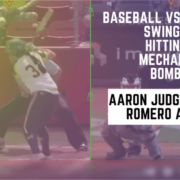
Discover the baseball vs softball swing and learn beginner hitting drills and mechanics to hit bombs further in this swing comparison between Aaron Judge and Sierra Romero.

Aaron Judge Home Run: Same As Sierra Romero?


Let me be up front with you in this Aaron Judge home run post.  Some hitting coaches still think the baseball and softball swing are drastically different.  I disagree…Bigly.  Human movement is human movement.  Sure there are undeniable anatomical differences in body type between males and females, and differences in reaction time from sport to sport…

But there’s virtually zero difference in explosive human movement when the swing objective is hit the ball as hard as you can, as far as you can…consistently.  In this video analysis, I wanted to compare the swings of Sierra Romero and Aaron Judge.  Don’t worry if you don’t know one or the other…you will by the end of this post.

Actually, you know what, if you don’t know either of these hitters, then SHAME ON YOU!!! 😛 lol

Kidding aside, and in my opinion, more baseball players can learn A LOT by watching Sierra Romero swing the bat than any Big Leaguer.  It’s a bold thing to say, but it’s true.

In comparing Sierra Romero to Aaron Judge, we’ll compare the following components of an effective swing:

Who is Sierra Romero?

Besides being my favorite swing model for Fast-Pitch Softball hitters, and according to the USSSA Pride website:

  • 5-foot, 5-inches in height.
  • Sierra finished her rookie professional Fast-Pitch Softball season batting .339 in 109 at-bats with 18 runs scored, 37 hits, 4 doubles, 2 triples, 5 HR, 21 RBI and a .397 OBP.
  • First player in NCAA softball history (at Uni of Michigan) to record 300 runs, 300 hits and 300 RBI in her career.
  • Owns NCAA record in career runs (300) and grand slams (11). Ranks fourth all-time in career RBI (305) and slugging percentage (.882) and eighth in home runs (82) and walks (225).
  • Joined the USA Junior Women’s National Team (2012), ISF Junior Women’s World Championship Silver Medalist (2012).


Who is Aaron Judge?

Besides this guy being a friggin’ BEAST of a human being!?  Here are some major talking points, according to Wikipedia.org and FanGraphs.com:

  • 6-foot, 7-inches tall, and 282-pounds (imagine the parents that had to feed this guy!!) lol
  • Was a three sport athlete in High School (Football, Basketball, and Baseball).
  • Played at my Alma-mater, Fresno State, from 2010 and got drafted by the Yankees 32nd overall by the Yankees in 2013.
  • As of April 2017 Exit Velocity metrics, Judge clocked game batted balls of at least 115-mph SIX TIMES!!  Joey Gallo was second with two.
  • Did I mention this guy is a BEAST?!


The Bottom Line…?

In comparing the swings of Sierra Romero and Aaron Judge, there are many BIG WIN mechanical similarities.  They both hit for power and precision.  The softball swing isn’t any different than its baseball counterpart.  Power and precision don’t have to be mutually exclusive.  Size doesn’t matter, however if you’re a beast like Aaron Judge the capability of hitting the ball farther with consistently higher Ball Exit Speeds is greater.  What is clear however, is if you move better, then you perform better.

In the day and age of advanced technology and access to specific experts on human movement and Physics, there’s no room for coaches who resist getting educated.  If you aren’t growing, then you’re dying.
Discover how to hit slow pitching, improve batting timing and rhythm mechanism, and STOP swinging early.  For beginner baseball and softball players.  Learn simple drills and tips for better more on-time hitting…

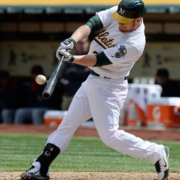
Brandon Moss Swing Analysis REVEALS Slow Pitcher Timing Secret


Brandon Moss REVEALS Slow Pitcher Timing Secret

Brandon Moss photo courtesy: Zimbio.com

This Brandon Moss analysis comes from a conversation I had with Coach Justin Karr and his 12-U Bakersfield Sliders Black team.  Thanks Coach Karr, I hope this helps your troops!

I want to compare what Brandon Moss does differently hitting a slower pitcher, like knuckle-baller R.A. Dickey of the Toronto Blue Jays, to a hard throwing “King” Felix Hernandez of the Seattle Mariners.  We’re going to:

  • Make the complicated, uncomplicated,
  • Learn how-to adjust to slower pitching according to Brandon Moss, and
  • Discuss what a hitter can do to adjust timing.


Make the Complicated, Uncomplicated

Hitting Training For Baseball & Softball Swing Trainers | Hitting Performance Lab

Brandon Moss photo courtesy: MLB.com

First of all, executing flawless hitting mechanics mean nothing if timing is off.  I love how Dr. Kelly Starrett describes learning complicated movements (or strategies) in his book Becoming A Supple Leopard: The Ultimate Guide to Resolving Pain, Preventing Injury, and Optimizing Athletic Performance:

 “When it comes to learning complicated movements efficiently, the key is to make them uncomplicated.  We do this by breaking them down into precise, manageable steps.  Then we emphatically encourage like-your-life-depends-on-it focus in performing each step.  This is the path to a tight learning curve.  It’s the foundation required for optimal performance.”

We focus on one aspect at a time.  In respect to the calibration of timing, we have to forget swing mechanics and focus solely on adjusting the timing.  Making in-game adjustments, timing is THE most important priority.  We teach three possible swing adjustments with our seven hitting strategies.  We refer to these as the three dimensional hitting adjustments:

  1. Timing – is hitter out front or behind?
  2. Vertical (Launch Angle) – did hitter hit popup or ground-ball (or line drive?), and
  3. Horizontal (Barrel Path) – did hitter get jammed or hit ball off the end?

Which one of these after an in-game swing, if tweaked, fixes the other two?

How-To Adjust to Slower Pitching According to Brandon Moss

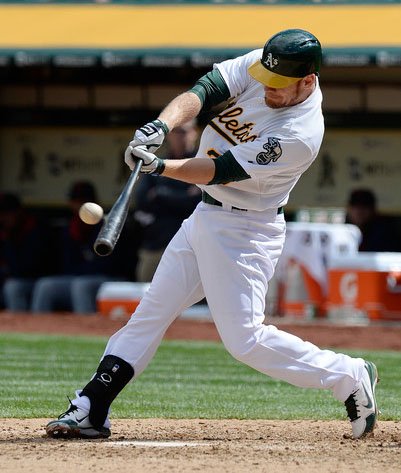
In the video, I compare and analyze two 2013 home-run swings by the Oakland A’s first baseman Brandon Moss:

  1. 77 mph knuckle-ball from R.A. Dickey Moss (left-handed) hit over the center field fence (418 feet*), and
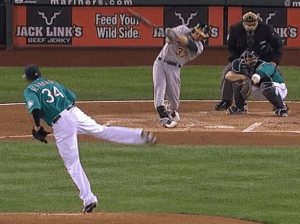
  2. 93 mph fastball from “King” Felix Hernandez Moss hit over the right-center field fence (387 feet*)

(*You can find out more home-run stats at BaseballSavant)

CLICK HERE to revisit a video blog article I did, featuring Josh Hamilton and Mike Trout, where I went over:

  • When does a swing start?
  • Leg kick or slide step? and
  • How to practice timing?

For an average velocity pitcher, each hitter MUST figure out at what point in the pitcher’s delivery that they start their swing.  Then experiment starting the swing at a later point with a slower pitcher.  This will be slightly different for every hitter as the Josh Hamilton article shows.

The main point is, the hitter has to make a a conscience effort to change their timing.  They can’t just use the same timing for every pitcher.  Hitting is a game of inches…being one inch ahead or behind can mean barreling the ball or not.

What’s the best way to practice this? The 2-plate drill shared in this article, and home run derby??  Using the 2-plate drill and throwing seated from 25-30 feet away (under or over hand front toss).  The thrower will be literally lobbing the ball to the hitter as they take two swings and switching plates.  Six swings per round.  The slower the throw, the better.  In our system, this is hitting strategy number 4.

Also, if the whole team’s offensive numbers are suffering against a slower pitcher, then the adjustment DOES NOT necessarily have to be a mechanical one.

One more interesting point…notice how far Brandon Moss cranked the Dickey knuckle-ball?  418 feet!!  “King” Felix?  387 feet…a pitcher’s velocity doesn’t dramatically contribute to batted ball distance.  It’s bat speed that does.  According to a forum at eFastball.com, for every 1 mph of added pitching velocity, 1 foot of batted ball distance is the outcome.  BUT for every 1 mph of increased bat speed, 4 feet of batted ball distance is the result!!  Don’t let low velocity pitchers slow your bat speed down hitters!


Here’s a fun youth hitting drills post to help STOP bat drag for beginner baseball and softball players.  Easy at home indoor use with limited space.  Learn how to fix dragging back elbow for 6 year olds on up.  Discover batting instruction tips for what is bat drag and what causes it.

Okay, I’ll admit it…

Baseball Hitting Instruction: Zack Racing Rear Elbow

It took 30-mins to clean up my Sophomore in High School, Zack May’s, Rear Racing Elbow using Reactive Neuromuscular Training (RNT)…

The one hitting fault that is a bugger to fix is,

Rear Racing Elbow.

Unfortunately: I find that a baseball hitting instruction fix for one player with this challenge, may not work for another.

Fortunately: I do see symptoms that tend to haunt specific Rear Racing Elbow bat drag hitters.

Unfortunately: I also find that the same combination of symptoms may not be present for every hitter.

Fortunately: For this baseball hitting instruction drill to work, the symptoms must be present.

In this post:

  • We’ll define Rear Racing Elbow,
  • Look at the symptoms of this particular case study,
  • Front knee action at landing: slightly bent or straight? and
  • How we fixed the issue in one 30-min session, using RNT…


What is Rear Racing Elbow?

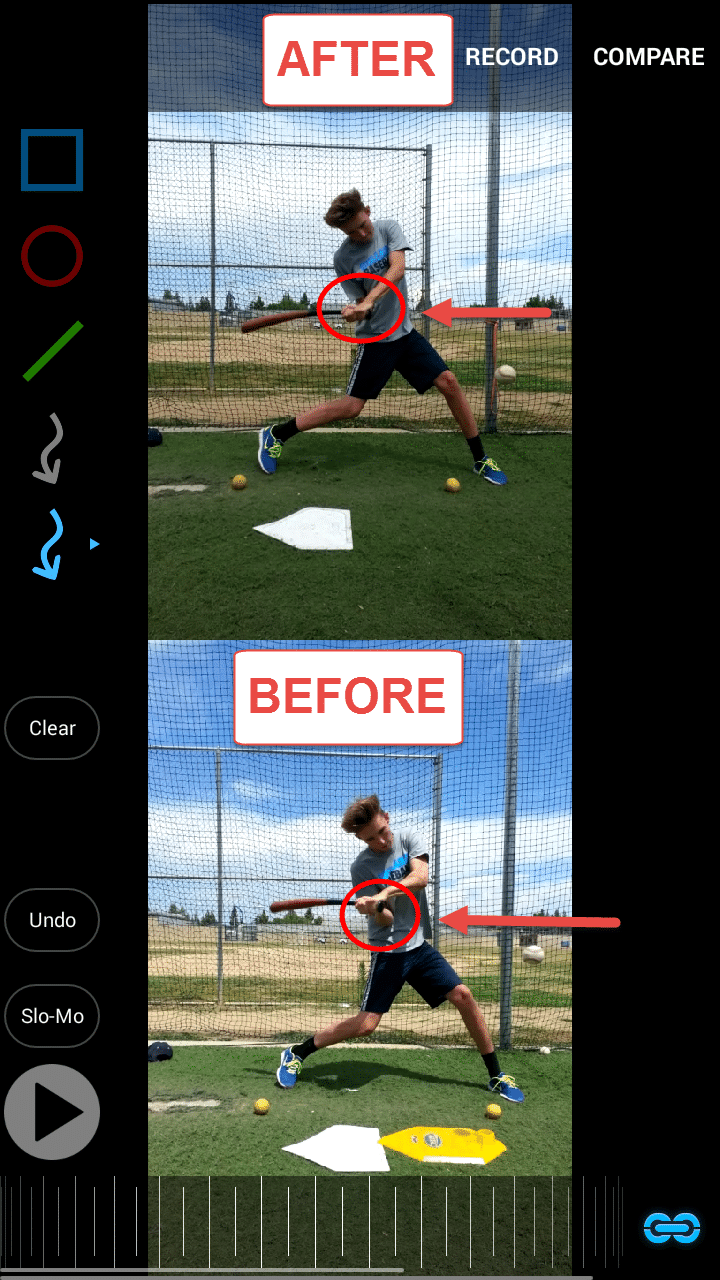
It’s when the rear elbow “races” passed the hands towards the middle of the body (see “BEFORE” image up and to the right).

It can cause the hitter to:

  • Dump the barrel prematurely, which leads to flares OR misses completely to the opposite field, OR
  • Roll over or get jammed on inside pitches.

It’s a nasty bug to fix with conventional baseball hitting instruction, and one my readers sounded off on at the following two HPL posts:

  1. Hitting Tips to Boost Barrel Time on Pitch-Plane, and
  2. Baseball Online: Never Suffer from Bat Drag Again.

Symptoms of Rear Racing Elbow Bat Drag

In this particular baseball hitting instruction case study, one of my local hitters Zack May, a Sophomore in High School, over the past year, has been haunted by these three things…NOT getting the:

  1. Front leg to straight at or passed impact,
  2. Back knee to 90-105 degrees during the turn, and
  3. Downhill shoulder angle before landing, and
  4. Post UPDATE: Over-rotation is a BIG issue we see with the over-coaching of rotational mechanics.


Front Knee Action at Landing: Slight Bend or Straight?

This is a major baseball hitting instruction debate among instructors I respect.  They teach their hitters to keep a slight bend in the front knee at or passed impact.

They point to big sluggers like Mark McGwire and Mark Teixeira, among others, as examples.

The amount of bend in the front knee up to impact will depend on the amount of forward momentum (FoMo) the hitter uses.

The more FoMo a hitter uses, the more Ground Reaction Forces (GRF) are needed to transfer planes of motion from the Frontal/Coronal* (sideways) to the Transverse* (twisting).  In which case, a straightening of the front knee would be highly recommended.  Hitters like Jose Bautista and Josh Donaldson come to mind.

On the contrary though, like a lot of big sluggers, the less forward momentum (wide to little striders), there doesn’t seem to be a need to straighten the front knee during impact.

Think of a wide receiver running a 10-yard 90-degree cut route.  He uses GRF and FoMo just like a hitter, but he’s transferring from Sagittal* (front) to the Frontal/Coronal* (sideways) plane of motion.  In this case, he’s reaching a maximum forward running speed (FoMo), then has to cut very quickly, so you’ll see his plant leg go from bent to straight as he uses Ground Reaction Forces.  Evidenced by him dropping down (or getting shorter) before making the cut.

My hitter Zack is both tall (6’4″), and uses quite a bit FoMo.  So, for him, when that front knee doesn’t get to straight, that’s a problem.  Coupled with the issue of not getting sufficient bend in his back knee during the turn causes the pelvis to not fully rotate.  And as a result, his back shoulder and arm feel like they have to do extra work.  And Rear Racing Back elbow is born!

*CLICK HERE for a more in-depth overview of planes of motion on Wikipedia.

Post UPDATE: we’ve since moved away from the front knee action having to get straight as an absolute to fixing bat drag or contributing to significant power, for that matter.  We see hitters like Bellinger, Seager, Rizzo, Pedroia, and Beltre all keep significant bend in the front knee when getting a ball below their belt line.


Baseball Hitting Instruction: How We Fixed Zack’s Bat Drag in 30-Mins…

To get you up to speed, check out this Dustin Pedroia & how to fix stepping in the bucket post I did that will explain the use of Reactive Neuromuscular Training, or RNT.

Baseball hitting instruction and RNT drill we used with Zack,

  • We used two long resistance bands positioned as close to his pelvis as possible (high up the thigh without damaging “the goods”),
  • Both resistance bands pull in opposite directions (feeding the mistakes – front knee wants to stay bent, and back knee wants to straighten during the turn), and
  • We worked on getting him to “resist the resistance” during the turn.

One thing we also used that seemed to be the permanent fix was finger pressure (see below…)

Baseball Hitting Instruction SAFETY Issue: Please be careful with this drill.  The person facilitating the front band is in the way of a swinging bat!!!  To be done with adults who know better, not teammates.  Please watch video above for clarification on this.

Post UPDATE: one other concept we’re had even BETTER results with fixing dragging back elbow bat drag is the concept of wrist snap or pronation.  We kind of talk about the concept here.