Posts

Discover the load and stride!  Learn how to fix lower body swing mechanics, weight distribution, and proper footwork for beginning baseball and softball hitters.

Gain Distance The Easy Way PART 1


We’re going over:

  • How to feel lighter in the Final Turn using the rule of Un-Weighting,
  • Moving the body forward to create momentum, and
  • Turning Yourself into a Projectile Missile (Broad v. Triple Jump).

It’s amazing what happens when you add a little momentum.  Muscles don’t have to work as hard, and the body moves effortlessly through space.  We get a “head start” using our body’s weight more than we realize…to get up from the floor, the couch or chair, or to step up into the bed of a truck.  Why should hitting be any different…heck, just about every good player uses momentum in some way.  I hope you enjoy Baseball Hitting Video Gain Distance PART-One.

CLICK HERE to watch a YouTube video on how Babe Ruth gains distance the easy way.


MLB Small-Boppers Who Use Forward Momentum…

Jose Bautista (4-Time All-Star):

Baseball Hitting Video Gain Distance the Easy Way: Jose Bautista

Video courtesy of MLB.com

Andrew McCutchen (2013 NL MVP, 3-Time All-Star):

Andrew McCutchen Spine Engine

Video courtesy of MLB.com

Robinson Cano (5-Time All-Star):

Robinson Cano Baseball Hitting Video

Robinson Cano is one of the best examples I can think of for Baseball Hitting Video Gain Distance the Easy Way PART-One


Jumping World Record Holding Athletes Who Use Forward Momentum:

Standing Long Jump, Korean World Record holder at almost 10.5 feet:

WR Standing Long Jump

Look at how he uses his arms to gain Forward Momentum…video courtesy of YouTuber Hyrugaful

Triple Jump World Record Holder Jonathan Edwards from Great Britain at 18.29 m (60 ft 0 in):

Jonathan Edwards GBR WR Triple Jump

Look at how much Forward Momentum is gained before breaking the world record. Video courtesty of YouTuber MCTnF

CLICK HERE for Baseball Hitting Video PART-2, where we go over how to apply what we learned in this video.

Discover how to hit more line drives using swing bat path mechanics science to hitting on the plane of the pitch like Joey Votto.

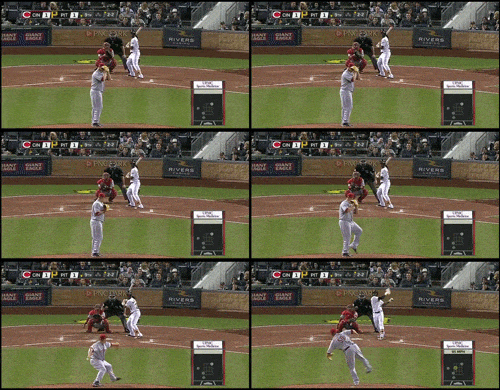
Baseball Swing Slow Motion Analysis Of Joey Votto


This is Part-2 of a 3-part baseball swing slow motion analysis video series coming straight out of the Pitch-Plane Dominator online video mini-course…

Hitting Training - Pitch-Plane Dominator

Sick of struggling to reduce your hitters ground balls, swing and miss strikeouts, and non-productive weak fly balls?  This simple 4-Step online video mini-course (7-modules total) will help hitters weighing less than 100-pounds, barrel the ball more consistently.  Dramatically decrease ground balls, strikeouts, and weak fly balls (no matter the pitch location or speed) by applying human movement rules validated by science.

If you haven’t already, then CLICK the Link below to…

Get Access to The Pitch Plane Dominator Online Video Mini-Course

“If you want to be successful, find someone who has achieved the results you want and copy what they do and you’ll achieve the same results.” – Tony Robbins

I received the following reader question:

“If you could only teach one swing, whose would you teach?”

And what follows in this baseball swing slow motion analysis of Joey Votto video, is my answer, as it relates to getting the barrel on, and staying on the plane of the pitch for as long as possible.

We’ll discuss Joey Votto’s:

  • Pitch-Plane consistency metrics,
  • 2015 ESPN’s HitTracker spray chart, and
  • Mechanics as they apply to Pitch Plane Domination.

Let’s build Joey Votto’s case as the best to copy for Pitch-Plane Domination…


Joey Votto Pitch-Plane Consistency Metrics

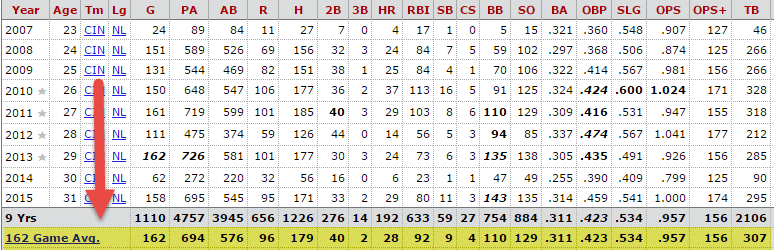
According to Baseball-Reference.com, Joey Votto’s 162-game averages (over 9 years in the League) are as follows:

Baseball Swing Slow Motion Analysis: Joey Votto Metrics

Look at the “yellow” highlighted line…

Here are the Joey Votto Metrics to pay particular attention to (definitions are according to FanGraphs.com):

  • On-Base% (OBP) – measures the most important thing a batter can do at the plate: not make an out…Joey Votto: .423, League Average is: .320
  • Isolated Slugging% (ISO) – measure of a hitter’s raw power and tells you how often a player hits for extra bases…Joey Votto: .223, League Average is: .140
  • OBP + SLG (OPS) – the sum of a player’s on-base percentage and their slugging percentage…Joey Votto: .957, League Average is: .710
  • OPS+ – This statistic normalizes a player’s OPS — it adjusts for small variables that might affect OPS scores (e.g. park effects) and puts the statistic on an easy-to-understand scale…Joey Votto: 156, League Average: 100

As you can see, Joey Votto is well above average in “not making an out”,  and “raw power”.  What’s also interesting is Joey Votto’s strikeout and walk percentages (averaged over his career):

  • Strikeout%Joey Votto: 18.6%, League Average: 18.5%, and
  • Walk%Joey Votto: 15.9%, League Average: 8.5%.

Joey Votto 2015 ESPN’s HitTracker Spray Chart

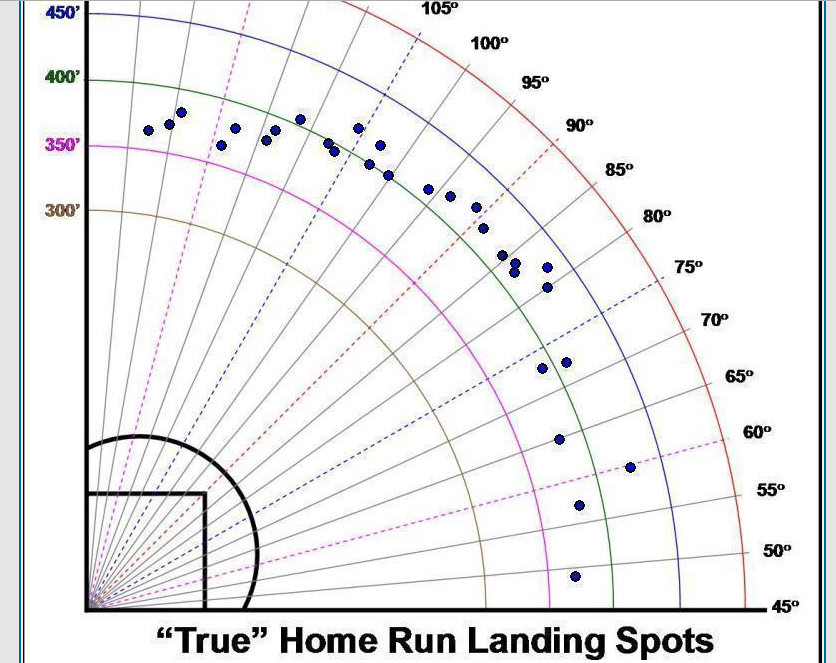
Check out the HitTrackerOnline.com spray chart of Joey Votto’s 29 homers in 2015 (keep in mind he’s a left handed hitter):

Baseball Swing Slow Motion Analysis: Joey Votto spray chart

Joey Votto 2015 spray chart courtesy: HitTrackerOnline.com

CLICK HERE for a FanGraph.com article titled, “Joey Votto on Hitting”. It goes into how:

  • Cerebral a hitter he is about his mechanics,
  • He purposely tools his swing to limit defensive shifts, and
  • He’s given up some power (dingers in particular) to cover the Pitch-Plane more effectively.

The aforementioned link is a GREAT read.  From the above spray chart and metrics, I’d say he “NAILED IT!!”


Joey Votto Mechanics as They Relate to Pitch-Plane Domination

In the above 17:23-minute baseball swing slow motion analysis video of Joey Votto’s swing, we go into more detail about the following FIVE human movements rules for Pitch-Plane Domination:

  1. Front Knee bend before swing initiation, and during the Final Turn,
  2. Back Knee bend during the Final Turn,
  3. Back foot skip during the Final Turn,
  4. Barrel matching the plane of the pitch early, and
  5. Barrel ‘chasing the ball’ passed impact getting to ‘Power-V’ after impact.

As Tony Robbins said,

“If you want to be successful, find someone who has achieved the results you want and copy what they do and you’ll achieve the same results.” 

Joey Votto is your hitter to dominate the Pitch-Plane when looking at baseball swing slow motion analysis.

Discover how to coach footwork hitting mechanics with this Yordan Alvarez slow motion frame by frame swing breakdown.  Learn how to teach perfect youth baseball and softball drills for beginners.

Yordan Alvarez Swing Analysis: Where Should Hitter “Adjustability” Be And How To Get It 


Before we get to the Yordan Alvarez swing analysis … we MUST …

This is our 300th hitting blog post!!!! 😀

Golly, time has flown since we started HittingPerformanceLab.com back in 2014.

Since 2013, we’ve had almost 20,000 coaches, instructors, and parents – just like you – invest in our books, courses, and resources.

One of the comments we sometimes run into on the socials, is that we’re not credible to talk hitting because we’re “just trying to sell something”

What these people don’t understand about our Goodwill…

  1. This is our 300th FREE blog post on hitting!! And,
  2. As of today, we’ve given away – for FREE – 8,293+ ebook versions of our books currently being sold on Amazon (majority of those are our Amazon bestselling book The Catapult Loading System).
  3. You don’t know what you don’t know…you know?

And yes, I spend A LOT of time, money, and effort researching, studying, and working with hitters.  This is what I do for a living.  This isn’t a side hustle for me, like it is for some.  100% of my attention is spent researching, studying, tinkering, experimenting, testing, and talking to others who do the same…

So yes, I deserve to monetize my time, effort, and knowledge.  I don’t go to this cotton headed ninny muggin’s workplace or business, and tell their customers not to buy from them because they’re “just trying to sell something”

And by the way, just because someone sells a hitting product, DOES NOT automatically relieve them of credibility on the subject.  Test their theories, philosophies, or products, and if they don’t work within 1-3 weeks, THEN call them a snake oil salesman.

That aside, one more thing…

Today (8/15) is my birthday!  39-years young.  For some of you, I’m still a young buck…to others, an old fart…and for those around my same age, what did you think about the Beverly Hills 90210 reboot? 😛 lol

“Okay, I get it, lots to celebrate, so what can you teach me in the above Yordan Alvarez swing analysis video?”


Yordan Alvarez Swing Analysis Video Includes…

This Yordan Alvarez swing analysis video explores where hitters SHOULD build “adjustability” in the swing (HINT: it’s not in the upper half or the front arm).  Here’s what we go over:

  • Sideways back foot,
  • Skipping back foot,
  • Front knee used to buy time, and
  • Back leg bend versus straightening.

Learn how to teach perfect line drive science-based swing mechanics to baseball and softball beginners at the Hitting Performance Lab…

Baseball Hitting Tips For Youth: Can We Teach One Swing To ALL Hitters?


This is Part-3 of a 3-part baseball hitting tips for youth video series coming straight out of the Pitch-Plane Dominator online video mini-course…

Hitting Training - Pitch-Plane Dominator

Sick of struggling to reduce your hitters ground balls, swing and miss strikeouts, and non-productive weak fly balls?  This simple 4-Step online video mini-course (7-modules total) will help hitters weighing less than 100-pounds, barrel the ball more consistently.  Dramatically decrease ground balls, strikeouts, and weak fly balls (no matter the pitch location or speed) by applying human movement rules validated by science.

If you haven’t already, then CLICK the Link below to…

Get Access to The Pitch Plane Dominator Online Video Mini-Course


“The man who grasps principles can successfully select his own methods. The man who tries methods, ignoring principles, is sure to have trouble.” – Ralph Waldo Emerson

I received the following reader question:

“Do you believe in one swing fits all hitters?”

In this baseball hitting tips for youth video post, we’ll:

  • Define ‘one-swing-fits-all’,
  • Reveal a human movement formula, and
  • Talk about how Principles are like bowling “bumpers”.

Before you get your panties in a bunch, let’s…


Define ‘One-Swing-Fits-All’

Is there truly a ‘one-swing-fits-all’ baseball hitting tips for youth hitting approach?

Most baseball or softball hitting savants will tell you that you can’t mold every hitter into cookie cutter mechanics.

But I’m here to tell those people,

You’re WRONG.

DEAD wrong.

Look, I know this will piss some people off.

And it may sound like I’m setting the hitting community back 4-decades for saying it.

But hear me out,

I’m not talking about messing with a hitter’s “style”

  • Babe Ruth’s unique feet together position pre-pitch….OR
  • Joe Morgan’s ‘chicken-wing’ back elbow…OR
  • The patented Kevin Youkilis dainty hand grip position pre-swing (pictured above).

Here’s what I’m saying,

Hitting is quite frankly…

A Human Movement Formula

Like Tony Robbins always says, success leaves clues.

And there are certain players that dominate the Pitch-Plane, like I covered in this Joey Votto baseball swing slow motion analysis video.

What are the baseball hitting tips for youth clues hitters like Joey Votto are leaving behind for us to model?

Or better yet, what natural forces on the planet empower him to be such a tough out, while also hitting the ball consistently harder than others?

Let’s revisit the Ralph Waldo Emerson quote from above:

“The man who grasps principles can successfully select his own methods. The man who tries methods, ignoring principles, is sure to have trouble.”

A ‘one-swing-fits-all’ hitting approach has to do with, The man who grasps principles can successfully select his own methods”.

Think of ‘methods’ as the hitting drill or movement being practiced.  And the ‘principle’ as the objective that that hitting drill is based upon.

What baseball hitting tips for youth principles govern human movement, are validated by science, and are clues that are left behind by hitters, like Joey Votto, who effectively dominate the Pitch-Plane?

What’s more…

Principles are like ‘Bowling Bumpers’

Think of these baseball hitting tips for youth human movement principles, or “rules”, as bowling bumpers.

Whenever we teach a ‘one-swing-fits-all’ approach, be careful that you’re not to mess with a hitter’s style.

HOWEVER, what does NEED to be analyzed is whether the hitter is using the myriad of principles mentioned above.  These are the “bumpers”.

When analyzing any hitter…male OR female…Little Leaguer OR professional,

We need to know whether Johnny or Sally are applying Ground Reaction Forces (or GRF’s) properly.  Are they loading and unloading their body correctly?  Are they using rotation and anti-rotation forces effectively?  Are they moving their spine in a way that’s safe, but also optimizes the body’s energy transfer?

This is where I believe in a ‘One-Swing-Fits-All’ hitters.  It has NOTHING to do with a hitter’s style, and MORE to do with a hitter’s use of naturally occurring forces on the planet.

If you aren’t teaching the swing between these ‘bumpers’, then you’ll be left far behind.  And most certainly will your hitters.

J.D. Sullivan Hitting4Contracts.com

J.D. Sullivan hitting…

Discover how to use lower half ground forces in this hitting mechanics breakdown.  Learn proper weight transfer and footwork drills for youth baseball and softball beginner swings.

3 Shocking Mistakes Killing Your Effortless Power

You guys are in for a treat… (also, make time to go through the comments at the end of the blog post.  There are a ton with REALLY good information!!)

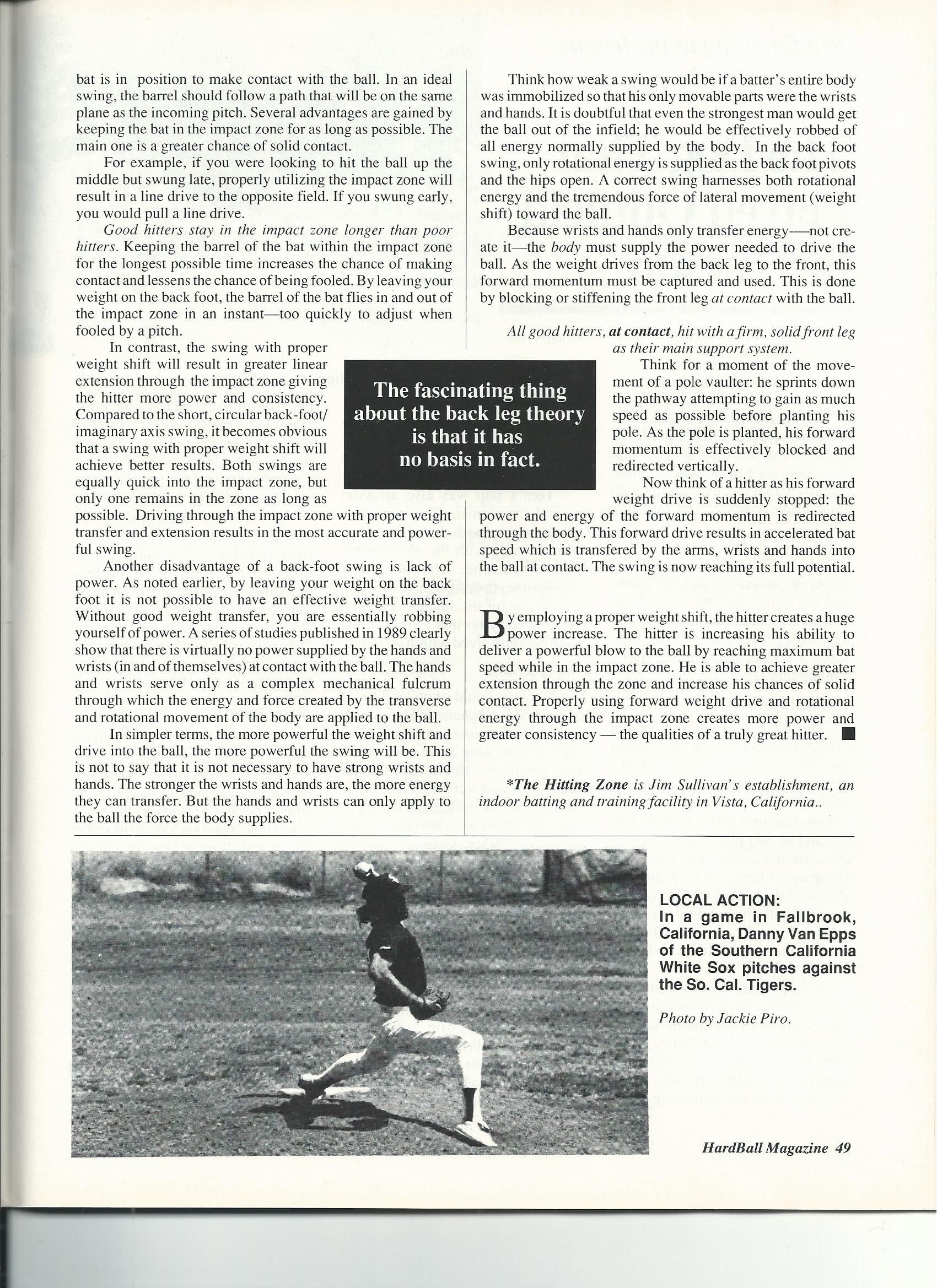
I wanted to share with you a 1991 article published in Hardball Magazine about hitting.  Keep in mind that video motion analysis was virtually non-existent at that time.  Video cameras resembled what Michael J. Fox held in the movie Back To The Future 😛 lol

The information contained in the following two pages is eerily similar to what we talk about here at HPL.  Even down to the “buzz” words used.  And just to let you know, the ‘3 Shocking Mistakes…” are covered in the below article.  By the way, I’ve never come into contact with the gentleman I’m about to introduce until now…

The author of the published post, Jim Sullivan (J.D.), has accumulated the following credentials with his hitters over the last couple decades (from his website: Hitting4Contracts.com):

  • 7 First Round Draft Choices,
  • $20,000,000 (million) in Signing Bonuses,
  • Players Drafted or Signed 60 Times, and
  • Millions in Scholarships.

And he did this completely under the radar.  As he said, to escape coaches punishing his hitters in their lineups.  My hitters have received the same treatment, much like a lot of yours.  Crazy how fragile a 40+ year old male ego is when it comes to hitting!

One of the hitters J.D. worked with at both the amateur and professional levels was Troy Glaus:

“JD introduced me to key concepts that are essential to my approach to hitting. Concepts that you won’t find anywhere else. I first met him in 1991 and have since spent serious one on one hitting time with him (as both an amateur and pro).  I have seen him greatly increase power in not only individual hitters but also entire teams.”

For those that don’t remember Troy Glaus, he was a World Series MVP, American League Home Run Champion, Four Time All Star, 1996 U.S. Olympic Team. Angels #1 Draft Pick 1997, # 3 overall.

J.D. reached out to me via comment on my baseball swing mechanics “Squish the Bug” experiment YouTube video.  Without further adieu, here are the two pages of the published article in 1991…

J.D. published post on hitting in 1991


Page 2…

J.D. published hitting article in 1991

What are your thoughts on the article?

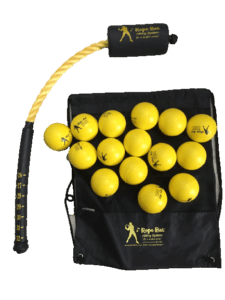
In this Rope Bat review, discover the best place hitting aid training drill to hit opposite field home runs for baseball, fastpitch softball, and slow pitch softball pull hitters!

What Is The #1 Pitch Location Focus Against Hitters?


Now, if you guessed down or outside, then you’re on the right track. How do we teach hitters to consistently smash the ball to the opposite field? Two things MUST be considered:

  1. When the barrel enters the zone, and…
  2. Where the contact point is.

One of my favorite hitting aids for feeling this is the Rope Bat. In the above video, I  demonstrate one of my favorite ways to teach hitters how to consistently smash the ball to the opposite field, which I call the “Deep, Deep” opposite field hitting drill.

But before I get there, let’s talk about setup.  You’ll notice I’m in a small confined space for those parents that have the same challenge with being able to work on hitting stuff.

Like I said, there are two things you want to be concerned with: when the barrel enters the zone and where the contact point is.  For this drill we’ll only setup the two (of three) catcher’s glove markers for Deep, Deep…

  • Set baseball or softball right under where the real catcher’s glove would be, and
  • Set another baseball or softball right under where a catcher’s glove would be IF his glove were inline with the hitter’s back foot.

Click this link to see contact points batting tee setup.   If throwing LIVE, then make sure that whoever is throwing is targeting middle away or middle down in the zone.

And what we can do with the rope bat is we can get the hitter to feel deep deep deep barrel, deep contact by knocking off the back catcher’s glove, the real catcher’s glove and then passing right over the deep contact point. So we want to let it get deep and hit it deep.

In this Rope Bat review, you’ll discover a swing training aid to fix youth bat drag in baseball and softball hitters.  Learn about “shifting foot pressure” in this modern hitting mechanics video guide swing breakdown.

Baseball Swing Drills: Improve Bat Lag & Forward Momentum On The On-Deck Circle With The RopeBat


This is Part-2 of a 3-part baseball swing drills Ropebat (works well for softball too) video series coming straight out of the Reaction Time Mastery online video course…

Baseball Swing Drills Ropebat: Reaction Time Mastery

Sick of struggling to get your hitters on-time, balanced, and keeping high Ball Exit Speeds, especially while hitting off-speed and breaking pitches?  This online video course (7-modules total) reveals cutting edge science on the topics of: Vision, Tracking, Timing, and Forward Momentum.  Finally, you’ll be able to track pitches crystal clear, accelerate reaction time decision-making, & get ON-TIME without losing swing effectiveness with this “secret” online video course you can’t live without.

If you haven’t already, then CLICK the Link below to…

In this baseball swing drills video, we’ll discuss the following:

  • Rope Bat benefits to bat lag,
  • Forward Momentum Drill using Rope Bat, and
  • Top-hand finger pressure bat lag drill…

Baseball Swing Drills RopeBat Benefits to ‘Bat Lag’

‘Bat Lag’ is the beautiful result of fascial lines in the torso being CONNECTED to what the explosive rotational athlete is holding in their hand or hands.

See image of Josh Donaldson to the right.  Look how his hands are positioned between his elbows (odd camera angle to see this I know).

Which is to say, the barrel position in space and time in this image is perceived by A LOT of coaches as being waaaaay too long.

They add that Josh Donaldson is just strong and can get away with a ‘long barrel’ like that.

And they’re WRONG.  Dead wrong!!

The difference between ‘The Bringer of Rain’, and those youth hitters that DO HAVE long swings is this…

‘Bat Drag’ (the evil one) is one of a racing back elbow.

The following baseball swing drills using the Rope Bat, particularly the Top-Hand Finger Pressure Drill, will be a lethal combination to crushing the ‘EVIL ONE’…

Forward Momentum using Rope Bat

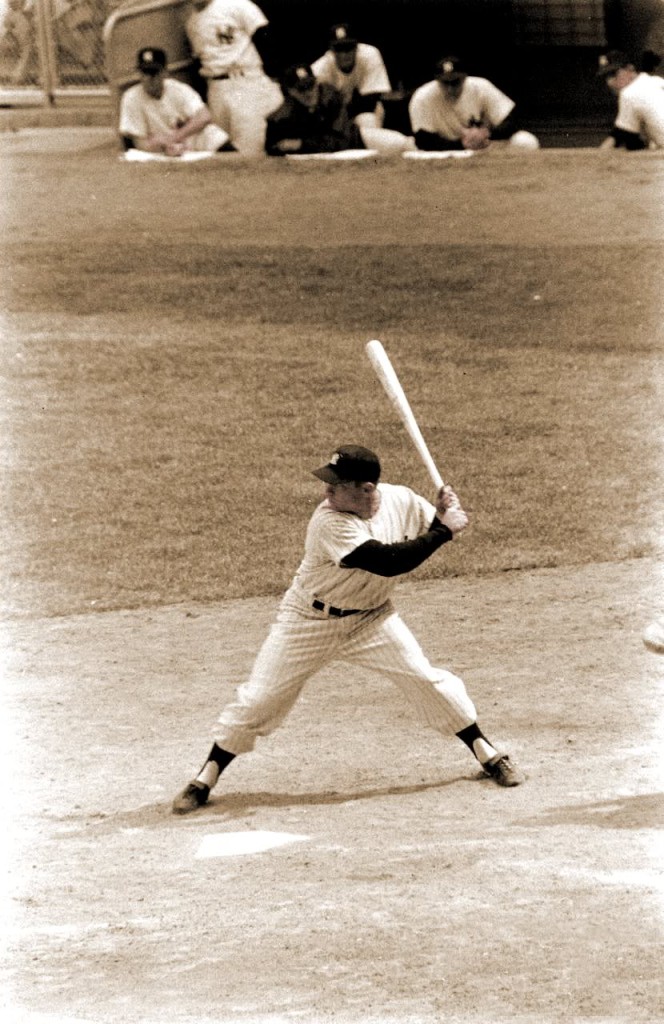
Baseball Swing Drills Ropebat: Mickey Mantle Shifting Foot Pressure

The Mick’s first phase of shifting foot pressure. Photo courtesy: http://s685.photobucket.com/user/BillBurgess

In the HPL article titled, “Crush the Ball Like Mickey Mantle”, I went over his shifting foot pressure (aka Forward Momentum.  Quoted from the article,

“We can see from the moment he lifts his stride foot to that foot touching down that his foot pressure looks like this:

  • Back foot pressure – is on the outside, and
  • Stride foot pressure – is on the inside.

As Mickey Mantle’s stride foot lands the foot pressure shifts as follows:

  • Back foot pressure – moves to the inside, and
  • Stride foot pressure – moves to the outside.”

Before using shifting foot pressure baseball swing drills using the Rope Bat, a hitter must FIRST get comfortable executing shifting foot pressure without a bat, then with, then progressing to using the Rope Bat.

These are the proper progressions to get a younger hitter acclimated to the new skill.


Top-Hand Finger Pressure Bat Lag Drill using RopeBat

Baseball Swing Drills Ropebat: Finger Pressure

We used a couple ‘racing back elbow’ fixes for Zack, but it wasn’t until we used top hand finger pressure, that the fix stuck. It took two 30-min sessions, a week apart.

Nothing banishes Bat Drag like top hand finger pressure…

Bottom three fingers of the top hand only (pinky, ring, and middle fingers)…

Start squeezing these fingers when the hitter picks up their front foot, and hold the finger pressure well past impact.

This activates the springy fascia connecting what Thomas Myers, in his book Anatomy Trains, calls the Front Arm Lines to the multiple lines mapped throughout the torso.

CLICK HERE for the “Babe Ruth Reveals Hand Tension?” Zepp swing experiment I did testing this.  And a big THANKS goes out to Lee Comeaux for shedding even more light on this strategy.

Like I mentioned earlier, combining top hand finger pressure while swinging the Rope Bat, is a LETHAL combination for crushing ‘Bat Drag’.

Improve a hitter’s ‘Bat Lag’ and shifting foot pressure by having them swing the Rope Bat on the on-deck circle.

Unfortunately, you can’t hit baseballs, softballs, or tennis balls with it.  But whiffles are fine.  However, I think the magic in the Rope Bat, is in dry swings anyway. Baseball swing drills (works well with softball too) that promote a hitter’s tempo and cadence are worth their weight in gold.

This newly UPDATED article (video isn’t updated) presents a fun youth hitting drills approach to help fix bat drag for baseball and softball players.  We go over what causes and what is bat drag, how to cure and stop it tips for batting swing beginners.

#1 Youth Baseball Swing Fix To Deflating Bat Speed


Awhile back I posted the following youth baseball post to my Hitting Performance Lab Facebook fan-page (CLICK HERE if you haven’t “Liked” my fan-page yet…new content daily):

[fb_embed_post href=”https://www.facebook.com/HittingPerformanceLab/posts/565739680222497/” width=”400″/]

This video blog post will target one of the worst youth baseball swing offenders to deflating bat speed…bat drag.  In this article, we’re going over:

  • What is and What Causes Bat Drag?
  • The science of Bat Drag (to hitting an unknown moving pitch), and
  • 1 Way How to Fix, Cure, & Stop Youth Bat Drag


What Causes AND What is Baseball Youth Bat Drag?

#1 Youth Baseball Swing Fix To Deflating Bat Speed

Notice the difference in Charles’s barrel angle.

Article UPDATE: Bat drag is when a young hitter’s upper and/or lower body rotates way passed the hands and bat to cause the back arm elbow to race passed the hitter’s belly button.  We call this racing back elbow.

Youth bat drag is causes mostly by over rotation of the upper and/or lower half.  It is NOT like what some coaches say, being caused by a dominant top hand or back arm, quite the opposite actually.  Bat drag can be caused by a weak and disconnected top hand and back arm.

This article I originally posted back in 2015, and blamed bat drag on a barred out-front arm.  I’ve since revised my position on this thanks to Perry Husband.  A barred out-front arm DOES NOT result in a long slow swing, an early barrel in the hitting zone does.  Specifically on pitches that are middle in.  For a refresher on how barrel path changes based on pitch depth, then click this post.

3 Common Myth “Tips” of Fixing Bat Drag

Myth#1 – sometimes coaches say get the back elbow up in the batting stance.  We do teach this to help get the front shoulder slightly down at stride landing.  Lifting the back elbow without this principle is irrelevant to fixing anything.

Myth#2 – the hips before hands argument is old and stale.  This is EXACTLY what’s happening with bat drag, the hips are way out front of the hands, resulting in a connected swing.  The two main problem with bat drag are 1) Not taking slack out of system (fix below helps with this), and 2) over rotation of upper and or lower half.  Over-teaching myth #2 tends to promote over-rotation.

Myth#3 – again, hip rotation is not the end all be all to power, contact, etc. in the swing.  It’s over coached.  If anything, we should be coaching LESS hip rotation, NOT more.

Bat drag is a disease of over rotation, so rotating more will only make matters worse.  Here’s a great place to start…

1 Way How to Fix, Cure, & Stop Youth Bat Drag

Youth Baseball ALERT: Stop Arm Barring

See Cutch pulling his top hand, while bottom hand restrains that pull forward (look at muscles in left forearm and triceps). Photo courtesy: MLB.com

Typically, I have my youth baseball hitters practice the Catapult Loading System when we have an arm barring issue.  The finer points before a hitter lands in the Fight Position are:

  • Showing pitcher your numbers,
  • Hiding hands from pitcher, and
  • Slight downhill shoulder angle.

Another piece I’ve just added to the puzzle comes from Homer Kelly in his book The Golfing Machine.  The following quote may shed additional light on “educating the hands” to combat arm barring…

“Power Accumulator #1 (for right handed golfer) – is the bent right arm. Even though the right biceps is active, the backstroke is always made with the right arm striving to remain straight. But the straight left arm restrains this continuous extensor action of the right triceps with an effortless checkerin action. Consequently , during release, the right arm can straighten only as the left arm moves away from the right shoulder.”

You see, the problem with bat drag at the youth baseball level isn’t the move itself, but how the compensation is triggered.  What’s happening before the front arm bars out?  Is the hitter properly activating the springy fascia within the torso?

If you “Click here to ‘Get Instant Access'” button below, you can get a free video that explains:

  • Why the following advice: “Power is all in the hips”, “Load and explode the hips”, and “The hips lead the way” won’t produce the repeatable power you’re looking for…

  • Where power really comes from – the answers to how the body actually loads are validated by science…

  • The 3 Do’s & Don’ts that will help you execute this simple strategy without any hitches in swing quality…

Fun ways to teach a beginner kid (get them to buy in) to hit with power and improve batting timing for baseball and softball players.  Helpful drills and tips for 4, 6, 8, 9, 10, & 12 year olds.

Softball Hitting Tips for Beginners: 5 Little Known Ways To Improve Hitters


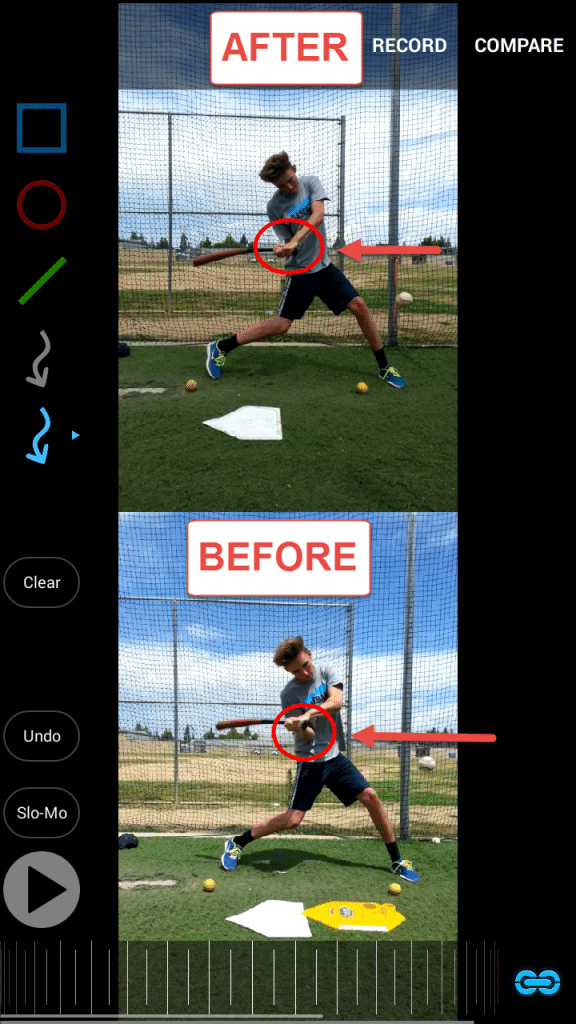
Softball Hitting Tips for Beginners: 11yo Jackson Handler

This is one of my online lessons out in Pennsylvania (I’m in Cali), 11yo Jackson. 2.5 months between BEFORE/AFTER’s.

A great softball hitting tips for beginners question came in recently, from a reader (relates well to baseball too)…

“What percentage of hitters that you have coached got no improvement or no benefit from your program? How many swings per day would you recommend for a 10yr old hitter (what’s too much and not enough?”

Here’s what we’ll cover in this softball hitting tips for beginners post:

  • Improvement depends on these 5 things…, AND
  • How many swings are too much & not enough?


Improvement Depends on these 5 Things…

Softball Hitting Tips for Beginners: Mia Buffano 15yo

This is one of my online fastpitch hitters 15yo Mia out in Florida.

I’d be lying to you if I said that ALL my online and local hitters are continually improving or benefiting from my system.

Sadly, this holds true for anyone’s system…effective or ineffective.

Unless…

The instructor is HIGHLY selective on who they accept as a client.

Although, it must be said those hitters being taught ineffective mechanics will get cut much sooner than ones learning how to hit employing human movement principles that are validated by science.

We coaches and instructors can control only so much.

We’re like a flashlight guiding the way in the dark.  We can illuminate where we want the hitter to go and how to get there, but ultimately it’s up to the hitter to do their homework.

Here are FIVE critical factors for seeing constant improvement with hitters…

Softball Hitting Tips for Beginners #1: Motivation/Inspiration

Like Tony Robbins says, “Motivation is like a warm bath”.  Motivation wears off in the short term.  But inspiration can last up to months, if not years, from its inception.

There’s a time and place for each.

Think of motivation as PUSHING the player, whereas inspiration allows them to be PULLED by their own self-motivation.

The latter is obviously ideal, but the challenge is that every player is inspired and motivated by different things.

There’s nothing more frustrating for a hitting coach or the parents, than an unmotivated and/or uninspired player…

Which we may have to face the conclusion that this player is probably not in the right sport or activity.

Softball Hitting Tips for Beginners #2: Effective mechanics

Is the hitter applying human movement principles – that are validated by science – to hitting a ball?

You see, effectiveness is doing the right things, while efficiency is doing those things right.

In other words, I can get real good at ‘squashing the bug’, ‘chopping down on the ball’, and ‘sitting back’ but my playing career will be dwarfed in comparison to executing more effective body movements.

One of the biggest competitive advantages I would recommend to any coach, would be to invest and read Thomas Myers’s book Anatomy Trains.  Here’s a short video from Thomas Myers explaining “What is Tensegrity”:


https://youtu.be/BzgxYpDyO0M


Softball Hitting Tips for Beginners #3: Effective coaching cues

As most of you coaches know, player learning styles are different.  Do you know how many learning styles there are?

Here’s a clue…

Neuro-Linguistic Programming, or NLP, says there are 3 main ones (acronym – VAK):

  1. Visual (sight/pictures),
  2. Auditory (sound), and
  3. Kinesthetic (feel).

Furthermore, vague coaching cues like ‘get on top of the ball’ or ‘be short to the ball’, which can be used effectively as adjustment cues, are too general and broad in scope to teach as a default swing strategy.

Without extended explanation, these cues aren’t very intuitive, and are ultimately ineffective on a broad scale.

On the other hand, ‘show your numbers to the pitcher’ or ‘land shorter’, will require minimal explanation to get the hitter executing exactly what you want them to do.

Softball Hitting Tips for Beginners #4: Feedback systems

I think it was Peter Drucker that said what gets measured, gets managed.

If you’re a hitting coach that DOES NOT use slow motion analysis, then you’re not being effective.

With free slow motion video phone apps like CoachesEye and HudlTech, and inexpensive PC/MAC software like Powerchalk, there’s ZERO excuse to not do slow motion analysis with your hitters.

Also, swing apps like Zepp, SwingTracker, and the more expensive HitTrax cage system are great for getting more in depth in measuring a hitter’s outcomes.

You can also use Pocket Radar or a Bushnell radar gun to measure Ball Exit Speeds.

There are also intuitive hitting aids out there that help to cut down the learning curve when teaching a hitter specific swing movements.  One inexpensive one giving audible feedback of when the barrel is accelerating is the Swing Blaster.

The point is, there are great forms of technology and a few hitting aids out there to aid in your feedback systems.  These modalities give hitters INSTANT feedback on where to improve.

Softball Hitting Tips for Beginners #5: Doing the work

This shouldn’t come as a shock to anyone.  Even if you’ve checked the previous FOUR factors off your list, if the hitter isn’t putting the work in, then they’ll get better…but can take years to see consistent improvement.

The overarching theme of Arnold Schwarzenegger’s biography, in his tell all book Total Recall, was:

  • Goals,
  • Steps, and then
  • Reps.

You see, if the hitter is inspired/motivated, employing effective mechanics and coaching cues, using feedback systems to manage what’s measurable, then it’s all about putting the work in.

Do the right things, then get outstanding at doing those things right.

How Many Swings are too Much & not Enough?

Positive Coaching Alliance

Positive Coaching Alliance website is PositiveCoach.org

Fine Line Between Motivation & Inspiration

Remember motivation is like a warm bath, good in the moment, but will soon cool.  Inspiration is the PULL of self-motivation we want to cultivate in our athletes.

Most young athletes ARE NOT inspired to go to practice.  Most go because they want to have fun and connect with friends and teammates.  It’s the 1/3 Rule:

  • 1/3 of your team wants to be there AND get better,
  • 1/3 of your team wants to be there, and the last
  • 1/3 of the team DOES NOT want to be there & could care less about getting better.

And unfortunately, coaches have to spend most of their time on strengthening the weakest links.  This at least holds true for school ball, whereas the parents to have to pay to play.

I find leaning on an organization like the Positive Coaching Alliance (PCA) to help equip coaches, players, umpires, and parents on how to build, motivate, and inspire better athletes, resulting in better people later in life.

Over-Practicing

The International Youth Conditioning Association, whom I’m certified with, talks about how long is too long to have young athletes train or practice.

If we’re coaching 12u, practices SHOULD NOT be more than 45-60 mins, 3 times per week.  More than that is too much.  30-mins or less for 8u.  Middle School should be around 1 hour 30-mins, High School 2 hours 30 mins, college 3-5 hours (depending on weight training days).

And if you feel that’s not enough time to get things done, then you’re not being effective and/or efficient with your practices.

CLICK HERE for an insightful interview with NCAA college Hall of Fame baseball Coach Bob Bennett (my coach for 3 years at Fresno State).  He outlines what MUST be the highest priority for practices.

Do you know how to tell if an athlete is over training?

CLICK HERE to read this BreakingMuscle.com article to see how to by just monitoring an athlete’s resting heart rate.

At-Home Sweet Spot

I recommend to all my hitters, to start with 5-15 minutes/day of purposeful quality swing reps at home.  4-5 days per week.  This range will depend on self-motivation of course.  Players can put in more time, but only if they’re feeling it on that day.  The point is to get them REVISITING the material everyday.

By the way, this is outside of normal team practice time.  This is time on their own without coach around.

And they need to know, less frequency will translate to a larger learning curve.  In other words, it’ll take LONGER to improve.

And lastly,

Look for the Signs

When practicing or training, look for signs of frustration/anger, boredom, or shutdown.

You’ve seen these before, for example…

When a player is getting frustrated, you may see tears welling up in their eyes…OR anger may be taking unfocused swings as hard as they can.

When a player is bored, you may see them yawn, or being distracted.  The latter could be ADD/ADHD.  The point is they’re not into what you’re teaching them, so you have to make an adjustment.  Make practice a game, and more fun.  That will grab their attention…and keep it.

When a player looks shutdown, it’s time to shut down their session.  Go back to the drawing board and start anew tomorrow.

An outstanding coach is an observant one.  Don’t try to fit a round peg in a square hole.

Above all, PLEASE use common sense.

Learn how to get more baseball or softball swing power using a lower body stride and weight distribution for the legs in this beginner case study.

How To Get More Power In The Lower Half (A Case Study)


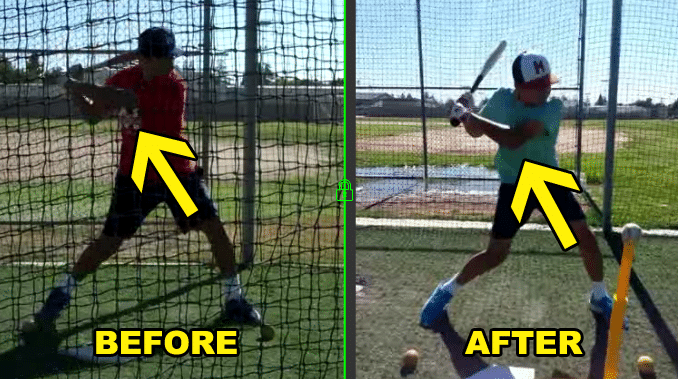
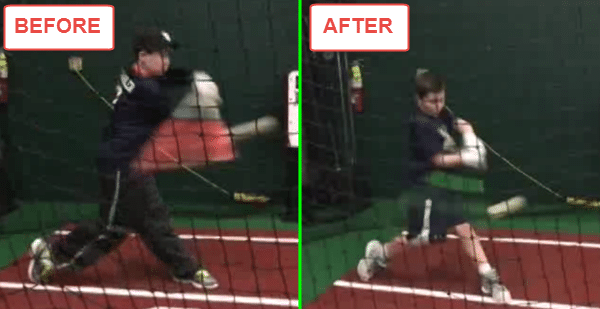
…We discuss the #1 way to hitting for consistent power by analyzing one of my younger hitters Braden:

  • Before and after swing,
  • The Un-Weighting Principal, and
  • What baseball hitting drill to work on next.


Before & After Swing

It’s so fun to see young men – like Braden – begin to build in human movement principals like Un-Weighting and notice an instant jolt in force at contact.  I ask all my students, if you wanted to live, would you rather get hit by a train going thirty miles-per-hour, or a motorcycle going sixty?

Of course the motorcycle!  You see, the motorcycle swing is very handsy, fast like a bike but no weight.  The train swing uses heavy mass and the slower rotational speed of the torso to pack a wallop at impact.  Forward movement and Un-Weighting are only the beginning…

The Un-Weighting Principal

I’m working with Braden on throwing his body mass at the ball.  Much like a projectile missile.  This helps to make the bat feel lighter to the hitter.  And be able to turn harder with less muscle involvement.  The swing is a transfer of energy.  We’re taking the potential energy contained in the hitter’s body, and getting it moving to transfer into the barrel.  Then effectively shift this moving energy into the incoming baseball.

This video I put together demonstrates the power of the Un-Weighting Principal:


What Baseball Hitting Drill to Work on Next?

Braden is coming along nicely with his footwork – with the exception of making sure his lower half is mostly open at the Fight Position (landing).  We’ll be getting him to tap into the natural springy effect of his torso.  I call it the Catapult Loading System.  How the swing is loaded is a difficult concept for most to understand because their focus is on the wrong things:

  1. Not every great MLB hitter walks away from their hands.
  2. And not every great MLB hitter is swinging as effectively as they can.
  3. We tend to study the wrong hitters.
  4. And the camera view matters.

If you have any questions on this, then please post them below…