

6 Shocking Mistakes Killing Baseball Hitting Mechanics for Youth at Stride Landing
What is the proper front foot stride, knee, and leg position when batting? Baseball and Softball hitting drills to keep feet still during the swing.
After posting the “Fastpitch Softball Hitting Mechanics: Different Than Baseball? How?” rant on my Facebook fan page, I received the following baseball hitting mechanics for youth comments about the front knee behavior after landing…
“The locked out front knee is a more consistent method that results in a hard transfer of weight creating more power and less variation since it is the same every time. Coach Joe Brockhoff’s system is a great example.
I teach to lockout the leg when the heel hits the ground. I think if this method is causing too many ground balls there is something else going on with it. With the proper weight distribution and rotation throughout it is the most natural and consistent method.”
And I mostly agree. However, I think there’s some confusion about what the front knee position should look like at landing.
In this baseball hitting mechanics for youth post, I want to address my top-6 reasons for landing bent:
- Engaging springy fascia in the legs,
- Pitch adaptability to off speed pitches,
- Shrinking the strike zone,
- Using Ground Reaction Forces,
- Getting eyes closer to lower pitches in the zone, and
- How humans change directions and planes of motion…
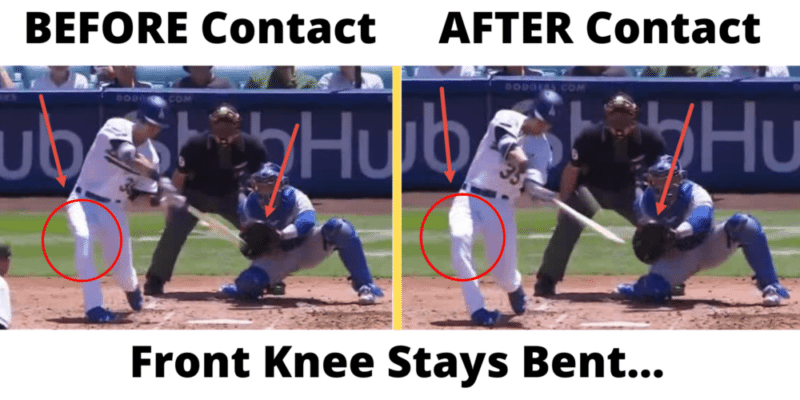
And, at the end, I wanted to clean up WHY I like my hitters to straighten their front leg at impact, however please note this IS NOT an absolute, especially when looking at a hitter like Cody Bellinger (he’s not the only one who does this)…look at the catcher’s glove which shows pitch location (down)…
1. Engaging Springy Fascia in the Legs
Watch Thomas Myers, from his book Anatomy Trains , explain the importance of fascia (said like Fashia).
If you aren’t analyzing baseball hitting mechanics for youth based on the rules of fascia, then you’re wasting your hitters’ time.
It’s not enough to base the swing off firing fast twitch muscles fibers. Repeatable power is in how we load fascia and fast twitch muscles.
For our purposes in this post, a hitter MUST be bending the knees at landing to engage, what Thomas Myers calls, the Spiral & Deep Functional Lines extending down as a stirrup under the feet.
My friend Lee Comeaux, who works with professional golfers out in Texas, has studied Thomas Myers’s book more extensively than myself, and he’s found the amount of bend in the knees at landing must add up to 45-degrees.
Same with the arms.
But my baseball hitting mechanics for youth point is, there has to be some bending in the knees at landing to activate the springy fascia contained in the legs. And the amount of bend will depend on the amount of Forward Momentum, and whether we’re talking a fastpitch or baseball hitter.
2. Pitch Adaptability to Off-Speed
In the above baseball hitting mechanics for youth video, I use Hanley Ramirez to demonstrate how important the bending of the front knee is to making timing adjustments to off-speed pitches. CLICK HERE for the full HPL post.
In his book Positional Hitting , Jaime Cevallos called the hitter bending into the front knee at landing, or to buy more time, the:
- ‘Cushion’ (normal timing), or
- ‘Double Cushion’ (off-speed timing).
JK Whited and Chas Pippitt of the Baseball Rebellion calls it ‘pushing the pause button’.
And we typically see this if a hitter is sitting fastball, and adjusting to off-speed or breaking balls.
3. Shrinking the Strike Zone
Watch the above baseball hitting mechanics for youth video I did February 13, 2014 of Barry Bonds ‘getting shorter’. It’s received over 47,789 views on YouTube. You can also find this ‘getting shorter’, OR shrinking the strike zone, approach with (pay attention to the action of their landing knee)…
Josh Donaldson
Jose Bautista
Mike Trout
Bryce Harper
And, Dustin Pedroia
Please do a baseball hitting mechanics for youth experiment for me…
Go into your bathroom with a bat (don’t worry, I’m not going to make you swing it)…
Get into your stance facing the mirror, as the pitcher…
Now, draw a line on the mirror just above your head, using a dry erase pen.
Okay, so now stride and land with a straight front leg… (make sure you have an athletic gap between your feet after striding).
Note the gap between where the top of your head is now, and the line you drew on the mirror.
Now, stride and land with a bent front leg,
How much of a gap there?
If you observe this little experiment with your hitters, you’ll see how we’re effectively ‘shrinking the strike zone’ by landing, what I call, ‘shorter’.
4. Using Ground Reaction Forces
Watch Chris Welch from Zenolink give a simplified background on Ground Reaction Forces (or GRF’s).
Basically, you push into the ground, and the ground pushes back, with equal and opposite force.
It’s VERY difficult to harness GRF’s when your knees are straight.
Try jumping as high as you can with straight knees.
Try running as fast as you can with straight knees (you’d look like Forest Gump with his leg braces on!!!) lol
Try defending a forward in basketball…
…a soccer striker…
…and an offensive Lineman on “the line” in football…
…with straight knees.
My baseball hitting mechanics for youth point is, you have to be athletic to hit. And landing with a straight front leg doesn’t allow the hitter to optimally use GRF’s.
This also goes for the hitter’s stance. I like my hitters to start with bend in their knees, regardless of the width of their feet.
5. Get Eyes Closer to Lower Pitches in the Zone
Taylor Gardner of the Backspin Tee brought this to my attention. Watch what happens to the first baseman’s head when receiving a throw…
The first base person strides forward toward the incoming ball, and bends the front knee (‘gets shorter’) to get the eyes closer to the ball.
A hitter MUST do the same thing, although the ball isn’t coming straight at them like the first baseman in the video.
The pitch is coming in sideways.
And to be more consistent with hitting the ball hard, we have to teach our hitters to bring their body – somewhat – down to the pitch’s level.
In other words, you don’t hit a low pitch consistently well by landing on a stiff front knee.
6. How Humans Change Direction & Planes of Motion
Pay attention to how Armanti Edwards and other NFL wide receivers change direction while doing a “Route Tree Session” with trainer Gari Scott…
Watch them run routes from a big picture point of view. In other words, not looking for any specific arm or leg angles.
Watch them ‘get lower’ when changing directions, or cutting.
They land on a bent plant leg, then push off the same leg, extending it, to accelerate again.
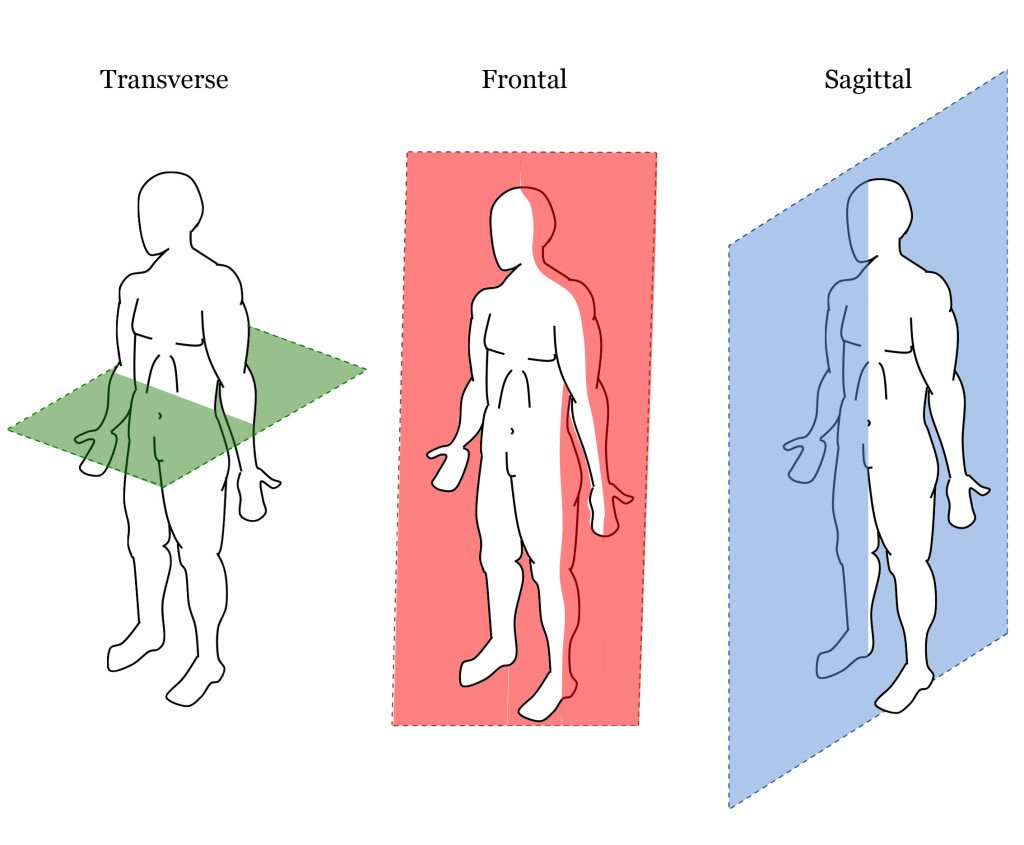
Three main planes of motion. Photo courtesy: goldsgymwebsterny.wordpress.com
There are three main human planes of motion:
- Saggital – divides the body into right and left halves
- Frontal (a.k.a. Coronal) – any vertical plane that divides the body into ventral and dorsal (belly and back), and
- Transverse (a.k.a. horizontal plane, axial plane, or transaxial plane) – is an imaginary plane that divides the body into superior and inferior parts. It is perpendicular to the coronal and sagittal planes.
In changing from one plane of motion to the other, there MUST be a ‘getting shorter’ of the body’s stature, as the athlete plants and pushes off the ground to change directions.
The wide receivers above are changing from the Sagittal (front to back) to Frontal (sideways) Planes. While a hitter changes from the Frontal (sideways) to Transverse (rotational) Planes.
In other words, just like an NFL wide receiver goes from a bent plant leg to straight at push off, a hitter MUST go from a bent landing leg, to a straight leg at ‘push off’. You don’t see these wide receivers keeping a ‘slight bend’ at the end of their push off.
So this brings me to the million dollar baseball hitting mechanics for youth question,
Straight Front Leg or Bent at Impact?
First a little background…
CLICK HERE for a Zepp experiment I did where I looked at the Discus technique of ‘blocking’. ‘Blocking’ is basically the action of going from a bent front leg at landing, to straight at impact.
I took 100 swings landing bent versus landing straight with the front leg…
Results?
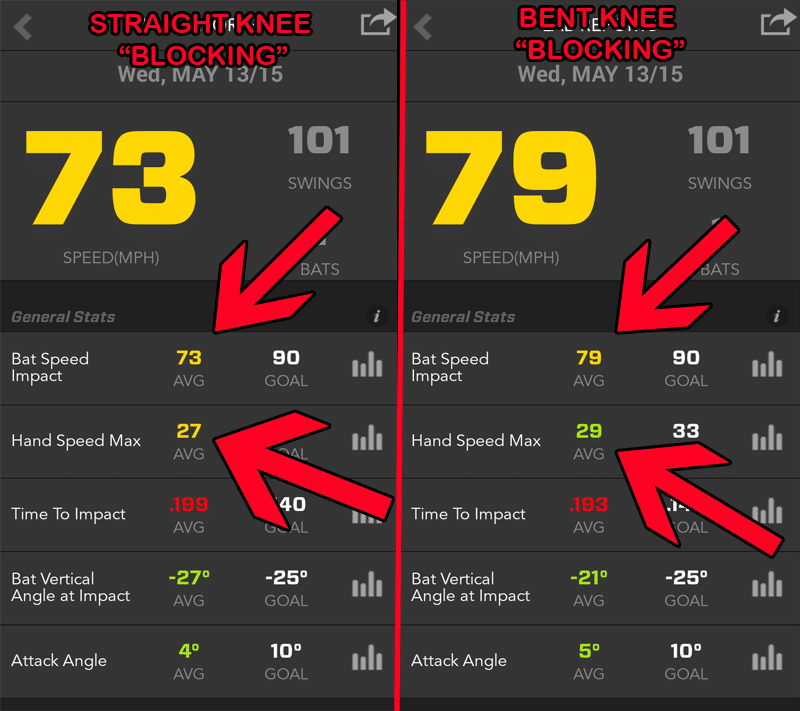
As you can see, landing bent with the front leg, then moving to straight at impact, added an average of 6-mph of bat speed!
CLICK HERE for another HPL article I did on ‘blocking’ analyzing Edwin Encarnacion’s swing.
Okay, so now that you’re following me on this,
Let’s look at the function of the front leg at impact, and WHY I choose to teach my hitters to straighten it versus keeping it bent…
Homer Kelly wrote The Golfing Machine . He was an aeronautical engineer for Boeing during the Great Depression, and fell in love with golf, and applied his engineering principles to the golf swing.
About ‘Knee Action’ Homer Kelly says:
“The slant is up in the direction of a straightened Knee. The slant of the Hips affects the degree of the Hip Turn. Actually, the primary function of Knee Action – as with Waist Bend – is to maintain a motionless Head during the Stroke.”
There’s a lot going on in that statement that you can run with…
But did you catch the bolded part?
We slant our body up in the direction of the straightened knee. And this is assuming we’re working with enough bend in the back knee during the turn.
In other words, the pitcher is throwing downhill, and also yes in fastpitch the ball is falling down by the time it reaches the last 20% of ball flight.
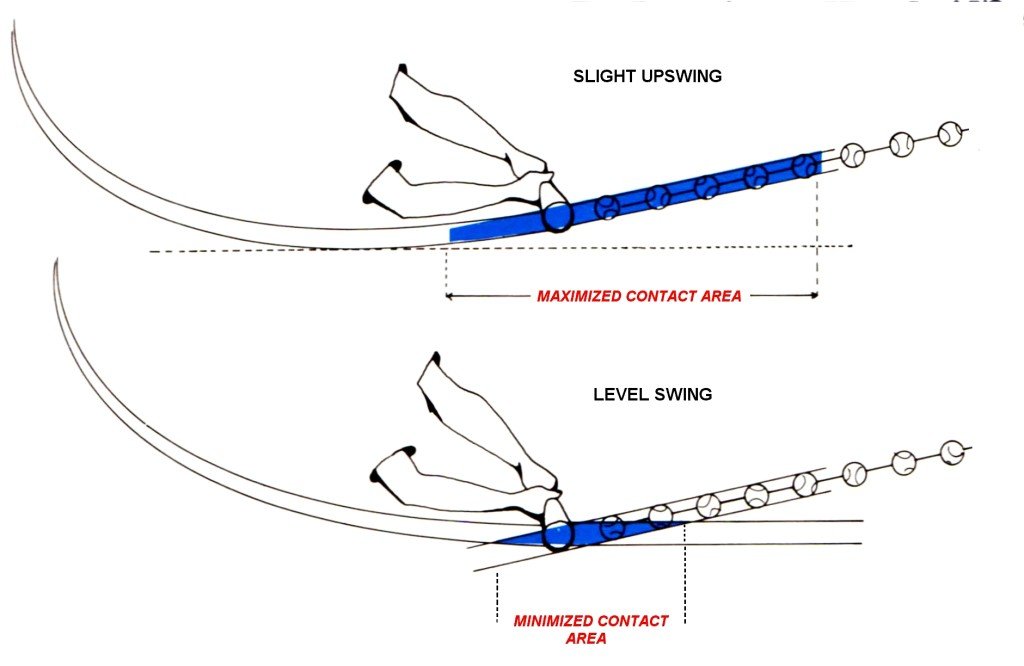
Photo from “The Science of Hitting”, book by Ted Williams
So if the hitter wants to be consistent, they MUST match the downward pitched plane with a positive barrel attack angle (barrel traveling up to impact), not negative (or down).
And according to Homer Kelly, the front knee must get to straight before impact, in order to slant the hitter (or golfer) up.
This is WHY I teach my hitters to land bent, then straighten the front leg at impact. Big Leaguers don’t all do this of course.
There are many BIG slugger examples of keeping a slight bend in the front knee at impact, Mark McGwire and Mark Teixeira to name a few…
But I work with A LOT of smaller hitters that can’t afford to be mechanically ineffective at driving the ball. I base my hitting program on human movement principles that are validated by science. Not on theory, philosophy, or what I think is right or wrong.
I hold my hitters’ swings to a higher standard. A standard that’s validated by science.

 is where 70-80% of consistent power is found. The best example I like to share can be found in
  ’ said, that locomotion, the arms and legs aren’t necessary for locomotion, they’re an enhancement, they help enhance movement of the spinal engine.
 ’ way back, I think it was in the early 2000’s or mid to late 2000’s. He talked about this idea of a ‘Cushion’. You’ll see a hitter especially, if they’re looking fastball, and they see a curve ball or changeup. You’ll see them actually bend, sink, or cushion into their knees. They use their knees by bending them to buy them a little bit of time to get on time a lot better. It’s pushing the ‘pause’ button.
 , and harness the power of the spinal engine. If you want a majority of power, 70-80% of consistent power.
 , they use it in pitching a lot. But in hitting, we use the VeloPro.