
Youth Softball Workout Plan PDF (Ages 10–14)
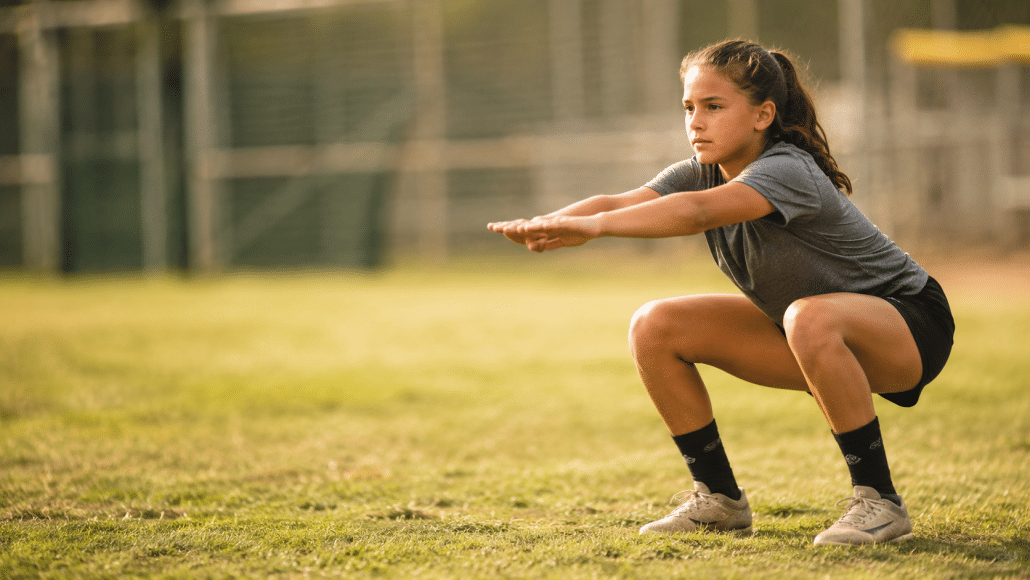
Your daughter plays 4 days a week — but nobody’s ever given her a training plan built for a body that’s still growing.
This free youth softball workout plan is built for girls ages 10–14. Three days per week, 30–40 minutes, no gym membership required. Build the athleticism, bat speed, and arm strength her game needs — without overloading a body that’s still developing.
By Joey Myers — D1 Baseball, Fresno State | Author, Catapult Loading System | NASM-CES · IYCA Youth Fitness Specialist | 20+ years of coaching
Quick Answer
A youth softball workout plan for girls ages 10–14 should run 3 days per week, 30–40 minutes per session, built around bodyweight strength, rotational power, agility, and arm care. The 12-week structure in this post follows three 4-week phases: Athletic Foundation (Weeks 1–4), Power Development (Weeks 5–8), and Sport Speed (Weeks 9–12). No gym membership required — most exercises need only a resistance band, a light medicine ball, and open space.
In This Article
Why does a youth softball workout plan need to be different from high school programs?
A youth softball workout plan for girls ages 10–14 is different because the body is still in development. Growth plates — the cartilage zones at the ends of long bones — remain open throughout early adolescence. Excessive load through those plates before they close creates injury risk that doesn’t show up in high school lifting programs because those programs were designed for more mature physiology.
That doesn’t mean youth players shouldn’t train hard. It means the training stimulus needs to match where they are. At ages 10–14, the highest-return investment is movement quality, not max load. A player who develops excellent squat mechanics, rotational core strength, and throwing mechanics by age 13 will outperform a player who was rushed into barbell training at 11 by the time they reach high school.
Compared to a high school softball off-season program, a youth program uses shorter sessions (30–40 min vs. 45–60 min), fewer working sets per exercise, longer rest intervals, and prioritizes coordination and balance work that older athletes can bypass. The focus shifts from loading to learning.
What should a youth softball workout plan include?
A well-designed youth softball workout plan covers five training categories. Each one addresses a different athletic capacity that matters for game performance — and the balance between them is what separates an effective program from just running laps and doing push-ups.
1. Lower body strength and power. Squats, split squats, and lunges build the hip and leg strength that drives acceleration, first-step quickness, and the rotational ground force that transfers into every swing. At the youth level, bodyweight and goblet squat variations are sufficient for the first 8 weeks.
2. Rotational core training. The swing is a rotational movement — the core connects the lower body force to the upper body. Medicine ball rotational throws, band-resisted twists, and Pallof press variations build the core stiffness and rotational speed that show up in bat speed and throwing velocity.
3. Upper body pushing and pulling. Push-up progressions, band pull-aparts, and bent-over rows build the shoulder stability, scapular strength, and arm-path control that protect against overuse and support clean mechanics. These also address the overhead demands of pitching and fielding.
4. Speed and agility work. Cone drills, lateral shuffles, and acceleration sprints develop the first-step quickness and body control that separate average defenders from good ones. This category is also the most fun for youth athletes — and fun increases adherence.
5. Arm care. A simple 5-minute daily band routine before every throwing session — similar to the J-Band arm care routine used by travel coaches — protects the rotator cuff and posterior shoulder capsule across a full season. Youth players who skip this are building toward the shoulder problems that show up at 15 or 16.
How many days per week should a 10–14 year old softball player train?
Three days per week is the evidence-supported target for youth softball training. This frequency produces measurable improvements in strength, speed, and athletic performance while leaving enough recovery space between sessions and practice days. A girl who trains 3 days and practices 4 more is effectively training 7 days a week — recovery happens on rest days, and there have to be some.
The sessions should be spread across the week with at least one recovery day between each. Monday / Wednesday / Friday or Saturday is the most practical schedule for players who have practice Tuesday and Thursday. The program’s arm care component gets added before every throwing session regardless of the schedule — that’s a daily habit, not a training day obligation.
Four or more training sessions per week is not only unnecessary at this age — it frequently pushes youth athletes into overtraining patterns. When a player starts showing poor practice performance, irritability, or loss of motivation, added volume is almost never the answer.
What are the best exercises for a youth softball workout plan?
The best exercises for youth softball players are movements that build sport-specific athletic capacity without requiring a gym or advanced equipment. Below are the top exercises by category — these are the backbone of the 12-week program included in this post.
Scroll right on mobile to see full table →
| Category | Top Exercises | Why It Matters |
|---|---|---|
| Lower Body | Bodyweight squat, goblet squat, reverse lunge, lateral step-up | Drive force production and first-step speed |
| Rotational Core | Med ball rotational throw, Pallof press, dead bug, bird dog | Connects lower body force to bat speed |
| Upper Body | Push-up progressions, band pull-apart, bent-over row, face pull | Shoulder stability and throwing mechanics |
| Speed / Agility | Cone shuffle, lateral bound, sprint starts, box jump (Phase 2+) | First-step quickness and body control |
| Arm Care | Band external rotation, band scarecrow, sleeper stretch, prone Y-T | Protects the rotator cuff and posterior capsule |
Notice what’s not on this list: barbell back squat, bench press, and Olympic lifts. These movements require years of technical development and adult-level load tolerance. They belong in a college softball strength and conditioning program — not a youth training block.
How does a youth softball workout plan affect hitting power?
Training affects hitting power through two distinct channels: the muscular channel and the neuromuscular channel. Most coaches focus only on the first one — getting stronger — but at the youth level the second one matters more. The neuromuscular channel is about teaching the nervous system to fire the right muscles in the right sequence at the right speed. That’s bat speed training, and it can improve dramatically at ages 10–14 without adding any weight at all.
Research on softball hitting power for youth players consistently shows that bat speed is more trainable at this age than most coaches expect — not through heavy resistance, but through overspeed bat swings, rotational med ball throws, and hip hinge patterns that train the kinetic chain. A player who develops clean rotational mechanics by age 13 carries that pattern into every level of play.
The muscular channel contributes too — particularly hip and glute strength, which determines how much ground force gets transferred into the swing. But even here, the goal at the youth level is movement pattern quality. A player with a technically perfect goblet squat and single-leg RDL will transfer more force into the swing than a player who can barbell squat twice her bodyweight with sloppy mechanics.
Free Download
Get the Full 12-Week Youth Softball Workout Plan PDF
3 phases · 3 days/week · 30–40 min sessions · Bodyweight-first, no gym required · Arm care routine included. Print it or save to your phone.
The 12-Week Youth Softball Workout Plan: Phase Overview
The full program is organized into three 4-week phases, each building on the previous one. The complete exercise-by-exercise breakdown with sets, reps, rest periods, and coaching cues is in the PDF — here’s what each phase accomplishes.
Bodyweight squats, lunge matrix, push-up progressions, core stability, agility ladder. Emphasis on movement quality and building the habit of training. 2–3 sets per exercise.
Goblet squats (light DB/KB), med ball rotational throws, band-resisted push-ups, lateral bounds, box step-ups. Intensity increases. 3 sets. Load introduced where mechanics are solid.
Split squats, sprint mechanics, med ball slam, overspeed bat swings, reactive agility drills. Power output at speed. Highest intensity phase — prepares for in-season performance.
Weekly Structure: Day A / Day B / Day C
Each week follows the same three-session structure across all 12 weeks — the exercises and loads progress, but the pattern stays consistent. Consistency in scheduling is what allows the nervous system to adapt.
| Session | Focus | Example Day | Duration |
|---|---|---|---|
| Day A | Lower body + Core | Monday | 35–40 min |
| Day B | Upper body + Rotational power | Wednesday | 30–35 min |
| Day C | Speed, agility + Bat speed | Friday or Saturday | 30–35 min |
Plus: 5 minutes of fastpitch-specific arm care drills before every throwing session — practice days included. This is not optional and does not count as a training session. It’s injury prevention, and it should become as automatic as putting on cleats.
The programming principles in this plan align with the National Strength and Conditioning Association (NSCA) youth resistance training guidelines, which recommend 3-day-per-week programs for pre-adolescent and early adolescent athletes, with emphasis on technique-first progression before external load.
More Free Programs from HPL
Free Download
Get the Full 12-Week Youth Softball Workout Plan PDF
Printable. Mobile-friendly. No gym required. Enter your email and I’ll send the PDF directly to your inbox.
Frequently Asked Questions
What age should girls start a softball workout plan?
Girls can begin a structured plan as early as ages 8–9 with bodyweight movements, balance drills, and coordination games. Ages 10–14 are the ideal window for a more formal 3-day program. The key is load — at this age, movement quality matters far more than how much weight is being lifted. External resistance should only be added once proper form is consistent.
Can youth softball players lift weights?
Yes — the American Academy of Pediatrics confirms that properly supervised resistance training is safe and beneficial for athletes ages 8 and older. Start with bodyweight, build movement competency over 4–6 weeks, then introduce light external resistance like bands or light dumbbells. Heavy barbell training is not appropriate until growth plates close, typically ages 16–18.
How long should a youth softball workout be?
For girls ages 10–14, sessions should run 30–40 minutes, three days per week. Sessions longer than 45 minutes at this age typically indicate too much rest time, unfocused programming, or an adult-volume program that wasn’t scaled for youth athletes.
What exercises improve batting power for youth softball players?
The highest-return exercises are rotational medicine ball throws, goblet squats, split squats, push-up progressions, and lateral band walks. These develop the hip rotation, core stiffness, and upper body linkage that drive softball hitting mechanics. Overspeed bat swings with a lighter bat 2–3 times per week also develop bat speed neuromuscular patterns directly.
Should youth softball players do arm care exercises?
Yes — arm care is essential even at the youth level. A simple 5-minute band routine before every throwing session protects the rotator cuff, posterior shoulder capsule, and elbow. Skipping it during the youth years is a leading contributor to shoulder and elbow problems in high school.
How is a youth softball workout plan different from a high school program?
Youth programs emphasize movement foundations — coordination, balance, body control, and basic strength patterns — over maximum load. High school programs introduce heavier resistance and more complex periodization because the athlete’s physiology can handle it. Youth programs also use shorter sessions, fewer total sets, and more rest between efforts.
What does a 3-day youth softball workout week look like?
Day A is lower body and core, Day B is upper body and rotational power, Day C is speed, agility, and bat speed. Separate each session by at least one rest day. The most practical schedule: Monday (Day A), Wednesday (Day B), Friday or Saturday (Day C). The program in this article follows exactly this structure across 3 four-week phases.

With 28,000+ online bat speed program sales, my methods have transformed coaches, instructors, and parents just like you. I'm affiliated with esteemed organizations like ABCA, IYCA, and SABR, advocating for positive coaching. With 15+ years in corrective fitness and a Division One baseball background, my knowledge is unmatched.
Join our blog and unlock the secrets to successful hitting, elevate your performance, and ignite your passion. Welcome to the world of limitless possibilities at HittingPerformanceLab.com.
- The Season Started. Here’s The Program That Keeps Your Daughter Athletic Through All Of It - September 27, 2026
- The Season Started. Here’s The Program That Keeps Your Kid Athletic Through All Of It - September 27, 2026
- Baseball Pitcher Workout Program PDF: Free 12-Week Off-Season Strength Plan for HS and Youth Pitchers - September 26, 2026