
Your Player Runs Hard On Every Rep — The Gap To Faster Players Isn’t Effort, It’s The Mechanical Pattern Nobody’s Teaching
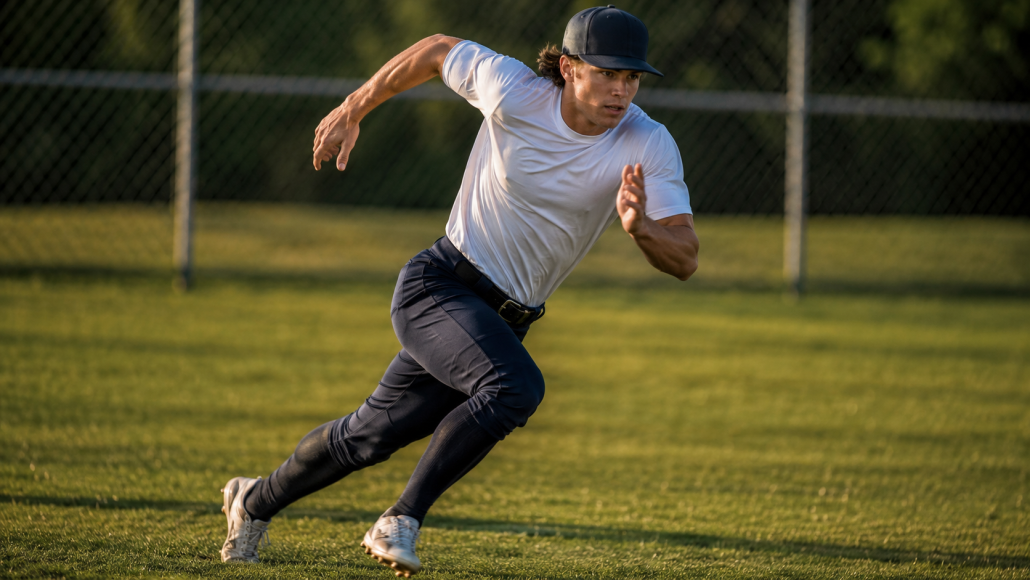
By Joey Myers | HittingPerformanceLab.com
Most baseball players who want to get faster do the same things: ladder drills, cone work, sprint intervals, maybe some box jumps. They work hard. They get marginally faster — and then they plateau. The reason isn’t effort. It’s that traditional baseball speed training never addresses the mechanical pattern that actually generates sprint velocity. This free baseball conditioning program PDF fixes that by building the four-week plan around the spinal engine — the system your body already has for producing speed, that almost no baseball program teaches.
The PDF includes the full baseball conditioning program with speed mechanics drills, baseball-specific strength work, and a pre-game activation routine. Download the free baseball conditioning program PDF here if you want to skip straight to the program.
In This Article
- What a baseball conditioning program PDF needs to include
- Why baseball players plateau on speed despite training hard
- What the spinal engine is and how it applies to baseball
- What the Head Over Foot technique does for baseball players
- The connection between the arm swing and sprint speed
- What the 4-week program looks like
- What strength work belongs in a baseball conditioning program
- FAQ
What does a baseball conditioning program PDF need to include that most don’t?
A complete baseball conditioning program PDF needs four components most programs omit: speed mechanics instruction, baseball-specific strength progressions, rotational power transfer work, and a pre-game activation routine that primes the nervous system instead of fatiguing it.
Most conditioning programs available online for baseball players are adapted from generic athletic performance templates. They include sprints, cone drills, agility ladders, and some variation of lower-body strength work. None of that is wrong — but it’s incomplete. The missing piece is the speed mechanics layer: the biomechanical instruction that teaches the body how to move faster, not just how to move harder.
The difference matters because baseball speed is not the same as track speed. A baseball player’s sprint context is almost always 60–90 feet, starting from a static or low-momentum position, often with a directional read (first step toward the ball, first step off first base). The conditioning program has to train that pattern — short bursts, first-step quickness, direction changes — not just top-end velocity. The baseball agility training principles that carry over to the game are built on first-step mechanics, not finish-line speed.
This baseball conditioning program PDF addresses all four components in a 4-week, 3-days-per-week structure that fits a pre-season or in-season training window without competing with practice volume.
Why do baseball players plateau on speed despite training hard?
Baseball players plateau on speed because they are training effort without training pattern. Ladder drills and sprint repeats improve conditioning and agility coordination, but they do not teach the neuromuscular pattern that produces elite sprint velocity — the sequencing of the spine, hips, and arms that the body uses to generate locomotion.
Think of it this way: a player who can run a 6.9-second 60-yard dash and does six weeks of sprint intervals will run a better-conditioned 6.9. The same player who learns the correct mechanical pattern during those six weeks may run a 6.5 — not because they got stronger, but because they stopped fighting their own body.
This is what David Weck at WeckMethod.com has identified and systematized over two decades of movement research: most athletes run with mechanics that work against the body’s natural speed-generation system. The correction isn’t more conditioning. It’s pattern-first training — teaching the spinal engine to fire correctly before layering in speed and strength work.
What is the spinal engine and how does it apply to baseball speed?
The spinal engine is the biomechanical system by which the spine generates locomotion through lateral flexion and rotation — not just the legs. The concept originates in the research of biomedical engineer Serge Gracovetsky, who demonstrated that walking and running are driven primarily by spinal mechanics, with the legs acting as the output of the system rather than its source. David Weck’s WeckMethod training system applies spinal engine principles specifically to speed and power development in athletic movement.
For baseball players, the spinal engine has two direct applications. First: sprint speed. When the spine engages correctly during the running stride, it amplifies force transfer from the ground through the kinetic chain — the player covers ground with less effort per stride. Second: rotational power. The same coiling and uncoiling of the spine that drives elite sprint mechanics is the identical pattern that powers the baseball swing at the highest level. Learning one reinforces the other.
Why this matters for your baseball conditioning program: Most players who are labeled “not naturally fast” are actually fast — their spinal engine is just not engaged. They are running with a pattern that bypasses the most powerful force-generation system in the body. The drills in this baseball conditioning program PDF are designed to turn that system on, not around it.
The practical difference is visible in a player’s stride. An athlete running with a disengaged spinal engine looks stiff through the torso — the trunk is locked, the arms swing across the body, and the stride length is limited by hip flexor mobility alone. An athlete running with an engaged spinal engine has visible counter-rotation through the torso, a longer natural stride, and significantly less upper-body tension. For reference, watch elite outfielders and base stealers at the major-league level. The trunk involvement is not an accident.
What is the Head Over Foot technique and why does it matter for baseball players?
Head Over Foot (HOF) is a WeckMethod speed principle that states at ground contact, the athlete’s head should be positioned directly over the striking foot. This alignment creates the optimal mechanical relationship for force transfer from the ground up through the kinetic chain — the ground reaction force travels vertically through the skeleton rather than being deflected by misalignment at the hip or trunk.
Most athletes run with the head slightly behind the foot at ground contact — a common pattern that creates a braking force on every stride. The player is simultaneously pushing forward and braking. HOF eliminates the brake. When the head is over the foot, the ground reaction force propels the athlete forward rather than redirecting energy upward and backward.
For baseball-specific speed, HOF is most critical during the first three strides of any burst — the acceleration window that determines whether a player beats a throw, catches a ball, or gets a good jump on a steal. A player who understands HOF and practices the pattern has an immediate mechanical advantage in every first-step situation on the field, even before any strength or conditioning improvement takes effect.
The drill that teaches HOF most efficiently is the Wall Acceleration Drill: the player leans into a wall at roughly 45 degrees, maintaining a straight line from ankle to ear, and drives the knees up alternately while keeping the head directly over the contact point. This reinforces the head-over-foot position at ground contact before the player ever runs full speed. The baseball speed increase research consistently points to ground contact mechanics as the primary differentiator between fast and faster athletes.
The connection between the arm swing and baseball sprint speed that coaches rarely teach
The arm swing drives the spinal engine. This is one of the most important and least-taught concepts in baseball speed development — and it’s the direct bridge between sprint mechanics and swing mechanics.
David Weck’s WeckMethod system teaches a specific arm action called pulsing — a deliberate pulse or flick at the end of each arm swing that amplifies the rotational signal sent to the spine. Most athletes swing their arms across the body or in a straight forward-back path. Both patterns suppress the spinal engine by limiting the rotational input the arm swing delivers to the torso. The pulsing pattern — where the hand drives back and slightly across at the end of the backswing — activates the counter-rotation through the thoracic spine that generates stride power.
For baseball players, this has a second application: the pulsing arm action trains the same counter-rotation pattern that stores elastic energy in the swing at stride landing. Players who learn the pulsing pattern for speed often report that their swing feels more loaded and less forced — because the thoracic counter-rotation they’re using to run is the same movement they need at the top of their swing sequence. The bat speed drills that produce the biggest results are the ones built on this same rotational chain.
This cross-application is why the conditioning program works as both a speed program and a swing power program. The movement patterns are not separate skills — they are the same spinal engine expressed in two different athletic contexts. A player who learns to run with the spinal engine and arm pulse will find their rotational power in the batter’s box improving alongside their 60-yard dash time. Understanding baseball hitting drills for power becomes much more intuitive once the athlete can feel the rotational chain already working in their sprint.
What does the 4-week baseball conditioning program look like?
The 4-week baseball conditioning program in the PDF follows a pattern → load → integrate → activate structure. Week 1 teaches the mechanics. Week 2 loads them under resistance. Week 3 applies them to multi-directional baseball movement. Week 4 condenses everything into a pre-game and in-season maintenance format.
Scroll to see full table →
| Week | Phase | Speed Focus | Strength Focus |
|---|---|---|---|
| Week 1 | Pattern | HOF wall drill, marching pulse, A-skip with arm pulse | Goblet squat, RDL, Pallof press — 2 sets, pattern focus |
| Week 2 | Load | Resisted sprints (band), bound drills, HOF acceleration runs 20 yd | Split squat, trap bar deadlift, rotational med ball — 3 sets |
| Week 3 | Integrate | First-step reads, crossover start, 60-yd full effort with HOF cue | Hex bar jump, lateral band work, anti-rotation press — 3 sets |
| Week 4 | Activate | Pre-game activation circuit (8 min), reactive first-step drill | In-season maintenance: 1 session/wk, full-body, 20 min |
Each session runs 20–25 minutes. The program is designed to run alongside practice — it is not a replacement for hitting or pitching work, and it does not require a weight room. Weeks 1–2 need only a resistance band. Week 3 adds a medicine ball. Week 4 requires no equipment at all.
The full session breakdown — exercise order, sets, reps, coaching cues, and WeckMethod speed drill descriptions — is in the baseball conditioning program PDF. The 12-week off-season baseball workout plan extends these same principles into a longer training block for players who want a full off-season program.
What strength exercises belong in a baseball conditioning program?
Baseball conditioning programs should prioritize hip-dominant lower body strength, rotational core stability, and pulling patterns — not the pushing and bench-heavy templates borrowed from football or general fitness. The strength component of this baseball strength and conditioning program PDF selects exercises that directly transfer to the movements baseball demands.
The four strength categories in the program:
Hip-dominant lower body: Trap bar deadlifts, Romanian deadlifts, and Bulgarian split squats build the posterior chain strength that powers both sprint acceleration and the drive phase of the swing. These are preferred over back squats in a baseball context because they train hip extension without the spinal compression that accumulates over a long season.
Rotational core: Pallof press variations, anti-rotation holds, and rotational medicine ball throws train the core to resist and produce rotation — the exact demand of every swing and every throw. The strength training component intentionally excludes crunches and sit-ups, which train flexion in a sport that demands rotational stability.
Pulling patterns: Band pull-aparts, face pulls, and rows counterbalance the anterior dominance that throwing creates over time and support the posterior shoulder health that arm care programs address separately. If your pitcher is also running this program, pair it with the J-Band arm care program for a complete system.
Explosive output: Hex bar jumps, broad jumps, and medicine ball scoop throws train the rate of force development — how fast strength becomes speed at the moment it’s needed. A player can be very strong and still be slow if their nervous system hasn’t been trained to express that strength quickly. The athletic performance training research is consistent: rate of force development, not raw strength, is what separates fast baseball players from strong ones.
What Athletes Say About WeckMethod Speed Training
“The ProPulse® Speed Trainers help me generate greater ground force through my swing and improve the overall timing of my body’s weight shift.”
Justin James — 2017 World Long Drive Champion
“I use the RMT® Club every chance I get to warm-up and strengthen my body. I can feel how it carries over from training to the field.”
Austin Barnes — L.A. Dodgers 2020 World Series Champion
“ProPulse® Speed Trainers help connect my strength training with my sport, increasing speed and fluidity between those two things.”
Jordan Burroughs — 4x Team USA Wrestling Olympic Gold Medalist
Free Download
Baseball Conditioning Program PDF
4-week speed and strength plan built on David Weck’s spinal engine mechanics.
HOF technique, pulsing arm drills, strength progressions. Free. Printable.
Frequently Asked Questions — Baseball Conditioning Program PDF
What is the best baseball conditioning program PDF for high school players?
The best baseball conditioning program PDF for high school players combines speed mechanics instruction with baseball-specific strength work in a format that fits alongside a practice schedule. The program should address first-step quickness, sprint acceleration, rotational core strength, and hip-dominant lower body strength — not just generic agility drills. This free PDF is structured specifically for high school and college players with three 25-minute sessions per week over four weeks.
How does the spinal engine improve baseball speed?
The spinal engine improves baseball speed by engaging the spine as an active force generator in the running stride rather than a passive torso. When the spine coils and uncoils correctly during each stride — through lateral flexion and thoracic rotation — it amplifies ground reaction force and increases stride length without requiring additional muscular effort. Most players who learn spinal engine mechanics improve their 60-yard dash time by 0.2–0.4 seconds without any change in strength or conditioning volume, simply from running with a more efficient pattern.
What is Head Over Foot and how do you teach it to baseball players?
Head Over Foot (HOF) is a WeckMethod speed principle that positions the athlete’s head directly over the striking foot at ground contact, creating optimal force transfer up the kinetic chain. To teach it to baseball players, start with the Wall Acceleration Drill: player leans into a wall at 45 degrees, holds a straight line from ankle to ear, and drives the knees up alternately. This reinforces the HOF position before adding full-speed sprinting. Once the player can feel the difference between HOF and the broken position at the wall, they transfer it to short acceleration runs of 10–20 yards.
Can this baseball speed training PDF be used in-season?
Yes — the program is designed to run alongside practice without competing with throwing or hitting volume. Sessions are 20–25 minutes and use no barbell movements that create excessive soreness or recovery demand. Week 4 specifically transitions into an in-season maintenance format: one session per week that preserves the speed mechanics and strength gains made in Weeks 1–3 through a full spring or fall season.
What equipment does this baseball conditioning program require?
Weeks 1 and 2 require a resistance band only. Week 3 adds a medicine ball (6–10 lbs). Week 4 requires no equipment — the pre-game activation circuit is designed to be done in a dugout, parking lot, or anywhere on the field. The strength progressions can be done with dumbbells, a trap bar, or kettlebells; no barbell or rack is required.
How is this different from other baseball speed training programs?
Most baseball speed programs teach athletes to run faster by running more. This program teaches athletes to run faster by running differently — using the spinal engine mechanics David Weck has developed and validated at WeckMethod.com. The drills in Weeks 1–2 specifically address the mechanical patterns most athletes are missing, before speed and strength volume is layered on in Weeks 3–4. Players who have plateaued on 60-yard dash time despite consistent training typically see the largest improvements from this approach.
Does this baseball conditioning program work for pitchers?
Yes. Pitchers benefit from the spinal engine and HOF training because the same thoracic counter-rotation that drives sprint speed is the rotational pattern that generates velocity in the delivery. The strength component — hip-dominant lower body work and rotational core stability — directly supports drive-phase power and deceleration load management. This baseball conditioning program PDF includes pitcher-friendly progressions, and the arm care pairing (J-Band work) is recommended for pitchers alongside this conditioning program for a complete training system.
More Free Programs from HPL
Free Download
Get the Free Baseball Conditioning Program PDF
Enter your email and get the full 4-week speed + strength program instantly.
References: Gracovetsky S. The Spinal Engine. Springer-Verlag, 1988. | WeckMethod.com — Speed and Movement Training Resources. | Cronin J, Hansen K. “Strength and power predictors of sports speed.” Journal of Strength and Conditioning Research. 2005;19(2):349-357. | Nimphius S, et al. “Change of direction deficit: a more isolated measure of change of direction performance than total 505 time.” Journal of Strength and Conditioning Research. 2016;30(11):3024-3032.

- The Season Started. Here’s The Program That Keeps Your Daughter Athletic Through All Of It - September 27, 2026
- The Season Started. Here’s The Program That Keeps Your Kid Athletic Through All Of It - September 27, 2026
- Baseball Pitcher Workout Program PDF: Free 12-Week Off-Season Strength Plan for HS and Youth Pitchers - September 26, 2026