Discover whether a metal baseball or softball bat (aluminum, composite, etc) can STOP wrist rolling over in the swing path? Learn how the Easton’s Mako Torq bat CANNOT! Why? Because “rolling over” is a timing issue, NOT a mechanical breakdown. Good timing equals NO wrist roll. Therefore, this bat was as irrelevant as the Easton “engineer” that bad mouthed me when I first published this post.
Composite Bats: Easton Mako Torq MISSED The Mark?
As a side note, let me clear the air about metal vs aluminum vs composite because there seems to be quite the confusion in the YouTube comments. In doing a quick Google search:
- Is aluminum a type of metal? “Aluminum is the most abundant metal on Earth, and one of the cheapest to buy. Aluminum is the third most common element in the Earth’s crust, but it also bonds easily with other elements. That means it is not found in nature as a pure metal.”
- Are alloys considered metal? “An alloy is technically an impure metal, but when referring to alloys, the term impurities usually denotes undesirable elements. Such impurities are introduced from the base metals and alloying elements, but are removed during processing.”
- Are composite bats metal? “Composite baseball bats, opposed to aluminum or wood baseball bats, incorporate a reinforced carbon fiber polymer, or composite, into the bat’s construction. This composite material can make up all or part of the bat. Bats made entirely of this polymer are referred to as composite bats.”
Okay, on with the review…
Let me be clear about the objective of this article. There are bats, and there are hitting aids. Easton Mako Torq composite bats have attempted to fuse both together. This is fine, but the price point is high ($280-550) when compared to a simplified alternative.
We HAVE to scrutinize hitting aids with science, like we do efficient hitting movements. If you haven’t heard of Easton Mako Torq composite bats yet, then here you go…
Key product marketing differentiation says they use “360-degree Torq Rotating Handle Technology”. Easton’s claim is to stop a hitter from rolling their hands over at contact. Their launch video says these composite bats help to be “short to the ball”, “square up more pitches”, “get to the zone faster”, and “stay in the zone longer”.
Let’s answer these THREE questions:
- Is rolling over a big problem?
- What do cues like being “short to the ball” really mean? And,
- Attack of the shady Easton “engineer”?
SCIENCE-BASED TRAINING:
Improve your hitting strategy dramatically by applying human movement principles.
Learn not only how and what to train but also the science behind the methods.
Is Rolling Over a Big Problem?
Short answer is YES. The real question is, is rolling over a mechanical problem? NO. It’s a timing problem. I would challenge you to find a hitter ON-TIME rolling over. Even with the worst thing you can think of, try and find THAT swing rolling over.
With that being said, making a bat that “cures” rolling over is COMPLETELY irrelevant. And if that’s your main marketing point, then you’re conning people into buying your gimmick.
What Do Cues like Being “Short to the Ball” Really Mean?
The marketing for Easton Mako Torq composite bats promise – that by using their bat – a hitter will:
- “Be short to the ball”,
- “Square up more pitches”,
- “Get to the zone faster”, and
- “Stay in the zone longer”.
Let’s briefly break these claims down…
“Be short to the ball”
Being short to the ball is a term we use for middle in and middle up pitches. This is achieved with top hand barrel control. It can be argued that a more balanced bat would make it easier to control the barrel, rather than an end loaded one, but that has zero correlation to the Easton Mako Torq technology.
“Square up more pitches”
If rolling handle technology can counteract a hitter from rolling their wrist over at contact, then this may be true, sometimes. Squaring up more pitches has MORE to do with a hitter’s timing. Also, where a hitter makes contact in the impact zone can be the difference between hitting the sweet spot consistently or not. Unfortunately, the Easton Maco Torq DOES NOT help with timing or a hitter’s contact point.
“Get to the zone faster”
Getting to the zone (impact zone I assume) is all about the Conservation of Angular Momentum. Since a hitter doesn’t know which type of pitch, speed, and location beforehand, it’s a race – after a decision to swing has been made – to get the barrel on the pitch plane as soon as possible. In order to spin faster, the hitter MUST stay tight in the turn until the barrel is on plane.
“Stay in the Zone longer”
Here’s where I think Easton Mako Torq composite bats hit the mark. IF – and it is a BIG “if” – these bats can stop rolling over, then a hitter’s “stay through” will get better. But at a price ($280-550). And once the hitter has to swing a normal “one-piece” bat, then I’m not sure if the anti-roll over mechanics would transfer. I don’t see higher levels adopting Easton Mako Torq composite bats.
Attack of the Shady Easton “Engineer”?
Post UPDATE: By the way, about a couple months after publishing this YouTube and article (when it began to gain serious traction – and as of this ‘update’ the video has been viewed almost 90K times on YouTube), one of Easton’s engineers contacted me VERY unprofessionally. Clearly he had a bone to pick. Saying I had zero ground to stand on, and how could I ‘bad mouth’ their precious Mako Torq technology…that I didn’t know what I was talking about. What’s laughable is that this “engineer” couldn’t supply me with credible studies that supported their claims…he said they had them, but he wouldn’t share. Hmmmm…
Let me be clear, I LOVE Easton bats, and preferred them well over Louisville Slugger’s. However, I don’t agree with their opinion on Torq technology benefits.
From what I’ve heard, Easton purchased the patent from a High School player who made the technology, in wood shop class, to alleviate pain in his wrist when swinging. IT WORKED!! If Easton would have marketed it based on that, there would be no discussion. But I feel they stretched the technology truth a bit too much. You be the judge.
Grab 'Finger Pressure' Video
Frustrated with fixing BAT DRAG? Beat it!
Swing Study reveals how majority of hitters are correcting 'racing back elbow' bat drag within 1-2 weeks WITHOUT overhauling swing mechanics OR buying fancy and expensive hitting aids.
Click button below to access FREE video that has been downloaded over 20K times!
Click here to 'Get Instant Access'








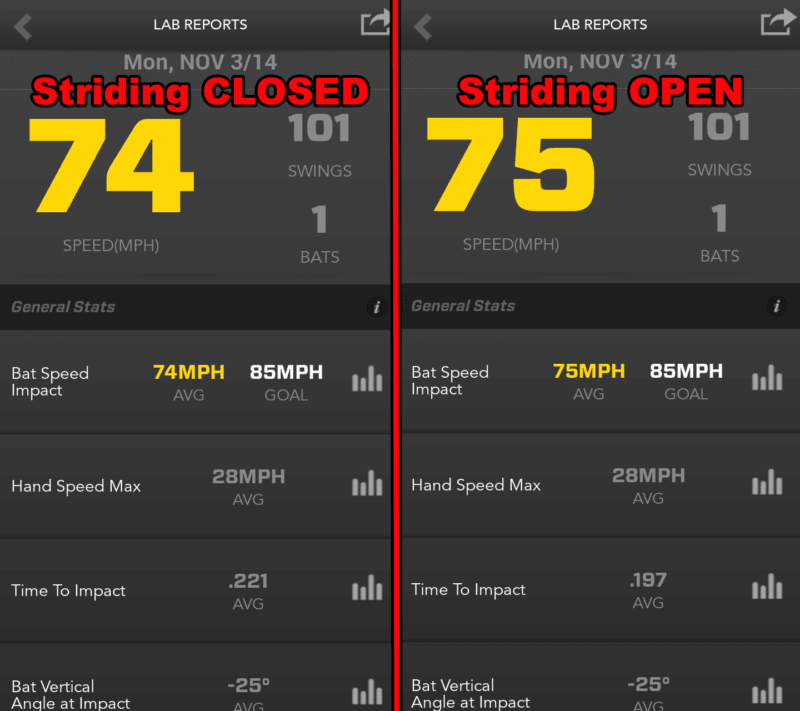
 , I wanted to use the Scientific Method to analyze whether striding with the front leg closed will have a positive or negative effect on bat speed.
 , I believe landing with an open front leg – like Alex Gordon – will result in increased bat speed and farther batted ball distance. Landing closed with the front leg – like Kansas City Royals catcher Salvador Perez (who popped out to end the 2014 World Series) – will result in an inefficiency to hitting inside and high pitches. And will allow other compensations to occur such as rolling over, pulling the head, and the front shoulder flying open.