Posts

Online softball hitting training with proven results

Boost Your Batting Average with Just 5 Minutes a Day

I’ve spent a good majority of my life playing baseball, always chasing the perfect swing to increase my batting average. It takes hard work, expert advice, and the right tools to reach my best. That’s why I’m excited to share the best online hitting programs that change how college and professional players like me play the game.

For baseball or softball players, the secret to doing better is using training that’s made just for you. Online softball hitting coaching is a big deal, giving players like your kiddo access to top coaches without the high cost of an in person lesson or hassle. These coaches can check out your swing and give you advice to boost your game.

With tools like Blast Motion, you get swing analysis and training based on data. And with the Hitting Performance Lab, you have a strategic library of videos to learn from. These online options are all about making your swing better and keeping track of your progress. They make sure you’re always moving forward towards your goals.

Key Takeaways

  • Discover proven online hitting programs to elevate your softball or baseball performance.
  • Improve your swing mechanics and boost your batting average with expert instruction and data-driven training.
  • Online softball hitting coaching offers personalized lessons and video analysis to enhance your swing and batting.
  • Platforms like Blast Motion provide affordable swing trainers, video analysis, and premium coaching services.
  • Virtual instruction lets you train from anywhere, fitting your schedule perfectly.

Unlock Your Hitting Potential with Online Softball Hitting Training

As a softball player, it’s key to reach your full batting potential to improve your game. Online softball hitting training programs are changing how players work on their swing and performance. They offer real-time swing analysis and smart bat technology to help athletes boost their skills.

Blast Motion: Real-Time Swing Analysis and Feedback

Blast Motion is a top knob sensor choice for online softball hitting training. It’s used by pro, college, and elite travel ball teams. Players get valuable swing metrics and feedback to improve their batting. With Blast Motion’s tools, athletes can track their swings and see how they’re getting better.

Diamond Kinetics: Smart Bat Technology for Metric Tracking

Diamond Kinetics is another big name in online softball bat sensor hitting training. Their free DK app lets players track swing metrics like barrel speed and acceleration. The Diamond Kinetics CATX Smart Bat is a smart bat approved for USSSA games. It gives detailed insights into power, speed, and control for every swing.

Hitting Performance Lab: Comprehensive Video Library and Programs

Hitting Performance Lab offers a comprehensive online video hitting program for baseball and softball players. Led by expert coaches, it features over 200 instructional videos designed for players at all levels. The program focuses on hitting more consistent hard line drives, ensuring dramatic improvements in just 3 weeks.

With these online hitting training tools, players can unlock their true potential. They can make consistent, powerful contact and elevate their game to new heights. Our digital coaching approach allows players to improve their skills from anywhere, revolutionizing the way they train.

Online softball hitting training with proven results

If you want to improve your softball hitting, online training programs can help a lot. They offer personalized lessons and data to help you hit better.

Rapsodo: Certified Softball Hitting Coaching Course

The Rapsodo Certified Softball Hitting Coaching Course is a great choice. It has over 80 minutes of video lessons and a test to get certified. After passing with at least 75%, you pay just $100 a year to keep your certification.

Top Online Hitting Coaches: Personalized Instruction

There are many top online hitting coaches who give personalized lessons. Coaches like Epstein, Lisle, Line Drive Nation, PRO Baseball Insider, Tewksbary, Connor Powers, and Joey Myers are known for their custom drills and detailed swing analysis.

Hitting Performance Lab offers step-by-step video hitting programs for baseball and softball players. Led by expert coaches, our sessions focus on consistent, powerful hitting. Choose from 6 sessions at $150/month or 12 sessions at $260/month. Achieve dramatic improvements in just 3 weeks.

Many athletes say they’ve gotten stronger and hit better with these online programs.

Choosing the Rapsodo certification or a top online coach can really help your game. These online softball hitting training options offer the support and data you need to improve.

Elevate Your Swing Mechanics with Remote Batting Instruction

Want to become a top hitter? Mastering your swing mechanics is key. Thanks to remote batting instruction, players can now improve their swings like never before. Coaches use advanced video analysis and motion tracking to spot areas for better swing mechanics. They focus on body position, weight transfer, and the bat path.

These coaches give personalized feedback and online batting lessons based on data. This helps players fix swing flaws and swing consistently and efficiently. It’s a flexible way to learn from top experts, no matter where you are.

Data-driven softball training helps players make smart choices and improve their swings. With real-time feedback and analytics, players can quickly spot and fix weaknesses. This leads to better performance and becoming top hitters.

“The remote batting instruction from the online coaches has been a game-changer for me. I’ve seen a significant improvement in my swing mechanics and my overall hitting ability. It’s incredible how much progress I’ve made without ever having to leave my local training facility.”

Using remote batting instruction, players can boost their swing mechanics and hit their best, no matter where they are. With the right guidance and data-driven training, becoming a top hitter is easier than ever.


The Rise of Remote Hitting Lessons: Revolutionizing Baseball and Softball Training

Baseball and softball training have changed a lot with remote hitting lessons. Technology has made it possible for two types of online training: asynchronous and real-time.

Asynchronous and Real-Time Sports Instruction

Asynchronous instruction lets players learn at their own pace. They can watch lessons and get feedback whenever it fits their schedule. Real-time lessons, on the other hand, offer live chats with coaches for quick feedback and personal advice.

This new way of learning has changed how players improve their skills. It goes beyond what traditional training offers.

The Evolution of Online Baseball and Softball Instruction

Online training has grown thanks to better mobile tech and high-quality smartphone cameras. Tools for video analysis and the shift to remote work have made remote coaching more popular.

Using small learning sessions and feedback at the right time has made online lessons more effective. This approach helps players remember skills better and get better over time.

Remote lessons are now common, with parents recording their kids’ swings and using phones for coaching. This change has made training easier to get and lets players work with top coaches from anywhere in the world.

“The rise of remote hitting lessons has truly transformed the way we approach baseball and softball training, empowering players to unlock their full potential from the comfort of their own homes.”

Mastering the Art of Remote Hitting Lessons

Remote hitting lessons have changed how baseball and softball players get better. They use technology, sports science, and personalized coaching. This gives players a great learning experience that goes beyond where they are.

How Do Remote Hitting Lessons Work?

First, the parent, remote hitting coach and or player talk to each other. They use an online platform like zoom for this, where they can share feedback and use training resources.

Then, players can learn at their own pace or get real-time help. They can watch training videos and get feedback on their swings at any time. Real-time sessions let the coach help them right away.

Technology like motion sensors and video tools makes these lessons better. They give players detailed info on their swings. This helps the coach make better training plans.

Thanks to mobile learning, top-notch softball and baseball training is now easy to get. Players of all levels can work with great coaches and use the latest training tools from home.

Remote hitting lessons have changed baseball and softball. They let players reach their goals and improve their skills. With this new way of learning, athletes can get better at hitting and take their game up a notch.

The Convenience of Online Batting Lessons: Anytime, Anywhere

Imagine getting top-notch hitting lessons without worrying about time or where you are. That’s what online batting lessons offer. This new way is changing how players, from young ones to pros, improve their skills.

With online lessons, busy schedules and where you live don’t stop you from getting expert advice. Just a few clicks, and you can meet with coaches and start a training plan made just for you.

Online platforms let players check out their swings, get tips, and work on their skills when it fits their schedule. This new way of learning sports is opening doors for people to improve their game and reach their goals, anytime and everywhere.

Remote batting instruction has changed the game for softball training. It offers flexible and data-driven ways to meet the sport’s needs. With tech like smart bat sensors and motion tracking, online lessons give a full and personalized experience that was hard to get before.

If you’re a young player, a high school athlete, or a pro looking to improve, online batting lessons are here for you. They offer the convenience and know-how you need to do your best. Boost your skills and succeed on your own time.

“The use of video feedback in sports skill acquisition studies dates back to the 1980s, and studies have shown that groups receiving video feedback in sports, such as tennis players working on their serves, achieve statistically better results.”

Conclusion

Online softball hitting coaching has become a key tool for players wanting to get better at batting. It gives expert advice, personalized feedback, and tech for swing analysis. This helps athletes improve their mechanics, hit more often, and hit harder. Players can work with top coaches from anywhere, thanks to online lessons, boosting their game anytime.

Online hitting programs and remote coaching have changed how players at all levels get expert help and new tech. They offer everything from advanced drills to video libraries and personal coaching. This lets athletes reach their full potential and improve their game. Online coaching is making a big difference in sports training, helping players perform better and reach their goals.

Using online coaching and data-driven training, players can get better skills, feel more confident, and become their best on the field. The future of hitting instruction is about combining tech, expert advice, and personal feedback easily. As sports evolve, online hitting coaching will keep changing how players hit, making a big impact at all levels.

FAQ

What are some top online hitting programs for softball and baseball?

Top online hitting programs include Blast Motion, Diamond Kinetics, and the Hitting Performance Lab. They offer real-time swing analysis and smart bat tech. Plus, they have video libraries with proven hitting programs.

What kind of online softball hitting coaching and certification courses are available?

Rapsodo has an online Softball Hitting Certification course with over 80 minutes of high-definition videos. Top online coaches like Myers, Epstein, Lisle, and Line Drive Nation offer personalized lessons and video analysis.

How do remote hitting lessons work?

Remote hitting lessons come in two types: asynchronous and real-time. Asynchronous lets players watch instructional videos and get feedback on their own time. Real-time lessons mean live chats with coaches.

What are the benefits of online batting instruction?

Online batting instruction is flexible and accessible. Players get expert advice, video analysis, and data-driven training at home. It fits their schedules perfectly.

How do online platforms and apps enhance the baseball and softball training experience?

Technology has changed sports training. Now, players get real-time feedback, biomechanical analysis, and lessons from top coaches worldwide through online platforms and apps.
Discover this online hitting lessons swing analysis program to increase bat speed and power for the baseball and softball swing.

The Sooner You Use These Baseball Exercises the Better


I was working on a feedback session with one of my online lessons Austin, from SoCal, the other day…

And I realized that yes, most of the time, fixes are swing specific, but other times…

It can be suggesting a corrective exercise to help stabilize the core better during the swing.  In this post, I’m going to walk you through:

  • The late torso “tip”, and then
  • How to correct it with two simple baseball exercises…


The Late Torso “Tip”

Watch the quick analysis video above…

Basically it’s a late tipping of the torso towards the plate, at the waist.  This can cause the head to lay parallel to the ground obstructing vision.  Sometimes, the back shoulder and ear get closer to together (like Derek Jeter), which breaks, what Dr. Kelly Starrett calls, spinal integrity, and will bleed force at impact.

This can be caused by a dysfunctional Quadratus Lumborum (or QL).  And, according to Thomas Myers of Anatomy Trains, an imbalanced Lateral Fascial Line.
 

How To Correct it with Two Simple Baseball Exercises

Here are the two exercises to help with lateral core stabilization during the Final Turn:

  1. Side Plank (specific) – or CLICK HERE to view a side plank laying on the forearm (if you have wrist issues).
  2. One-Sided Farmer’s Walk (integrated).

Here’s what the acute variables look like (for both baseball exercises)…

  • Week-ONE: 2 sets X 45 secs ea. side,
  • Week-TWO: 2 sets X 60 secs each side,
  • Week-THREE: 3 sets X 45 secs ea. side, and
  • Week-FOUR: 3 sets X 60 secs ea side.

Do these baseball exercises horizontally.  In other words, do a set of side planks (both sides), followed by a set of one-sided farmer’s walks (both sides).  Rest 60-seconds, then move onto set #2.

Learn the baseball and softball weight transfer, distribution, and footwork stance science while batting.  Discover our unique online swing analysis coaching instruction drills program.

Baseball Bats MYTH Debunked: Discover The Back Foot Variance Drill Secret…


I wanted to share a couple things in this baseball bats myth debunked post…

  • An updated video of the Back Foot Variance Drill, and
  • A testimonial from one of my online lesson dads from Tennessee (I’m in California!).


Back Foot Variance Drill UPDATED

Since putting this baseball bats myth debunked drill together a few years ago, I’ve improved on it to reflect what the best are really doing.  Here’s an outline of what we talk about in the above video:

  • Objective: to shift body-weight into ball and un-weight the back foot,
  • Squishing bug?
  • Variance Drill – fix hitters who skip too much v. not skipping, and
  • Options: skip backwards (scissoring).

Back Foot Variance Testimonial

I prescribed the Back Foot Variance Drill to Lawrence (Jr.) back on July 9th, along with the Babe Ruth Drill (forward momentum), and the Snapping Towel Drill (angling the body back over the catcher during turn).

Before I show you a couple BEFORE/AFTER images of his swing, please read what dad emailed me…

“Joey

Wanted to sit down and let you and your readers know how much of an impact you make on players lives. The key is to listen and follow what you say. 

First my background. I played at the Juco level, independent ball and amateur ball until i was 39. I pride myself on knowing the game and thought I was a pretty good hitter and taught hitting. I walked away with three amateur world series rings and no regrets on my playing career. 

I have taught my son hitting since he was 4.  As any parent has, I am proud of my son with probably some dad goggles on. But fact is he is a gifted physical specimen at 15, he is 6’1 and 175-lbs

For this I’m just going to focus on the facts. He ran into some hitting issues I was having trouble correcting this Spring. But I know hitting, right? And my son still listens to me so I should be able to help him. But it was not happening, we both were getting frustrated. As a freshman he still hit over .300 in varsity. But something was off.

Then while researching, (yes people if you or your coach does not have a growth mindset do yourself a favor and go do something else.) I ran across you this Spring. After studying what you were saying and swallowing my pride I decided to have you give my son video lessons online. 

Best thing I ever did for my son. We are only half way through the lessons taking our time to digest and work on what you have suggested, but here are the results. This after 3 months and 2 lessons

My son exit velocity before you was 86-mph it now sits at 91-mph. He recently did a show case with perfect game. On the hitting metrics they use he is between the 93-98 percentile on all players they have seen. In batting practice he would routinely hit the ball 325-350 feet using wood or bbcore. He is now hitting balls in excess of 400 feet.

While taking batting practice on a high school field yesterday dimensions of 320 down the line and 370 to center he hit 16 out of 45 pitches out including 3 in excess of 400 feet. I sent you video of a game he played last night. To have you evaluate, that home-run was to dead center which was 360 feet. The ball was a line drive and landed in the road over 40 feet behind the fence.

Yes the catapult loading system works. He is hitting baseballs with a wood or bbcore bat at 2.5x his body weight. Using those bats and at his age is just as impressive as 3x body weight. 

I mentioned before he is a big kid at 15. But he is still a kid, he has not begun to physically mature yet. He does not shave, no hair on chest, no definition of muscles. I fully expect to see within the year as he starts maturing he will be hitting baseballs over 500-ft. In three months working with you he has gained over 50 feet consistently. It now looks like he is on the little fields again taking bp.

Thank you for what you do and giving my son confidence moving forward, you helped a young man more than words I’m writing will ever be expressed.

Here is what he accomplished since we started using you. Named all world series team for the 15u babe ruth world series where his team finished second. Playing for 15u south east team Rawlings led team in batting average for the summer. That team went 6-1 in the wwba perfect game world series where he was named to the all tourney team. 

Named all tourney to perfect game summer showdown as well. Before you he had played in three events with perfect game with no all tourney nominations. He has also been approached as a rising sophomore by a high level D1 head coach that is interested in him. 

Thanks Joey for everything, and for not only being a great person to get to know, but being so knowledgeable on the scientific metrics on hitting. 

All the best
Lawrence Sutton”

Thank YOU Lawrence for such a glowing baseball bats myth debunked testimonial.  And thank you Junior for being such a respectful and coach-able student of the game.  By the way, originally Lawrence (dad) left this as an UNSOLICITED message on my phone, and I asked him to put it down on virtual paper, so I could share it with you.

Before sharing the BEFORE/AFTER images, let me address naysayer objections I frequently read on the Socials, speaking out against my book, “The Catapult Loading System: Teaching 100-Lb Hitters To Consistently Drive The Ball 300-Feet”, this email clearly dispels:

  • “In High School homers virtually disappear because of BBCor bats”,
  • “15yo High School hitters can’t hit balls in excess of 400-feet at 175-pounds”,
  • “Sure, your system may increase power, but it will be at the cost of Batting Average and Strikeouts”, and
  • “This kid is just a freak [or they may use the word ‘mutant’]”

All this is FAKE NEWS Coaches!!

The last one always makes me laugh…I say take me to VEGAS then, because I’m running into A LOT of mutants!! Buahahaha

And you know why homers “virtually disappear” with BBCor bats in High School?

Because many of these coaches are teaching their hitters to HIT THE BALL ON THE GROUND!  Please STOP!  It’s insane these coaches don’t want their offense to score more runs and win more games.  Ground-balls SUCK for hitters!  The reverse is true for pitchers by the way 😉

I have faith, “winners” will make the adjustment and not whine, complain, and come up with every excuse in the book as to why hitting the ball HARD IN THE AIR doesn’t work.  Sad.

Boosting Ball Exit Speed and Launch Angles is a formula folks.  With hard work, attention to detail, and dedication, more hitters can achieve what we’re sharing.  The Catapult Loading System takes care of the former, and Pitch-Plane Domination the latter.

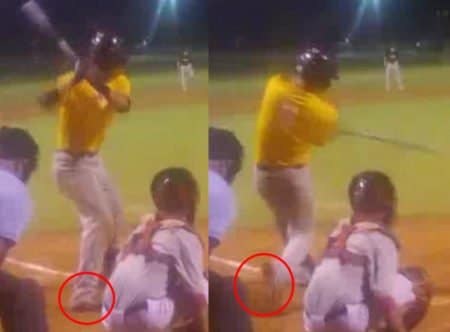
Here’s a BEFORE/AFTER image of Lawrence’s back foot skip (too much) on July 9th…

Baseball Bats Myth Debunked

Lawrence’s feet are too close together in these swings…

Here’s a BEFORE/AFTER image of his August 25th 360-foot dinger…

Baseball Bats Myth Debunked

This angle is a challenge, but use the catcher’s belt as a reference point to the back foot in both images. In addition, look at the gap between his feet.

Now, as you remember, we made three changes to Lawrence’s swing back in early July:

  • Increase forward momentum,
  • Create more space between his feet, and
  • Increase spinal tilt during the turn…

…so it’s hard to tell which one of these was THE ONE thing that made the biggest difference.  My argument for the Back Foot Variance is this:

  1. In past swing experiments, Forward Momentum hasn’t been shown to increase Bat Speed at Impact significantly.
  2. Increasing spinal tilt is great, but doesn’t work if the hitter’s feet are close together – like a golfers.
  3. The greater the distance between the feet (although not too much), the more consistent the hitter can get to the bottom half of the ball.

Also, if you read this Washington Post article titled, “Bryce Harper: A Swing of Beauty”, you’ll discover:

“Glenn Fleisig, an expert in the field of biomechanics, said the majority of hitters he’s studied transferred 90 percent of their weight to their front foot and kept 10 percent on their back leg at contact. Harper, of course, would move 100 percent of his weight forward at contact when his back leg lifts. That, Fleisig said, would enable him to generate a ground rotational force equal to 150 percent of his body weight.”

At Bryce Harper’s current weight of 215-lbs, that would be 322.5-lbs of force transferred at impact!  Any weight transfer less than 100% would be an inferior model, so that’s why ‘squishing bugs’ isn’t optimized.

Coaches, be careful who you’re following.  Make sure they’re sticking close to the human movement principles that are validated by science.  If not, then quickly abandon ship.

Baseball bats myth debunked!

Please keep me updated on your hitters’ progress using the Back Foot Variance Drill below…

Learn about this online baseball and softball hitting lesson program to increase bat speed.  Discover our remote swing analysis instruction coaching program teaching kiddos how to hit the ball with more power.  Check out this 9 year old Thomas case study…

To People That Want To Fix Baseball Swing Mechanics Slow Motion But Can’t Get Started


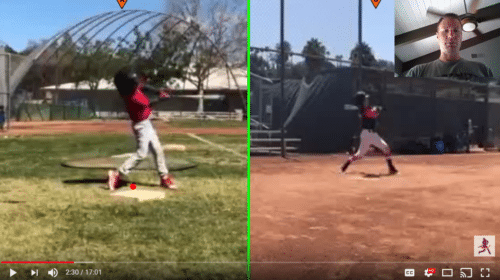
With permission from Dad, I wanted to share 9-year-old Thomas P.’s hitting journey after 12 baseball swing mechanics slow motion online video feedback sessions with me at The Feedback Lab.

We started session #1 January 18th, 2016, and finished session #12 June 2nd, 2016.  The video above is an actual Feedback Session I routinely do for my online hitting students.

I’m so proud of Thomas persevering through the struggle and frustration that comes with honing effective mechanics.

AND, the same can be said for Scot, his Dad, who’s persevered right alongside his son.  Not to mention how much Scot learned in the process…

  • How to train Thomas in these mechanics at home,
  • How to offer just the right amount of feedback, and
  • Finding out when too much is too much when it comes to learning a new skill.

In this video post, I wanted to share:

  • How far Thomas’s swing has come,
  • What he’s working on next, and
  • Some of the ‘Ah-Ha Moments’ for Thomas along the way…

The main objective of this post is to show parents what baseball swing mechanics slow motion online video feedback sessions look like at The Feedback Lab.  Not only do we accept baseball, but softball hitters as well!

PLEASE NOTE: Thomas is still on the journey, his swing isn’t perfectly clean yet.  This is only a 5-month snapshot of how far his swing has come.  Don’t judge his swing at this point in time, celebrate it!  Also, as you’ll find out, just because he moved away from a high leg kick, doesn’t mean I HATE high leg kicks.  It just wasn’t working for Thomas’s swing, timing-wise.

CLICK HERE to view and/or download Thomas’s custom “Marching Orders” PDF that I build for each of my hitters after each baseball swing mechanics slow motion feedback session.


How Far Thomas’s Swing has Come (in his 12 baseball swing mechanics slow motion feedback sessions)

I always like to use the ‘Pat & Pop Method’ when giving feedback to my hitters…’Pat’ is the pat on the back, and the ‘Pop’ is the pop in the mouth.

When I first started with Thomas, he had some good elements already working for him:

On the ‘Pop’ side of things, these were the mission critical things we had to begin tweaking:

  • Build stability in stance and setup,
  • Being better at swinging within the strike zone (plate discipline),
  • Calibrating solid rhythm and stride timing, and
  • Maximizing tension/compression forces within his small frame (racing back elbow bat drag).

I am confident to say that, over these past 5 months of baseball swing mechanics slow motion online video feedback sessions, Thomas has:

  • Built a more stable stance setup,
  • Developed a better sense of his strike zone (swinging at better pitches),
  • Gone away from his inconsistent leg kick timing to more of a slide step (he’s barreling the ball more often), and
  • Banished his racing back elbow bat drag (he’s been smashing the ball according to his Zepp sensor).

Here’s a quote from Dad talking about his jump in Bat Speed at Impact using the Zepp app…

“He started in mid 30’s, I would say his average is 46-47 now. He hits a very occasional speed of 50 when he puts it all together, which is seldom.”

What’s he’s Working on Next

Here are the polish points I included in Thomas’s current baseball swing mechanics slow motion video feedback session marching orders (CLICK HERE to download the PDF):

  1. Plate discipline,
  2. Being more balanced on his finish,
  3. Finger Pressure, and
  4. Letting the ‘barrel chase the ball’ post-impact.

#1 is a journey, and NEVER a destination.

With #2, it’s amazing how being ‘silent’ helps hitters be more efficient (CLICK HERE for this Breaking Muscle article on the ‘silent’ concept).

#3 because he’s still wanting to do top hand release way too early.  We’re working on keeping both hands on the bat into his finish now.  He’ll add another 2 to 4-mph of Ball Exit Speed by not letting go too early.

#4, he’s not letting his barrel naturally finish and extend on the pitch plane, which will cause him to be susceptible to missing off-speed and breaking balls.


Some of the ‘Ah-Ha Moments’ for Thomas Along the Way

Here are a few coaching moments I felt were turning points for Thomas (and Dad) as we moved through the baseball swing mechanics slow motion Feedback Lab online video lesson program:

  • At first, Scot (Thomas’s dad) was sending me video once per week, which I found – after about 6-weeks – wasn’t allowing Thomas enough time to practice the changes.  Once we moved to a video once every two weeks, Thomas’s swing started changing by leaps and bounds (and frequency here depends on the age, amount of practice, and level of the hitter).
  • Thomas is having a challenge to repeat his mechanics in games, so I shared this post with Scot, basically to only take 3-5 swing rounds, of which are high intensity swings, during practice sessions.
  • Shifting from having an swing outcome focus (what ball is doing off bat) versus a movement execution focus.  In the beginning, I tell my hitters I don’t care what the ball is doing off the bat…I care MORE about if they’re repeating the movements I want them to repeat.  In other words, if they swing and miss, but keep both hands on the bat through finish, with top hand finger pressure (in the case of Thomas), then that’s an “A” swing.
  • There were multiple times when both Thomas and Dad were frustrated with Thomas’s progress.  And it’s during this time when words of encouragement such as embracing the struggle, taking a day or two off from hitting, getting back to the hitting objectives in the Marching Orders, etc. are crucial.  The process gets overwhelming when we’re attempting to eat the elephant ALL AT ONCE.

I have quite a few other hitters online and off that are doing real well, and I let them know I’m VERY proud of them too, but I wanted to highlight Thomas’s story because most baseball swing mechanics slow motion video lesson cases on the bell curve look like his.  The story of ineptitude and woe…

But it DOES get better…IF the hitter puts in the work, and in the right direction.

It DOES NOT matter whether we’re talking girls v. boys, a 9yo v. a 21yo, a big hitter v. a smaller hitter.  The system works predictably.

Swing Smarter by Moving Better 😉

Discover our online hitting lesson mechanics analysis program for the baseball or softball swing.  Learn how to increase bat speed and hit for more power with our remote instruction.  Check out 9 year old Ethan’s case study…

Hit Training: What Your Hitting Instructor Won’t Tell You & How It Can Save You Time And Money 


Before we dig into 9yo Ethan’s hit training case study 3-part series, I wanted to RANT on something that transpired this past week.  Where does the MAJORITY of power come from?  I recently posted this on Facebook:

https://www.facebook.com/HittingPerformanceLab/posts/1670819569714497

The comments under this post were a little confirmation bias because my readers – who know my hit training teachings – not shockingly responded with “C”.  Please note: the keyword is “majority” in that question.  Unlike my readers – who know better, in the social media reality I can tell you the majority teach the legs and/or hips (pelvis) to be the main driver of power.

This is what your hitting instructor won’t tell you and can save you time and money: Legs and/or hips aren’t the main drivers of power.

The hips (or better yet – the pelvis) are a start, making up 1/3 of the spinal engine.  And I can prove it with REAL science!  If you haven’t already, then please check out the following two posts, and you’ll see my reasoning:

The following video is the first link in “video” form, in case you want to “watch” the gist in 4-mins and 30-secs…


The week prior, I debated with a few “leg/hip drives majority of power” hit training gurus on Twitter, and I posed this question,

“Do legs drive the spinal engine, or does the spinal engine drive the legs?”

And I followed that question up with the following statement:

“The answer to that question will determine credibility in hitting mechanic circles” (something to that effect)

That caught some off guard.  Bold statement another well known said.  “Yes. It is,” I responded.  Tis’ the facts.  Some ask me, aren’t you afraid others will take this information, claim it without attribution, and take all the glory?  I say no, because Hitting Guru #57 is too stubborn to listen and learn.   They clutch to their hitting dogmas like a rich woman and her Prada walking through the “ghetto”.  And last time I checked, opinions ARE NOT facts.

Do you know how many Physical Therapists, Doctor MD’s, Physicists, Chiropractors, Engineers, and other Body Workers follow me?  A LOT!  If I was full of it – as my wife says – do you think THEY would be following me and offering kudos to what I’m doing?

Okay, RANT over.  Let’s move onto a young 9-year-old hitter, Ethan, that I’m VERY proud of.  He’s put in so much hard work, bought into the process (which is key), and has made fantastic strides with his swing in less than 6 short months…pun intended 😛

In this 3-part series we’ll be covering:

  1. Ethan case study The Feedback Lab online hit training video [YOU ARE HERE],
  2. Khris Davis Swing Analysis: Ball Exit Speed & Launch Angle Hacking With Khris Davis [Part-2],

In Part-1 (tippy-top video above), Hit Training: Catapult Loading System Like Andrew McCutchen [9yo 6-Month Case Study], we’ll be discussing:Hit Training: 9yo Ethan Case Study

  • How far Ethan’s swing has come,
  • What he’s working on next, and
  • Follow up notes about Ethan’s progress…

PLEASE NOTE: Ethan is still on the journey, his swing isn’t perfectly clean yet.  This is only a 6-month snapshot of how far his swing has come.  Don’t be that “guy” and judge his swing at this point in time, celebrate it!

How far Ethan’s Swing has Come

I keep notes on all my online hit training hitters at The Feedback Lab.  Here are a few things Ethan had working well for him before we started (Thanks Peter! – he’s dad btw):

  • Forward Momentum,
  • Good space between feet before the turn, and
  • Decent barrel path, not extreme down or up.

In Ethan’s first online hit training with me, I wanted to start working with him on:

Fast forwarding over the past six months together (six total online hit training sessions), our working strategy methodically moved to other human movement principles such as:

By the way, I don’t typically cover this much in such a short period of time with a 9-year-old, but Ethan was ON IT!!  Diligent with getting in his 4-5 days per week, for at least 5-mins per day.  He worked the process like a ROCK STAR, and is one of the many reasons I’m so proud of him 😀  Ethan is a coaches dream client!

What’s that famous quote…? “Hard work beats talent when talent doesn’t show up.” Yah, that’s Ethan.

Now, let’s move on to…


What Ethan’s Working on Next…

As many of you coaches or instructors who do hit training for a living, every hitter has one or two things their brain/body doesn’t want to give up easily.  These stubborn challenges don’t go away without a fight.  Here are Ethan’s:

  • Showing numbers to the pitcher at landing, and
  • Taking Slack Out of the System to landing.

You’ll see in Part-2 of this series when we look at high level MLB hitters, the key to these two human movement principles is to get that “shape” at stride landing.

Okay, so let’s move on to…


Follow up Notes about Ethan’s Progress…

Here’s some of the hit training dialog over the past few months between Peter (dad) and I via email…

“Joey, hope all is well and you’re enjoying the summer. Attached is Ethan latest video from this weekend. We took a week off while on vacation at the end of June, but Ethan’s been great the last three weeks getting in 5-6 sessions a week. He really likes these round of drills and tells me he’s feeling more power. You’ll see he’s changed up his stance a bit. He made that change naturally while working through the drills.  Thanks Joey looking forward to your feedback!” – Peter (Mon, Jul 16, 2018)

After sharing these particular hit training “marching orders”, Peter said this…

“Thanks Joey, great feedback and analysis as always. The great part is that I’m also learning from you as we continue along. As I was getting ready to send you the last video I was seeing a lot of what you discussed in your analysis; keeping the shoulder angle and showing numbers to landing, and the top hand coming off way too soon. But I was struck by the consistency with his swing, every one had good barrel angle at landing, head movement after landing is way down and as you mentioned you can really see a much more confident swing!  Thanks again Joey, we couldn’t be happier! Looking forward to getting back at it! Talk again in a few weeks!” – Peter (Thursday, Jul 19, 2018)

And finally, after sending the most recent “tippy top” hit training video analysis above to Ethan and Peter, and after asking permission to share that video with you all, Peter said this…

“Joey, absolutely, we’d be honored and he’ll be so excited. It’s funny because I was also going to send you a note today. We did the taking the slack out drill for the first time yesterday, ran through it doing break it apart and then we always finish up our sessions with about 30 soft toss balls. The first soft toss ball he did it beautifully and he just says “oh wow”, I asked him if he felt the difference and his eyes light up and he says “oh yeah, I crushed it but didn’t even feel the ball it just jumped off the bat.”  Thanks for everything Joey! Looking forward to seeing the blog post!” – Peter (Wednesday, September 5, 2018)