Posts

Discover the reality of turning the barrel vs pushing the barrel in a modern MLB bat path swing.  Learn drills to help fix a step swinging under the baseball or softball swing.

Slingshot Your Way To An Effective Barrel Path


In this video, we’ll chat about the difference between two opposing forces described in Physics as Centripetal (center “seeking”) versus Centrifugal (center “fleeing”), and how they apply to the swing.

I borrowed this ‘rock-on-a-string’ concept from Jim Lefebvre’s book The Making of a Hitter.  I understood it as a hungry 11yo hitter looking for an edge, and I think it’s still applicable now to help hitters understand their intention with barrel path.

Yes obviously, barrel path is in an arc, circle, oval, ellipse, etc whatever helps get the point across.  However, to get an optimal impact point, hitters must think in terms of center seeking versus center fleeing forces.

It’s easy to understand optimal impact points and how they relate to Centrifugal Forces (center fleeing) when looking at what the left and right “flappers” must do to hit a pinball effectively…

…think of the flappers as hitter swinging a bat.  There are optimal depths of impact – from MORE out-in-front (inner 1/3 of the plate), to out-in-front (middle 1/3), and to slightly DEEPER than out-in-front (outer 1/3).  This demonstrates the Centrifugal Forces (center fleeing) part of the barrel arc.

Centripetal Forces (center seeking) of WHEN the barrel enters hitting zone depends on pitch depth – how long the barrel stays near the rear shoulder.  And here’s the critical mass, the barrels of elite hitters DO NOT enter the zone at the same time, regardless of pitch depth.  CLICK HERE for a post clearing this up.

Discover if push barrel path hitting drills fix a steep swinging under the ball swing for baseball and softball players…

The Sooner You Know ‘Swinging Down’ Can Be A Disaster The Better

The funny thing is…

That was actually ME in the above video!  This was a two tee drill video I did a long time ago for my old site SwingSmarter.com (not around anymore), between 2008 and 2010.  Like many at the time, I was taught to swing down and through the baseball my whole career.  This is where I agree AND disagree with Sean T. Plouffe’s comment to my video….

I agree, swinging down MUST not be a blanket teach, like many were taught in my era.  However, I DISAGREE with him because ‘swinging down’ is VERY helpful to pitches middle in and middle up in the zone.  And THIS is what guys like Sean DO NOT understand.  They’re just as bad as the blanket ‘swing down’ coaches, but they use the opposite blanket teach, ‘swing up’!  Click Here for a post I explain in depth why BOTH of these blanket teaches are WRONG.

Jake C.: Swinging Down

One of my HS Frosh hitters swinging down at the beginning of one of our first lessons together. We’re using the RopeBat to fix this. Photo courtesy: ME

We’ll discuss:

  • ‘That’s what he was taught’,
  • The journey that led me away from conventional wisdom, and
  • The bottom line… (how to fix)

‘That’s What he was Taught’…

Take this email I recently received from one of my readers, Bryan Nugent:

“Good morning,

My predicament is that over the last year or so I have been working with my son using your style  (catapult loading) from your book. My son is like a night and day difference when he doesn’t load like you point out. Some of my cue words I tell him are tuck, hide, see and drive.

  • Tuck – for his shoulder
  • Hide – his hands
  • See – keep his eye on the ball
  • Drive – hit through the baseball

Ok, now to the issue his baseball coach is trying to get him to have a different approach, stance and pretty much a different swing all together. From what we have been working on. How would I or what is the best way to approach the Coach and tell him to leave his swing alone in your opinion?”

And here was Bryan’s response after I emailed him a couple questions…

“Thank you for responding to my email. My son is 10. This past Saturday morning before our first pool play game we went back to the cage and got back to doing what we have learned from you. His results were outstanding including a solo shot that the opposing coach told him he hasn’t ever seen a 10 yr old hit the ball that far before.

The coach is young(23) just graduated from a local college where he played baseball. Not knocking him in any way but when talking to him he states ‘that’s what he was taught’ quite a bit. So maybe since this is his first time to coach young boys he is trying too hard, if that makes sense.

I did talk to him a little bit and told him I would bring him your book so he can see where we are coming from. Hopefully he will see there are 2 ways to skin a cat to get the same result. Which is to be able to get the kids to reach there full potential. Thanks again”

Thank you Bryan for sharing and for your continued support.  And yes, I asked his permission before sharing with you coaches.


The Journey that Lead Me Away from Conventional Wisdom

I can honestly say that I was where this young coach is when I first started teaching hitters.  And I know many of you coaches out there, if you’re being honest with yourself, can relate.

I had stopped seeking knowledge about the swing…stopped reading…stopped asking questions.  My mindset was VERY fixed.

Needless to say, I came to the realization that my hitters weren’t getting better.  At the time, my local lessons weren’t growing.  I was teaching what everyone in my area was teaching.  There was zero differentiation.  And you know what Mark Twain once said,

“When you find yourself on the side of the majority, it’s time to pause and reflect”.

It wasn’t till about 2011 that I started asking questions, and bought Jaime Cevallos’s book Positional Hitting (who’s a good friend of mine).

Then met Chas Pippitt of Baseball Rebellion, and helped him develop an online presence in 2012.

This was a good start, but there were still A LOT of unanswered questions that I had.

You see, I found a passionate curiosity for corrective human movement science back in 2005.  I got educated by gathering a large wicker basket full of alphabet soup certifications.  In a short time, I was training athletes and non-athletes by helping them troubleshoot their mobility and stability issues to improve performance or quality of life.

This led me down a rabbit hole that went pretty deep.

When my son was born at the end of 2012, I had an epiphany after reading a couple highly influential resources.  I digested the following books over and over, using them to reverse engineer the swing from a human movement principles validated by science perspective:


The Bottom Line…

If you’re a young coach – or more seasoned – who still teaches swinging down on the ball, squishing the bug, and that the hips are where the power is at…I know how you can feel married to these because you’ve put a lot of time, effort, and emotion into them while coaching and/or playing.

Believe me, I felt the same way.  Looking back now, it was a form of collective wisdom brainwashing that runs rampant in baseball and softball circles.

Here’s what I found teaching young hitters to apply human movement principles that are validated by science to hitting a ball:

  • My hitters see and feel productive outcomes within a reasonably short amount of time (huge for getting them to ‘buy into’ the system),
  • The online and local lesson part of my business has increased 5-fold (the word is getting out!),
  • The coaches that learn this from me are getting the same productive results with their hitters – if not better (and their hitters are raising the eyebrows of other coaches), and
  • The best news is, the knuckleheads on social media have a VERY difficult time arguing the true science of the swing!

My recommendation is this:

  • Educate yourself like I did with previously mentioned books,
  • Question very things you teach by asking, “What don’t I know?”
  • Do swing experiments like I do to see if a hitting mechanic is inferior or superior to its counterpart (CLICK HERE for a post on how to do this), And…
  • Above-all, be big enough to swallow your pride, regardless of how many years coaching or playing, or if you had the privilege to coach or play at the highest level, and admit you may be wrong.  Because let me tell you, many are, so you’re not alone.

Rest assured, if I can change, then so can you.

Believe me, your hitters will THANK YOU.  Learning can start when ignorance admits its ignorant. You don’t know what you don’t know, right?  Well, now you do 😉

Discover how to hit more line drives using swing bat path mechanics science to hitting on the plane of the pitch like Joey Votto.

Baseball Swing Slow Motion Analysis Of Joey Votto


This is Part-2 of a 3-part baseball swing slow motion analysis video series coming straight out of the Pitch-Plane Dominator online video mini-course…

Hitting Training - Pitch-Plane Dominator

Sick of struggling to reduce your hitters ground balls, swing and miss strikeouts, and non-productive weak fly balls?  This simple 4-Step online video mini-course (7-modules total) will help hitters weighing less than 100-pounds, barrel the ball more consistently.  Dramatically decrease ground balls, strikeouts, and weak fly balls (no matter the pitch location or speed) by applying human movement rules validated by science.

If you haven’t already, then CLICK the Link below to…

Get Access to The Pitch Plane Dominator Online Video Mini-Course

“If you want to be successful, find someone who has achieved the results you want and copy what they do and you’ll achieve the same results.” – Tony Robbins

I received the following reader question:

“If you could only teach one swing, whose would you teach?”

And what follows in this baseball swing slow motion analysis of Joey Votto video, is my answer, as it relates to getting the barrel on, and staying on the plane of the pitch for as long as possible.

We’ll discuss Joey Votto’s:

  • Pitch-Plane consistency metrics,
  • 2015 ESPN’s HitTracker spray chart, and
  • Mechanics as they apply to Pitch Plane Domination.

Let’s build Joey Votto’s case as the best to copy for Pitch-Plane Domination…


Joey Votto Pitch-Plane Consistency Metrics

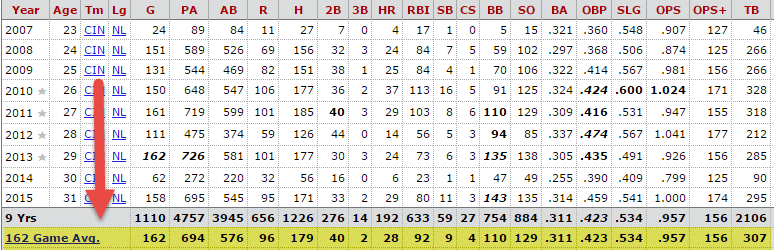
According to Baseball-Reference.com, Joey Votto’s 162-game averages (over 9 years in the League) are as follows:

Baseball Swing Slow Motion Analysis: Joey Votto Metrics

Look at the “yellow” highlighted line…

Here are the Joey Votto Metrics to pay particular attention to (definitions are according to FanGraphs.com):

  • On-Base% (OBP) – measures the most important thing a batter can do at the plate: not make an out…Joey Votto: .423, League Average is: .320
  • Isolated Slugging% (ISO) – measure of a hitter’s raw power and tells you how often a player hits for extra bases…Joey Votto: .223, League Average is: .140
  • OBP + SLG (OPS) – the sum of a player’s on-base percentage and their slugging percentage…Joey Votto: .957, League Average is: .710
  • OPS+ – This statistic normalizes a player’s OPS — it adjusts for small variables that might affect OPS scores (e.g. park effects) and puts the statistic on an easy-to-understand scale…Joey Votto: 156, League Average: 100

As you can see, Joey Votto is well above average in “not making an out”,  and “raw power”.  What’s also interesting is Joey Votto’s strikeout and walk percentages (averaged over his career):

  • Strikeout%Joey Votto: 18.6%, League Average: 18.5%, and
  • Walk%Joey Votto: 15.9%, League Average: 8.5%.

Joey Votto 2015 ESPN’s HitTracker Spray Chart

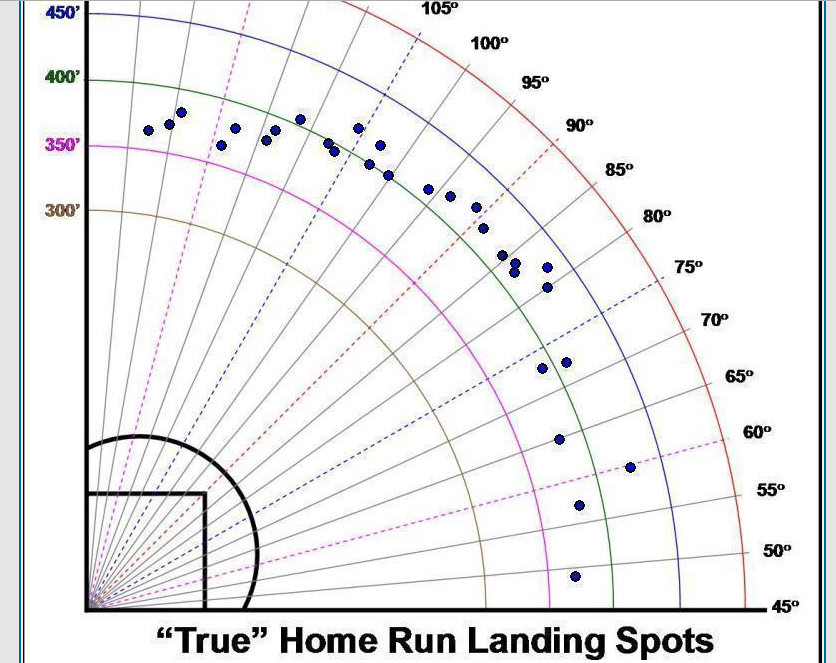
Check out the HitTrackerOnline.com spray chart of Joey Votto’s 29 homers in 2015 (keep in mind he’s a left handed hitter):

Baseball Swing Slow Motion Analysis: Joey Votto spray chart

Joey Votto 2015 spray chart courtesy: HitTrackerOnline.com

CLICK HERE for a FanGraph.com article titled, “Joey Votto on Hitting”. It goes into how:

  • Cerebral a hitter he is about his mechanics,
  • He purposely tools his swing to limit defensive shifts, and
  • He’s given up some power (dingers in particular) to cover the Pitch-Plane more effectively.

The aforementioned link is a GREAT read.  From the above spray chart and metrics, I’d say he “NAILED IT!!”


Joey Votto Mechanics as They Relate to Pitch-Plane Domination

In the above 17:23-minute baseball swing slow motion analysis video of Joey Votto’s swing, we go into more detail about the following FIVE human movements rules for Pitch-Plane Domination:

  1. Front Knee bend before swing initiation, and during the Final Turn,
  2. Back Knee bend during the Final Turn,
  3. Back foot skip during the Final Turn,
  4. Barrel matching the plane of the pitch early, and
  5. Barrel ‘chasing the ball’ passed impact getting to ‘Power-V’ after impact.

As Tony Robbins said,

“If you want to be successful, find someone who has achieved the results you want and copy what they do and you’ll achieve the same results.” 

Joey Votto is your hitter to dominate the Pitch-Plane when looking at baseball swing slow motion analysis.

Learn how to STOP hitting pop-ups, why are you swinging under and missing, and drills on how to fix an uppercut swing by staying on top of the baseball or softball.

Paul Goldschmidt: Can a Bleeding Barrel Kill Hitting Potential?


Paul Goldschmidt Youth Hitting Case Study

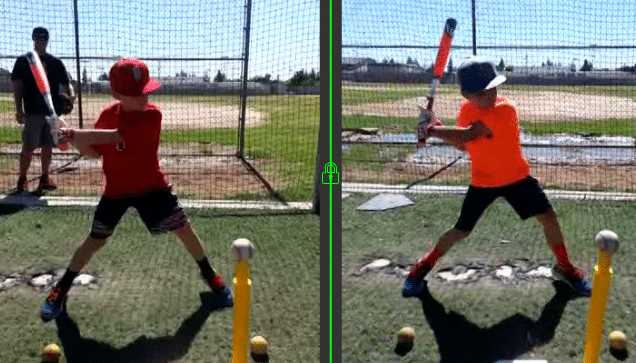
My 9yo hitter Collin bleeding his barrel. Swings are synced, before (on the left) & after (on the right)

In this video, we’ll look at 2013 National League MVP runner up Paul Goldschmidt’s swing and relate it to one of my younger hitters.  We’ll talk about:

  • What is a bleeding barrel (1-week before & after case study),
  • The “Goldy” standard, and
  • How-to fix a bleeding barrel at home.


What is a “Bleeding Barrel” (1-week before & after case study)

I’ve been working on this with one of my young hitters, Collin.  Bleeding the barrel is when the barrel starts to launch (turn into the hitting zone) before the hitter’s front foot touches down.

It’s caused by a premature turning of the shoulders, and is very inefficient when it comes to transferring energy.  In order to load powerful springy fascia and connective tissue in the torso, the front shoulder must stay in and down towards the back hip, at front foot touch down.  CLICK HERE for similar analysis comparing Josh Donaldson (Oakland A’s) to Jose Bautista (Toronto Blue Jays).

The week following my young hitter Collin’s AFTER video, he was bleeding his barrel again.  The cause?  His dad said a coach was doing rapid-fire soft toss before games.  Needless to say, Collin’s dad had a talk with the coach.

The “Goldy” Standard

Notice Paul Goldschmidt (pictured to the right) at front foot touch down:

  • His barrel angle is up (70-degree angle), and
  • He’s showing his numbers to the pitcher  (see video above).

Most importantly, taking care of point #2 above will stop the bleeding barrel.

Can Paul Goldschmidt do better?  According to Baseball-Reference.com, he stands at 6’3″, and weighs 245 lbs.  With this line, he can get away with inefficient mechanics and still hit for decent power.  His average home-run total per 162-game season is only 29.  For how big he is, he can average over 40 homers per season.

Here are a couple things I’d love to see change in Goldy’s swing:

  1. More forward momentum,
  2. Better down shoulder angle (side bending in the spine),
  3. Hide his hands a little more from the pitcher, and
  4. Extend up and back over the catcher more (he was a little out front on this pitch).


How-To Fix a Bleeding Barrel at Home

Remember to use Variance in the following scenario.  Three steps to stop the bleeding barrel:

  1. Break Swing into 2-Steps (1-2 second pause between): 1) Fight Position (landing), and 2) Final Turn – focus on showing the hitter’s numbers to the pitcher at the Fight Position, and keep a barrel angle around 45-55 degrees.
  2. Check-Swing Drill – get hitter to show they can keep from bleeding the barrel to impact.
  3. Put Swing Together – once they get here, then progress them from tee, to soft toss, to LIVE batting practice.  If they can hold together their mechanics, then the brain has ingrained the movement.

CLICK HERE to get more information on my online hitting lessons program The Feedback Lab.

Learn how to Stop AND Fix missing under the ball, hitting too many popups, and late batting timing for baseball and fast-pitch softball players.  Discover how to swing the bat faster, for more power, and ultimately hit more line drives.

“Shorten Swing” Like An Elite Hitter (Not What You Think)


Ask any “self-proclaimed” hitting coach what a “short swing” is, and you’ll get many differing interpretations.  I think the problem is found in the debate of feel versus real.  If you ask professional and MLB hitters what they’re trying to do, and they’ll use phrases like:

  • “I’m trying to stay short to the ball”, or
  • “I’m trying to be compact”...

The challenge is these examples are so vague, they’re widely open to interpretation.  And give coaches that kind of slack, and they tend to “hang” their hitters.  For instance, take the following swing example of Kris Bryant:


Some coaches will say his swing is too long, and that ONLY Big Leaguers can have swings like this.  This is an EXCUSE.  Albert Pujols, Alex Rodriguez, and Mark McGwire have been quoted as saying they swing/swung down on the ball.

You see, what elite hitters are feeling, and what we’re actually seeing on slow motion video (what’s real) can be two totally different things.  So how do we get our hitters to “swing shorter”, like Kris Bryant…?

…without using hitting aids, and using effective external coaching cues, which science says are far superior than internal ones (CLICK HERE to read this post about that).  Without further adieu, here’s the…

Shorten Swing Path Drill

In the above video we discuss:

  • Drill Objective: to help fix “casting”, “long”, or “bat drag” type swings.
  • Define “Long” versus “Short” swing
  • Finger Pressure for “connection”
  • Hitting the “catcher’s glove”:
    – “Ferris Wheel” versus “Merry-Go-Round”
    – Throwing barrel “sideways”
    – Using Variations
  • Ropebat as a supplemental hitting aid.

The following is the NEW Improved and Updated version of the video above…

Discover flat swing bat path trainer drills to square up a baseball or softball and learn how to hit more line drives instead of swinging under fly balls and hitting top half chopping grounders.

Hitting Tips To Boost Barrel Time On Pitch Plane

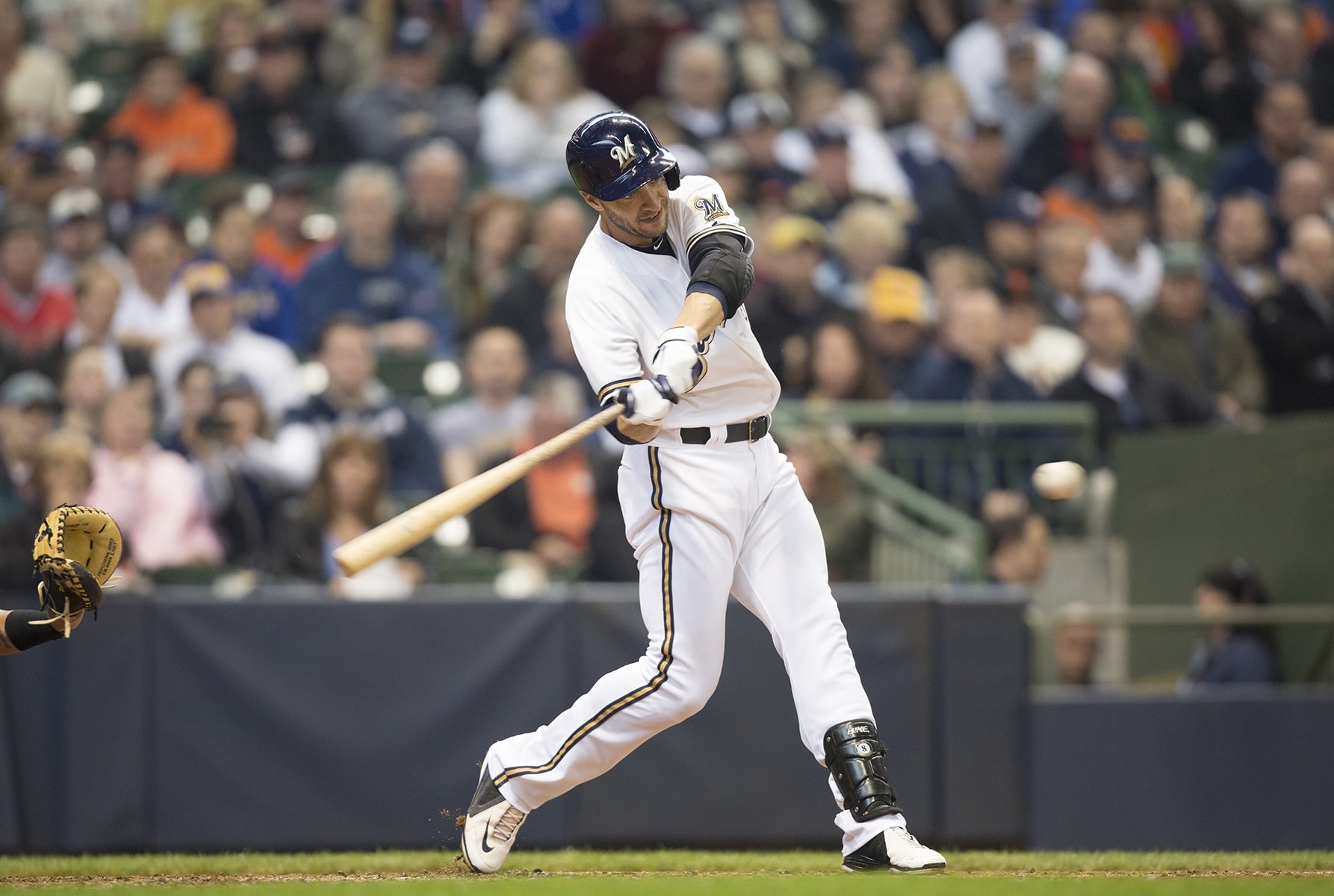
Ryan Braun early on pitch-plane

Ryan Braun early on pitch-plane. Photo courtesy: JTA.org

I often get caught up in my own ways of doing things that I sometimes lose sight of better hitting tips others are using for the same outcomes.  I’m not perfect.  And I’ll readily admit that I don’t know all the answers.  This my wife will surely echo 😉

But I do take pride in submitting and standing on the shoulders of giants.  This quote by Ralph Waldo Emerson changed my life:

“As to methods there may be a million and then some, but principles are few. The man who grasps principles can successfully select his own methods. The man who tries methods, ignoring principles, is sure to have trouble.”

Think of methods as “the drills.”  This post is for you hitting instructors or coaches who’re applying human movement principles, and successfully selecting your own methods.  I want to pick your brain, and hear your thoughts below.

But first, here’s the gist of the hitting tips assignment…

Hitting Tips from the Collective Few…

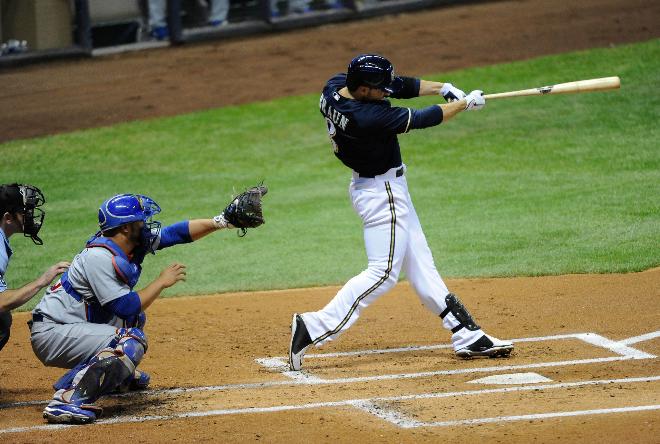
Ryan Braun Hitting Tips: staying long on the plane of the pitch

Ryan Braun staying long on the plane of the pitch. Photo courtesy: SportsWorldNews.com

I want to focus on efficiently increasing barrel time on the plane of the pitch using the Conservation of Angular Momentum.  By the way, it doesn’t matter if you come from baseball or softball.  So drawing from your teaching experience, what are your thoughts on the following (PLEASE leave your pearls of wisdom in the hitting tips comment section below):

  • Your go-to hitting drill for boosting barrel time on the pitch plane (pics or vids are welcome),
  • The best sticky coaching cue (or cues) that you use with young hitters, and/or
  • Any kind of underground (i.e. DIY) hitting aids that help with boosting barrel time on the pitch plane.

Keep in mind, inefficiencies such as arm barring, bat drag (racing back elbow), rolling over, and staying “attached” through the finish are issues you can address.   After a week, I’m going to have my readers vote on the best approach, and we’ll announce a winner.  Please share your thoughts in the “Leave a Reply” section below…

In this JD Martinez swing breakdown, discover if we need to fix dropping the back shoulder or if “tilt” is a natural part of the swing. Learn how to fix swinging under the baseball or fastpitch softball by STOPPING the dropping of hands and a swing uppercut. You’ll also see how to fix hitting well in the cage and batting practice but not in games. Learn how to make swings more “game-like”.

JD Martinez Swing Analysis: 3 Quick Ways To Solve Dipping, Transitioning Swings, & Dropping Hands


In this JD Martinez swing analysis, we’ll be answering the following reader questions:

  • How much of a dip in swing is too much?
  • How can we get the same results from what we see in the cage to the games?
  • Drills to keep hitters from dropping hands?

Also, I referenced the Ground-ball rant in the video detailing why I think ground-balls are gross for hitters.  Think about this: what would happen to current MLB average ground-ball rates for hitters (currently 46%) if ALL pitchers suddenly started pitching up in the zone, instead of down in the zone?

Below is the video outline and referenced links…

How Much of Dip in Swing is too Much?

  • Goldilocks Golden Rule
  • Trouble with excessive upper cut
  • Controlling Launch Angle Goal: batted ball leaves bat same height as pitch at impact

For the post I referenced in the above video for this section CLICK, “Baseball Batting Drills To Stop Dipping The Back Shoulder”.


How can we get the Same Results from what we see in the Cage to the Games?

  • Training principle of Specificity
  • Make it harder in the cage
  • Post that addresses this

For the post I referenced in the above video for this section please CLICK, “Baseball Batting Cages: How To Transition Practice Into Game Swings”.


Drills to Keep Hitters from Dropping Hands?

  • Effective versus ineffective hand path to the ball
  • Hands drop drill

For the post I referenced in the above video for this section please CLICK: “STOP ‘Hands Drop'”Also, here’s Dr. Mark Cheng explaining Reactive Neuromuscular Training (RNT) as “reverse psychology for your body”.

Hitting Baseball Drills: What Leads to Hitting More “Predictable” Line Drives and Less Strikeouts?

Hitting Baseball Drills Line Drive Mystery?

Hitting Baseball Drills Mike Trout photo courtesy: MLB.com

Discover how to hit more hard line drive lasers, up the middle, for baseball and softball players.  Fix swinging under the ball too much, STOP excessive pop ups, and figure out WHY you’re hitting too many ground ballsLearn beginner hitting drills you can do at home by yourself.

In this hitting baseball drills line drive mystery post, we’re going to answer the question above by diving into the following:

  • What does “predictable” mean and why does probability matter?  And,
  • Difference between ‘Launch Angle’ and ‘Attack Angle’…

What does “Predictable” mean and Why does Probability Matter?

Let’s define terms. What is probability?  Dictionary.com says this:

“The extent to which something is probable; the likelihood of something happening or being the case.”

Why does probability matter?  I have parents ask me, “What is the probability that if my kid does the hitting baseball drills you’re telling us, he or she will hit a line drive?”  What do you think an extraordinary yet reasonable line drive rate is?  We’ve talked about Major League average line drive rate being 20%.  That’s the gold standard for highest level in the land.  A high failure rate in hitting can be expected.  We’ve all heard the maxim that you can fail three out of ten times in the Big Leagues and make it into the Hall of Fame.  Probability of success in hitting DOES NOT match that of in the classroom.  Or shooting free throws.  Or a quarterback’s completion percentage.  Success measured in hitting isn’t even close to these examples.  Keeping probability in perspective matters when measuring hitting success.

Now, let’s look at the word predictable.  Hitting more “predictable” line drives.  What does predictable mean?  Dictionary.com, what say you?

“Behaving or occurring in a way that is expected.”

What “predictable” is for some hitting coaches may not be for others.  Consider this…Coach A uses horoscopes, astrology, and sorcery to teach his hitters how to hit line drives.  And after 20 years of teaching like this, he swears his hitters hit predictable line drives.  This is all he knows.    All he knows.

Let’s look at Coach B, who applies human movement principles validated by REAL Science to hitting a ball.  And after 20 years of teaching hitters like this, she swears HER hitters hit line drives predictably.  So which coach is more effective with their hitters?

If the hitting baseball drills answer doesn’t immediately jump out at you, then you may be the first one dead during a zombie apocalypse.  Of course I was exaggerating the two coaching strategies for effect (well, at least one of them).  This seems to be the duality of hitting logic I see online.  “Listen to ME because I said so”.  No standard.  Just listen to me because I slept in the same bed as Ted Williams in XYZ hotel.  Or I’ve binge watched millions of hours of slow motion hitting video of only the best hitters.  Or I have the MLB record of 9th inning doubles in the month of August.  Blah blah blah.

“Behaving or occurring in a way that is expected.”  20% line drive rate is expected.  So in 20-years of coaching, would Coach A or Coach B do better?  Let’s say Coach A’s astrology hitters came in at an average 12% line drive.  This is exceptional to him because it’s the pinnacle of what he’s experienced.  But what Coach A doesn’t know is Coach B’s science hitters clocked in at a 20% average line drive rate.  Coach A doesn’t have a clue until he talks to Coach B.  Lesson here?  We don’t know what we don’t know.  Now you know!

I can tell you, when it comes to THIS means THAT … hitting predictable line drives and striking out less comes from applying human movement principles that are validated by real science to hitting a ball. Hitters hit more predictable line drives when they follow principles outlined in: Physics, Engineering, Biomechanics, body work, Geometry, and Psychology.

Of course there is bad Science.  Just read Ben Goldacre’s book Bad Science: Quacks, Hacks, and Big Pharma Flacks.  But there are irrefutable principles that have been proven for decades, if not hundreds of years.  Take Gravity for one.  Jump out of a plane and you’ll fall 100% of the time – as long as you call earth home.  Look, there are 50 ways to skin a cat, but there is always one most efficient way…


Astrology Coach A may say something like this about Science:

…yes u can argue with science. Science is religion not fact. It’s guessing and testing not thinking and proving. Very little is proven fact in science. Science is only science until better science comes along. For example. The science of hitting….. there’s ppl out there that say he wasn’t completely right. Then there will be someone new saying the same of your doctor…..i find it funny scientists who can’t hit anything telling ppl the proper way to hit.”

And Science Coach B may respond with something like this:

“Science is neither religion or guessing and testing. It is the discipline of seeking knowledge in pursuit of the truth and understanding. Whether being applied to medicine, the weather or the baseball swing, that understanding is only as good as the currently available information (data), and yes a process of observation, testing and retesting as tools improve necessarily updates our knowledge and improve our understanding. It does not rely on faith as religion does. It relies on evidence and data. “Hard anywhere” is a result. It doesn’t explain or teach how in fact one hits the ball hard anywhere consistently. That requires some understanding of how the biomechanics of the swing works and can be made most efficient for each player.  If you want to argue with “science” as you refer to it, you are welcome and encouraged to do so…but bring your superior evidence and data to the argument!” 

I want to keep Coach A’s name anonymous, so as not to expose him to ridicule, thrown tomatoes, and bunny ears.   Look, there are hundreds of different ways to teach hitting baseball drills. A lot of coaches believe this, and I agree.  But I’d argue there is a more effective way.  What is it?

Consider this scenario…imagine you and I sitting down at the kitchen table to talk hitting.  One hour before, we were both involved in a feverish game of Octopus Tag (you don’t want to know).  And are famished!  What’s on the menu?  A big fat bowl of creamy tomato soup.  But before we begin nourishing our bodies with sweet Lycopene, I give the choice of eating your soup with three primitive caveman tools.  WARNING: you can only pick one…

  1. Spoon,
  2. Fork, or
  3. Knife

Which tool would you choose to eat your soup?  Think hard.  I’ll wait… okay, time’s up!!  You chose the spoon didn’t you.  How did I know?  Astrology?  Horoscope-ology (is that a word)?  No, of course not.  I knew because that was the most effective tool for the job.  Hitting is the same.  Anything less than applying human movement principles validated by REAL Science to hitting baseball drills, is like eating delicious creamy tomato soup with a fork or even dumber, a knife.  One can pull it off.  But others would look at you like you were a wooden dummy.

Remember, we’re looking at “behaving or occurring in a way that is expected.”

Let’s look at another puzzle piece to helping hitters consistently hit line drives…

Difference between ‘Launch Angle’ and ‘Attack Angle’?

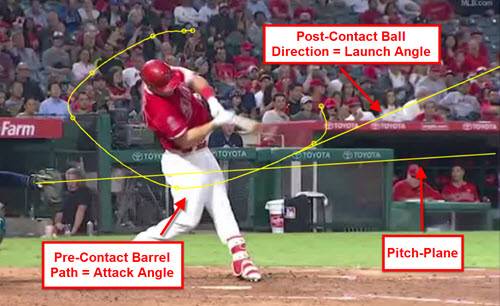
Here are the definitions of both attack angle and launch angle…

According to FanGraphs.com, Attack Angle is…

“The attack angle, or swing plane, is the angle that the bat is moving at when it hits the ball.”

And according to MLB.com, Launch Angle is…

“Launch Angle represents the vertical angle at which the ball leaves a player’s bat after being struck.”

There is no such thing as a ‘Launch Angle” swing, since every batted ball produces a Launch Angle, even a bunt.  Attack and Launch Angles are just numbers without a brain.  They’re a mode of measurement. They’re different, but similar.  More like first cousins. That’s it.  Period.  End of story.

But I can see where the hitting baseball drills confusion is.  The Launch Angle “swing” is a case of guilty by association.  In the past, coaches preaching launch angles, maybe using HitTrax or Rhapsodo, tended to instruct their hitters to hit the top back third part of the cage.  Did you get that?  Imagine that for a second…top-back-third-part-of-the-cage.  The coaching logic goes like this … if most doubles and dingers are hit within twenty to thirty degree launch angles, then let’s teach hitters to do just that.

Problem is, when the majority of hitters – especially the young ones –  attempt this, they end up hitting more popups.  I know because I taught it too!!  And like the Big Bang, just like that, the ‘Launch Angle’ swing was spoken into existence.  But I can tell you, THIS does not mean more predictable line drives.  Let me explain…

What is an Optimized Attack or Launch Angle?

The angle the barrel takes to the ball is an Attack Angle. The Launch Angle is angle ball takes off the bat.  Which begs the question, “What is an optimized Attack or Launch Angle?”

According to Fangraphs.com, the league average Attack Angle from 2015 through 2017 are: 11.4, 12.0, and 13.8 (in degrees), respectively.  The average Launch Angles in the same time frame were: 10.5, 11.1, and 11.0 (in degrees), respectively.  Launch Angle is a little more tricky than Attack Angle.  A hitter can control their Attack Angle.  Not so much their Launch Angle.  Fangraphs.com adds…

“…we see a relatively weak correlation between attack angle and launch angle, because launch angle is also strongly dependent a hitter’s aim, timing, and bat speed. While we don’t have any direct measurements of aim or timing, we can see that players with flatter swings (lower attack angles) have more margin for error when it comes to timing, and therefore tend to have higher contact rates than players with uppercut swings (larger attack angles).”

And the optimal home run Launch Angle seems to be about 24-degrees.  Ironically, the optimal Attack Angle for home runs is about 24-degrees.   But think about this, in the Big Leagues a fastball being thrown at 95-mph, typically is coming DOWN at a 5-degree angle.  So if the hitter’s Attack Angle is UP at 24-degrees, then yes we may see more dingers and doubles, but at the expense of hits, Batting Average, and higher strikeouts percentages.  The extreme uppercut example isn’t a good demonstration of the “slight uppercut” Ted Williams was talking about in his book The Science of Hitting.  Food for thought.

Furthermore, a fantastic post on the topic of the longest home run ever, comes from Dr. Alan Nathan in a post at PopularMechanics.com titled, “What’s The Longest Possible Home Run”. Alan Nathan is a professor emeritus of Physics at the University of Illinois.  The professor has spent a career tracking physics, especially as it relates to baseball. He says two primary factors guide how far a ball is going to fly: exit velocity and launch angle.  From the Popular Mechanics post:

“Consider Nathan’s ideal home run, hit with 120-mph exit velocity at a 26-degree launch angle. If Giancarlo Stanton hit that ball on a 70-degree day, at sea level, with no wind and 50 percent relative humidity, then Nathan’s calculations show the ball will travel 492 feet…If you start changing those atmospheric conditions, that number can go up a lot.  An out-blowing wind at 5 mph, which is not a lot of wind, can add 24 feet to a fly ball, so now you are at 516 ft. If instead you go to Denver (lower air density at a higher elevation) and that goes up to 533 feet.”

Now, I know what you may be thinking…

How does the Brain get the Body to Optimize Attack (AA) and Launch Angles (LA)?

Perry Husband of HittingIsAGuess.com dragged me to the following hitting baseball drills conclusion.  We talked about this already, but league average line drive rates in the Bigs is 20%, so this should be our primary focus.  Physics says, the hardest ball hit requires center-center contact between barrel and ball.  And remember league average fly-ball and ground-balls rates hover around 40% each.  The best hitters in the game are missing center-center contact 80% of the time – LOSERS!!  Kidding!

Dingers and doubles are what we call “quality misses”.  Aim small, miss small.  Hit the ball back through the “tube”.  Shoot for the ten to fifteen degree Launch Angle (our 20% line drive rate), and rest assured hitters will accumulate more of these quality misses.  Dingers and doubles without sacrificing swing quality.  Practicing this may not be sexy, but the results are, believe me.  Because if hitter shoots for dingers and doubles, they’ll hit more pop flies – I can tell you.

Remember, we’re looking at “behaving or occurring in a way that is expected.”  Consistent.  Predictable.  Higher probability of line drives.  Here’s the how and the hitting baseball drills lesson…

To optimize AA, we focus on optimizing the net outcome of LA.  Our hitter’s default focus is back through the “tube”.  Path ball takes from pitcher’s hand to catcher’s glove.  Distance from the ground sets the “tube”.  Hitter works on hitting it back through the tube.  If it’s an inch off the ground … ball comes off bat an inch off the ground.  If the tube is set at 4-feet off the ground, then ball comes off bat 4-feet off the ground.  So if it comes back through the tube, it’s coming back through the tube at 10 to 15 degrees. That is our optimized default launch angle we want to see our hitters practicing every single swing they take.

If it is not back through the tube, then we want them making the Dr. Victor Frankl Man’s Search For Meaning paradoxical intention adjustments. If they hit the ball above the tube (pop fly or quality miss above), then we want them to make an adjustment down below the tube next time.   Why do we want to include an adjustment for quality misses (doubles and dingers) above the tube?  Because if they try for them, they’ll miss higher.  Not good.  We praise them for the quality miss, but remind them to get back to the tube.  The same is true if they hit it below the tube (a grounder), then we want them to make an adjustment above the tube.

I know I sound like a broken record, but the body is always a step or two behind the brain.  So we have to exaggerate the adjustment cue in order to get the body to do what the brain wants it to.  Thoughts move quickly. We want to make sure that we get the big old bag of bones, muscle, springy fascia, and organs on par with the brain. Tell body to overshoot where we want it to go, in order to get it in the middle.

Case Study: does Teaching Hitters to Hit Top Back Third Part of Cage Work for Hitters in Games?

I argue no, it does not. And I will also say that I was there a few years ago, teaching the same thing to my hitters.  If I was talking to two years in the past Joey Myers today … he would think I was crazy.  And in his finite wisdom, would demand whose hitting baseball drills Kool-Aid I was drinking. But I can assure two-years in the past Joey Myers that hitting the back third part of the cage isn’t what we want our hitters practicing.

I mentioned I taught this exact thing a few years ago, and what I found, especially with a lot of my junior high and high school hitters, was that focusing on the double and dinger caused a majority of my hitters to hit more … you guessed it … pop flies. Some were flying out three and four times a game. And at that time we were telling our hitters to get the ball off the ground, and that all ground balls sucked eggs. There are still a lot of coaches out there, progressive ones, good coaches, that still subscribe to that.  But the problem is probability of averages.  “Behaving or occurring in a way that is expected.”  Consistent.  Predictable line drives.

Again, you look at the best hitters in the game, league average 20 percent line drive rate, 40 percent fly ball, and 40 percent ground ball. 80 percent of the time, the best hitters in the world miss hit the center of the ball. Center ball meeting center bat. The best hitters in the game are missing 80 percent of the time. So think about that. If we shoot for a ten to fifteen degree launch angle, hit it back through the tube, then our misses are going to be more quality.  Net results?

A higher probability of lines drives.  Back to at least league average.  So if we’re shooting for a 10 to 15 degrees Launch Angle, and we miss slightly under that center point, what ends up happening is that 20 to 30 degree launch.  We’re going to accumulate more doubles and dingers by shooting for the middle.  Shooting for the tube.

And when it comes to quality ground-balls, I think in the big leagues, when the ball exit speeds get above 94 miles an hour defensive errors go up. They significantly increase. Now, why is that? Well, because the ball’s speeding up and it’s moving faster than the best can react to get to the ball.  And the less bounces, the more likely the ball will get to an outfielder.  More bounces slow the ball down significantly.  So the speed the ball comes off the bat matters “big tyne”, as Domingo Ayala would say.  According to a “Fun With Statcast (Exit Velo)” post at Medium.com, here’s what happens to batting average when ball exit speeds increase:

  • 92-mph = .261
  • 94-mph = .311
  • 96-mph = .369
  • 98-mph = .425
  • 100-mph = .508
  • 102-mph = .565
  • 104-mph = .635
  • 106-mph = .701
  • 108-mph = .718

Then they level off on any ball exit speeds above that.  So not all ground-balls are bad.  Especially if we’re hitting them over 94-mph.  And by the way, the stats you just read reflect Major Leaguers!!  If you have a kid in Junior High or High School hitting 92-mph ground-balls, then the batting average for that hitter at that level will be much higher than what’s reflected above.   Major Leaguers are MUCH better fielders.

Bottom line?  Our focus should be in hitting the ball hard. Ball exit speed MUST be a big part of the equation. It’s king.  Optimized launch angles don’t mean as much with slow ball exit speeds.  We can get away with it for a little while, but the ability to hit more extra base hits, hit the ball to the wall or over the wall is going to be a major challenge at higher levels.

And if it’s one thing that high school coaches hate, are their hitters hitting an excess of fly balls.  They would take a ground ball, even if it’s a weak one any day of the week.  Why?  Because they bank on that fielder either miss playing it, or over throwing it. They’ll say that there’s more that can go wrong with the ground-ball than a fly ball, which is true. Fielder has to field and throw cleanly, and the receiver has to catch it. Three things can go wrong with the ground ball than a fly ball. They just have to catch it.  I’d disagree that “just catching” the ball is easy though.

As an outfielder who played at the Division 1 level in college, I can tell you it’s not that easy to track and catch a ball in the air.  You’ve got to take the right route. You’ve got to read it correctly off the bat. You’ve got to listen to the sound of contact. Solid, or not quite. If the ball is hit hard, we were taught to take your first step back. You don’t want a line drive going over your head. There’s a lot that goes into catching a ball in the air. So I will disagree that it’s easy to catch a fly ball. And I think most that say it’s easy, never played outfield on a regulation big field against higher level hitters.

In addition, with a skill like hitting that is reactive, versus pitching which is proactive, control isn’t what hitters are gifted with.  Only control what you can control. And to hear these coaches say hit the ball on the ground because the defense might make an error.  In a sport with less control, why would you pin hopes and dreams on “might” make an error.  You can’t control that.  So only focus on what you can control.

“Behaving or occurring in a way that is expected.”  Consistent.  Predictable line drives.  Our hitters CAN control improving their Ball Exit Speeds and optimize their Attack Angles.  In Chapter-3, we discussed what leads to hitting more “predictable” line drives and less strikeouts.  We dove into the following:

  • What does “predictable” mean and why does probability matter?  And,
  • Difference between ‘Launch Angle’ and ‘Attack Angle’…