Posts

Discover the reality of turning the barrel vs pushing the barrel in a modern MLB bat path swing.  Learn drills to help fix a step swinging under the baseball or softball swing.

Slingshot Your Way To An Effective Barrel Path


In this video, we’ll chat about the difference between two opposing forces described in Physics as Centripetal (center “seeking”) versus Centrifugal (center “fleeing”), and how they apply to the swing.

I borrowed this ‘rock-on-a-string’ concept from Jim Lefebvre’s book The Making of a Hitter.  I understood it as a hungry 11yo hitter looking for an edge, and I think it’s still applicable now to help hitters understand their intention with barrel path.

Yes obviously, barrel path is in an arc, circle, oval, ellipse, etc whatever helps get the point across.  However, to get an optimal impact point, hitters must think in terms of center seeking versus center fleeing forces.

It’s easy to understand optimal impact points and how they relate to Centrifugal Forces (center fleeing) when looking at what the left and right “flappers” must do to hit a pinball effectively…

…think of the flappers as hitter swinging a bat.  There are optimal depths of impact – from MORE out-in-front (inner 1/3 of the plate), to out-in-front (middle 1/3), and to slightly DEEPER than out-in-front (outer 1/3).  This demonstrates the Centrifugal Forces (center fleeing) part of the barrel arc.

Centripetal Forces (center seeking) of WHEN the barrel enters hitting zone depends on pitch depth – how long the barrel stays near the rear shoulder.  And here’s the critical mass, the barrels of elite hitters DO NOT enter the zone at the same time, regardless of pitch depth.  CLICK HERE for a post clearing this up.

Discover if push barrel path hitting drills fix a steep swinging under the ball swing for baseball and softball players…

The Sooner You Know ‘Swinging Down’ Can Be A Disaster The Better

The funny thing is…

That was actually ME in the above video!  This was a two tee drill video I did a long time ago for my old site SwingSmarter.com (not around anymore), between 2008 and 2010.  Like many at the time, I was taught to swing down and through the baseball my whole career.  This is where I agree AND disagree with Sean T. Plouffe’s comment to my video….

I agree, swinging down MUST not be a blanket teach, like many were taught in my era.  However, I DISAGREE with him because ‘swinging down’ is VERY helpful to pitches middle in and middle up in the zone.  And THIS is what guys like Sean DO NOT understand.  They’re just as bad as the blanket ‘swing down’ coaches, but they use the opposite blanket teach, ‘swing up’!  Click Here for a post I explain in depth why BOTH of these blanket teaches are WRONG.

Jake C.: Swinging Down

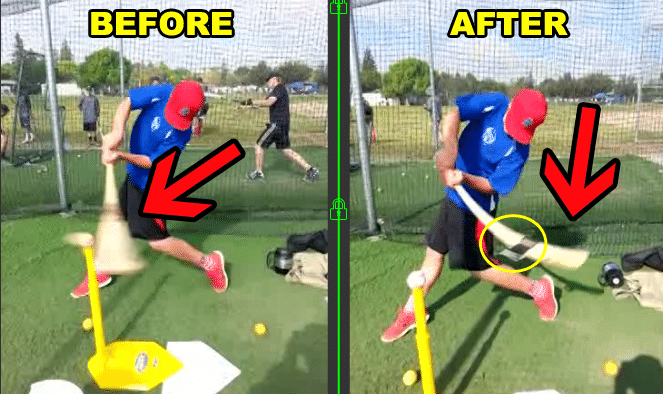
One of my HS Frosh hitters swinging down at the beginning of one of our first lessons together. We’re using the RopeBat to fix this. Photo courtesy: ME

We’ll discuss:

  • ‘That’s what he was taught’,
  • The journey that led me away from conventional wisdom, and
  • The bottom line… (how to fix)

‘That’s What he was Taught’…

Take this email I recently received from one of my readers, Bryan Nugent:

“Good morning,

My predicament is that over the last year or so I have been working with my son using your style  (catapult loading) from your book. My son is like a night and day difference when he doesn’t load like you point out. Some of my cue words I tell him are tuck, hide, see and drive.

  • Tuck – for his shoulder
  • Hide – his hands
  • See – keep his eye on the ball
  • Drive – hit through the baseball

Ok, now to the issue his baseball coach is trying to get him to have a different approach, stance and pretty much a different swing all together. From what we have been working on. How would I or what is the best way to approach the Coach and tell him to leave his swing alone in your opinion?”

And here was Bryan’s response after I emailed him a couple questions…

“Thank you for responding to my email. My son is 10. This past Saturday morning before our first pool play game we went back to the cage and got back to doing what we have learned from you. His results were outstanding including a solo shot that the opposing coach told him he hasn’t ever seen a 10 yr old hit the ball that far before.

The coach is young(23) just graduated from a local college where he played baseball. Not knocking him in any way but when talking to him he states ‘that’s what he was taught’ quite a bit. So maybe since this is his first time to coach young boys he is trying too hard, if that makes sense.

I did talk to him a little bit and told him I would bring him your book so he can see where we are coming from. Hopefully he will see there are 2 ways to skin a cat to get the same result. Which is to be able to get the kids to reach there full potential. Thanks again”

Thank you Bryan for sharing and for your continued support.  And yes, I asked his permission before sharing with you coaches.


The Journey that Lead Me Away from Conventional Wisdom

I can honestly say that I was where this young coach is when I first started teaching hitters.  And I know many of you coaches out there, if you’re being honest with yourself, can relate.

I had stopped seeking knowledge about the swing…stopped reading…stopped asking questions.  My mindset was VERY fixed.

Needless to say, I came to the realization that my hitters weren’t getting better.  At the time, my local lessons weren’t growing.  I was teaching what everyone in my area was teaching.  There was zero differentiation.  And you know what Mark Twain once said,

“When you find yourself on the side of the majority, it’s time to pause and reflect”.

It wasn’t till about 2011 that I started asking questions, and bought Jaime Cevallos’s book Positional Hitting (who’s a good friend of mine).

Then met Chas Pippitt of Baseball Rebellion, and helped him develop an online presence in 2012.

This was a good start, but there were still A LOT of unanswered questions that I had.

You see, I found a passionate curiosity for corrective human movement science back in 2005.  I got educated by gathering a large wicker basket full of alphabet soup certifications.  In a short time, I was training athletes and non-athletes by helping them troubleshoot their mobility and stability issues to improve performance or quality of life.

This led me down a rabbit hole that went pretty deep.

When my son was born at the end of 2012, I had an epiphany after reading a couple highly influential resources.  I digested the following books over and over, using them to reverse engineer the swing from a human movement principles validated by science perspective:


The Bottom Line…

If you’re a young coach – or more seasoned – who still teaches swinging down on the ball, squishing the bug, and that the hips are where the power is at…I know how you can feel married to these because you’ve put a lot of time, effort, and emotion into them while coaching and/or playing.

Believe me, I felt the same way.  Looking back now, it was a form of collective wisdom brainwashing that runs rampant in baseball and softball circles.

Here’s what I found teaching young hitters to apply human movement principles that are validated by science to hitting a ball:

  • My hitters see and feel productive outcomes within a reasonably short amount of time (huge for getting them to ‘buy into’ the system),
  • The online and local lesson part of my business has increased 5-fold (the word is getting out!),
  • The coaches that learn this from me are getting the same productive results with their hitters – if not better (and their hitters are raising the eyebrows of other coaches), and
  • The best news is, the knuckleheads on social media have a VERY difficult time arguing the true science of the swing!

My recommendation is this:

  • Educate yourself like I did with previously mentioned books,
  • Question very things you teach by asking, “What don’t I know?”
  • Do swing experiments like I do to see if a hitting mechanic is inferior or superior to its counterpart (CLICK HERE for a post on how to do this), And…
  • Above-all, be big enough to swallow your pride, regardless of how many years coaching or playing, or if you had the privilege to coach or play at the highest level, and admit you may be wrong.  Because let me tell you, many are, so you’re not alone.

Rest assured, if I can change, then so can you.

Believe me, your hitters will THANK YOU.  Learning can start when ignorance admits its ignorant. You don’t know what you don’t know, right?  Well, now you do 😉

Discover turning vs pushing the barrel by looking at the modern MLB bat path from Andrew McCutchen.  Learn drills to fix misguided baseball or softball hitting advice.  Turning the barrel is fantastic for middle away and middle down pitches, while pushing the barrel is great for middle in versus middle up pitches, Click Here for a post I did on that.

Modern MLB Bat Path Swing Like Andrew McCutchen


In this video post, we’re going to talk about:

  • Discuss when barring the front arm is okay,
  • Explore the science of spinning fast vs slow,
  • See how effective The Cutch is at turning, and
  • Look at how to work on this at home.

CLICK HERE to watch the – 2 min, 5 second – PBS Circus Physics video about the Conservation of Angular Momentum, or turning faster.


Straightening the Front Arm Out…Good or Bad?

I’ve shifted my thoughts on this since doing this video back in 2014.  I’d rather have my hitters bar their front arm out (or slight bend in front elbow) to and through contact.  Click Here to watch an interview I did with Perry Husband of EffectiveVelocity.com about arm barring.  This will answer all your questions on the topic.

The Science of Spinning Fast vs “Slow”

There are two Physics principles working with the Conservation of Angular Momentum:

  1. When an ice skater moves her arms in towards her center-line while spinning, then her turning speed goes UP, but inertial mass goes DOWN.
  2. And when an ice skater moves her arms away from her center-line while spinning, then her turning speed goes DOWN, but inertial mass goes UP.

What does this mean for hitters?  Two additional things:

  • Firstly, swing tempo means something.  If you accelerate a small part without the big part, then the spinning top becomes wobbly.
  • Secondly, you can’t “spin” faster and maximize force at contact, when inertial mass goes down.
  • And thirdly, the longer front arm accomplishes the best of three worlds: it promotes healthy swing tempo, increases inertial mass (balancing turning speed), AND encourages predictability in barrel path because it keeps the front arm shape at a constant versus the inconsistent “bending” of the front elbow taught by a few.


Did Cutch Pass the Turning Speed Test?

In the above Andrew McCutchen baseball hitting video, science clearly says that ‘Cutch’ can in fact turn faster during his Final Turn.

However in this Andrew McCutchen baseball hitting video, he can get away with it because of his shorter arm span in comparison to a hitter with a longer one, like Miguel Cabrera.  Cabrera would have to stand farther off the plate to make an early arm bar work.  Similar to what Ken Griffey Jr. did.

And as we’ll discover what force bleeding compensation he makes – possibly – because of his early arm barring in Part-3 of the Andrew Mccutchen baseball hitting video: Do This For Longer Drives video series.

UPDATED NOTES: Cutch is doing just fine in this swing analysis.  Just how it’s suppose to be 😉


How Do We Practice a Faster Turn at Home?

  1. Break the swing into two-steps: 1) To the Fight Position (Landing), and 2) the Final Turn
  2. Use a mirror or batting tee
  3. Video analysis feedback – either Coach’s Eye app (free for android) or Ubersense app (free for iphone)
  4. Hitter “hides their hands from the pitcher”, while keeping front arm straight or with a slight bend
  5. Going into the Final Turn, the hitter will try and “crush the proper catcher’s glove”

CLICK HERE for Part-3: Do This For Longer Drives: Andrew McCutchen baseball hitting video series, where we look to see if Cutch breaks the One-Joint Rule…If you missed Part-1, then CLICK HERE.

Discover how to hit more line drives using swing bat path mechanics science to hitting on the plane of the pitch like Joey Votto.

Baseball Swing Slow Motion Analysis Of Joey Votto


This is Part-2 of a 3-part baseball swing slow motion analysis video series coming straight out of the Pitch-Plane Dominator online video mini-course…

Hitting Training - Pitch-Plane Dominator

Sick of struggling to reduce your hitters ground balls, swing and miss strikeouts, and non-productive weak fly balls?  This simple 4-Step online video mini-course (7-modules total) will help hitters weighing less than 100-pounds, barrel the ball more consistently.  Dramatically decrease ground balls, strikeouts, and weak fly balls (no matter the pitch location or speed) by applying human movement rules validated by science.

If you haven’t already, then CLICK the Link below to…

Get Access to The Pitch Plane Dominator Online Video Mini-Course

“If you want to be successful, find someone who has achieved the results you want and copy what they do and you’ll achieve the same results.” – Tony Robbins

I received the following reader question:

“If you could only teach one swing, whose would you teach?”

And what follows in this baseball swing slow motion analysis of Joey Votto video, is my answer, as it relates to getting the barrel on, and staying on the plane of the pitch for as long as possible.

We’ll discuss Joey Votto’s:

  • Pitch-Plane consistency metrics,
  • 2015 ESPN’s HitTracker spray chart, and
  • Mechanics as they apply to Pitch Plane Domination.

Let’s build Joey Votto’s case as the best to copy for Pitch-Plane Domination…


Joey Votto Pitch-Plane Consistency Metrics

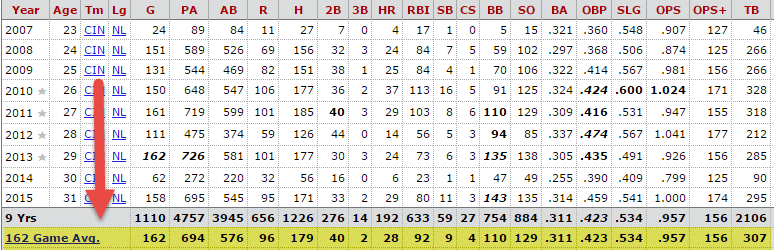
According to Baseball-Reference.com, Joey Votto’s 162-game averages (over 9 years in the League) are as follows:

Baseball Swing Slow Motion Analysis: Joey Votto Metrics

Look at the “yellow” highlighted line…

Here are the Joey Votto Metrics to pay particular attention to (definitions are according to FanGraphs.com):

  • On-Base% (OBP) – measures the most important thing a batter can do at the plate: not make an out…Joey Votto: .423, League Average is: .320
  • Isolated Slugging% (ISO) – measure of a hitter’s raw power and tells you how often a player hits for extra bases…Joey Votto: .223, League Average is: .140
  • OBP + SLG (OPS) – the sum of a player’s on-base percentage and their slugging percentage…Joey Votto: .957, League Average is: .710
  • OPS+ – This statistic normalizes a player’s OPS — it adjusts for small variables that might affect OPS scores (e.g. park effects) and puts the statistic on an easy-to-understand scale…Joey Votto: 156, League Average: 100

As you can see, Joey Votto is well above average in “not making an out”,  and “raw power”.  What’s also interesting is Joey Votto’s strikeout and walk percentages (averaged over his career):

  • Strikeout%Joey Votto: 18.6%, League Average: 18.5%, and
  • Walk%Joey Votto: 15.9%, League Average: 8.5%.

Joey Votto 2015 ESPN’s HitTracker Spray Chart

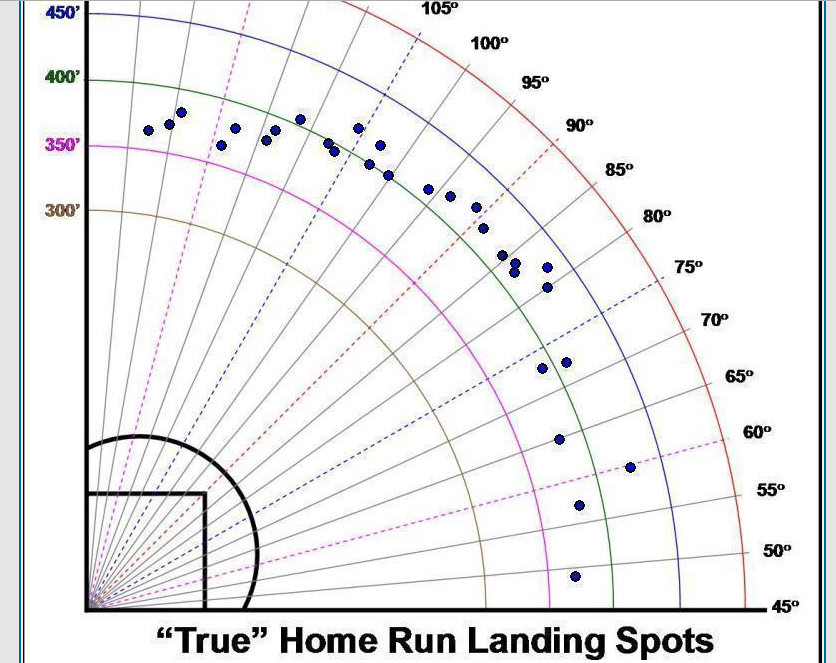
Check out the HitTrackerOnline.com spray chart of Joey Votto’s 29 homers in 2015 (keep in mind he’s a left handed hitter):

Baseball Swing Slow Motion Analysis: Joey Votto spray chart

Joey Votto 2015 spray chart courtesy: HitTrackerOnline.com

CLICK HERE for a FanGraph.com article titled, “Joey Votto on Hitting”. It goes into how:

  • Cerebral a hitter he is about his mechanics,
  • He purposely tools his swing to limit defensive shifts, and
  • He’s given up some power (dingers in particular) to cover the Pitch-Plane more effectively.

The aforementioned link is a GREAT read.  From the above spray chart and metrics, I’d say he “NAILED IT!!”


Joey Votto Mechanics as They Relate to Pitch-Plane Domination

In the above 17:23-minute baseball swing slow motion analysis video of Joey Votto’s swing, we go into more detail about the following FIVE human movements rules for Pitch-Plane Domination:

  1. Front Knee bend before swing initiation, and during the Final Turn,
  2. Back Knee bend during the Final Turn,
  3. Back foot skip during the Final Turn,
  4. Barrel matching the plane of the pitch early, and
  5. Barrel ‘chasing the ball’ passed impact getting to ‘Power-V’ after impact.

As Tony Robbins said,

“If you want to be successful, find someone who has achieved the results you want and copy what they do and you’ll achieve the same results.” 

Joey Votto is your hitter to dominate the Pitch-Plane when looking at baseball swing slow motion analysis.

Discover swing bat path to hit more line drives, square the ball up more, increase hitting power, and gain faster bat speed using principle drills for baseball or softball hitters.

How To Consistently Crush The Ball Using Geometry & Springy Forces


The objective of this presentation was to give a technical speech to a non-technical audience.  Sorry, the video and audio aren’t the best, but I think you’ll get the overall message.  Also, I’ve provided the power-point slides I used for this presentation (CLICK HERE to download from Google Drive).

You may find it quite helpful to follow along with the slides during the presentation.  PLEASE NOTE: in each section, I do skip to the images in that section to help illustrate a point.  We discussed the following:

  • Move better, perform better,
  • Use movement tests,
  • Match the Pitch-Plane with Geometry, and
  • Knock snot out of the ball with Springy Fascia.

Below is the basic outline of the speech…

ENJOY!


Move Better, Perform Better

  • ‘Governor’ truck engine story
  • Repetitive movements/position shape your body
  • “You can’t fire a cannon from a canoe” Mobilize & Stabilize


Use Movement Tests

  • Following “rules” to human movement – GRF, FoMo, Ang Mom, Centrip/Centrif, springy forces
  • Gorilla Grip
  • One-Joint Rule
  • Un-Weighting


Match Pitch-Plane with Geometry

  • Define Pitch-Plane
  • Importance of Back Leg Angle
  • Attack Angle + Ball Exit Speed


Knock Snot Out of Ball with Springy Fascia

  • Define springy fascia – tension/compression forces
  • Seen the biggest jumps in average Bat Speed with spinal engine experiments
  • Showing numbers – 6-mph
  • Downhill shoulder angle – 4-mph
  • Finger Pressure – 3-mph
  • Hunched Posture – +4 Attack Angle

Discover the modern MLB bat path ‘level swing’ trainer that helps fix bat drag.  Learn difference between turning the barrel versus pushing with these hitting aids for baseball and softball.

Baseball Training Aids: Long Slow Swing Fix?


It’s featured advertising on MLBNetwork.  Derek Shelton, the Tampa Bay Rays hitting coach, is the spokesperson in the video ad (CLICK HERE to see video).

Go to the SpeedHitter website, and you’ll see endorsements from:

  • CC Sabathia (son uses),
  • Aaron Boone (son uses),
  • Kerry Wood (son uses), and
  • David Segui.

I’ve also seen the Speed Hitter being used – this past summer – in Little League All-Stars game on-deck circles.  Does it work?  In this baseball training aids video blog post, we’ll talk about:

  • Speed Hitter baseball training aids review,
  • Barrel path science, and
  • A better alternative


Speed Hitter Baseball Training Aids Review

Two main objectives of Speed Hitter baseball training aids (softball included) allegedly address a hitter’s contact point and barrel path.  A hitter is suppose to swing it and hear the “pop” of the ball where contact is made.  The Speed Hitter is priced between $59.99-79.99 + shipping.  Baseball training aids that are highly endorsed and visible often raise red flags for me.  THREE reasons WHY:

  • Endorsements – A majority of Pro-level athletes simply CANNOT teach what they do (or did)*,
  • Expertise – MLB hitting coaches carry A LOT of high “lose-your-job” risk instructing big money ballplayers, and
  • Marketing – Big money ads, in the proper places, can lend massive credibility to a defective concept that as a result, users tend to overlook.

*This actually has to do with what Neuro Linguistic Programming calls Unconscious Competence.  Players simply perform on ‘auto-pilot’.  On the other hand, Conscious Competence is being able to instruct someone else to exactly model what you’re doing.

Barrel Path Science

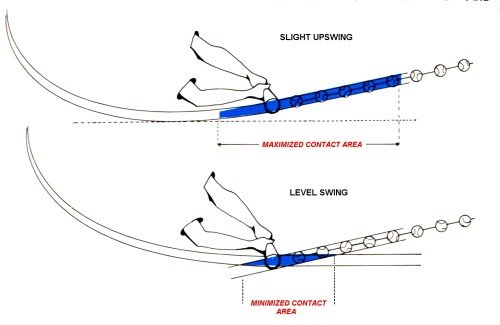
Baseball Swing Path

Image from Ted Williams’s The Science Of Hitting. We want the hitter’s barrel path to match the plane of the pitch, not chop down OR put an extreme uppercut on it.

Speed Hitter baseball training aids are flawed for FOUR-reasons:

  1. Point of contact and when the barrel enters the zone are two different things,
  2. Point of contactCLICK HERE for a post I did illustrating point of contact based on pitch depth,
  3. When Barrel Enters Zone – this will depend on pitch depth – the farther the pitch is away from the hitter, the earlier the barrel should enter the zone.  The closer the pitch, the later the barrel should enter the zone, and
  4. Tampa Bay Rays hitting coach and Speed Hitter spokesperson Derek Shelton doesn’t have an efficient swing himself (wraps the bat in the ad).

Addressing #2 above – The Speed Hitter doesn’t seem to be a hitting aid that lends itself to practicing “point of contact”.  It’s more geared for when the barrel enters the zone.

Addressing #4 above – nothing against MLB hitting coaches or any coach on YouTube demonstrating a hitting aid or technique, but there’s always context.  There are “snapper” hitting coaches out there teaching every one of their hitters to force barrel back right away, this is great for middle-away and middle-down approaches but terrible middle-in and middle-up – at least WITHOUT significant mechanical compensation to the latter pitch locations (loss of ball exit speed).  And then their are ‘down swinger’ coaches who teach the exact opposite of the snappers.  Both approaches can work in the right circumstances, but teaching one approach to all hitters is a BIG mistake.


A Better Alternative…The Swing Blaster

Baseball Training Aids: Swing Blaster Review

Keenan Wolf, one of my H.S. Frosh hitters, after one 45-minute session using a Swing Blaster demo this past summer. Swings are synced.

FIVE benefits of using Swing Blaster baseball training aids (good for softball as well) are:

  1. Early Barrel Acceleration – focuses on getting the barrel on pitch plane ASAP.  It’s not about being quick to the ball, it’s about being quick to pitch plane.
  2. Lengthens Hitter’s Pitch Plane – Gives hitter the ability to hit pitches harder – and keep them fair – that they may be late on otherwise.
  3. EIGHT levels of difficulty – there are eight little ‘washers’ that increase or decrease the level of difficulty to hear the audible “click”.
  4. Take soft toss – You can use the Swing Blaster to take short range soft toss.  A hitter CANNOT do this with Speed Hitter baseball training aids.  DO NOT hit LIVE batting practice with it unless the hitter has good bat control.
  5. MADE IN USA

How does it work?

The Swing Blaster gives a hitter audible feedback in the form of a “click” when max barrel speed has been reached.  It’s simple…

If the hitter hears the “click” AND contact at the same time, then they’re doing it WRONG.  If they hear a “click” FOLLOWED by contact, then they’re doing it RIGHT.  Whereas Speed Hitter baseball training aids have it backwards.  They want the hitter to hear the “pop” at contact.  To be effective, this isn’t when a hitter should be accelerating the barrel.  The barrel should already be accelerated at impact.  Impact is when a hitter’s arms are lengthening out or adjusting in to increase turning speed or inertial force.

The price?  Get yours today for only $34.99 + shipping on Amazon…I’m not sure if Swing Blaster will be raising the price soon, but for now you’ll be SAVING at least $25 than buying a Speed Hitter.  CLICK the following link to

buy-button2

Learn how to fix bat drag or casting with this hitting drill.  Discover how to STOP missing the ball, looping swing, and swinging under the ball for baseball and softball players.

How To Use the Flashlight Barrel Angle Drill to Boost Barreling the Ball


Flashlight Barrel Angle Drill

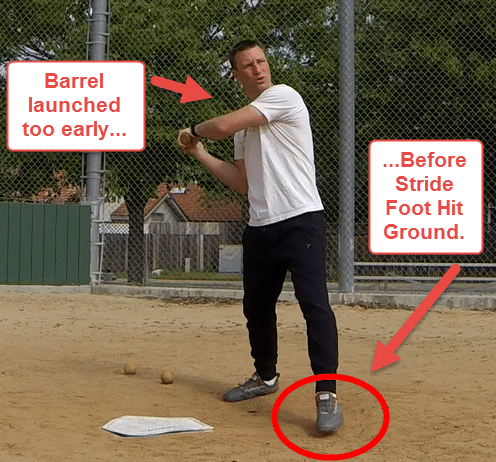
This time of the season, I’m getting a lot of younger hitters starting their turn before the stride foot hits the ground.  I ask them if they throw a baseball or softball before their stride foot hits the ground.

Try it. Feels awkward, doesn’t it?!  Why are these younger hitters starting their turn before landing their stride foot.  It could be because of a flat barrel at or close to landing.

I also called it a “bleeding barrel” in this post that analyzed Paul Goldschmidt’s swing.  A flat barrel can cause:

  • Racing back elbow bat drag,
  • Launching the turn too early, and
  • Inconsistently barreling the ball.

The biggest reason is because when the hitter flattens out the bat at or slightly before landing, it shifts the center mass of the bat behind the center mass of the hitter.

The video above is my favorite prescribed drill for fixing a “Bleeding Barrel” and a flat launched bat.  Here are the video notes:

  • What was once Pre-Launch Barrel Angle,
  • Fixing throwing before front foot lands v. Final Turn before front foot land,
  • Center mass of the bat,
  • Variance using feedback markers, and
  • As close to landing as possible.

Please keep me updated on your hitters using the Flashlight Barrel Angle Drill…

Discover flat swing bat path trainer drills to square up a baseball or softball and learn how to hit more line drives instead of swinging under fly balls and hitting top half chopping grounders.

Hitting Tips To Boost Barrel Time On Pitch Plane

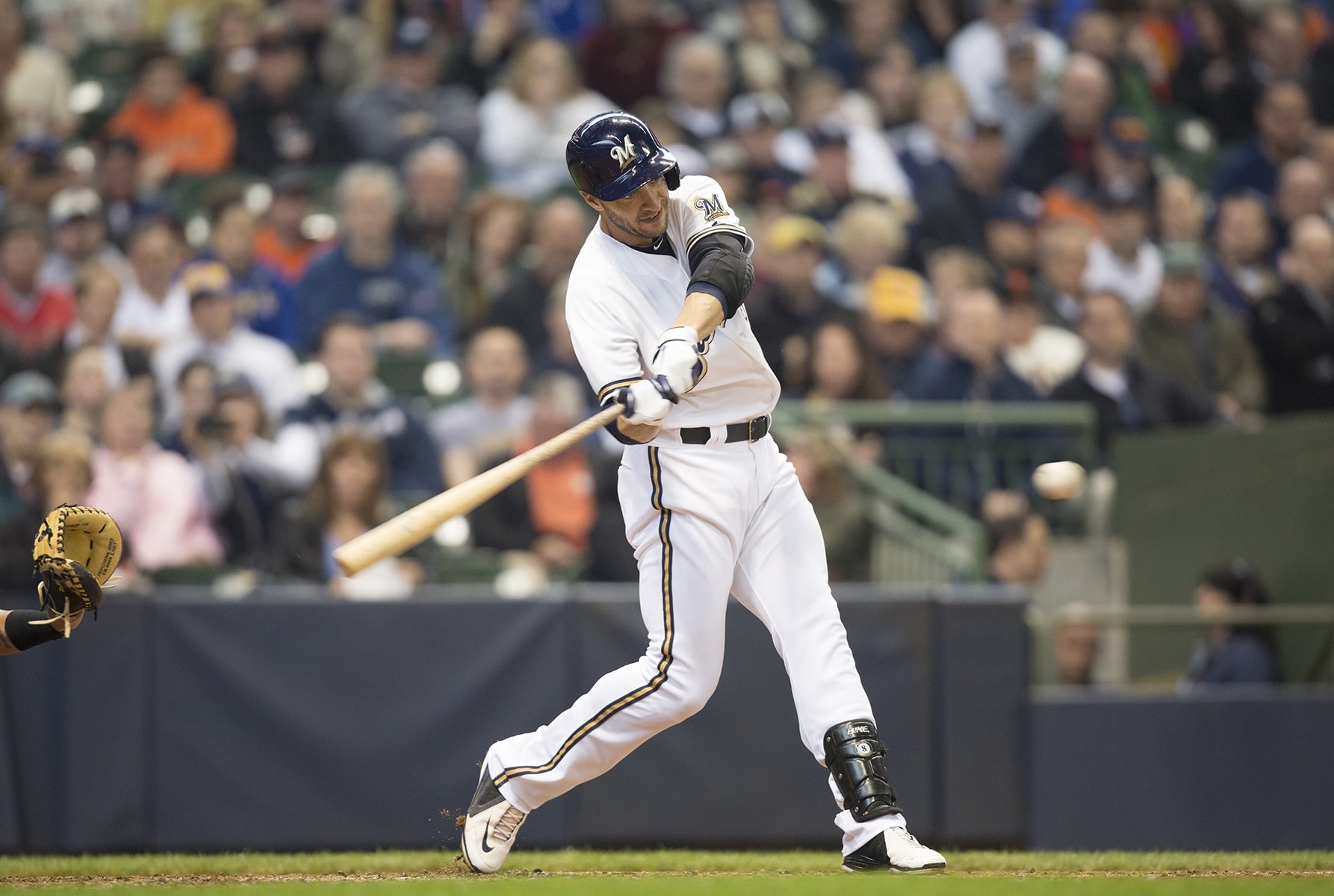
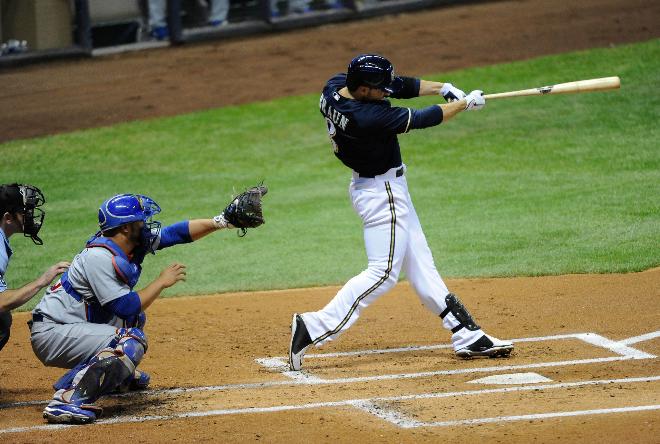
Ryan Braun early on pitch-plane

Ryan Braun early on pitch-plane. Photo courtesy: JTA.org

I often get caught up in my own ways of doing things that I sometimes lose sight of better hitting tips others are using for the same outcomes.  I’m not perfect.  And I’ll readily admit that I don’t know all the answers.  This my wife will surely echo 😉

But I do take pride in submitting and standing on the shoulders of giants.  This quote by Ralph Waldo Emerson changed my life:

“As to methods there may be a million and then some, but principles are few. The man who grasps principles can successfully select his own methods. The man who tries methods, ignoring principles, is sure to have trouble.”

Think of methods as “the drills.”  This post is for you hitting instructors or coaches who’re applying human movement principles, and successfully selecting your own methods.  I want to pick your brain, and hear your thoughts below.

But first, here’s the gist of the hitting tips assignment…

Hitting Tips from the Collective Few…

Ryan Braun Hitting Tips: staying long on the plane of the pitch

Ryan Braun staying long on the plane of the pitch. Photo courtesy: SportsWorldNews.com

I want to focus on efficiently increasing barrel time on the plane of the pitch using the Conservation of Angular Momentum.  By the way, it doesn’t matter if you come from baseball or softball.  So drawing from your teaching experience, what are your thoughts on the following (PLEASE leave your pearls of wisdom in the hitting tips comment section below):

  • Your go-to hitting drill for boosting barrel time on the pitch plane (pics or vids are welcome),
  • The best sticky coaching cue (or cues) that you use with young hitters, and/or
  • Any kind of underground (i.e. DIY) hitting aids that help with boosting barrel time on the pitch plane.

Keep in mind, inefficiencies such as arm barring, bat drag (racing back elbow), rolling over, and staying “attached” through the finish are issues you can address.   After a week, I’m going to have my readers vote on the best approach, and we’ll announce a winner.  Please share your thoughts in the “Leave a Reply” section below…

Discover how to fix an early dropping bat head, the dipping back shoulder truth, and put a STOP to hitting so many pop ups for the baseball and softball swing.  Learn 6 ways to flatten a batter’s bat path

Do You Recognize The 6 Early Warning Signs Of Hitters Dipping Their Bodies?


In the above video, we’ll be discussing:

  • Relationship between spinal engine and shoulder behavior in healthy effective swing,
  • Causes of unhealthy “dipping” of body in swing,
  • Head stability,
  • Arching low back,
  • Straightening out back leg,
  • Over-rotating upper half,
  • Over-rotating lower half, and
  • Core instability.

Hey, what’s going on. It’s Joey Myers again from the “Hitting Performance Lab. In this video, we’re gonna answer a reader question, this one is asking for advice to:

“Helping get youth players to stay on plane, and not dip their bodies when they swing”.

Now a couple things we have to define here, what ‘dipping’ is…


Relationship between Spinal Engine and Shoulder Behavior in Healthy Effective Swing

This is important to cover. Because there is some dipping that goes on, but I want to define what’s good versus what’s bad. What we should see with hitters, and good healthy spinal engine mechanics is, say with the righty, the shoulders will start in somewhat of a slightly down position, we call this the ‘Downhill shoulder’, and it’s just a side bend.

David Weck, founder of the BOSU ball, the RMT Club, and a lot of other cool stuff. He talks about this idea of the head over foot technique. The head shifts slightly over towards the front stride landing foot.  The side bend is crucial to the actual opposite action that’s gonna happen during the swing.

We’re gonna see the teeter totter effect of the shoulders starting down, and then they’re gonna flip up as I start my turn. Then what we should see is this shoulder, if we track the left one for a righty starts down, pops up. As we finish, should be back down again.  Think about those beautiful images of Mickey Mantle, Ted Williams, Babe Ruth, Lou Gehrig, in their finish, and the righties are kind of in this position. The lefties are in the opposite position.

We want to see a healthy accelerating-decelerating spinal engine, that is the healthy dipping that we should see if the shoulders or side bending.

6 Causes of Unhealthy “Dipping” of Body in Swing

1. Head Stability

I call it a ‘Collapsing backside’, so one of the causes of this is head stability. We’ll see a hitter will go chin to chest, when they’re at impact, going right into their sternum with their chin. Sometimes we’ll see the head go up (like looking up into the sky), we’ll see the bill of the cap go this way, and we’ll see the rear ear going to the rear shoulder, so for righties, right ear to the right shoulder. For lefties, left ear to the left shoulder.

There are some hitters in the big leagues that do this a little bit, they used to do this actually more in the past, they’ve been cleaning it up. But Andrew McCutchen used to go chin to chest, Bryce Harper would go rear ear to shoulder, Prince Fielder did what Harper did.  You even see Nolan Arenado more chin to chest. Because he tries to leave his head at impact, which I don’t recommend for younger hitters. When the head is in an unstable position, this creates a threat to the central nervous system. Wherever the head goes, the body follows.

If the head “rolls” (like Harper/Fielder)…when we’re rolling the head this way, you’ll see a collapsing of the backside, you see the whole body will dip, and it’s not a very strong position. Head stability is one of them, one of the causes of an unhealthy dipping of the body in the swing.

2. Arching low back

Arching the lower back, kind of similar to the neck, the C-spine. When we start arching the lower lumbar during rotation, which isn’t very good because you’re pushing the vertebrae together, and then rotating them, so you’re basically grinding. So, we don’t want to do that, and if we’re doing that, sometimes we’ll see this collapsing to the backside as well. You want to do it what’s called a ‘Hollow position’, or a ‘Hollow hold’, you can go on YouTube, and search “hollow hold gymnastics”, and you can find a video on how to practice this.  It’s basically taking the curve out of our lower lumbar, or lower back.

Imagine you’re lying on your back, on the ground, like you’re gonna do a crunch, you got your feet on the ground, your knees are up, and you go to do a crunch. What you have to do first is push your lower back into the ground, just want to push hard in the ground, create some pressure into the ground through your lower back.  That’s taking the curve out of your lower back, and doing what we call a hollow position. It’s a posterior tilting of the pelvis for those kinetic nerd jockeys like me.

3. Straightening out Back Leg

The other thing that could be causing dipping of the body in the swing is straightening out the back leg.  This tends to follow both head instability, and/or arching of the low back.

The glute fires, the back glute, for righties the right glute, and the right quad fires to straighten the knee. It’s the hamstring that we see in professional studies of hitters, back hamstring that’s turning on a lot more than you see in amateur hitters, where they tend to try and lock that back knee out. The glute locks out, and what’s happening is that back glute is trying to support and create stability in the lower back. Because it’s going into a bad position, a compromised position. As long as we can fix the hollow, get them into more of a hollow position, we fix the head movement with the neck brace drill. Not a stiff neck brace, but a soft one.  We don’t want to immobilize the head, just create feedback for movement.

If you can correct this, you can crack the lower back – metaphorically speaking of course – then you can start to work the hitter into bending that back knee a little bit more, using the hamstring, lesser the quad, and lesser the glute. Those are again trying to protect that lower back, that can be a major cause of unhealthy dipping in the swing.

4. Over-rotating Upper Half

I am starting to actually see this in some of my hitters, not in a lot but a few of them.  Where they’re actually over rotated at impact. They’re making contact almost behind themselves, and their sternum in the middle of their chest is out over in left field (for righties, reverse for lefties). We must get them to under rotate, so we do a lot of “deep” tee drills, and get them to try and pull the ball off a deep positioned tee. You set it up almost in line with the hitter’s belly button, and get them to kind of hook it, and hook it around to slow down that sternum.  The hitter should look and feel like they’re swinging their arms across their body. 

The upper half over rotating, we can also over rotate the lower half…

5. Over-rotating Lower Half

So, we use a VeloPro to strap it to the back hip and back ankle.  We get them to try and keep the back heel on the ground (like George Springer), and keep the back foot sideways. If they’re over rotating, it could cause a collapse of the backside as well. Again, we want to be effective between our 90 degrees of fair territory, and when we over rotate either the upper or the lower half, then what we’re doing is we’re sliding our 90 over into foul territory, which doesn’t do us any good, any of our hitters any good.

The last thing I want to add in this video is fixing core instability…

6. Core Instability

There are things that you can do at the gym with your trainer, hopefully your trainer is versed on mobility and stability exercises (certified in the Functional Muscle Screen – FMS, or in TPI). When we’re talking core stability, you want to do a lot of things like planks:

So, you’re creating some rotation in there as well. You also want to do like ‘Hollow holds”, you want do things like that, you want to do maybe suitcase carries, where you’re carrying a dumbbell on one side of the body and trying to keep your shoulders square, things like that you can do. You can ask your trainer on how to create more core stability, but those are some things to think about if you’re asking yourself the same question as our reader: “Helping get youth hitters to stay on playing, and not dip their bodies when they swing”.

Work on the things we discussed, clean them up, and check them off your list. Your hitter will be in a more healthy body “dipping” position. Make sure that we’re swinging smarter by moving better, and before I let you go…

Learn how to fix casting, a steep loopy swing, and STOP consistently missing under the baseball or softball.  Discover how to make a quick short swing and flatten an “up” bat path by swinging down

Here Are 4 Quick Ways To Fix A Long Casting Barrel…


…One of my favorite hitting demonstrations to do with hitters to help them understand the need to stack the bat’s “belly button” above theirs.  A flat bat at landing can cause a few of the following things:

  1. Hands drop (CLICK HERE to fix this),
  2. Racing back elbow bat drag (CLICK HERE for a video on how to use Finger Pressure to combat this), or
  3. A long casting barrel (CLICK HERE for a post that sheds light on how to fix this)

Since we’re on the subject of drills fixing specific swing dysfunction, CLICK HERE (solution #4) to see the “Flashlight Barrel Angle” drill to fix a flat bat at landing 😉