Discover our top-5 list of short inspirational hitting a baseball quotes by Ted Williams, Derek Jeter, Giancarlo Stanton, Sadaharu Oh, and Jose Bautista.
What Baseball’s Greats Actually Meant: 5 Quotes Decoded with the Science Behind Each One
I often post inspirational baseball quotes from top MLB hitters on my Facebook fan-page. So I wanted to share my top five player quotes and photos that get the most engagement on Facebook…ENJOY!
Derek Jeter

Photo courtesy: HighHeatStats.com
I read D.J.’s unauthorized biography The Captain: The Journey Of Derek Jeter
, and baseball quotes like this of his sum up his whole career.
Even though Derek Jeter was the 6th overall pick by the Yankees in the 1992 draft, he made over 50 errors at Shortstop his first year in professional baseball! The Yankees doubted him and talked about moving him to the outfield. He improved on his fielding, and the rest is history.
Whether it was brutal contract negotiations with the Yankees, media scrutiny from one of the biggest cities in the world, “Stat-heads” saying he had no range to his glove side, or injuries, Derek Jeter found a way to beat the critics, his competition, and inevitably etch himself into the Hall of Fame.
Giancarlo Stanton

Photo courtesy: SBNation.com
Fangraphs lists Giancarlo Stanton as a beast, 6-foot, 6-inches, 240-pounds! And according to Wikepedia.com he was a three-sport athlete. Before being drafted in 2007 by the Marlins, he was offered a baseball scholarship at USC, and offers to play football at UCLA and UNLV.
I love hearing this quote come from such a “big” guy. I subscribe to the fact that Giancarlo Stanton was such a well-rounded athlete, and didn’t have access to year-round baseball that contributed to his success so far.
Unfortunately, a lot of Little League coaches and parents focus on just hitting the ball, instead of hitting the ball hard. These types of baseball quotes are great to put hitting into perspective.
Jose Bautista

Photo courtesy: BirdDogRealty.net
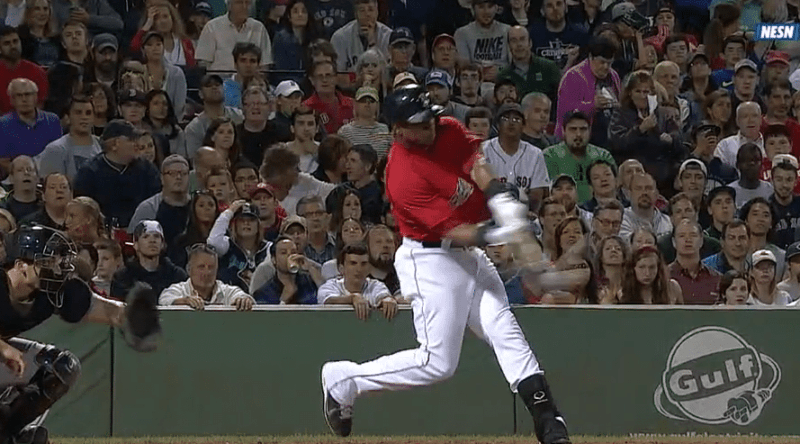
One of the “smallest big hitters” in baseball. FanGraphs.com lists him at 6-foot, 205-pounds. But his Metrics make him look like Giancarlo Stanton!!!
These types of baseball quotes are based on mindset at the plate. And after watching Jose Bautista swing, we can see he doesn’t get cheated…shocker, I know. Consider this…
One of my hitting friends Bob Hall from Canada shared with me something he heard from a scout about having a plan at the plate…
You’re either a fisherman OR a hunter. The fisherman waits for the fish to bite, while the hunter stalks his prey. I tell my hitters to use both, depending on the pitcher’s accuracy and hitting situation, to their advantage.
Sadarharu Oh

Photo courtesy: rnishi.Files.Wordpress.com
Sadaharu Oh, another small slugger, is listed at 5-foot, 10-inches, 173-pounds according to Baseball-Reference.com. Why is this significant?
During Hank Aaron’s time, Sadaharu Oh played in Japan and was considered the Barry Bonds (career home-run leader) of Japanese baseball. He blasted 868 dingers over the span of 22 seasons…and that’s almost 40 per year!
CLICK HERE for a post I did asking for my reader’s reaction on his mechanics. Judging by these types of Sadaharu Oh baseball quotes, technique was his saving Grace. It had to be, because he had to “do it right” to compete the way he did.
And sure, against today’s Major League pitchers, Sadaharu Oh probably wouldn’t hit as many homers, but man, how consistent his power was over 22 seasons. I agree with one of my reader’s comments from the article link above, that if Oh played in America today, they’d have made him a slap hitter, much like they did Ichiro, because of his small physique. Ichiro can hit the long ball, but not allowed. Darn shame 🙁
And last but certainly not least…
Ted Williams

Photo courtesy: ESPN.Go.com
I don’t think Ted Williams needs an introduction. Looking at this picture, it seems to be around his magical .406-year, three years into the Big Leagues and weighing about 180-pounds, soaking wet, while standing at 6’3″! He had the height, but definitely WAS NOT gifted with body mass.
In his biographies he often cited “inhaling” multiple malt shakes per day to put weight on his frame. Too bad he didn’t have access to the information we have on that today!
In baseball quotes like this, Ted Williams talks like a man who struggled to do it right. “…you can’t make a hitter, but I think you can improve a hitter,” is not something Daryl Strawberry would say. Failure is a huge part of hitting, way more than pitching. We learn from our failures more than our successes. Our hitters need to know from an early age that failure is okay. As long as we use it as a tool to get better. Progress is a process.
Free Download
“Hitting Greats on Hitting” — 37 Baseball Quotes Decoded with the Biomechanics Behind Each One
Ted Williams. Babe Ruth. Hank Aaron. Mickey Mantle. We took the most-quoted lines from baseball’s legends and broke down what each quote actually means for your hitter’s swing — using the Catapult Loading System and Spinal Engine framework. This is the coaching translation sheet coaches and parents don’t know exists.
Download the Free PDF →
No spam. Unsubscribe any time.
Frequently Asked Questions: Baseball Quotes & What the Greats Really Meant
These are the questions coaches, parents, and players ask most often. Each answer goes beyond the quote to deliver the coaching insight and biomechanical principle behind it — so you can use these lines as actual teaching tools, not just dugout motivation.
What is Ted Williams’ most famous quote about hitting a baseball?
Ted Williams’ most quoted hitting line is: “A hitter’s first obligation is to get a good ball to hit.” It comes from his book The Science of Hitting, where Williams divided the strike zone into 77 individual cells and charted a different batting average for each. His point: the best swing mechanics in the world can’t overcome a bad pitch selection. The biomechanical translation is this — every pitch location demands a different attack angle and swing length, and making contact on a pitch at the edge of your zone reduces force production even when your mechanical pattern is perfect. Williams was describing pitch selection as a multiplier on exit velocity, not patience for its own sake. In Catapult Loading System terms, you can only express maximum fascial energy release if the pitch location allows your optimal rotational plane. Williams understood this in 1971. The exit velocity data we have now confirms it.
What is the most famous baseball quote of all time?
In general culture, Yogi Berra’s “It ain’t over ’til it’s over” wins the name recognition contest. But the quote that matters most for coaches and hitters is Williams again: “Hitting a baseball — I’ve said it a thousand times — is the hardest single thing to do in sport.” What most people skip is the line that follows: “A round ball hit by a round bat, hitting it squarely, is the most difficult skill to master.” Williams was making the biomechanical case: a 90 mph fastball reaches the plate in roughly 400 milliseconds. The hitter has about 200 ms to decide to swing and 150 ms to execute. The margin for error is measured in millimeters and microseconds. That precision argument is exactly why motor pattern repetition under quality feedback matters more than any single tip, cue, or drill in isolation. Volume of correct repetitions is the irreplaceable foundation — and that’s what Williams was really saying.
What did Derek Jeter say about failure that every coach should know?
Jeter’s most coaching-applicable quote: “There may be people who have more talent than you, but there’s no excuse for anyone to work harder than you do.” The context makes this coaching gold: Jeter committed over 50 errors at shortstop in his first professional season. The Yankees organization discussed moving him to another position. He became a first-ballot Hall of Famer. The lesson backed by motor learning research: deliberate repetition with specific, immediate feedback builds competence faster than raw talent alone. Dr. Anders Ericsson’s expert performance research found that the quality and quantity of deliberate practice — not innate ability — is the primary predictor of elite performance. Jeter’s career is the practical proof of that principle on a major league diamond. The coaching takeaway: stop asking “does this kid have talent?” and start asking “how many quality reps has this kid gotten, and under what feedback conditions?”
What baseball quote best explains exit velocity to a young player or their parent?
Two quotes frame it together. Giancarlo Stanton: “I just want to hit the ball hard.” Jose Bautista (paraphrased): “Don’t be a fisherman — be a hunter.” The data behind both: at Hitting Performance Lab, we use the BES formula — every 1 mph of additional exit velocity adds approximately 4 feet of batted ball distance. FanGraphs research confirms fly balls carry a +358 ISO and +115 wOBA advantage over ground balls. Teaching a youth hitter to swing with maximum intent and hit the ball as hard as possible is not aggressive coaching — it is the exact biomechanical principle that separates elite hitters at every level. Stanton’s quote is the hitter’s version of that math expressed in the simplest possible way. When a parent says “I don’t want my kid to strikeout,” Stanton’s quote is the answer: the kid who swings hard and misses is building a better motor pattern than the kid who pokes defensively to avoid failure.
How did Sadaharu Oh hit 868 home runs at only 5’10” and 173 lbs?
Oh hit 868 professional home runs over 22 seasons — roughly 40 per year — at a physical profile American coaches would typically label a “slap hitter” or “gap hitter.” His quote on the method: “Practice doesn’t make perfect. Perfect practice makes perfect.” The biomechanical secret was his famous flamingo one-legged stance, which pre-loaded his hip flexors and created a massive stretch-reflex in the elastic fascia surrounding his pelvis and spine before any pitch was thrown. In Catapult Loading System terms, Oh was performing an advanced version of the Springy X Pattern — storing elastic energy in the myofascial system and releasing it explosively through spinal rotation. His power came entirely from fascial energy storage and sequenced rotation, not from physical mass. The coaching lesson: a smaller, lighter hitter using proper mechanical loading consistently outperforms a larger hitter relying on linear force. Oh proved it over 22 seasons.
What’s the best baseball quote to use with a young hitter who is afraid to strike out?
Babe Ruth: “Every strike brings me closer to the next home run.” For youth coaches, fear of failure is the most common mindset problem in the game — and it produces exactly the defensive, contact-first swing pattern that caps a hitter’s development ceiling early. Ruth’s quote reframes the strikeout from failure to information. From a Reactive Neuromuscular Training (RNT) standpoint, the body learns faster through committed, full-intent repetitions — even missed ones — than through cautious, “protect the plate” swings that avoid failure by avoiding commitment. A hitter who swings hard and misses is building the motor pattern for maximum force production. A hitter who pokes defensively at borderline pitches to avoid striking out is reinforcing a weak, reactive pattern that will hold them back at every level they advance to. Ruth’s career strikeout rate was among the highest of his era. His home run rate defined an era. Those two facts are connected, not contradictory.
What does “short to the ball” actually mean — is it good or bad advice for hitters?
This cue appears in nearly every dugout in America — and it creates more bat drag and dropping-hands problems than almost any other piece of coaching advice. What coaches usually mean: “don’t extend your arms too early in the swing.” What hitters actually hear and do: “keep the elbow in and stay compact.” The biomechanical problem: “short to the ball” is a position-focused cue, not a force-focused cue. Ted Williams never described his swing as “short” — he described it as rotational. The hips open first, the torso follows, the arms follow the torso, the hands follow the arms. The swing that looks “short” to coaches observing it is actually the result of proper sequential rotation, not arm suppression. If you want to teach what coaches mean by “short,” the more accurate cue is: “Let your hips fire first, and let your hands follow.” The arms appear compact as a consequence of good sequencing, not as a cause you can directly engineer by telling a hitter to keep their hands in.
How do you use baseball quotes to actually help a struggling hitter — not just motivate them?
The most effective quotes as coaching tools are the ones that reframe the goal without adding technical overload during an at-bat. When a hitter is struggling, the last thing they need is another mechanical cue competing for attention while a 90 mph fastball is coming. Instead: use Williams’ framing to change what the hitter focuses on. “Get a good pitch to hit” shifts cognitive load from mechanical cues (“fire the hips,” “stay back”) to situational strategy (“this pitch in my attack zone = swing, everything else = take”). The research on attention during motor performance consistently shows that external focus cues (aimed at the outcome or environment) outperform internal focus cues (aimed at body parts or mechanics) during live performance. Save the mechanics for practice. In the game, Williams’ quote is the mental model: hunt your pitch, execute when you get it.