Discover mental side, struggling hitter approach, and batter’s box psychology to overcome fear of failure for baseball and softball batting. Learn how to help your hitter relax and build confidence in the batter’s box when they feel anxiety and have a mental block at the plate.
Mental Approach To Hitting: “Failing Forward”
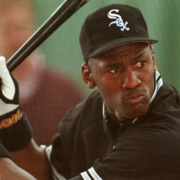
Michael Jordan hitting with the Chicago White Sox in 1994. Photo courtesy: http://www.sportsonearth.com/
“Failing Forward” like Derek Jeter, Reggie Jackson, & Michael Jordan. This was a “rough draft” inspirational speech I did for my local Toastmasters group. Sorry audio isn’t as good as my other videos.
I wrote it for my parents, coaches, and hitters who are struggling through the hitting process. CLICK HERE for my speech cliff notes. Big thanks go out to Ryan West and his son Ian for the text message 🙂
Here are some other great mental health, training, and approach posts we did:
https://hittingperformancelab.com/wp-content/uploads/2015/05/jordan_baseball_3b76sd8w_zbjthbpz.jpg7001200Joey Myershttps://hittingperformancelab.com/wp-content/uploads/2021/10/hitting-performance-labs_c90c0362088ef1d3d528f3078f4f8ac1-300x75.pngJoey Myers2022-07-18 09:00:462022-07-18 20:20:17Mental Side, Struggling Hitter Approach, And Batter’s Box Psychology To Overcome Fear Of Failure For Baseball & Softball Batting | Relax And Build Confidence When Feeling Anxiety & Mind Block At Plate
Baseball lost one of the hardest working hitters EVER. In this video blog, I want to answer the question of why Tony Gwynn couldn’t hit for repeatable power. I’m keying in on a two interesting points mentioned in an article at Deadspin.com, “How Tony Gwynn Cracked Baseball’s Code And Became A Legend“, after his passing. We’ll talk about:
How baseball history is made on the inside pitch,
How the front shoulder is crucial to repeatable power, and
Why Mr. Padre’s swing didn’t have built-in power.
How Baseball History is Made on the Inside Pitch
The Deadspin.com article mentioned a 1992 All-Star game conversation Tony Gwynn had with Ted Williams about how Williams preached that baseball history was made on the inside pitch. Quoted from the Deadspin article:
“The year before Williams offered his counsel, Gwynn hit .315 on pulled balls; the year after, .587. And in the five years following it, he hit .368, won four batting titles, and made a very serious run at being the first hitter since Williams to hit .400, which he may have done if not for the 1994 strike.”
Increased average, check! But, according to Baseball-Reference.com, over his 20 year career Tony Gwynn only hit over 10 home runs five times in a season. Although, four-out-of-five of those seasons were after the Ted Williams conversation. His career high was 17, in 1997. In the video, I offer an explanation of why it wasn’t too late for Gwynn to develop power after that Williams conversation.
SCIENCE-BASED TRAINING:
Improve your hitting strategy dramatically by applying human movement principles.
Learn not only how and what to train but also the science behind the methods.
The last point, mentioned in the Deadspin article, was in a conversation George Will had with Tony Gwynn in his book Men At Work, where Gwynn explains – during video analysis of his swing – if he was “staying on the ball”:
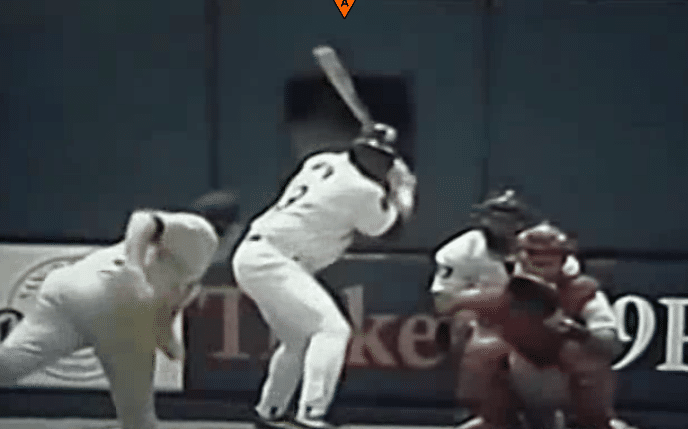
To know if he is swinging correctly, he counts the frames from when the pitcher lets go of the ball until his, Gwynn’s, front shoulder “opens up”—turns to the right…There’s one… two… three… four… five… six… seven… eight… nine… ten… There,” he says with satisfaction at the high count, “ten frames. That means I’m staying on the ball. I’m keeping my front shoulder in and staying back. If I open it up before then, I’m through, I’m out in front.”
How interesting. Mr. Padre may have been ahead of his time here. In the coming swing breakdown, you’ll discover how to not lose the repeatable power opportunity that Tony Gwynn did.
Why Tony Gwynn’s Swing DID NOT Have Power Built-In
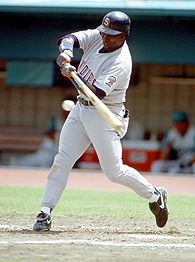
Tony Gwynn photo courtesy: MLB.com
What I reveal in the video, is proven human movement science. I’m standing on the shoulders of giants, body workers like Ida Rolf, Judith Aston, Thomas Myers, and Dr. Erik Dalton. I borrow from Dr. Serge Gracovetsky and his theory on Spinal Engine mechanics, and Dr. Kelly Starrett’s work in optimizing human movement.
Nowadays, we have a solid framework for producing power in the body through dynamic movement without having to worry about this hitting theory or that. Here are my top THREE fixes that would have built repeatable power into Tony Gwynn’s already consistent swing:
Down shoulder angle (spinal engine mechanics)
Hiding hands from the pitcher (loading springy connective tissue in the torso), and
Better spine angle at and after contact (pictured to the right, spine is too vertical).
My family’s thoughts and prayers go out to his family. We lost a good hard working man.
'Add 40-Feet' To Batted Ball Distance
Swing Study reveals how tens of thousands of hitters are adding 40-feet to batted ball distance by using one simple strategy.
Click the button below to access the FREE video that's been downloaded over 30K times!!
https://hittingperformancelab.com/wp-content/uploads/2014/07/tony-gwynn-missing-repeatable-power.jpg262195Joey Myershttps://hittingperformancelab.com/wp-content/uploads/2021/10/hitting-performance-labs_c90c0362088ef1d3d528f3078f4f8ac1-300x75.pngJoey Myers2022-07-11 09:30:142022-08-05 21:41:45Tony Gwynn: How To Hit Inside Outside Pitches, Increase Hitting Power, & Teach Kid To Hit Ball Further | Last Game, Highest Batting Average, Cause Of Death, Hit Chart, & Batting Titles
Discover the perfect baseball and softball swing plane trainer, bat path truth, and barrel turn hitting drills for contact, power, and quick hands. Does a one size barrel path fit all pitches? What is the performance consequence of a deep barrel turn on an inside pitch? Or what is the effect of swinging up to an elevated pitch?
Best Hitters Baseball Barrel Path – Do We Have It All Wrong?
…And I’m sorry. But I will say this, most are being misled on the best hitters baseball bat path. The principle you’ll discover shortly also applies to fast-pitch and slow-pitch softball.
In this best hitters baseball barrel path post, we’ll look at:
…according to Diamond Demo video above: “Breaking down Khris Davis”.
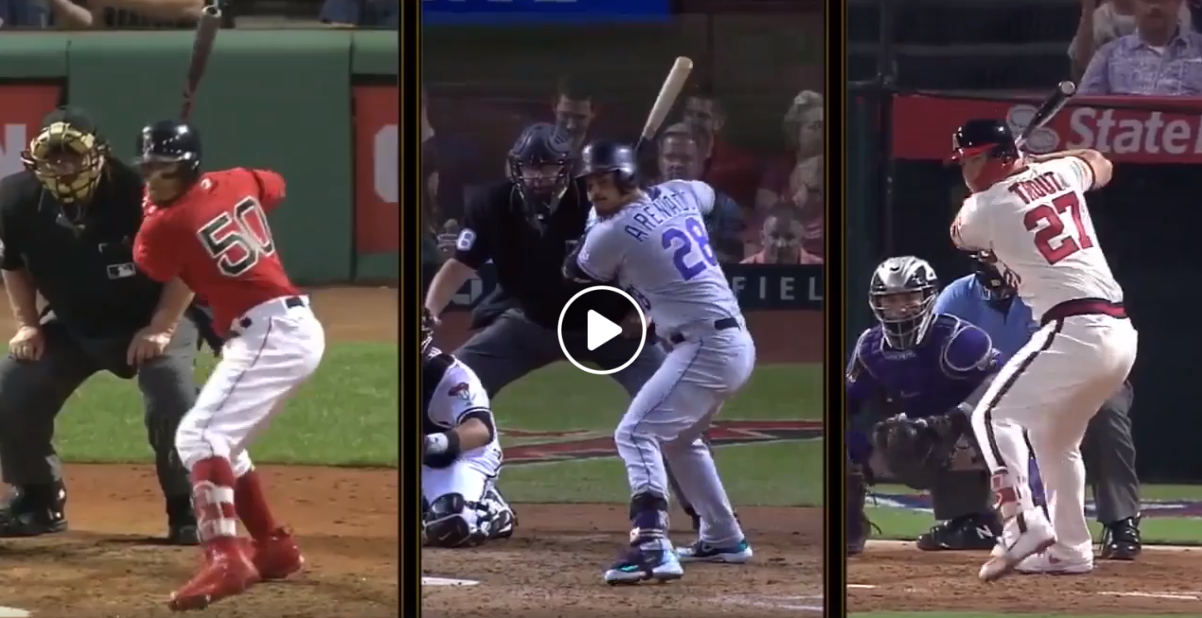
We published last week’s Khris Davis swing analysis post because of the Diamond Demo “Breaking down Khris Davis” video. The overwhelming response I received from readers sharing this video with me truly validates the Catapult Loading System seen in the best hitters. Don’t think so? Take a look at the following split screen snapshots from the above video (recognize ANY of the hitters??)…
Observe stride landing positions of JD Martinez, Aaron Judge, & Jose Altuve – ‘showing numbers’, ‘downhill shoulders’, & ‘hiding hands’. Photo courtesy: Diamond Demo video “Breaking down Khris Davis”
And,
Check out stride landing positions of Mookie Betts, Nolan Arenado, & Mike Trout – ‘showing numbers’, ‘downhill shoulders’, & ‘hiding hands’. Photo courtesy: Diamond Demo video “Breaking down Khris Davis”
We won’t spend a lot of time rehashing last week’s post, BUT I do want to bring up an important point that was talked about in the above Diamond Demo segment. And it has to do with best hitters baseball barrel path…
Starting at about the 2-min, 15-second video mark, and continuing to the end, they talk about this idea of Khris Davis getting his barrel in the zone early, and keeping barrel in the zone late. And this is where I’ve lied to you for the last 5-years! I used to teach my hitters this same one-size-fits-all SUPER deep barrel path. But what I found was this IS NOT true of the best hitters baseball bat paths…
SCIENCE-BASED TRAINING:
Improve your hitting strategy dramatically by applying human movement principles.
Learn not only how and what to train but also the science behind the methods.
WHY Hitters Baseball Current One-Size-Fits-All SUPER Deep Barrel Path Approaches are Losing
Let me tell you a story of how I stumbled onto this principle…
In January of 2018, I was working with one of my hitters, who has been working with me since he was 7 years old. He’s 15 years old now, in the 8th grade, and consistently hits with a low to mid 80’s Ball Exit Speed off the Backspin Tee, using a wood bat.
His mechanics are pretty clean compared to my other hitters. At the time, I was teaching my hitters the same one-size-fits-all SUPER deep barrel acceleration path, as many of you are now. One day, we were working on hunting pitch zones, inner third pitches specifically, and he responded,
“Coach, I don’t feel like I can get to that inside pitch effectively. Am I showing my numbers too much?”
This got me thinking, so I jumped on Twitter to look at the best hitters baseball bat paths. Specifically, I was looking for hitters, like the ones on the split screen images above, crushing 94-mph+ on the inner third of the plate, and guess what I saw??
The ones who demonstrated the Catapult Loading System principles well (namely ‘showing numbers’), still did so at stride landing on inside heat! Did you catch that?! ‘Showing numbers’ was irrelevant to crushing the inside pitch.CLICK HERE for a post I did debunking that. So what were they doing different on the inner third?
It had to do with what we call hitting a different “catcher’s glove”. I won’t go into the details of that here because I already did at the following post titled:“Accelerate Barrel Rearward Like Mike Trout”. The best hitters baseball barrel path isn’t about a one-size-fits-all approach to all pitches and timing.
Here’s the DANGER for hitters using a one-size-fits-all SUPER deep barrel acceleration approach…
Signs that pitcher’s are smartening up to countering this seemingly effective low in the zone barrel approach? Pitchers are now using this, which Perry Husband calls Effective Velocity (EV), to exploit hitters with longer barrel paths.
In short, 2018 homers are down, in addition to having a few months in the season where overall offensive strikeouts outweigh hits in the Big Leagues. This is troubling. To give a clue, check out Perry’s video explaining why Chris Davis (Orioles) is having issues with this one-size-fits-all barrel path…
If hitting coaches don’t smarten up to this soon, then they’ll be rendered obsolete, irrelevant to the hitting community, and ultimately out of a job. That’s not an exaggeration, and is where the puck is going, believe me. Now, let’s look at the behavior of different “catcher’s glove” approaches on inner, middle, and outer third of the plate pitches…
Grab 'Finger Pressure' Video
Frustrated with fixing BAT DRAG? Beat it!
Swing Study reveals how majority of hitters are correcting 'racing back elbow' bat drag within 1-2 weeks WITHOUT overhauling swing mechanics OR buying fancy and expensive hitting aids.
Click button below to access FREE video that has been downloaded over 20K times!
On time to deliver the backside through the direction of the ball. He lands a little open all the time, I think he opened more here based on anticipated pitcher release point. Rotate on a line. pic.twitter.com/tiAiYF2Org
Now, how do we train this? I’m going to give you two complimentary drills we use to sync the optimal “catcher’s glove” with the proper direction of force (See – aren’t you glad you read my post to the bitter end!?):
Frustrated with fixing BAT DRAG? Beat it!
Swing Study reveals how majority of hitters are correcting 'racing back elbow' bat drag within 1-2 weeks WITHOUT overhauling swing mechanics OR buying fancy and expensive hitting aids.
Click button below to access FREE video that has been downloaded over 20K times!
Baseball Batting Techniques: Simple Way To Use Forward Momentum That Works For Elite Hitters
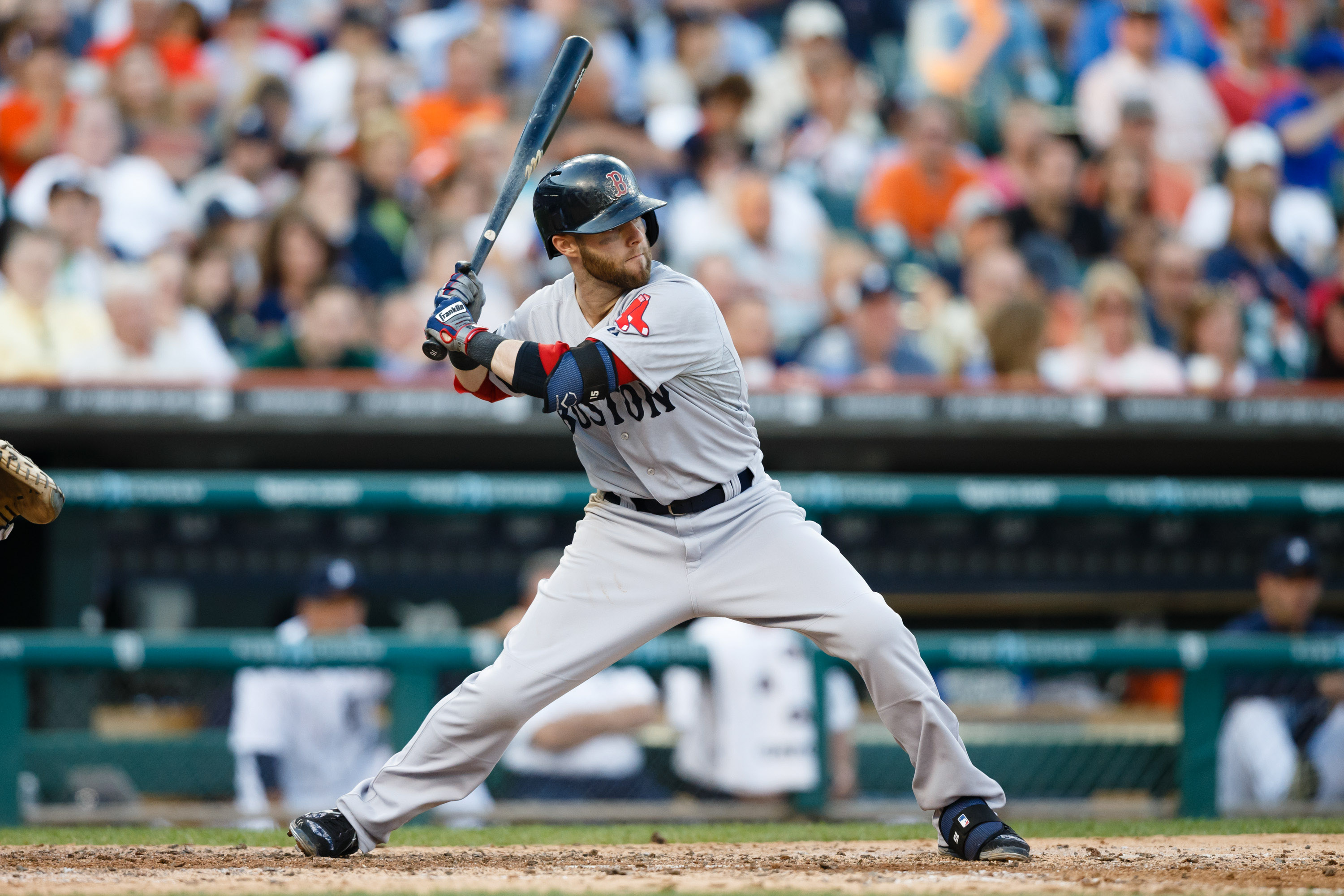
Dustin Pedroia, the King of FoMo. Photo courtesy: Rick Osentoski-USA TODAY Sports
In this baseball batting techniques post, we’ll talk about how elite MLB sluggers employ Forward Momentum (FoMo for short).
I’m going to answer the following questions from my readers:
Does a hitter transfer all their weight to the front leg at some point in the swing?
Does FoMo stride need to be big or small?
Does the back foot “follow” the front with FoMo?
Can a wide no-stride hitter utilize Forward Momentum?
Are FoMo hitters more vulnerable to off speed and breaking stuff?
Keep in mind, forward momentum is the objective, and in this baseball batting techniques post, I’ll show different elite hitter examples of forward momentum. The important thing isn’t what you use to get Forward Momentum, it’s the Forward Momentum itself.
Let’s get to it…
Does a hitter transfer all their weight to the front leg at some point in the swing?
Yes. With elite sluggers, it’s rare you don’t find them shifting their weight from back to forward. We typically see one of a few baseball batting techniques associated with FoMo: 1) a “Float”, or a slight weight shift back, then 2) a “Free Fall” forward.
And FYI during the Float, yes it’s okay for the back knee to drift over the foot, and NOT have to unnaturally be ‘shoved’ inside it.
You’ll see the following hitters, who try and start with the back knee inside the back foot (Jose Bautista), will accidently float the knee back out before falling forward.
The dead give away of elite hitters shifting their weight is to look at the weight distribution at impact. You’ll see a weight-free back leg at the start of the turning pelvis…
Andrew “Cutch” McCutchen
Troy “Tulo” Tulowitzki
Jose “Joey Bats” Bautista
SCIENCE-BASED TRAINING:
Improve your hitting strategy dramatically by applying human movement principles.
Learn not only how and what to train but also the science behind the methods.
Whatever the hitter is comfortable with. In other words, don’t be so specific in teaching certain Forward Momentum baseball hitting techniques. Remember, the objective is that they’re employing Forward Momentum. We don’t really care how they get there.
Feel free to recommend your hitters tinker with and test the following FOUR stride types:
Josh “The Bringer of Rain” Donaldson (BIG Leg Kick)
Dustin “Laser Show” Pedroia (MEDIUM Leg Kick)
Robinson “Mercedes” Cano (SMALL Leg Kick/Slide Step)
Victor Martinez (Toe Tap)
Does the back foot “follow” the front with FoMo?
It doesn’t have to, but I like it too. If a hitter gets too wide with the stride, and the back foot isn’t allowed to follow, then the hitter will have a challenge getting a tight back knee angle, which is responsible for a better ball launch angle. CLICK HERE for the back knee angle Zepp experiment.
Roberto “The Great One” Clemente (watch at the 0:33 mark and beyond)
Mike “Millville Meteor” Trout
Bryce “Bam Bam” Harper
CLICK HERE for one of my favorite baseball batting techniques, the Back Foot Variance Drill.
Grab This FREE 'Timing Master Class' Video
Struggling to get your hitters ON-TIME in games? Discover HOW TO build effective laser-focused timing, so your hitters can be ON-TIME more often. These principles are validated by REAL science.
Click the button below to access the FREE video that has been downloaded over 6K times!
Can a wide no-stride hitter utilize Forward Momentum?
Here are my questions for a coach who would ask this about baseball batting techniques:
“Why are you hooked on being so wide with the feet at the start, and/or not allowing a stride?…”
“Is it about minimizing head movement?”
“Is it cutting down on moving parts?”
“Is it a timing thing?”
Coaches on Facebook have told me, the stride is too hard to teach, or for a young hitter to get. Apparently this poison was shared during a speech at the American Baseball Coaches Association (ABCA) conference.
I’m not convinced, especially when 3-year-old Chinese females are learning some of the most complex human movements in Gymnastics.
Furthermore,
Look to other explosive athletes that almost NEVER start wide with their feet:
Pitchers,
Olympic Divers,
Olympic Throwers,
Soccer Players,
Quarterbacks, Linebackers, and Deep Backs…
Sometimes, it’s not about choosing particular baseball batting techniques. It’s a mindset. I always stress to my hitters, get athletic from the start, and be athletic when you land, so you can transfer the max amount of energy from your body, into the barrel, then to the ball.
About head movement, it’s going to happen. CLICK HERE for a compelling baseball batting techniques analysis by Dan Farnsworth at FanGraphs.com, that demystifies that elite hitters are keeping their head still (Read under “Keep Your Head Still” section).
If it’s about timing, then it’s the timing that must be adjusted. There are only two timing elements:
When the hitter starts their swing, and
How long they ‘Float’.
A hitter can change one or the other, or both. It’s up to them.
Those are the adjustments, it’s not a “stride issue”. CLICK HERE for my favorite baseball batting techniques for timing.
Even big guys use Forward Momentum. It just looks more subtle…coming in the form of a ‘sliding’ of the pelvis (Cruz and Pujols are great examples of this below)…
Miguel “Miggy” Cabrera
Nelson “Boomstick” Cruz
Albert “The Machine” Pujols
Are FoMo hitters more vulnerable to off speed and breaking stuff?
This is common issue #2 that coaches have with Forward Momentum, a hitter cannot adjust to breaking or off-speed stuff.
I invite you to look at the following sluggers who use FoMo, and their stats don’t reveal they had trouble adjusting to off speed and breaking stuff:
All these hitters had exceptional power, high averages, low strikeouts, and high walks compared to today’s hitters.
Last but certainly not least…
David “Big Papi” Ortiz
And how about Big Papi? Why wouldn’t we mention him, right?! He just hit his 500th career homer! He starts and finishes in the same spot, but there’s a whole lot of FoMo going on in-between:
In Conclusion
When it comes to baseball batting techniques, Forward Momentum is the objective. How we get our hitters there doesn’t really matter. Just give them examples of how to accomplish more FoMo, and allow them to tinker and test until they find something they’re comfortable with doing.
CLICK HERE to Enter for a chance to Win one free account access to The Truth About Explosive Rotational Power online video course (a $77 value). You have until 12:00pm PST today to enter. To better your chances of winning, you can spread the word on social media. I’ll be picking the winner Monday, September 21st, and reaching out via email. Good luck! 😀
Contest UPDATE: this contest is now closed, and Jon Ball was our winner!
Grab This FREE 'Timing Master Class' Video
Struggling to get your hitters ON-TIME in games? Discover HOW TO build effective laser-focused timing, so your hitters can be ON-TIME more often. These principles are validated by REAL science.
Click the button below to access the FREE video that has been downloaded over 6K times!
https://hittingperformancelab.com/wp-content/uploads/2015/09/baseball-batting-techniques-dustin-pedroia-forward-momentum-e1442543731835.jpg333500Joey Myershttps://hittingperformancelab.com/wp-content/uploads/2021/10/hitting-performance-labs_c90c0362088ef1d3d528f3078f4f8ac1-300x75.pngJoey Myers2022-07-05 09:15:142022-07-05 18:14:19Fun Youth How To Teach No Stride Length, Toe Tap, And Leg Kick Hitting Tips For Beginner Baseball & Softball Swing | Where Does Front Foot Land, And When, Hit Drills For 6 To 10 Year Olds
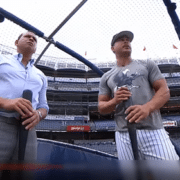
MLB Network and Alex Rodriguez swing analysis interview with New York Yankees player Giancarlo Stanton as he talks hitting approach. Learn concepts applicable to High School pre game routines.
I can’t believe I missed this Giancarlo Stanton swing breakdown video. I remember how on fire he was July of 2018, when he made a certain change to his stance.
Also, other information people search about Giancarlo Stanton (as of July 2022): he’s 32yos, batting average is .245, he’s 6-foot 6-inches, and is American: Irish American, Puerto Rican, and of African American descent.
Here are some thoughts and time stamps from the above video…
At the 0:45 minute mark, A-Rod makes the observation that Giancarlo Stanton works hard. Before, during, and after games, like A-Rod says, “Almost working too much.” I don’t agree with that. As long as the player digs the hard work, and works on the right things.
At the 1:00 minute mark, Giancarlo Stanton gives a little insight into his approach at the plate. Focusing on what he expects to see from the pitcher. I’m assuming this is based on data collection. Pitch patterns and sequencing. Based on what the pitcher is trying to do to him. “Altering” Stanton’s homework a bit. Wants the video analysis he watches to be as fresh as possible, so at least 30-mins before going out to the game.
At the 1:45 minutes mark, A-Rod asks how Giancarlo Stanton’s hitting strategy changes based on ballparks – in reference to his trade from Marlins (big park) to the new Yankee stadium (small park). Is he trying to lift more or just hit line drives? Stanton says he’s still trying to hit line drives. Still have to put barrel on the ball for the short corners. A-Rod tells Stanton that when he used to hit there, he’d pick out sponsorship signs as targets to drive to. Act like a fairway and have targets? Giancarlo Stanton said he likes the bullpen and Toyota sign as a target at Yankee stadium (RCF) – keeps him “inside the ball”. Gives his hands a chance to strike, and get good barrel on the ball.
At the 2:44 minutes mark, A-Rod asks Giancarlo Stanton about the change in his stance – to more closed. Why did he do it? It keeps his direction towards the bullpen. Less chance to pull off – shoulder and hip.
At the 4:00 minute mark, Stanton is asked what his ideal pitch and location is. Slightly in from middle and 92-mph, 4-seamer, straight. Interesting to note, Perry Husband has said a majority of pitchers throw to 88 to 93-mph perceived velocity. They throw to barrels by slowing their fast stuff down and speed up their slow stuff – based on pitch location and sequencing. I’m not shocked Giancarlo Stanton picked 92-mph, regardless of FB, CB, CU, etc. It’s ideal timing zone of most Major League hitters.
At the 5:20 mark, A-Rod asks Giancarlo Stanton how he hits Jacob DeGrom so well. And btw, DeGrom does well with Effective Velocity according to Perry Husband. Be patient and lock in what Stanton is trying to do, not what DeGrom is trying to do. Sometimes you’ll get what you want and sometimes not. He’s thinking right center against DeGrom.
🚀 Unlock the Secrets: FREE VIDEO on Mastering Powerful Oppo Field Hits & Pulling
Are your hitters struggling to effectively hit to the opposite field or pull the ball with power? Discover our breakthrough techniques now!
Get instant access to our exclusive FREE VIDEO: 'Mastering the Art of Pulling & Going Oppo'. Learn how to maintain explosive ball exit speeds while mastering directional hitting.
https://hittingperformancelab.com/wp-content/uploads/2020/08/Giancarlo-Stanton-Swing-Breakdown.png280500Joey Myershttps://hittingperformancelab.com/wp-content/uploads/2021/10/hitting-performance-labs_c90c0362088ef1d3d528f3078f4f8ac1-300x75.pngJoey Myers2022-07-05 09:00:242022-07-05 18:46:09MLB Network Swing Analysis: Player Giancarlo Stanton Talks Hitting Approach | High School Pre Game Routines For High School Baseball & Softball 2022
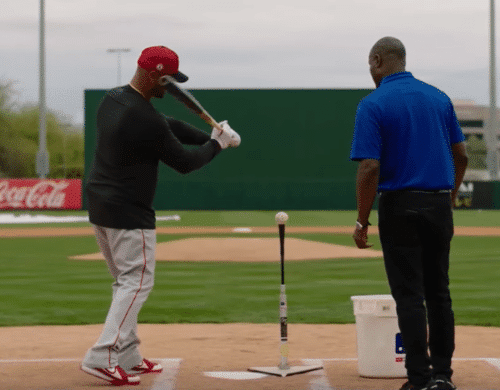
Watch Albert Pujols talking about how to teach swing drills off hitting tee, place hitting outside pitches to opposite field vs pull, and keeping the hands inside out for baseball, slow-pitch, and fast-pitch softball players.
Albert Pujols Hitting Mechanics Video Talk
In this Albert Pujols hitting mechanics talk, some questions Pujols and Harold Reynolds answer:
Albert Pujols & Harold Reynolds Interview, MLB Network 30 Clubs in 30 Days. Photo courtesy: MLB.com
Hitting ball off same spot off tee or vary?
Dangers of a purely opposite field approach…
When is using ‘hands inside the ball’ okay?
Hit top part of the cage of the back?
How many swings until you should take a break to reflect?
Inside pitch barrel path: is it different than away?
At the 0:10 second mark, tsk, tsk…notice Harold Reynolds isn’t following the 4-foot social distancing rule!! (for those watching this well after the craziness of the Coronavirus has passed – lol).
At the 0:30 second mark, interesting Pujols talks about building a consistent swing, hitting off the tee in one spot. He references variance training with some hitting coaches moving the ball up and down, in and out. I do agree with him, but it depends on the end result. If you’re just introducing a new hitting mechanic, then keep the tee in one spot. If you’re looking to deeply embed a well worn hitting mechanic, then variance or chaos training is key.
SCIENCE-BASED TRAINING:
Improve your hitting strategy dramatically by applying human movement principles.
Learn not only how and what to train but also the science behind the methods.
At the 0:45 second mark, Albert Pujols talks about setting tee up slightly off center of the plate towards outer part. He likes to work gap to gap and not force or push the ball to right field. He mentions if he focuses too much on right field, then he gets under the ball too much.
At the 1:30 minute mark, Pujols dispels the myth of “staying inside the ball”. He says of course you’re inside the ball…you don’t see hitters EVER getting their hands outside the ball. ‘Hands inside the ball’ can be a great cue for those hitters doing the opposite – casting barrel early. It’s not a perfect cue, but may work in some cases. Then to throw gas on the fire, he mentions ‘knob to the ball’. Real v. Feel. There’s a reason you keep hearing this kind of stuff from guys like Pujols, A-Rod, and Bonds. It has to do with top hand dominance and pronation. We call it the “wrist snap”.
At the 2:00 minute mark, Albert Pujols talks about working on the liner, not trying to hit the top part of the cage. He picks a spot in the cage he wants the ball to travel. External cue. He wants the ball to come off the bat as high as the tee is set. Harold brings up that some people are teaching to hit the top of the cage (I used to be one of them!!). But Albert plays the politician and comments that he doesn’t want to say what those coaches are doing is wrong, but that he wouldn’t teach that. And right now, I’d agree with him.
At the 3:00 minute mark, Harold asked Pujols if there’s a rhythm to working on gapping the ball, and Pujols says he tries to hit 3 or 4 in a row, then take a break to reflect on the feeling. He tries not to rush when working out. He tries to take his time. Process what he just did. Great advice!
At 4:00 minute mark, Harold asks Albert about his inside approach. How to hit the inside pitch. Watch how Pujols demos his barrel path to get to it … barrel above hands? This Adam Eaton video reveals the same thing. Interesting huh? We call this knocking the “belly button” catcher’s glove off. He says he’s just reacting to the inside pitch. Typically, he’s looking out over the plate. He doesn’t try to focus on one area of the plate. He looks middle, then adjusts in or out from there. Definitely works for Albert. And Mike Schmidt also talked about it in his book the “Mike Schmidt Study”. Only downside is when pitchers start using EV tunnels Perry Husband talks about. It’s easier to cover middle in/out/up/down (50% of the plate), based on pitcher’s pattern. Obviously, this is more effective the better the pitcher is.
At 5:00 minute mark, in the above Albert Pujols hitting mechanics video, Pujols talks about keeping his shoulders “square” or keep front shoulder pointing at “400-foot” mark in straight center. Not to close shoulders off. Albert never really did ‘show numbers’ much, but he does a lot of other things right.
At 6:00 minute mark, Pujols talks about not getting “taller” to get to the pitch up in the zone, but to stay sink down and use hands to get to it. Again demonstrates keeping barrel above hands. We talk about getting shorter and staying shorter. And middle in, middle up pitches are addressed by knocking off belly button catcher’s glove or telling hitter to keep barrel above hands. Real v. Feel. Now, this isn’t actually what’s going to happen. The result of this hitting cue is a tighter, shorter, more compact barrel path. Much needed closer the ball is to the hitter or the eyes. He talks about using his legs to get to pitches down in the zone.
🚀 Unlock the Secrets: FREE VIDEO on Mastering Powerful Oppo Field Hits & Pulling
Are your hitters struggling to effectively hit to the opposite field or pull the ball with power? Discover our breakthrough techniques now!
Get instant access to our exclusive FREE VIDEO: 'Mastering the Art of Pulling & Going Oppo'. Learn how to maintain explosive ball exit speeds while mastering directional hitting.
https://hittingperformancelab.com/wp-content/uploads/2020/03/albert-pujols-hitting-mechanics-e1584392758126.png390500Joey Myershttps://hittingperformancelab.com/wp-content/uploads/2021/10/hitting-performance-labs_c90c0362088ef1d3d528f3078f4f8ac1-300x75.pngJoey Myers2022-07-01 09:15:372022-07-01 21:34:14Albert Pujols Talking How To Teach Swing Drills Off Tee, Place Hitting Outside Pitches To Opposite Field Vs Pull, And Keep Hands Inside Out For Baseball, Slow-pitch, & Fast-pitch Softball
Discover how to hit slow pitching, improve batting timing and rhythm mechanism, and STOP swinging early. For beginner baseball and softball players. Learn simple drills and tips for better more on-time hitting…
This Brandon Moss analysis comes from a conversation I had with Coach Justin Karr and his 12-U Bakersfield Sliders Black team. Thanks Coach Karr, I hope this helps your troops!
I want to compare what Brandon Moss does differently hitting a slower pitcher, like knuckle-baller R.A. Dickey of the Toronto Blue Jays, to a hard throwing “King” Felix Hernandez of the Seattle Mariners. We’re going to:
Make the complicated, uncomplicated,
Learn how-to adjust to slower pitching according to Brandon Moss, and
“When it comes to learning complicated movements efficiently, the key is to make them uncomplicated. We do this by breaking them down into precise, manageable steps. Then we emphatically encourage like-your-life-depends-on-it focus in performing each step. This is the path to a tight learning curve. It’s the foundation required for optimal performance.”
We focus on one aspect at a time. In respect to the calibration of timing, we have to forget swing mechanics and focus solely on adjusting the timing. Making in-game adjustments, timing is THE most important priority. We teach three possible swing adjustments with our seven hitting strategies. We refer to these as the three dimensional hitting adjustments:
Timing – is hitter out front or behind?
Vertical (Launch Angle) – did hitter hit popup or ground-ball (or line drive?), and
Horizontal (Barrel Path) – did hitter get jammed or hit ball off the end?
Which one of these after an in-game swing, if tweaked, fixes the other two?
SCIENCE-BASED TRAINING:
Improve your hitting strategy dramatically by applying human movement principles.
Learn not only how and what to train but also the science behind the methods.
How-To Adjust to Slower Pitching According to Brandon Moss
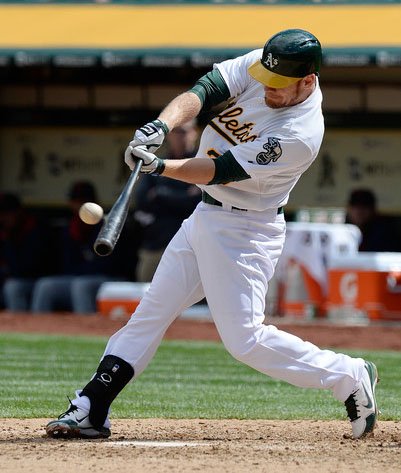
In the video, I compare and analyze two 2013 home-run swings by the Oakland A’s first baseman Brandon Moss:
77 mphknuckle-ball from R.A. Dickey Moss (left-handed) hit over the center field fence (418 feet*), and
93 mphfastball from “King” Felix Hernandez Moss hit over the right-center field fence (387 feet*)
(*You can find out more home-run stats at BaseballSavant)
CLICK HERE to revisit a video blog article I did, featuring Josh Hamilton and Mike Trout, where I went over:
When does a swing start?
Leg kick or slide step? and
How to practice timing?
For an average velocity pitcher, each hitter MUST figure out at what point in the pitcher’s delivery that they start their swing. Then experiment starting the swing at a later point with a slower pitcher. This will be slightly different for every hitter as the Josh Hamilton article shows.
The main point is, the hitter has to make a a conscience effort to change their timing. They can’t just use the same timing for every pitcher. Hitting is a game of inches…being one inch ahead or behind can mean barreling the ball or not.
What’s the best way to practice this? The 2-plate drill shared in this article, and home run derby?? Using the 2-plate drill and throwing seated from 25-30 feet away (under or over hand front toss). The thrower will be literally lobbing the ball to the hitter as they take two swings and switching plates. Six swings per round. The slower the throw, the better. In our system, this is hitting strategy number 4.
Also, if the whole team’s offensive numbers are suffering against a slower pitcher, then the adjustment DOES NOT necessarily have to be a mechanical one.
One more interesting point…notice how far Brandon Moss cranked the Dickey knuckle-ball? 418 feet!! “King” Felix? 387 feet…a pitcher’s velocity doesn’t dramatically contribute to batted ball distance. It’s bat speed that does. According to a forum at eFastball.com, for every 1 mph of added pitching velocity, 1 foot of batted ball distance is the outcome. BUT for every 1 mph of increased bat speed, 4 feet of batted ball distance is the result!! Don’t let low velocity pitchers slow your bat speed down hitters!
Grab This FREE 'Timing Master Class' Video
Struggling to get your hitters ON-TIME in games? Discover HOW TO build effective laser-focused timing, so your hitters can be ON-TIME more often. These principles are validated by REAL science.
Click the button below to access the FREE video that has been downloaded over 6K times!
https://hittingperformancelab.com/wp-content/uploads/2014/05/brandon-moss-timing.jpg473401Joey Myershttps://hittingperformancelab.com/wp-content/uploads/2021/10/hitting-performance-labs_c90c0362088ef1d3d528f3078f4f8ac1-300x75.pngJoey Myers2022-07-01 09:00:312022-07-05 15:58:17How To Hit Slow Pitching, Improve Batting Timing Rhythm Mechanism, & STOP Swinging Early For Beginner Baseball And Softball | Drills & Tips For Better Hitting
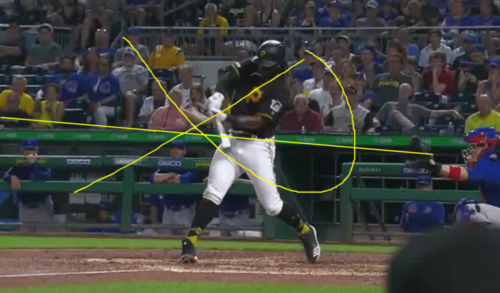
Some interesting things in swing analysis: Float, Fall, Barrel Path – CB down/away v. FB mid/up (and late), how well he matches plane of pitch (tube)
CLICK HERE to view the size and metrics data on FanGraphs.
In looking at the Josh Bell image, it’s interesting to note how Josh Bell’s barrel path line intersects the plane of the pitch line. Hitters that match the plane of the pitch line better will inevitably have higher batting averages and less strikeouts.
We teach our hitters to match the “tube”. Imagine the pitch being thrown through a tube, and the hitter’s goal should be to hit the ball back through the tube. Based on pitch height. If the pitch tube is set at four-feet off the ground, then the ball must come off the bat four-feet off the ground. If tube is set at one-inch off the ground, then ball comes off bat one-inch off ground.
If the hitter doesn’t hit it through the “tube”, which the best in the world miss the tube 80% of the time (league averages: 20% line drive rate, 38% fly-ball rate, and 43% ground-ball rate), then they make adjustments using the principle of paradoxical intention.
Consider the following…
Grab 'Finger Pressure' Video
Frustrated with fixing BAT DRAG? Beat it!
Swing Study reveals how majority of hitters are correcting 'racing back elbow' bat drag within 1-2 weeks WITHOUT overhauling swing mechanics OR buying fancy and expensive hitting aids.
Click button below to access FREE video that has been downloaded over 20K times!
https://hittingperformancelab.com/wp-content/uploads/2019/07/Line-Drive-Hacking-With-Josh-Bell-Swing-Breakdown-e1563425526448.png281500Joey Myershttps://hittingperformancelab.com/wp-content/uploads/2021/10/hitting-performance-labs_c90c0362088ef1d3d528f3078f4f8ac1-300x75.pngJoey Myers2022-06-28 09:15:422022-07-01 22:22:17Josh Bell: Improve Attack Angle And Ideal Home Run Launch Angle For Baseball & Softball | Building Faster, Flatter, & More Powerful Bat Path To Fix Choppy & Uppercut Swings
The Barry Bonds drill everyone talks about is the one he ran with Christian Yelich in 2016 — but it is one of four distinct Barry Bonds hitting drills that coaches and players have documented over his career. Bonds is the all-time home run leader with 762 home runs and a .607 on-base percentage that may never be matched, and he is widely regarded as the most complete hitter the game has ever seen. When he coached, players paid attention. This post breaks down every major Barry Bonds drill — including the famous Yelich backspin drill, the Catch Drill he used with Giants players, the eye speed machine drill, and his philosophy on grip and top-hand use — so you can apply what he actually taught.
What the Barry Bonds video above is actually showing you
The video compares Barry Bonds’ swing to a youth hitter named Alex, and the difference comes down to one cue: Bonds gets shorter when his front foot lands. Watch the line drawn at the top of his head at load — then watch his head drop as the front heel hits the ground. That’s not a flaw. That’s intentional. Bonds lowers his backside and lets the front side straighten out to get his front hip out of the way, which puts the barrel on the upward plane of the incoming pitch.
Alex, by contrast, stays short through the load but then stands back up the moment he starts to swing. His head rises and his nose pulls out — the body compensating with the upper body instead of staying short through the turn. The result is that he has to get on plane with his hands, which is inconsistent, rather than with his body, which is repeatable.
The drill in the video — the lane drill — uses an exercise band looped under the hitter’s armpits and attached to a chain link fence. The band pulls them forward into landing position. Then the hitter pulls hard back against it and gets shorter, bending the back leg and staying low through the turn. It trains the body to get on plane automatically, without a verbal cue.
This “get shorter” mechanic is the foundation everything else Bonds taught is built on. Additionally, it connects directly to the four drills below — especially the Yelich Backspin Drill, where the wide stance and the chopping sensation create that same lowered, body-on-plane position through contact. The body getting shorter is what generates the leverage; the short bat path delivers it.
What makes Barry Bonds’ hitting drills different from standard coaching?
Most hitting drills target a single mechanical fix. Additionally, they are often built around a cue — “squish the bug,” “stay back,” “keep your hands inside the ball” — that works for some hitters and confuses others. Barry Bonds’ drills are different because they are built around feel and feedback, not verbal cues. Each drill creates a sensation the hitter can self-monitor in real time, which is why the players who worked with Bonds almost universally describe the same experience: they felt something click immediately.
Brandon Crawford, after working with Bonds during a 2014 Giants spring training session, described it simply: “Everything I heard him talk about this morning [regarded] keeping your swing as simple as possible. And he explains it in the simplest ways.” That principle — simple, feel-based, self-correcting — runs through every Barry Bonds drill below.
Barry Bonds Drill #1: The Catch Drill (barrel awareness and contact points)
The Catch Drill is the Barry Bonds hitting drill that best captures his core philosophy: if you can catch the ball, you can hit the ball. Bonds used this drill extensively during his 2014 guest instructor stint with the San Francisco Giants and again with various players throughout his Marlins coaching tenure.
How to run the Catch Drill:
The hitter puts a glove on their top hand — the back hand (right glove if you’re left-handed, left glove if you’re right-handed).
The coach or a machine tosses balls to different locations: inside, middle, outside.
The hitter catches each ball in their normal hitting stance without swinging.
Progression: start with underhanded tosses at close range, then graduate to a pitching machine at reduced velocity.
Bonds’ teaching cue was direct: “If I can catch it with my glove, then I can catch it with my bat.” The goal is barrel awareness — feeling exactly where the bat barrel needs to be for pitches at each location. An inside pitch is caught out front; an outside pitch is caught deeper and closer to the body. Most hitters who struggle with bat drag are trying to meet every pitch at the same contact point. The Catch Drill eliminates that instantly by making the contact point tangible.
This is also why Bonds consistently had elite opposite-field power — he understood, at a deep mechanical level, that the outside pitch requires a later, deeper contact point and that trying to pull it creates weak contact or rolling grounders.
Barry Bonds Drill #2: The Yelich Backspin Drill (bat path and contact)
This is the most famous Barry Bonds hitting drill, documented in detail by Christian Yelich on the Sequence podcast with Trevor Plouffe. The session took place in July 2016 when Bonds was the Marlins’ hitting coach and Yelich was struggling to turn his barrel path into consistent hard contact. Yelich called the batting practice session that followed “the best of my entire life.”
How to run the Yelich Backspin Drill:
Take a wide, stable stance — wider than your normal setup.
Have the pitcher (or machine) throw the ball so you make contact right off the front of the plate — the ball should land its first bounce a few feet in front of home plate.
Hit 3-5 pitches at that contact point. Focus on the sensation — it should feel like you are chopping down on the ball.
Move the contact point out: now hit the ball 6-7 feet out front. The first bounce moves forward accordingly.
Continue working the contact point out gradually, raising the trajectory toward line-drive level.
Here is what Yelich said about the drill: “I still had that chopping feeling, but you’re not actually steep. Your path is just so short and cleaned up. It was his way of cleaning up his bat path when he played.”
The result Bonds was after: true backspin. A hitter who catches the bottom half of the ball with a clean, short path creates backspin that carries — to the opposite field, up the middle, or pull side. Yelich described the outcome perfectly: “opposite field: backspin missile. Up the middle: backspin missile. Pull side: backspin missile.”
This drill connects directly to what we teach at HPL about swing plane and barrel path — the bat has to match the plane of the pitch to produce consistent backspin. The Yelich drill creates that feeling progressively rather than through verbal instruction.
After that session, Yelich’s home run rate nearly doubled for the rest of the 2016 season. He went on to win back-to-back NL MVP awards in 2018 and 2019.
Barry Bonds Drill #3: The Eye Speed Machine Drill (vision and visual tempo)
Barry Bonds had arguably the best plate discipline in baseball history — he averaged 2.28 walks per strikeout in his prime years. A big part of that was his ability to see the ball early and read its location and movement. To train that visual tempo, Bonds used a progression drill on the pitching machine.
How to run the Eye Speed Machine Drill:
Set the pitching machine to a challenging velocity — harder than the hitter is comfortable with.
Hit 3-5 pitches at the normal hitting distance.
Take one full step toward the machine and hit 3-5 more pitches.
Take another step forward. Repeat for 4 steps total.
Return to the original distance and take several swings.
Each step reduces the time the hitter has to react, which compresses the visual window and forces the brain to pick up the ball earlier out of the release. Therefore, when the hitter returns to the original distance, the pitch looks slower and the ball looks larger. This is the same principle behind overload/underload training for bat speed — you stress the system beyond normal load, then return to normal load and it feels easier.
For youth hitters, this drill should be run at an appropriate age-level velocity — the goal is a meaningful challenge, not danger. A 10U hitter using a machine set to 55 mph stepping up toward 45-50 mph gets the same visual stress adaptation as a professional stepping toward a machine set to 85+.
This approach to pitch recognition and timing is one of the most underrated aspects of elite hitting development.
Barry Bonds Drill #4: The Bullpen Catch Drill (picking up release early)
This is the simplest Barry Bonds drill and arguably the most transferable. Bonds would grab a fielder’s glove and step into the catcher’s spot during a pitcher’s bullpen session — not to catch, but to train his eyes to find the ball out of the pitcher’s hand as early as possible.
The goal was not pitch recognition in the traditional sense (breaking ball vs. fastball). The priority was the visual moment of release — seeing the ball leave the fingertips at the same instant the arm fires through. Bonds believed that elite hitters read release, not spin. By the time you can identify the spin, it is too late to make a mechanical adjustment.
This drill is easy to replicate at any level: have the hitter stand behind the backstop or in the batter’s box without a bat while the pitcher throws a full bullpen. The job is to call the pitch location before it crosses the plate — but the real training is the habit of locking the eyes onto the release point from the very first frame of the arm action.
What did Barry Bonds teach about bat grip and choking up?
Barry Bonds’ bat grip approach is frequently misunderstood. He used a 34-inch, 31.9-ounce Sam Bat — and he choked up on it, typically 1-2 inches. This is the opposite of what most power hitters do. The conventional wisdom is that you hold the bat at the knob to maximize the bat’s lever length and, therefore, power. Bonds rejected that logic entirely.
For Bonds, choking up was about barrel control — the ability to get the barrel where it needed to be, on time, without compensating with the upper body. A hitter who cannot control the barrel will drag it, roll over, or get beaten on the inner half. By shortening the effective length of the bat, Bonds gave himself the ability to respond to any pitch location with the barrel, not with his body mechanics.
This connects to what he told Brandon Crawford during the 2014 Giants spring training: “Your hands are fast enough to get to an inside pitch. You don’t need to cheat or use your body or shoulders to get to that pitch.” The choke-up supported that — it kept the hands in control without the hitter having to do anything extra with the body to accelerate the barrel.
Most youth hitters are taught to choke up only with two strikes. Bonds treated it as a permanent setup feature, not a defensive adjustment. For hitters who fight top-hand issues or bat drag, experimenting with a small choke-up as the primary grip is worth a few rounds of batting practice.
What did Bobby Bonds tell Barry about the downswing?
Barry Bonds has spoken publicly about his father Bobby Bonds’ instruction throughout his childhood. The central piece of advice Bobby gave him: perfect your downswing, because swinging up is easy.
This sounds counterintuitive in 2026, when launch angle optimization is central to most hitting conversations. However, Bonds — and Yelich after working with Bonds — was not literally swinging down on the ball. The teaching was about bat path direction through the zone, not about launch angle outcomes. As Yelich described it, you get that “chopping feeling” but you are not actually steep — the path is short and tight, and the result is backspin and hard contact, not ground balls.
Specifically, Bobby Bonds emphasized the top hand as the driver of that short, down-path direction through the zone. “Get the top hand through” was the cue — top hand leading the barrel from slot to contact, rather than the bottom hand casting or the front side opening early. This is exactly what the Catch Drill and Yelich Backspin Drill train: a short, tight path where the top hand drives the barrel to the ball rather than letting the barrel drag behind the hands.
The relationship between the downswing philosophy and the barrel staying on plane is why Bonds had elite contact ability alongside his power — he was not choosing between contact and power, he was using the same path for both. For more on how barrel plane affects both outcomes, see our breakdown of launch angle and exit velocity in context.
How can youth baseball and softball hitters apply Barry Bonds drills?
Youth hitters can run all four Barry Bonds drills with simple modifications. The Catch Drill works at any age — a tennis ball or foam ball reduces the risk if you are working with very young hitters, and underhand tosses make it accessible at 6U. Additionally, the Yelich Backspin Drill scales well: adjust the starting contact point to match the hitter’s stride length and timing.
The Eye Speed Machine Drill is the one to use most carefully with youth athletes — start at a velocity that is genuinely challenging but not so fast that the hitter is flinching. A good rule is to use the maximum comfortable velocity and then step 6-12 inches closer rather than a full stride, especially for hitters under 10. The visual stress happens immediately; you do not need to be dangerous about it.
The most transferable Bonds insight for youth hitters, however, is the choke-up. For softball hitters in particular, many coaches resist the choke-up because it “looks weak.” Bonds disproved that thinking — he hit 762 home runs while choking up on a 34-inch bat. Barrel control creates power by eliminating the compensation patterns that bleed force at contact.
For hitters who also struggle with dropping the hands, the Yelich drill is particularly effective because the short contact-point start forces the hands to stay level — there is no room for a downward loop when you are trying to put the ball 6 feet out front.
Ready to fix the barrel path beyond what drills alone can do?
Grab the free Barry Bonds Hitting Tips Cheat Sheet — all 4 drills on one printable page, plus the body-on-plane mechanic from the video above.
Frequently Asked Questions: Barry Bonds Drills and Hitting Tips
What is the Barry Bonds drill that changed Christian Yelich’s career?
The Barry Bonds drill that changed Yelich’s career is the Backspin Drill, run during a July 2016 batting practice session when Bonds was the Marlins’ hitting coach. Bonds had Yelich start by hitting balls off the front of the plate, then progressively move the contact point outward — 6 to 7 feet, then to line-drive level. The drill created “true backspin” by cleaning up Yelich’s bat path. Yelich described the result as hitting “backspin missiles” to all fields and called it the best batting practice of his life. His home run rate nearly doubled for the rest of that season.
What is the Barry Bonds Catch Drill?
The Barry Bonds Catch Drill has the hitter wear a fielder’s glove on their top (back) hand and catch pitched balls in their normal hitting stance — without swinging. Bonds started with underhanded tosses and progressed to a pitching machine. The drill teaches the hitter where the barrel needs to be for inside, middle, and outside pitches. Bonds’ cue was: “If I can catch it with my glove, then I can catch it with my bat.” It is one of the best barrel-awareness drills ever documented because it gives instant, tangible feedback on contact points without any verbal instruction.
What was Barry Bonds’ bat grip — did he teach a specific grip?
Barry Bonds used a 34-inch, 31.9-ounce Sam Bat with a choke-up of 1-2 inches. He taught barrel control over grip mechanics — the choke-up was his way of keeping the barrel responsive at every pitch location without needing to compensate with the upper body. He told Brandon Crawford that “your hands are fast enough to get to an inside pitch — you don’t need to cheat or use your body or shoulders.” He did not advocate a specific knuckle alignment; the emphasis was on holding the bat in the fingers (not the palm) for maximum control, and shortening the lever when needed to keep the barrel under command.
Did Barry Bonds teach a tee drill?
The Yelich Backspin Drill is functionally similar to a tee drill — it starts with contact made right off the front of the plate, essentially a ground-level tee placement, and works outward from there. Bonds would have the pitcher throw or use a machine rather than a stationary tee, but the contact-point progressions are the same principle a tee drill uses. The key difference is that a live throw or machine adds timing, which Bonds believed was essential — the feel of the short, clean path had to survive a moving pitch, not just a stationary ball.
What was Barry Bonds’ top-hand philosophy?
Barry Bonds was a strong advocate for the top hand driving the barrel through the zone. His father Bobby Bonds’ instruction — “perfect your downswing” — translated into the top hand leading the barrel from slot to contact with a short, direct path. Bonds believed the top hand should be the engine of the swing, not the lead hand casting or the front side pulling. This philosophy is visible in his swing mechanics: minimal casting, tight to the body, top hand delivering the barrel on time regardless of pitch location. The Catch Drill and the Yelich Backspin Drill both reinforce this top-hand-led approach.
What did Bobby Bonds tell Barry about swinging down?
Bobby Bonds told Barry to perfect his downswing because, in Bobby’s words, it is easy to swing up. This was not an instruction to hit ground balls — it was about bat path discipline. A downward-directed path through the hitting zone stays short and tight, generates backspin, and keeps the barrel in the zone longer than a path that casts or loops. The Yelich Backspin Drill shows exactly what Bobby meant: Yelich described the “chopping feeling” but noted that the ball came off as line-drive backspin missiles, not grounders. The swing feels down but the contact outcome is a hard, carry-heavy line drive.
Can youth baseball and softball hitters use Barry Bonds drills?
Yes — all four Barry Bonds drills work for youth hitters with basic modifications. The Catch Drill works at any age; use a tennis ball or soft toss for very young hitters. The Yelich Backspin Drill scales to any level by adjusting the starting contact point and using age-appropriate pitching. The Eye Speed Machine Drill should use challenging but safe velocity — step 6-12 inches closer rather than a full stride for hitters under 10. The choke-up approach is especially valuable for youth athletes who struggle with barrel control on inside pitches or bat drag on balls away. Bonds’ drills are sensation-based, which makes them self-correcting at any skill level.
https://hittingperformancelab.com/wp-content/uploads/2022/06/barry-bonds-drill-catch-drill-coaching-youth-hitter.png9411672Joey Myershttps://hittingperformancelab.com/wp-content/uploads/2021/10/hitting-performance-labs_c90c0362088ef1d3d528f3078f4f8ac1-300x75.pngJoey Myers2022-06-28 09:00:372026-09-07 21:18:22What Barry Bonds Actually Taught: 4 Drills Players Still Talk About
Do ONLY strong baseball, fast-pitch, and slow-pitch softball players hit farther home runs? And how far? Can an “average” person hit home runs? See how 14u small slugger Hudson White beat BIG slugger Blaze Jordan in the Power Showcase home run derby. Learn Sadaharu Oh lessons on how to hit the first homer.
Sadaharu Oh: 5’10” 173-lbs, 868 Dingers Over 22-Years – How?
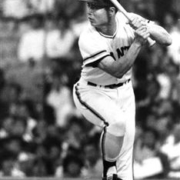
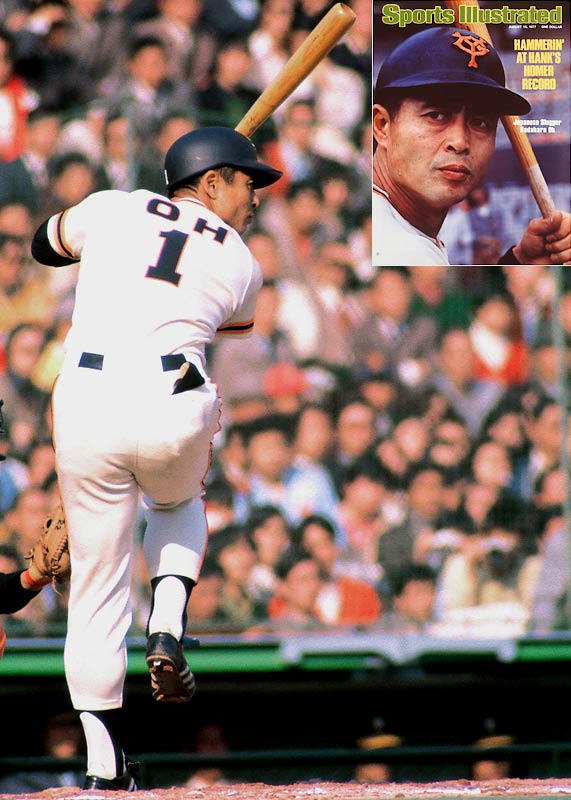
Sadaharu Oh photo courtesy: rnishi.wordpress.com
According to Baseball-Reference.com, the “Barry Bonds” of Japanese baseball, Sadaharu Oh:
Is 5-foot, 173-pounds, and
Hit 868 homers in 22 years (that’s almost 40/season!!)…
How did he do this?
Sadaharu Oh Analysis: Your Mission, if you Choose to Accept it…
Watch the above hitting footage, and identify – what you think – are the two most critical things contributing to his consistent power at the plate over a 22-year span.
Of course, Sadaharu Oh probably wouldn’t have put up those kind of numbers against today’s Major League pitchers. BUT still…his body type…that many homers…for that long???!
I had an interesting conversation about Oh with one of my colleagues about if he were playing today, and was recruited over to the MLB, that coaches/instructors would probably make him a slap happy version of Ichiro Suzuki.
This actually makes A LOT of sense when you look at conventional American baseball/softball wisdom to make a “small left handed hitter” into a situational ground-ball inducing machine. There NEVER would have been a “Sadaharu Oh”!
I agree there are roles to play in a lineup, and of course there’s a time and place for situational hitting, but if we taught ALL our hitters effective hitting mechanics, then what kind of metrics could a small slugger put up in-between?
Could we have a Dustin Pedroia-type who hits a 162-game average 15 dingers and 44 doubles?! In addition, to be a bunting, hit-and-run, move ’em over extraordinaire! Why can’t EVERY hitter experience repeatable power…?
A couple things to keep in mind when analyzing and commenting:
Use human movement science as a rule of thumb (un-weighting, spinal engine mechanics, springy fascia, etc.),
Be open minded and positive in the comments (no “spitting” on someone’s shoes PLEASE),
Clarify by giving a “time stamp” in the video to see what you may be talking about…
You can post your thoughts in the “Leave a Reply” section below…
'Add 40-Feet' To Batted Ball Distance
Swing Study reveals how tens of thousands of hitters are adding 40-feet to batted ball distance by using one simple strategy.
Click the button below to access the FREE video that's been downloaded over 30K times!!
https://hittingperformancelab.com/wp-content/uploads/2014/12/sadaharu-oh-stance.jpg400234Joey Myershttps://hittingperformancelab.com/wp-content/uploads/2021/10/hitting-performance-labs_c90c0362088ef1d3d528f3078f4f8ac1-300x75.pngJoey Myers2022-06-21 09:15:152022-06-22 01:42:25Do ONLY Strong Baseball & Softball Players Hit Farther Homeruns? How Far? Can Average Person Do It? Sadaharu Oh Lessons On How To Get First One!



 ,
,
 seen in the best hitters. Don’t think so? Take a look at the following split screen snapshots from the above video (recognize ANY of the hitters??)…
 principles well (namely ‘showing numbers’), still did so at stride landing on inside heat! Did you catch that?! ‘Showing numbers’ was irrelevant to crushing the inside pitch.

 also talked about it in his book the “Mike Schmidt Study”. Only downside is when pitchers start using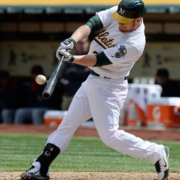
 :
: