Posts

Discover the ideal line drive launch angles and ball exit speeds for optimal distance while hitting a baseball or softball.

Addressing The Biggest Lies In Hitting: Improve Line Drive Frequency In A Few Short Weeks


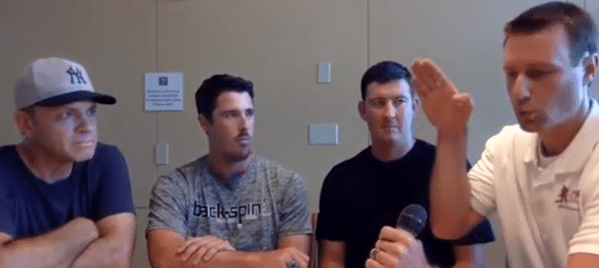
ABCA Hitting Think Tank: Matt Nokes, Taylor Gardner, Jarrett Gardner, & Joey Myers

This Hitting Think Tank will be doing more talks like this at the 2017 ABCA in Anaheim in our booth (from left to right: Matt Nokes, Taylor Gardner, Jarrett Gardner, & Joey Myers)

I have a confession to make…

But first, the context,

After driving 7 hours down to San Diego, I met up with a couple boss hitting/pitching dudes.

I had the privilege to sit down and talk hitting with the two co-founders of the Backspin Tee (brothers Taylor and Jarrett Gardner), and 1987 All-Star Silver Slugger Matt Nokes.

Now, the confession…

We only spent 15 minutes “sitting down” (for the above interview), the other time was spent talking hitting in:

  • Underground parking garages,
  • A library,
  • Down the streets of Padre’s Petco Park,
  • At a USSSA Pride professional fast-pitch softball game, and
  • In a Hilton Hotel lobby over beverages with USSSA Pride infielder Shelby Pendley….

Not to mention, Matt Lisle graced us with his presence to talk hitting for over an hour at the Pride game.

Also, we narrowly missed Ryan Lehr on account of him having to be home late night to be a good dad and husband 😉 lol j/k Lehr just busting your balls.

…By the way Lehr (if you’re reading this), Matt Lisle’s wife allowed him to attend the All Star festivities in San Diego (he’s from the Bay Area), for 4+days away from the her and their 4 kids!!

I told him, he must have a lot of money in the family’s ’emotional bank account’ to have the ability to do that.

So, there’s NO excuse Lehr 😛

Needless to say, my brain hurt on the 7-hour drive back home the next day (not a hangover, believe it or not, I only had one beer the night before)

Moreover,

We’ll be sharing a booth at the 2017 American Baseball Coaches Association (ABCA) conference in Anaheim,

And will be doing more of these LIVE Hitting Think Tank Q&A’s during the conference, so if you find yourself out that way, at that time, then please stop by booth #383 and say hi.

In addition, there will be other mystery guests at the conference coming to our booth to talk about things like pitch tracking, recognition, bat lag, and distraction training.

So, DON’T MISS IT!!

Besides me, here are the cast of characters in the above video:

In this interview, we discuss the following:

  • Defining a line drive (Matt Nokes at 2:13 mark)
  • How to get a line drive? (Matt Nokes at 3:20 mark)
  • Making adjustments to get to the line drive (Matt Nokes at 4:20 mark)
  • The right swing path to get a line drive (Jarrett Gardner at 6:00 mark),
  • The idea of a “flat swing” (Matt Nokes at 7:37 mark),
  • The goods and bad of “Feel v. Real” & making bold adjustments (Joey Myers at 10:20 mark),
  • Correlation DOES NOT necessarily equal causation (Matt Nokes and Joey Myers at 13:31 mark).

We’d love to get YOUR take on what was discussed in the above video,

And, please respond below by letting us know what else you’d like us to discuss at the upcoming ABCA event…by the way, we may record these Q&A sessions and make them available to you at a later date.

THANKS in advance!

Discover the best launch angles for batted ball distance, and learn how to hit more line drives and square up the baseball or softball instead of hitting too many ground balls. Check out this interview with EffectiveVelocity.com’s Perry Husband

Why You SHOULD NOT Teach Hitters To Hit Homers?


Here’s the Hitting Jam Session Interview Collection with Perry Husband:

  1. [YOU ARE HERE] Why You Should Not Teach Hitters To Hit Homers?
  2. What’s The Biggest Mistake Coaches Make In Boosting Ball Exit Speeds
  3. How To Make Teaching Proper Weight Shift In Swing More Understandable To Hitter
  4. Teach: How To STOP Hitting Excess Of Ground-balls & Fly-balls
  5. 5,000 Swing Experiments Validate Locked Lead Arm Is Superior To Bent
  6. Overload Bat Training: Hitting Has To Work Butt Off To Resist “Casting”

Here’s what we discuss in Hitting Jam Session #1:

  • Formal Introductions
  • Carlos Pena and Boston Red Sox hitting coach phone conversation for segment on MLB Now Show,
  • Bro-Science v. REAL Science,
  • How to know who/what to follow,
  • Demystifying Launch Angles, and
  • Q&A…

You can also CLICK HERE to view the original video and comments from the Jam Session on Facebook.


Show Notes

  • At about the 3-minute mark, Perry Husband shares a phone conversation he had with Carlos Pena and Boston Red Sox hitting coach Tim Hyers about Effective Velocity (EV) tunnels from a hitter’s perspective (watch Liquid Analytic videos to MLB Now segments below)
  • At about 5-min, 30-secs mark, cool swing experiment Perry did with Tim Hyers in the past, showing how same speed pitch “appears” faster or slower depending on location in the zone, and how this disrupts a hitter’s reactionary timing (aka hitter’s “attention”).  Gear hitters to a speed, they focus on that speed – changing it causes hitters to be early or late.
  • At about 12-min, 30-min mark, the basic idea of Liquid Analytics, and how to look at pitchers through EV “eyes” we can get hitters to understand the best approach against certain pitchers.  How pitchers adapt to changes to hitter’s approach, it’s like a Chess game, approaches can shift and change multiple times throughout the game, and how to use Liquid Analytics to make these changes predictable.
  • At about 15-min mark, we talk about sabotaging hitting coaches who have no clue how to counter EV by releasing EV 101, 202, and 303 to pitchers.  This will take a couple years for younger pitchers to catch up.  Our hitters will have the anecdote.  2018 World Series was a great picture of a team using EV on both sides of the ball (Red Sox), and a team that really wasn’t (Dodgers).  Any hitting approach right now will get away with murder, but when pitchers get EV efficient, most approaches that don’t take EV into account will die off.
  • At about 20-min mark, Perry using the football cornerback analogy to explain EV tunnels and where hitters tend to stay when it comes to timing pitches.
  • At about 22-min mark, what is the main operating system you’re teaching your hitters? Decrease strikeouts? Hit homers?  Increase Batting Average?  Hard Hit Contact %?  Every drill, teach, hitting aid, etc. will lift up the main operating system, example of the early armbar teach in mechanics.
  • At about 25-min mark, these Jam Sessions are an experiment in themselves, what you’re doing right now may be working, but someone somewhere is doing it better, how to find out what “optimizing” hitters looks like, tinker and test, tinker and test, Growth Mindset v. Fixed Mindset, swing experimentation, REAL Science v. “bro-science”, Scientific Method: question, hypothesis, research & study, collect data (experiment), conclusion, is data Science? Jam Sessions going forward…
  • At about 31-min 30-sec mark, Perry starts talk on Launch Angles, Jay Bell experiment (at 10-degree Launch Angle), hit center of circular target at about 10-feet to measure Launch Angles, early or late hitter pulls or pushes the ball away from the center of the target, more ground-balls – hitting ball later in the swing arc, pop-fly – hitting ball earlier in the swing arc, comparing 9 possible golf shots to hitting, precision in golf.
  • At about 36-minute mark, ranking 10 swings off a tee using the circular target, how many times hit the target, measuring precision how often swing line is inline with pitch, hitter is going to miss more than they hit it good, Aaron Judge 75% of his one-rep swing max a majority of the time, it’s not about hitting it perfect, it’s the quality of your misses.
  • At about 41-min mark, are ALL ground-balls bad? 100-mph+ GB’s equals batting over .500 at the Big League levels, take out ground-ball hits and Donaldson hits .205, it’s about maxing out the Ground-balls, 90-mph fly-balls – how many guys hit .400? zero.  Did you know MLB skews data on fly-balls by adding line drives in the formula.
  • At about 45-min mark, I talk with my hitters about hitting the ball back through the “tube” that it came from, roughly misses are 40% up, 20% on a line, and 40% are down, trying to hit fly-balls causes more ground-balls?  Base your hitter’s operating system on the Jay Bell 10-degree Launch Angle, -5-degrees to 25-degrees highest exit velocities – keep misses within 10-degrees above or below the 10-degree line, extreme up Launch Angles will create a big hole in the swing for EV-minded pitchers to exploit, it’s about the “miss”
  • At about 50-min mark, we finish with Q&A…

Where you can find more about Perry Husband:

  1. HittingIsAGuess.com (Effective Velocity) use discount code: EV25 for 25% OFF
  2. Twitter: @EVPerryHusband

Discover how to hit more line drives using swing bat path mechanics science to hitting on the plane of the pitch like Joey Votto.

Baseball Swing Slow Motion Analysis Of Joey Votto


This is Part-2 of a 3-part baseball swing slow motion analysis video series coming straight out of the Pitch-Plane Dominator online video mini-course…

Hitting Training - Pitch-Plane Dominator

Sick of struggling to reduce your hitters ground balls, swing and miss strikeouts, and non-productive weak fly balls?  This simple 4-Step online video mini-course (7-modules total) will help hitters weighing less than 100-pounds, barrel the ball more consistently.  Dramatically decrease ground balls, strikeouts, and weak fly balls (no matter the pitch location or speed) by applying human movement rules validated by science.

If you haven’t already, then CLICK the Link below to…

Get Access to The Pitch Plane Dominator Online Video Mini-Course

“If you want to be successful, find someone who has achieved the results you want and copy what they do and you’ll achieve the same results.” – Tony Robbins

I received the following reader question:

“If you could only teach one swing, whose would you teach?”

And what follows in this baseball swing slow motion analysis of Joey Votto video, is my answer, as it relates to getting the barrel on, and staying on the plane of the pitch for as long as possible.

We’ll discuss Joey Votto’s:

  • Pitch-Plane consistency metrics,
  • 2015 ESPN’s HitTracker spray chart, and
  • Mechanics as they apply to Pitch Plane Domination.

Let’s build Joey Votto’s case as the best to copy for Pitch-Plane Domination…


Joey Votto Pitch-Plane Consistency Metrics

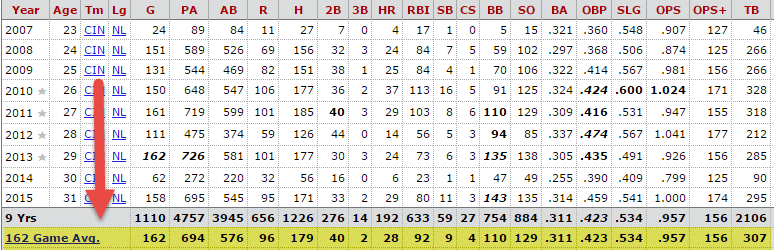
According to Baseball-Reference.com, Joey Votto’s 162-game averages (over 9 years in the League) are as follows:

Baseball Swing Slow Motion Analysis: Joey Votto Metrics

Look at the “yellow” highlighted line…

Here are the Joey Votto Metrics to pay particular attention to (definitions are according to FanGraphs.com):

  • On-Base% (OBP) – measures the most important thing a batter can do at the plate: not make an out…Joey Votto: .423, League Average is: .320
  • Isolated Slugging% (ISO) – measure of a hitter’s raw power and tells you how often a player hits for extra bases…Joey Votto: .223, League Average is: .140
  • OBP + SLG (OPS) – the sum of a player’s on-base percentage and their slugging percentage…Joey Votto: .957, League Average is: .710
  • OPS+ – This statistic normalizes a player’s OPS — it adjusts for small variables that might affect OPS scores (e.g. park effects) and puts the statistic on an easy-to-understand scale…Joey Votto: 156, League Average: 100

As you can see, Joey Votto is well above average in “not making an out”,  and “raw power”.  What’s also interesting is Joey Votto’s strikeout and walk percentages (averaged over his career):

  • Strikeout%Joey Votto: 18.6%, League Average: 18.5%, and
  • Walk%Joey Votto: 15.9%, League Average: 8.5%.

Joey Votto 2015 ESPN’s HitTracker Spray Chart

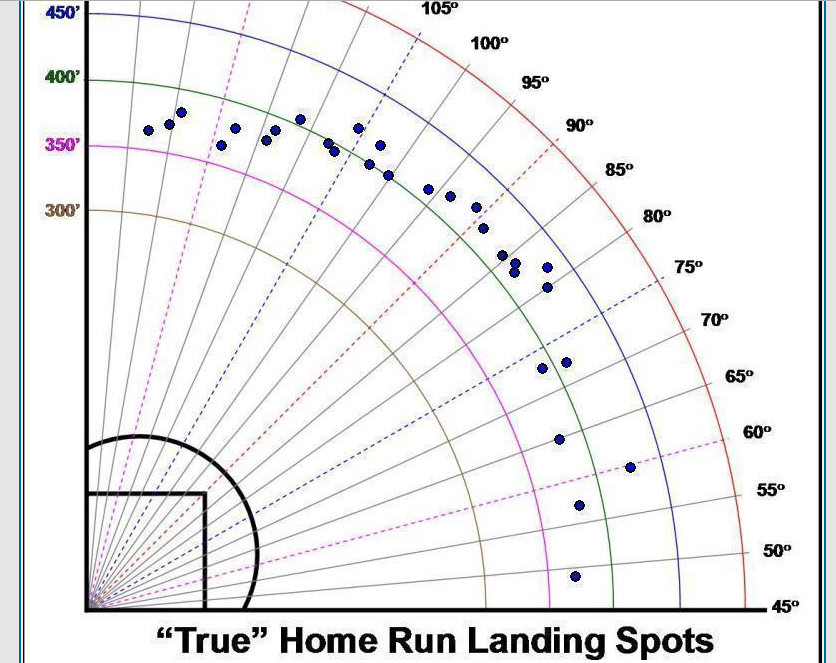
Check out the HitTrackerOnline.com spray chart of Joey Votto’s 29 homers in 2015 (keep in mind he’s a left handed hitter):

Baseball Swing Slow Motion Analysis: Joey Votto spray chart

Joey Votto 2015 spray chart courtesy: HitTrackerOnline.com

CLICK HERE for a FanGraph.com article titled, “Joey Votto on Hitting”. It goes into how:

  • Cerebral a hitter he is about his mechanics,
  • He purposely tools his swing to limit defensive shifts, and
  • He’s given up some power (dingers in particular) to cover the Pitch-Plane more effectively.

The aforementioned link is a GREAT read.  From the above spray chart and metrics, I’d say he “NAILED IT!!”


Joey Votto Mechanics as They Relate to Pitch-Plane Domination

In the above 17:23-minute baseball swing slow motion analysis video of Joey Votto’s swing, we go into more detail about the following FIVE human movements rules for Pitch-Plane Domination:

  1. Front Knee bend before swing initiation, and during the Final Turn,
  2. Back Knee bend during the Final Turn,
  3. Back foot skip during the Final Turn,
  4. Barrel matching the plane of the pitch early, and
  5. Barrel ‘chasing the ball’ passed impact getting to ‘Power-V’ after impact.

As Tony Robbins said,

“If you want to be successful, find someone who has achieved the results you want and copy what they do and you’ll achieve the same results.” 

Joey Votto is your hitter to dominate the Pitch-Plane when looking at baseball swing slow motion analysis.

Discover the optimal hit more line drives launch angle for home-run distance (25-30 degrees) like Joey Votto for baseball and softball hitters, and…

Joey Votto Explains Why Coaches SHOULD NOT Be Obsessed With Launch Angles


The Josh Donaldson interview last year was awesome, but I think THIS interview with Joey Votto may be better.  It doesn’t have the same let-the-beast-out-of-cage feeling that Donaldson contributed, but I feel Votto gives us more of a glimpse into the true art of hitting.  What Votto shares confirms what my hitters have been working on this past off season…line drive barrel control.  Precision.

Look, I love teaching my hitters the process of how to increase Ball Exit Speeds and to get the ball off the ground (optimal Line Drive Launch Angles), but as Joey Votto says, it’s not the whole story.  And this is where I’ve been lying to you for a couple years.  Actually, not lying, just not sharing the whole story. 😉

Let me explain…

My friend and professional golf instructor Lee Comeaux knows golf, and brought this idea of “precision” to my attention a few years back.  He understands springy fascia and the spinal engine, which is a PLUS.  Also, over the past few years he’s mentored his teenage daughter to hit .600 in Texas fast-pitch softball leagues.  But most importantly, he comes from a sport where precision is king.  Ask any golfer if they’re as obsessed about Ball Exit Speeds and Launch Angles like we are, and they’ll look at you as if a third eye grew in the middle of your forehead overnight.

What good is Ball Exit Speed if the ball is not going towards the hole?  And Launch Angles matter depending on the distance to the target.  And by the way, the angled club face kind of takes care of Launch Angles for golfers anyway.

Put yourself in a golf mindset for a moment.  Imagine thinking about hitting, like you would golf?  Precision.  In the above interview, Joey Votto mentions the best hitters can hit the ball where they want, when they want.   This may not be 100% true in games, but during Batting Practice most surely.  How many of your hitters can do that?  Not many of mine, but we’re working on it.

Precision.  This is not being talked about or taught in today’s baseball and softball circles.  How to control the line drive.  The height AND width of it.  Why are we so obsessed with the vertical aspect of the field and not the horizontal?  So many coaches out there believe a hitter can’t have power without sacrificing swing quality.  An increase in power doesn’t have to dampen Batting Average and/or increase a hitter’s Strikeouts.

Precision.  How to control the line drive.  It’s not easy, but it CAN be done.  Hitters CAN have a high Batting Average (even though BA isn’t a good indicator of value anymore, according to Sabermetrics), power numbers, and low strikeout totals.  And I think Joey Votto touched on what I feel is just the tip of the iceberg.  Here are the few key things to look out for in the above interview:

  • This idea of Precision. Controlling the line drive.
  • Setting hitting goals and reverse engineering purpose of the swing.
  • The idea of using a batted ball as feedback to make adjustments (not new for golfers btw).

Without further adieu, here are…


My Joey Votto Interview Notes on his 2018 Hitting Approach

  • About 0:20 second mark, Votto believes talking Launch Angles isn’t telling the whole story, how complete you are as a hitter, rebuts Josh Donaldson’s “ignore coach if he tells you to hit a ground-ball” comment, all fly-balls are not good fly-balls,
  • About 1:30 minute mark, Votto talks about how hitters like Donaldson, et al. can hit a ball with any trajectory to any part of the ballpark, he uses golfer with a bag of clubs metaphor, doing anything you want at anytime is the story we’re not telling, best hitters can do everything – he brings up Mike Trout (diverse array of skills),
  • About 3:00 minute mark, Eric Byrnes asked Votto how his approach has changed since coming into league in 2007, give away less pitches, anytime he takes a swing there’s intent or purpose to each swing (not being reckless), since he’s aging as a player, Votto isn’t able to make up for swing inefficiencies he could with a young athletic swing,
  • About 4:30 minute mark, Byrnes asks Votto how he is super-human with his walk to strikeout ratio when the league really doesn’t care about inflated K quantities, making a conscious effort to cut down on K’s, goals – looked to Sabermetrics to see how he could hit .340 or .350 last year and math said he had to strikeout a bit less, mentioned a few years prior his goal was to get on base half the time (OBP would = .500), chokes up, the “con” was it led to softer contact at times, ability to foul off tough pitches, buys a better pitch later in the AB, spreading out, seeing ball a little deeper,
  • About 6:50 minute mark, Votto was asked about how he has the highest batting average in his first AB, how important is starting game off with good momentum, separated each AB like it’s their own thing, focusing on one AB at a time, every single game over an entire season, sticking with plan in the long run, Jay Bruce “to hit homer, you have to miss homers”, focus on process,
  • About 8:40 minute mark, Byrnes asked Votto, “I have a 6yo boy at home, what’s the #1 thing you’d teach him about hitting?” Let the ball be your feedback.  Spending too much time on mechanics, ball is going straight in the air, ground-ball, in the air, is the ball coming off 4-seam, on a line with backspin, story about watching Albert Pujols with Cardinals on a line with backspin.

Discover 3 tips to hit line drives farther with power and square the ball up instead of hitting ground balls for baseball, fast-pitch, and slow pitch slow pitch softball players.

Like Anthony Rizzo Swing Mechanics, You Too Can Optimize ‘Line-to-Line’ & Launch Angles By “Bending The Knee”? 


We’ll be chatting about the following 4 things in the above Anthony Rizzo swing mechanics video:

  • Anthony Rizzo quick stat chat,
  • Bent front knee,
  • Sideways back foot, and
  • Spinal engine – pelvis opens, shoulders block…

There is a lot of misinformation out there that in order to have power, a hitter must straighten the front knee.  When it comes to power, the causation-correlation of this is very vague.  I’ve seen Rizzo hit a ball 460+ feet during batting practice with a bent front knee.  He never straightened it.

Look, 70-80% of power is the spinal engine.  Click Here if you don’t believe me.  I go over a thought experiment where we look at a water polo athlete with the fastest throw in water, and compare him to fastest velo pitcher on the planet.  Remember, the water polo thrower doesn’t have the luxury of Gravitational Forces.

Now, it can be argued the lower half (including and mostly because of the pelvis) is responsible for 20-30% of the power equation.  Since the lower half rotates the least, I say the it’s priority is setting the direction of the hitter’s force.  We achieve this through keeping the back foot sideways.

The spinal engine is at the heart of consistent power.  The Thoracic and Cervical vertebrae act against each other like a wringing towel to pre-load the torso before stride landing.  Then as the lower back and pelvis begin their limited rotation, they will complete the wringing towel effect on the lower half of the spinal engine – Lumbar and Thoracic.

Discover how to increase hitting power, bat, and hand speed like a Mookie Betts baseball or softball swing using the Catapult Loading System.  In addition, learn how to square the ball up and hit more consistent line drives instead of ground balls in this swing analysis…

Mookie Betts Swing Analysis: Build Massive Power For Small Sluggers Like Mookie Betts & Trea Turner…


What we’ll be contrasting in this Mookie Betts swing analysis compared with Trea Turner:

  • Mookie Betts stats on Fangraphs AND Trea Turner stats on Fangraphs
  • Catapult Loading System principlesCLICK HERE to watch this video post I did on taking slack out of the spine with the “wringing towel” metaphor…
  • Pitch-Plane Domination catcher’s glove barrel path principleCLICK HERE to watch this video post on WHY we may have barrel path all wrong…

Few out there think power comes from the snapping of the back hip and barrel.  These people are only one-third of the way there.  The pelvis (including hip), spine, and shoulders as a complete unit is where to find consistent power.

There are three pieces of our spine:

  1. Cervical (neck)
  2. Thoracic (shoulders and middle back), and
  3. Lumbar (lower back).

Imagine each section as a hand.  Now imagine three hands wringing a towel out.  The top (Cervical) and the bottom (Lumbar) are wringing in the same direction, while the middle (Thoracic) is wringing in the opposite direction of its “bookends”.  Mookie Betts does this just as well as anybody.

When it comes to barrel path, these same “snapper” hitting instructors promote a one path fits all barrel path.  And they claim teaching a high level pattern.  This is the exact opposite of what a higher level pattern is.  The best hitters’ barrel enters the hitting zone at different points depending on pitch depth.  You don’t see Mookie Betts knocking off the “real” catcher’s glove when hitting 97-mph inside.  If he did, he’d be picking up his thumbs.  Or he’d have to bend his front elbow so significantly that it would drop his average ball exit speeds by 20-mph, which equals at least 80-feet of batted ball distance.

Shorten the lever, you shorten power amplification.  The “snappy” pattern has its consequences.

In this Christian Yelich tongue-in-cheek swing analysis, can we discover how to hit more consistent line drives instead of ground balls and square up a baseball or softball better using a Rope Bat?

Here Are 6 Christian Yelich Swing Analysis Hitting Mechanic Strategies Helping Him Dominate (or Not? 🤔)


WARNING!  This Christian Yelich swing analysis video has been done tongue-and-cheek…sarcastic…mocking…joking…so please don’t send me HATE email because of this cheeky Christian Yelich hitting mechanics video.

Here are some of the topics we cover…

  1. Head movement,
  2. Back knee inside back foot,
  3. Over rotating back foot,
  4. Getting taller,
  5. “Launch angle” swing!
  6. Keep shoulders square (no counter rotation!!!)

By the way, at the beginning of the video, we look at the following Forbes article titled: “NL MVP Christian Yelich, Bucking The Launch Angle Trend”.

We teach our hitters to hit the ball back through the “tube”.  Imagine the pitcher throwing the ball through a tube.  Our hitters must hit the ball back through the tube.  For example is the pitch comes in hitting zone at 4-feet from the ground, then ball comes off bat four-feet off the ground.  If ball comes in two-inches off ground, then ball comes off bat two-inches off ground.

Consider this…

Major League average batted ball type percentages:

  • Line Drives = 20%
  • Ground-balls = 43%
  • Fly-balls = 38%

20% of the time the best in the world are hitting a line drive, and 80% of the time they’re miss hitting a line drive.  By hitting the ball back through the tube, the hitter matches the plane of the pitch better.  If ball is hit above or below the tube, then we use the adjustment principle paradoxical intention to get back to the tube.

Discover swing bat path to hit more line drives, square the ball up more, increase hitting power, and gain faster bat speed using principle drills for baseball or softball hitters.

How To Consistently Crush The Ball Using Geometry & Springy Forces


The objective of this presentation was to give a technical speech to a non-technical audience.  Sorry, the video and audio aren’t the best, but I think you’ll get the overall message.  Also, I’ve provided the power-point slides I used for this presentation (CLICK HERE to download from Google Drive).

You may find it quite helpful to follow along with the slides during the presentation.  PLEASE NOTE: in each section, I do skip to the images in that section to help illustrate a point.  We discussed the following:

  • Move better, perform better,
  • Use movement tests,
  • Match the Pitch-Plane with Geometry, and
  • Knock snot out of the ball with Springy Fascia.

Below is the basic outline of the speech…

ENJOY!


Move Better, Perform Better

  • ‘Governor’ truck engine story
  • Repetitive movements/position shape your body
  • “You can’t fire a cannon from a canoe” Mobilize & Stabilize


Use Movement Tests

  • Following “rules” to human movement – GRF, FoMo, Ang Mom, Centrip/Centrif, springy forces
  • Gorilla Grip
  • One-Joint Rule
  • Un-Weighting


Match Pitch-Plane with Geometry

  • Define Pitch-Plane
  • Importance of Back Leg Angle
  • Attack Angle + Ball Exit Speed


Knock Snot Out of Ball with Springy Fascia

  • Define springy fascia – tension/compression forces
  • Seen the biggest jumps in average Bat Speed with spinal engine experiments
  • Showing numbers – 6-mph
  • Downhill shoulder angle – 4-mph
  • Finger Pressure – 3-mph
  • Hunched Posture – +4 Attack Angle

Discover flat swing bat path trainer drills to square up a baseball or softball and learn how to hit more line drives instead of swinging under fly balls and hitting top half chopping grounders.

Hitting Tips To Boost Barrel Time On Pitch Plane

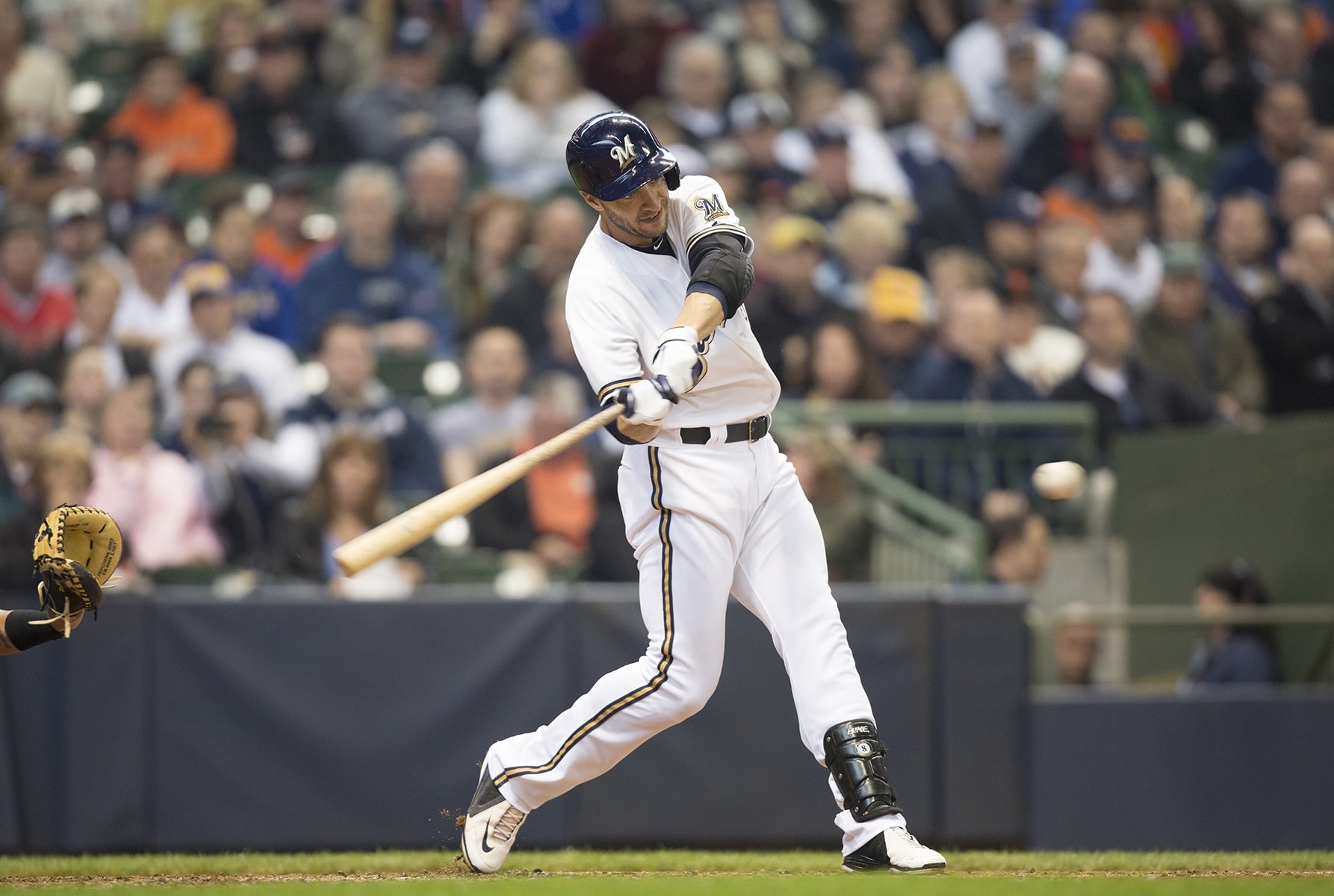
Ryan Braun early on pitch-plane

Ryan Braun early on pitch-plane. Photo courtesy: JTA.org

I often get caught up in my own ways of doing things that I sometimes lose sight of better hitting tips others are using for the same outcomes.  I’m not perfect.  And I’ll readily admit that I don’t know all the answers.  This my wife will surely echo 😉

But I do take pride in submitting and standing on the shoulders of giants.  This quote by Ralph Waldo Emerson changed my life:

“As to methods there may be a million and then some, but principles are few. The man who grasps principles can successfully select his own methods. The man who tries methods, ignoring principles, is sure to have trouble.”

Think of methods as “the drills.”  This post is for you hitting instructors or coaches who’re applying human movement principles, and successfully selecting your own methods.  I want to pick your brain, and hear your thoughts below.

But first, here’s the gist of the hitting tips assignment…

Hitting Tips from the Collective Few…

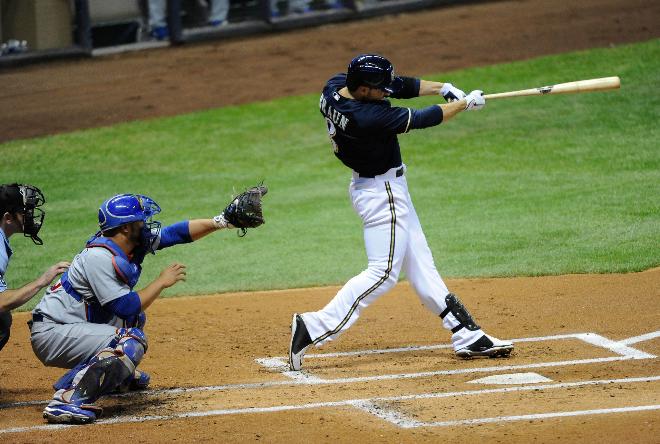
Ryan Braun Hitting Tips: staying long on the plane of the pitch

Ryan Braun staying long on the plane of the pitch. Photo courtesy: SportsWorldNews.com

I want to focus on efficiently increasing barrel time on the plane of the pitch using the Conservation of Angular Momentum.  By the way, it doesn’t matter if you come from baseball or softball.  So drawing from your teaching experience, what are your thoughts on the following (PLEASE leave your pearls of wisdom in the hitting tips comment section below):

  • Your go-to hitting drill for boosting barrel time on the pitch plane (pics or vids are welcome),
  • The best sticky coaching cue (or cues) that you use with young hitters, and/or
  • Any kind of underground (i.e. DIY) hitting aids that help with boosting barrel time on the pitch plane.

Keep in mind, inefficiencies such as arm barring, bat drag (racing back elbow), rolling over, and staying “attached” through the finish are issues you can address.   After a week, I’m going to have my readers vote on the best approach, and we’ll announce a winner.  Please share your thoughts in the “Leave a Reply” section below…

Find out if a NO stride versus leg kick makes for a better MLB player swing – does it REALLY matter?  In this video, discover whether you should STOP hip coil and hip slide hitting drills for lower body baseball and softball stride mechanics.  And lastly, learn how to hit line drives and square the ball up more often.

Anthony Rendon Swing Analysis: “Getting Shorter & Staying Shorter”


Hey, what’s going on, it’s  Joey Myers from the Hitting Performance Lab.  In this Anthony Rendon swing analysis, we’re going to go over a couple of things…

  • Inward turn of the pelvis pre-stride touchdown?
  • “Hip slide” as a stride technique,
  • Shifting foot pressure, and
  • Get short, stay short…

Transcription of above Anthony Rendon swing analysis is what follows…


Inward Turn of the Pelvis Pre-Stride Touchdown?

First off, I wanted to show a pitcher’s view and talk about how really insignificant the turning in of the pelvis is. I have Javier Baez over here on the right, and I’ve done a swing analysis on him where we talked about this.  Anthony Rendon is over here on the left.

You can see the difference in how much that they turn their pelvis in or don’t turn their pelvis in. And my argument is that we really don’t need to do that. We talk about putting the hips on a skewer … where the skewer goes through the hips towards the pitcher and that the hips slide on that skewer.

The only time they can come off the skewer is during the actual turn itself as the pelvis starts to open. But we don’t want to see it come off the skewer, by turning into the skewer before that, which we see Baez doing over here. You can see both butt cheeks pretty much from there, which you really only see one butt cheek over here with Anthony Rendon.

I wanted to start this off and show you this view and just take my word for it … there are many swings here of Anthony Rendon, who’s doing the same thing in all of them. It’s not just because this pitch is inside.

Anthony Rendon Swing Analysis: “Hip Slide” as a Stride Technique

Now, one thing I wanted to highlight, in this Anthony Rendon swing analysis video is the hip slide as a stride technique. And what you’ll see here is Anthony Rendon really doesn’t have much of a stride. You can argue here that maybe he’s got a little bit of a toe tap where he kind of sets the foot out there. He’s got his weight at about a 60/40 type of position. And then what you’re going to see is his hips slide forward on that skewer. And then he’s going to start his turn.

I have some hitters that do this, and that choose to do this especially with two strikes or when they’re facing somebody, a pitcher that’s got above average velocity, and that is OK. The stride in our system is not meant for power. In the stride, I argue for any hitting system doesn’t really contribute much power to the swing. You might get a half a mile per hour ball exit speed with a longer stride versus no stride. But a stride’s main purpose is timing.

If my hitters are getting on time more often or they’re comfortable with their timing and their stride, then we don’t touch anything. However, if they’re having a hard time with their timing and they have a high leg kick, then we may experiment with the toe tap or we may experiment with this hip slide style.


Shifting Foot Pressure

One thing I want you to check out in this hip slide is the shifting foot pressure, no matter what the hitter is using as a stride type, whether it’s a leg kick, medium or high, a toe tap, a hip slide, or a slide step.

Does it really matter?

You’re going to see them using shifting foot pressure. We should see in the beginning before the turn happens, before the hitter starts turning, and we should see foot pressure on the outside part of the back foot and the inside part of the front foot up until the start of the turn.

As you can see here, this is the start of the turn here. He’s starting to load and take slack out of his system. And then you’re going to see that shifting foot pressure go to the opposite side of what he started with. You’re seeing on the outside here is going to shift to the inside of the back foot and it’s going to shift from the inside of the front foot to the outside of the front foot.

Oftentimes you see hitters, some hitters more than others, where you can see the bottom of their front foot because they’re on the outside or on the fifth metatarsal of the foot – the pinky bone in the foot. You see the bottom of their foot as they do it. Now, this isn’t a teach. I don’t talk about doing more or less than that. Typically, when the ball is closer to the hitter, you’ll see more of the bottom of the foot. They’ll be more on the outside part of the front foot.

And if the ball is more away, you’ll see the foot a little bit flatter. Now, in this Anthony Rendon swing analysis, you can see that he stays pretty stable, pretty grounded with it, the sole of his foot, although it can be argued that he is definitely on the outside part of his foot, but more of the bottom than other players.

So this is the idea of a hip slide. It’s OK for hitters to use, especially facing high velocity pitching, or maybe a two strike approach. But the objective of this is, if you’re going to use a hip slide, minimal stride, minimal feet off the ground. The objective is to get on time more often. It isn’t about gaining power, or taking away power. It’s a timing mechanism.


Get Short, Stay Short

In this Anthony Rendon swing analysis, I’m going to show you a couple of swings exemplifying him getting shorter and staying shorter or getting low and staying low.

The benefits to this are when the hitter gets taller, as some coaches teach, getting their hitters to get tall or stand tall or stay tall or whatever. What tends to happen is, it pulls the hitter up on the plane and the pitch. They tend to hit the ball on the ground more, and if they are a little bit more mindful about their batted ball outcomes, and they are hitting more ground balls as they’re swinging, getting taller…

What they’ll end up doing is they’ll compensate by using their hands more to get under the ball. We don’t want to do that. We want to let the hands just swing. We want the body to get the barrel on the plane of the pitch.

What you’re going to see at the start of the swing, even with a hip slide, you’re going to see him drop below that bottom line. At the start of his turn, this is a typical at stride landing position, so if a hitter wasn’t using this hip slide … they were using a slide step or leg kick or whatever, you would see the best hitters drop below the starting line.

Or maybe if they’re more crouched like a Victor Martinez was, he’ll start at this bottom line and stay under. This line down here. So, you’re going to see he doesn’t really pick this back foot off the ground. He just kind of goes to the toe, shifts his weight against a braced front side, which is “a” OK.

As long as there is a shift going on there, of the center mass, we’re not squishing the bug or putting out a cigarette butt.

But you’re going to see him stay below this line. So, he’s going to get short. He’s going to stay short. And he’s using his knee action. He’s using the distance between his feet to do this. Players that tend to skip too much, they skip their back foot six inches will end up taller above this line. And as they’re swinging, they’re getting taller.

This messes with vision and tracking. It messes with them getting on the plane, Anthony Rendon even actually gets lower during his turn. You see him getting lower and staying lower.

Here’s another at-bat you can actually see from the beginning. You can see this hip slide toe tap, staying shorter principle where he’s starting at his head setting the top line. Then you’re going to see him set that foot out there. And he is going to, what we’re going to talk about it in a minute, he’s going to sit into this back hip, or his back-hip pocket.

Then you’re going to see him as his hip slides before his turn happens. You see him sink below the bottom line and he’s going to stay short or stay under that bottom line. Now, we talked about the neutral position that his pelvis, or hips, start in versus Javier Baez earlier in this video. You can see that here. And then what he’s going to do as he gets that front foot out there is, he’s going to sit and sink.

A couple of things we work on with hitters…

Sometimes our hitters will, as they stride, will straighten this back leg and will make them taller, obviously. Wherever they start, they’ll end up above the line. Well, what we do is there is something in there that that hitter is trying to take slack out of this system, trying to create and hunt and seek out stability to be able to move from as they move into their turn. And they will straighten this leg out, which there is stability in straightening the knee out. And also, possibly going into kind of a hip extension where you come out of a hip hinge, or an athletic position.

We want to promote or encourage our hitters to be in more of an athletic position, which you see in this Anthony Rendon swing analysis. You can see that’s what he’s doing. One thing we do is take this back toe … instead of it pointing straight at the plate or perpendicular to the plate. We turn the back toe in slightly, which now gives the hitter a little bit of hip torque in the back hip.

The second thing that we do is, as you’re seeing Anthony Rendon do here, is you’re seeing him sit or sink into this back hip or back hip pocket. He’s just kind of like there’s a harness going over the back butt cheek. So, for a righty, the right butt cheek, and for lefty the left butt cheek.

Maybe they might feel that they’re pinching their back groin a little bit, but they should feel like they’re bone in their butt is peeking out of that back-butt cheek, they’re sitting into that harness back there and it’s not a rotating inward of the hip. We saw that at the beginning of this video comparing it to Javier Baez.

We saw Anthony Rendon not inward turn his hips. He sat into his back-hip pocket. That’s more like what we’re trying to do. We’re trying to keep the hips on the skewer.

You see him sit. He goes from this kind of neutral position and then you see him take that stride and you see him sit into this back hip, which creates an environment of taking slack out of the system.

You turn that back toe in, creates back hip torque. And now we sit into that back-hip pocket and now we’re all ready to go with the pelvis.  Again, not an inward turn. He’s just sitting into it. It’s more linear, but in a diagonal fashion, it’s not back towards a catcher, but it’s kind of more behind, in line with the hitters back butt cheek.

Here it is again. Anthony Rendon swing analysis. You can see the getting shorter, staying shorter.  He starts at the top. He gets out to that stride, that 60/40 weight distribution, you can see this back toe turn slightly in. You can see him sit or sink into that back-hip pocket. It’s like he’s sitting down on one side of his butt cheek.

You’re going to see him move as he’s getting close to the turn. You’re going to see him move under the bottom line and he’s going to stay shorter and stay under the bottom line.

What’s also interesting to note here is this pitch is in and up, in or up, in and or up, and you’re going to see the barrel path… He’s not snapping it backwards like you see a lot of coaches doing. And teaching. It’s okay to snap it backwards… when we’re talking pitches middle away or middle down.

What he’s doing is he’s imagining that there’s a catcher’s gloves set up at his belly button and he is knocking that catcher’s glove off.  In order to get to this pitch, which is middle in and/or middle up. At a higher speed, this is how we catch up or how the best hitters catch up to pitches depth wise that are closer to their eyes and faster.

All right, last swing in this Anthony Rendon swing analysis, you can see, again, all the principles. In conclusion of this video, you’re going to see him maintain his distance between his feet. He’s going to start at the top before his swing starts, he starts to turn. He’s going to drop below the bottom one by maintaining the distance between his feet is going to help him to get shorter and staying shorter.

You can take a PVC pipe with your hitters. You can set it at about their nose level and have them practice getting shorter, staying shorter by using their knees. We also don’t want them to skip too far. We tend to like the one to three-inch skip and it all depends on how tall the hitter is and how young the hitter is. We maintain the distance between the feet. We use the knees.

You can see Anthony Rendon using his back knee. Even though the front knee gets straight, which some hitters like Anthony Rizzo, Cody Bellinger, Adrian Beltre … they tend to on pitches down in the zone, will keep this front knee bent and won’t actually get it to straight. But they’re also using their knee action to stay shorter, to stay below the bottom line.


How To Train Hitters with this…

And how do we do this? How do we train this into our hitters by taking this back foot, turn it slightly and towards the pitcher to create some hip torque back here. We are going to have the hitter sit or sink into that back hip. They’re going to feel like a bone is sticking out of their back-butt cheek.

And they’re going to ride that feeling up until their stride landing position. It also might help by using shifting foot pressure, getting the hitter to understand that they’re going to start on the outside of the back foot, inside of the front foot. And as they approach stride landing and about this point, you’re going to shift it to the opposite side of each foot. Outside becomes the inside of the back foot and inside becomes the outside of the front foot.

And this is an easy way to practice this. They can just do it in the room by just standing sideways like they’re hitting, grabbing their thumb, their top hand thumb and practice, shifting back and forth, back and forth, back and forth.

Again, in this Anthony Rendon swing analysis video, we talked about:

  • The hip slide as a stride technique,
  • Shifting foot pressure,
  • The difference between Javier Baez and Anthony Rendon and how they inwardly turn the hips pre stride landing or they don’t, and
  • The benefits of getting shorter, staying shorter, what to look out for distance between the feet, minimal to zero skip …
  • Using the PVC pipe…

…make sure that you’re swinging smarter by moving better. And before I let you go, please like this video on YouTube, like our YouTube channel, and check this out…